Chapter 1: The Quiet Pirate with Loud Regrets
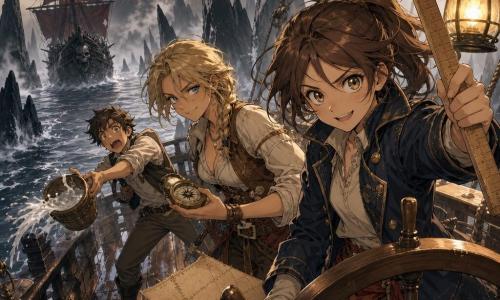
The sea was in a good mood—blue as a polished bottle and wrinkled with small, playful waves. The Windlass gulls screamed jokes only gulls understood, and the ship called the Wisp sliced forward as if it had somewhere important to be.
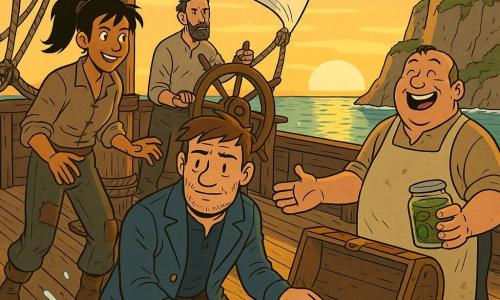
Elias Marlow stood near the mainmast, looking like he belonged to the shadows between ropes. He wasn't tall in a dramatic way or broad in a captainly way. He was the kind of pirate people forgot to describe—dark hair tied back, sleeves rolled, hands always busy with knots and repairs. Quiet. Useful. Dangerous when he had to be.
He kept his eyes on the deck, not because he was shy, but because the last time he looked too boldly at the world, he'd made a choice that still tasted like iron in his mouth.
“Eli!” called Nessa Pike, the Wisp's quartermaster, her grin sharp enough to cut bread. “You're staring at the planks again. Planning to steal the deck?”
“I was thinking,” Elias said.
“That's worse,” Nessa replied. “When you think, storms happen.”
Elias almost smiled. Almost.
Captain Rook Arden leaned on the rail, his coat flapping like it wanted to escape. Rook was the kind of captain who laughed at danger and argued with the wind. His eyes, bright and watchful, landed on Elias.
“Marlow,” the captain said, “I've got a job that needs a quiet pair of hands and a brave head.”
Elias's stomach tightened. Brave. The word always felt too big, like boots that didn't fit.
Rook tossed him a rolled piece of paper. “A map. Not a treasure map—don't get excited. A chart of tides and traps. We're going after the Lantern Vault.”
Several crew members stopped what they were doing. Even Old Bram, who claimed his hearing had been stolen by mermaids, looked up.
“The Vault?” Nessa whistled. “That's the place with the bells?”
“And the reef that eats ships,” Bram added helpfully, as if that was a fun feature.
Rook nodded. “Aye. The Lantern Vault is a stone chamber built into the cliffs of Blackwake Isle. A lighthouse once guarded it, back when honest folk still tried to tell ships where not to crash.”
Elias unrolled the map. Lines and symbols crowded the page: sharp reefs like teeth, currents curling like fingers. At the bottom was a simple mark: a circle with a small flame drawn inside.
Rook's voice lowered. “Inside the Vault is a crate of sea-lanterns—old glass globes that burn with stored sunlight. Bright enough to turn night into noon. They were meant for rescuing ships in storms.”
Nessa crossed her arms. “Sounds noble. Pirates and noble don't often shake hands.”
“They don't,” Rook agreed. “But we're not taking them for ourselves.”
Elias's throat went dry. “Then why?”
Rook looked straight at him. “Because three years ago, a ship called the Morning Star vanished near Blackwake. A fishing town named Gullmarsh still waits for sons who aren't coming back. Their harbor is deadly at night. Those lanterns could save lives.”
The deck seemed to tilt—not from waves, but from memory.
The Morning Star. Elias saw it in his mind: white sails, the creak of timber, a panicked shout. He remembered fog, a chase, and his own hand pulling a lever on a stolen signal bell. A prank, he'd told himself. A clever trick to scare the ship into turning away so the Wisp could slip past.
The Morning Star had turned, all right—straight into the reef.
He hadn't watched it sink. He'd told himself he didn't need to. But the ocean didn't let things disappear. It kept them, heavy and cold, inside you.
Rook's voice softened. “You knew that ship, didn't you?”
Elias swallowed. “I… heard stories.”
Nessa's eyes flicked to him, curious, but she didn't push. She had a talent for teasing without digging wounds open.
Rook clapped Elias on the shoulder. “This isn't just a raid, lads and lasses. It's a rescue, in a twisted way. We take the lanterns, we bring them to Gullmarsh, and we do it without spilling more blood. Understood?”
A chorus of “Aye!” rose up.
Elias nodded too, though his neck felt stiff. His mistake had been made in the dark. Maybe, he thought, he could fix it with light.
“Tell me the plan,” he said.
Rook's grin returned. “That's the spirit. First, we reach Blackwake without becoming fish food. Second, we deal with the bells. Third…” He winked. “We try not to get haunted.”
Bram muttered, “Too late for that.”
The Wisp surged onward, sails fat with wind, as if the sea itself wanted to see what Elias would do with his regret.
Chapter 2: The Reef That Chewed Ships
Two nights later, Blackwake Isle appeared as a jagged shadow against a sky full of sharp stars. Its cliffs rose like broken teeth. The air smelled wrong—too still, too salty, with a hint of wet stone.
Elias stood at the bow with a coil of rope over his shoulder. The sea around them had turned slick and dark, like spilled ink. Ahead, pale foam outlined reefs just beneath the surface.
“Lovely place,” Nessa said beside him. “Looks like it bites.”
“It does,” Bram wheezed from behind, holding a lantern up as if that would frighten the rocks. “The Blackwake Reef has a hunger. Ships come in proud, and come out as driftwood.”
Captain Rook didn't order full sail. He didn't shout for speed. Instead, he moved like a chess player, calm and calculating. “Oars,” he commanded softly. “No splashing. And watch the current.”
The crew worked quietly, oars dipping in smooth rhythm. The Wisp glided forward, slower now, the sound of the sea pressing close.
Elias studied the chart. “There's a channel,” he murmured. “But it shifts with the tide. If we miss it…”
Nessa finished the sentence. “We become a lesson.”
Elias's fingers traced the lines. The map showed a pattern: reefs, then a narrow safe path, then a pocket of calmer water near the cliffs.
Rook leaned in. “Can you read it?”
“I can try,” Elias said. He hated how small those words sounded.
Rook's tone sharpened—not cruel, but serious. “Try isn't enough tonight.”
Elias breathed in, tasting salt, and made his mind steady. He looked at the stars, at the angle of the wind, at the way the foam moved. He remembered the old fisherman who once taught him how water talked—how it tugged and slid, how it whispered where it wanted you to go.
“The current's pulling left,” Elias said. “But the safe channel is right. If we aim right now, we'll drift into it. If we aim straight, we'll drift onto the reef.”
Nessa blinked. “You sound like you've done this before.”
Elias didn't answer.
Rook trusted him without asking for proof. “Helm, right by two points,” he ordered.
The ship angled subtly. Foam hissed close, so close Elias could've reached down and poked the reef like a bad idea. The Wisp crept through the teeth.
Then—clang.
A sound rolled across the water. A deep bell tone, slow and far away, like someone tapping on the bottom of a giant pot.
Bram's face went pale in the lantern light. “The bells,” he whispered. “They've started.”
“Bells?” a young deckhand asked. “What bells?”
Nessa replied, “Bells that lie.”
Another clang followed, closer. The tone tugged at the mind, making it seem sensible to steer toward it, as if the sound were a lighthouse and not a trap.
Elias's skin prickled. The memory came back so sharp it made him flinch: his hand on a rope, the stolen bell on a buoy, the laugh he'd forced out because everyone else laughed.
He'd thought he was clever. The sea had proved him wrong.
Rook hissed, “No one follows the sound. Listen to me, not the bell.”
But the bell was persuasive in a strange way. Two crew members slowed their oars, staring toward the sound as if hypnotized.
Elias stepped between them and the rail. “Eyes on me,” he said, voice firm. It surprised him. “That sound isn't safety. It's a mouth.”
The two blinked, confused, then shook their heads as if waking up.
Nessa leaned close to Elias. “How do you know?”
Elias's jaw tightened. “Because I've heard it before.”
The bell rang again—clang, clang—like laughter made of metal.
Rook's eyes narrowed. “We're almost through. Keep the oars steady.”
A wave bumped the hull. A reef scraped the side with a horrible, nails-on-wood shiver.
“Hold!” Elias snapped before he could think. “Don't jerk the oars. If you pull hard, we spin.”
The crew obeyed, muscles trembling, oars held steady. The ship slid forward on a thin ribbon of safe water. Another scrape, then the pressure eased.
They drifted into the calmer pocket by the cliffs. The bell sounded once more—now distant, annoyed, as if it didn't like losing its dinner.
Everyone exhaled at once.
Rook let out a low chuckle. “Well. That's one problem not chewing us. Yet.”
Nessa nudged Elias's shoulder. “Quiet pirate, loud brain.”
Elias stared at the cliff face. Somewhere in those rocks, the Lantern Vault waited, and so did the weight of what he'd done.
He whispered to the sea, too softly for anyone to hear, “I'm here now.”
And for once, he meant it.
Chapter 3: The Climb to the Lantern Vault
The cliffs of Blackwake were slick with algae and streaked with white salt like old scars. A narrow ledge snaked along the rock, just wide enough for a boot if you didn't mind trusting your life to it.
Rook gathered a small team: Elias, Nessa, Bram, and two quick-footed sailors named Jun and Miri. The rest stayed with the Wisp, ready to pull away if the reef decided to get hungry again.
Rook passed out climbing hooks and rope. “No hero leaps,” he warned, then glanced at Nessa. “Especially no hero leaps that involve showing off.”
Nessa gasped dramatically. “Captain, I have never—”
“You have,” everyone said at once.
Elias tested his rope knots twice. Then, because he didn't trust himself, he tested them a third time. The wind carried the scent of wet stone and something else—old smoke, faint but stubborn.
They started along the ledge, backs pressed to the cliff. Below them, the sea slapped the rocks with impatient hands.
Bram muttered, “If I fall, tell my knees I loved them.”
Jun whispered, “If you fall, I'm not catching you.”
“Wise lad,” Bram replied.
Elias moved carefully, letting his fingers find small cracks. His heart hammered, but his mind stayed sharp. Fear, he'd learned, could either scream in your ear or sit quietly in your pocket. He forced it into the pocket.
Ahead, the ledge narrowed to almost nothing. A rusted iron ring jutted out of the rock. Rook tugged it. It groaned but held.
“Anchor point,” Rook said. “Elias, you go first. You're light.”
Elias nodded, swallowing. He clipped in, leaned out over the drop, and stepped onto a section of cliff that angled outward. His boots searched for grip. The rock was damp, trying to be helpful by pretending it wasn't.
Nessa called softly, “If you slip, try to scream something funny.”
“Like what?” Elias asked, breath tight.
“Like… ‘I regret nothing!' It's classic.”
“I regret plenty,” he said.
That made Nessa pause. Then her voice gentled. “Then climb like you plan to change it.”
Elias moved. Step, breath, hand, step. The rope held firm, and the cliff finally widened again. He reached a flat shelf and waved them forward.
One by one, they crossed. Bram took tiny steps and complained the whole way, which somehow made it less scary.
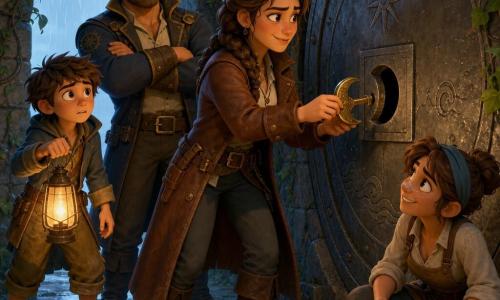
At the end of the ledge, half-hidden behind a curtain of hanging vines, was a stone door carved into the cliff. Its surface was covered in worn symbols: waves, stars, and—most unsettling—bells.
A metal plate sat in the center, with three holes shaped like teardrops.
Miri ran her fingers over the carvings. “This is old. Older than the Wisp. Older than most bad decisions.”
Rook tried the door. It didn't move. “All right. Vault doesn't want visitors.”
Bram leaned close to the plate. “Three holes. Means three keys.”
Jun pointed toward the symbols. “Or three drops of something.”
Elias studied the carving of the bell. Beneath it, a line of words had been chiseled in, faded but readable.
“‘Only the true tide opens the way,'” Elias read aloud.
Nessa frowned. “That sounds like the kind of sentence that makes sense right up until you're eaten by a trap.”
Elias's eyes drifted to the sea far below. The tide was pulling outward, draining water from the rocks and leaving slick gleam behind. True tide. Real tide. Not the false bell that lured ships.
He looked at the teardrop holes. “It might be seawater,” he said. “But not just any. It says true tide. Maybe it needs water touched by the moving tide.”
Rook tilted his head. “So… not from a bucket that's been sitting.”
“Fresh,” Elias said. “Taken while the tide's moving.”
Nessa grinned. “Good thing we brought a quiet pirate who thinks like the sea.”
They lowered a small tin cup on a rope down to the water. Elias timed it with the surge, watching the swell rise and pull. When the cup dipped in, he felt the rope tug as the current tried to claim it.
“Now,” he said, and hauled it up.
The water inside shimmered in the starlight.
Elias poured it into the first hole. The stone plate warmed slightly under his fingers, like it had been asleep and someone had whispered its name.
“Two more,” Bram said. “Because doors are never satisfied with one.”
They repeated the process, careful to catch the water as the tide tugged. Elias poured into the second hole. The plate vibrated faintly.
On the third pour, the air changed. The smell of smoke grew stronger, and a low hum ran through the stone, almost like a distant song.
The door shuddered.
Nessa stepped back. “If something jumps out, I vote we all pretend Bram is the leader.”
Bram straightened. “Finally! Respect!”
The stone door ground open, slow and heavy, revealing a narrow tunnel lit by a pale glow deeper inside.
Rook drew his sword, though his eyes were more curious than afraid. “All right,” he whispered. “Lantern Vault. Let's borrow some sunlight.”
Elias stared into the tunnel. The glow looked warm. Friendly, even.
He knew better than to trust friendly things on Blackwake Isle.
Still, he stepped in first.
Chapter 4: Bells in the Dark
The tunnel swallowed sound. Their boots thudded softly, and the air tasted of damp stone and old ash. The pale glow ahead flickered like trapped dawn.
As they walked, Elias noticed small metal discs set into the walls—like coins, but stamped with bell symbols. Each disc had tiny holes around its edge.
“Wind whistles,” Jun said, leaning in. “The breeze makes them sing.”
Bram shivered. “Or scream.”
They reached a wider chamber. The glow came from dozens of glass globes stacked in wooden racks. Each lantern held a thick, golden light, as if someone had bottled a summer afternoon and forgotten to let it out.
Nessa's eyes went huge. “That's… that's beautiful.”
Rook breathed out. “That's a lot of saved lives.”
Elias stepped closer, careful. The lanterns hummed quietly, warm against his skin even from a distance.
Then—clang.
Not from outside. From inside the Vault.
A bell tone rang out, sharp and sudden. The lanterns flared brighter, and shadows jumped across the walls like startled cats.
Miri spun. “Where did that come from?”
Elias's gaze darted to the ceiling. A set of bell-shaped stones hung there, dark and heavy, each with a crack running through it like a mouth.
Another clang. The sound pushed into Elias's head, pressing on his thoughts. For a heartbeat, he felt an urge to drop the lanterns and run—run anywhere, run nowhere, just obey the sound.
He clenched his fists. Nails bit skin. The pain anchored him.
Rook barked, “Hands on the rope line!”
They had tied themselves together loosely at the entrance for safety. Now the rope became something else: a reminder they weren't alone. Elias grabbed it, feeling the tug of other hands.
Nessa's voice came through tight teeth. “I hate musical caves.”
Bram, oddly calm, muttered, “It's not music. It's a command.”
The bell tone rose and fell, and with it the lantern light pulsed, as if the Vault itself breathed. The metal wind-whistles along the tunnel began to sing in reply, a chorus of thin notes.
Elias realized the trap wasn't meant to crush them. It was meant to confuse them until they made mistakes—dropped lanterns, tripped, turned on each other, or ran deeper into danger.
He focused on the pattern. The bell rang in threes, with a pause, then in twos. Like a code.
“Captain,” Elias said, voice strained, “the bells are signaling. Maybe they're tied to the tide. Threes, then twos… like waves.”
Rook glanced at him. “Can you use it?”
Elias shut his eyes for a second, listening. Threes. Pause. Twos. The pause was longer when the lanterns flared, shorter when they dimmed.
“It's a timing lock,” Elias said. “The bells want us to move at the wrong moment. The floor—look.”
Jun lifted his lantern slightly. The light revealed faint seams in the stone beneath their feet, forming squares.
“Pressure plates,” Nessa whispered. “Of course.”
Bram groaned. “If I step wrong, I'll become a pirate pancake.”
Elias opened his eyes and forced them to stay clear. “We go on the flares,” he said. “When the lanterns brighten, the plates reset. When they dim, they trigger.”
Rook didn't hesitate. “You heard him. Move on bright. Freeze on dim.”
Nessa pointed to the nearest rack. “And we have to carry these without dropping them. Easy. I never drop—”
A bell rang. The light dimmed. Nessa froze mid-boast, one foot in the air.
Elias whispered, “Careful with promises.”
The lanterns flared. “Now,” Elias said.
They moved in quick, controlled steps, lifting lanterns two at a time from the racks and passing them along the rope line. The light warmed their faces, painting them gold, making them look like heroes even when they felt like frightened kids in a haunted pantry.
The bell tried harder. The tones grew louder, faster, the chorus of wind-whistles turning shrill. Elias's head pounded.
A flare. Move. Dim. Freeze.
Bram, carrying one lantern tucked against his chest, muttered, “If this lantern breaks, I'm blaming Elias's ‘true tide' poetry.”
Elias shot back, “If it breaks, we'll have bigger problems than poetry.”
They reached the tunnel mouth with six lanterns secured in padded sacks. The bell tones behind them became frantic, as if the Vault hated losing its hoard.
Then the light dimmed, and Jun's foot slipped slightly.
A click.
Elias's heart stopped. For a terrible second, nothing happened.
Then a stone panel in the ceiling slid open, and a thick rope net dropped like a spider web.
“Down!” Rook shouted.
Elias lunged, yanking Jun backward by the rope line. They hit the ground as the net slapped onto the stones where Jun had been standing, trapping only air.
The lanterns flared again, and the bell tone faltered, disappointed.
Nessa let out a shaky laugh. “Well. That was almost very educational.”
Jun stared at Elias, breathing hard. “You saved me.”
Elias didn't know what to do with gratitude. He just nodded. “Keep moving.”
They stumbled out of the Vault and into the night air. The sea breeze hit Elias's face like a slap of freedom.
Behind them, the stone door began to grind shut, slow and final.
The bells fell silent.
For the first time in years, Elias felt like he'd stepped away from the edge of his old mistake—just a little.
Chapter 5: The Storm and the Hunter Flag
Getting back to the Wisp should have been the easy part. That was what stories always pretended.
But the sea didn't read stories.
Halfway down the ledge, the wind shifted hard, turning playful waves into sharp fists. Clouds rolled in fast, smothering the stars. The Wisp below bobbed anxiously in the narrow calm pocket, and beyond it the reef waited like a grin.
And then another ship slid out of the darkness.
It was longer than the Wisp, heavier, with dark sails and a black flag painted with a silver hook. A hunter ship—pirate-catchers who made money pretending they were heroes.
Bram squinted. “That's the Iron Vow.”
Nessa groaned. “Of course it is. If bad luck had a favorite, it would be us.”
Captain Rook saw it too, jaw tightening. “They must've followed our lights.”
Elias's stomach twisted. If they were caught with the lanterns, the Iron Vow would take them, sell them, or worse—take the lanterns for themselves and leave Gullmarsh in darkness.
A gust shoved Elias against the cliff. He clung to the rope. The lantern sacks bumped his hip like a reminder: you wanted this. You chose this.
From below, a shout carried up. “Ahoy, Wisp! Prepare to be boarded in the name of lawful seas!”
Nessa snorted. “Lawful seas. That's like saying polite sharks.”
Rook glanced up the ledge toward them, then down at the Wisp. “We've got minutes.”
Elias's mind raced. The Wisp was trapped between cliff and reef. If it tried to run, the reef might tear it apart. If it stayed, the Iron Vow would board.
He looked at the storm clouds. He looked at the reef foam. He listened—beneath the wind, faintly, the lying bell tone from the reef still echoed, as if the trap never truly slept.
An idea sparked, wild and dangerous.
“Captain,” Elias called down. “The bell trap—can we use it?”
Rook's head snapped up. “Explain!”
Elias shouted over the wind, “The bells lure ships into the reef. If we can make the Iron Vow hear it stronger than we do, they'll steer wrong.”
Nessa's eyes widened. “You want to trick the trick.”
Bram clutched the rope. “I would like to vote against dying.”
Rook's gaze sharpened on Elias. “How do we make them hear it?”
Elias remembered the metal discs in the tunnel—wind-whistles that sang when air moved through them.
“We can make a false call,” Elias said, thinking fast. “The lanterns—light carries. If we hang one low near the reef, they'll think it's a safe channel marker. And if we strike metal—”
“Like a bell,” Nessa finished, grin returning. “Oh, that's nasty. I like it.”
Rook's face was serious. “We don't kill them.”
Elias hesitated. The reef could kill them. This plan was sharp-edged.
But the Iron Vow had chosen to hunt. They weren't innocent fishermen. Still—Elias didn't want more sinking ships on his conscience.
He swallowed. “We don't lead them into the teeth. We lead them away from us. Toward the outer shallows. They'll run aground, not shatter.”
Rook nodded once. “Do it.”
Elias and Nessa hurried along the ledge to a lower outcropping. Wind lashed them, and rain began to spit like a bad mood. Elias pulled one lantern from a sack, its warm glow steady despite the storm.
He tied it to a rope and lowered it toward the water, positioning it near a patch of foam that marked safer rocks—not the worst reef, but enough to stop a ship.
Nessa pulled a small iron cooking pan from her pack, because Nessa always carried something ridiculous. “For emergencies,” she said as if this made perfect sense.
Elias grabbed a metal hook and struck the pan. CLANG. The sound rang out, thin but clear.
From the reef, as if offended, a deeper bell answered—CLANG.
Nessa's eyes glittered. “Now we're having a conversation with the ocean.”
On the Iron Vow, lanterns flared. Voices shouted. The hunter ship adjusted its course, drawn toward the glow Elias had lowered and the false bell he was making.
Elias's arm ached as he struck the pan again and again, matching the rhythm he'd heard in the Vault: threes, pause, twos. He couldn't explain why, but it felt right—like speaking the reef's language with a careful accent.
Below, Captain Rook ordered the Wisp's crew to pull oars and angle toward the channel out. The Wisp began to slide away, quiet as a cat.
The Iron Vow, convinced it had the Wisp cornered, turned harder toward the “marker.” Its bow surged forward.
Elias's mouth went dry. Please. Shallow. Not deadly.
The storm punched the sea. The Iron Vow's hull hit rock with a grinding boom. Sailors cried out. The ship lurched and stuck, tilted but not broken.
Elias stopped striking. Silence rushed in, filled with rain.
From the Iron Vow came furious shouting. “It's a trick! They've tricked us!”
Nessa wiped rain from her face. “Yes,” she called cheerfully into the storm, “that is indeed what just happened!”
Rook's voice rose from the Wisp, distant but clear. “All hands, full out! To open water!”
Elias hauled the lantern back up, cradling it like something fragile and precious—because it was. His hands trembled, not from cold.
He hadn't led them to death. He'd stopped them. He'd used his old kind of cleverness, but for a different purpose.
Nessa watched him, rain dripping off her nose. “You okay, Eli?”
He stared at the lantern's golden glow. “I don't know,” he admitted. “But I'm still here.”
“That's a solid start,” she said, and elbowed him lightly. “Now let's not fall off a cliff. I'd hate to explain that to your guilt.”
They hurried back along the ledge, the storm roaring behind them like an angry crowd.
Chapter 6: Gullmarsh and the Lowered Flag
By the time the storm faded, the Wisp was far from Blackwake Isle. The sea calmed slowly, smoothing itself out as if embarrassed by its tantrum.
Elias sat on a coil of rope near the stern, staring at his hands. They were scraped, bruised, and still smelled of iron from the pan. The lantern sacks were secured under a tarp, glowing faintly like a hidden sunrise.
Nessa dropped beside him with two mugs of something warm. “Tea,” she said. “Mostly tea. Slightly pirate-flavored.”
Elias took a mug. The heat seeped into his fingers. “Thanks.”
They sat in silence for a moment, listening to the Wisp's timbers creak and the soft slap of waves. Crew members moved around them, tired but buzzing with the kind of excitement that comes after danger.
Nessa spoke first. “You've been carrying something heavy since before Blackwake.”
Elias stared into his mug. The tea smelled like mint and questionable decisions. “I caused the Morning Star to crash,” he said, words coming out flat and honest. “Not on purpose. I thought it was… a prank. A trick. I didn't think—”
Nessa didn't interrupt. That was her quiet kind of kindness.
“I didn't hear the screams,” Elias continued, voice cracking, “but I heard the silence after. And I've heard it ever since.”
Nessa exhaled slowly. “That's awful.”
“It is,” Elias said. “And I can't undo it. But I can do this. Deliver the lanterns. Make sure no one else—” He stopped, throat tight.
Nessa bumped her shoulder against his. “Perseverance,” she said, like she was testing the word. “It's not about pretending you're fine. It's about rowing anyway.”
Elias let that settle in his chest. Rowing anyway.
Two days later, Gullmarsh appeared: a town crouched beside a narrow harbor, its docks worn smooth by generations of wet boots. The people there had weathered too many storms and too much waiting. Their faces were careful, their eyes quick.
The Wisp approached slowly, not with cannons ready or flags snapping proudly, but with sails half-lowered.
Captain Rook stood at the bow. “Lower the colors,” he ordered.
The pirate flag—black cloth with a white wisp curling like smoke—came down. In its place, Rook raised a plain blue banner, calm as open sky.
A murmur ran through the crew. Lowering a flag felt like stepping out of armor. It made you vulnerable. It also made you human.
Elias helped carry the lantern sacks onto the dock. The townspeople gathered, cautious. A few held fishing spears. One boy about Elias's age stared at the glowing sacks with wide eyes, as if he'd never seen light that looked so sure of itself.
A woman stepped forward. Her hair was braided tight, her hands strong and scarred. “Who are you?” she demanded. “And what do you want from Gullmarsh?”
Rook lifted his empty hands. “Nothing. We brought something.”
He nodded to Elias.
Elias's throat tried to close. He forced it open. “These are sea-lanterns,” he said, voice carrying over the dock. “They can light your harbor at night. Keep ships from wrecking on your rocks.”
The woman's eyes narrowed. “Why would pirates do that?”
Elias felt every stare land on him like stones. He could lie. He could let Rook talk. He could stay quiet, like he always did.
But quiet had helped him hide for too long.
“Because I made a mistake,” Elias said. The words were simple, but they shook. “Years ago. A ship near here. I… I led it wrong. I didn't mean to. But it happened because of me.”
A ripple went through the crowd—anger, grief, disbelief. The boy's expression hardened.
The woman stepped closer, her gaze sharp enough to cut rope. “The Morning Star,” she said, voice low. It wasn't a question.
Elias nodded. His mouth tasted like salt. “I can't fix what I broke,” he said. “But I can bring this. I can help install them. I can work. I can… keep rowing, even when it hurts.”
For a long moment, only the waves spoke.
Then an older man pushed through the crowd, leaning on a cane carved with fish scales. His eyes were cloudy, but his voice was steady. “My son was on the Morning Star,” he said.
Elias's chest tightened so hard he thought he might crack in half. “I'm sorry,” he whispered.
The older man studied him, as if weighing him like a net full of catch. “Sorry is wind,” he said. “It blows away.” He tapped his cane on the dock. “But this light… this stays.”
He turned to the townspeople. “We needed lanterns. We've prayed for lanterns. The sea doesn't care who brings help.”
The woman's shoulders dropped a fraction. Not forgiveness—nothing that easy—but a door opening just enough for a person to step through.
“Fine,” she said. “You can help. But if you steal so much as a sardine, I'll throw you back to Blackwake.”
Nessa, standing behind Elias, whispered, “I was going to steal two sardines. Glad you warned me.”
Elias almost laughed. It came out like a broken sound, half relief, half pain.
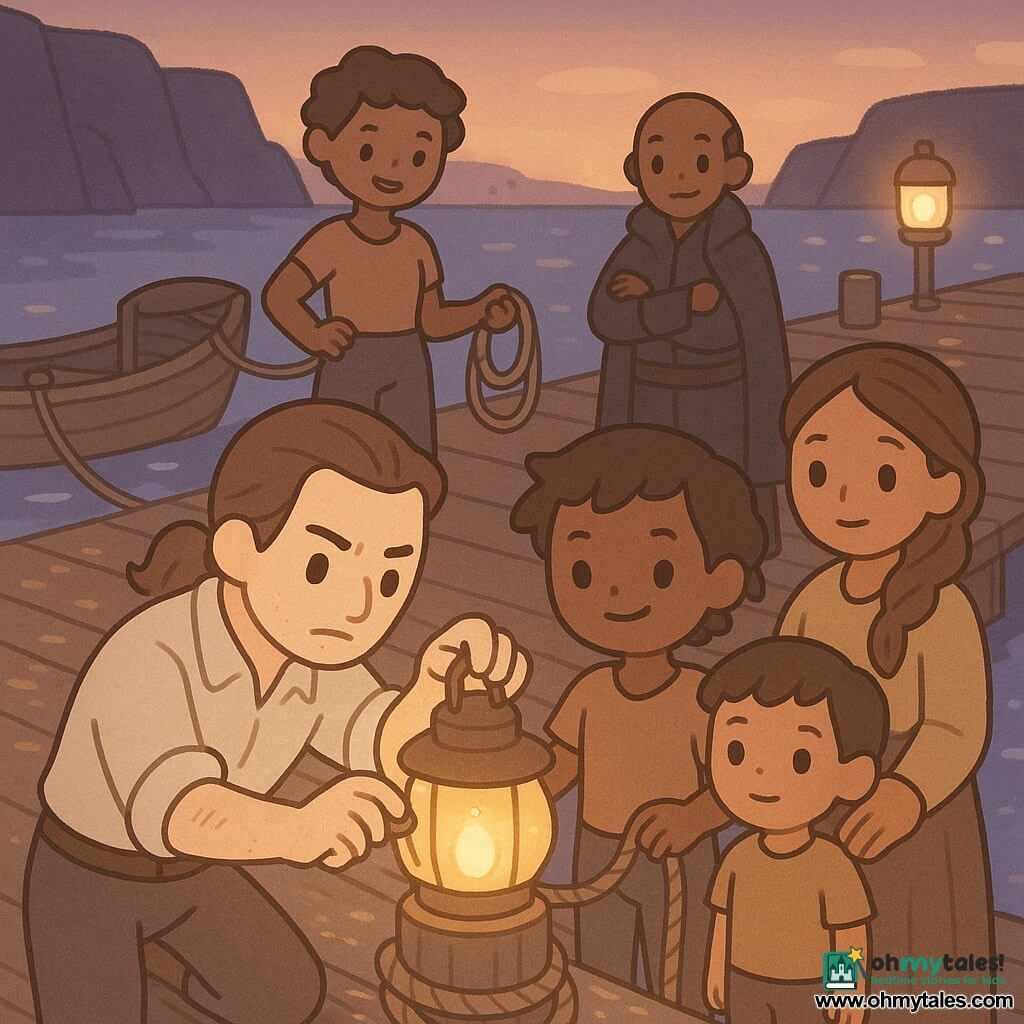
They spent the day mounting lanterns on tall posts along the harbor mouth. Each globe shone with warm gold, turning the water into a road instead of a threat. As dusk fell, Gullmarsh transformed. Shadows retreated. Boats coming in from the sea didn't drift blindly anymore; they followed a clear path home.
Elias worked until his arms ached. He tightened bolts. He tied knots. He climbed slick ladders and didn't look down. Every time fear nudged him, he kept going anyway.
When the last lantern was lit, the harbor glowed like a necklace of captured sun.
Captain Rook approached Elias quietly. “You did good,” he said.
Elias shook his head. “It's not enough.”
Rook's gaze was firm. “Maybe not. But it's real. And real is how you start.”
Across the dock, the woman—who had finally introduced herself as Mara—watched the lights with a guarded softness. The boy beside her leaned into the glow, his face warm for the first time in the fading evening.
Mara looked at Elias. “The sea will always remember,” she said.
Elias nodded. “So will I.”
Rook called for the crew to return to the Wisp. The townspeople didn't cheer. This wasn't that kind of ending. But they didn't raise weapons either. They stood under the lanterns, faces lit, watching the pirates prepare to leave.
As the Wisp pushed off, Captain Rook ordered the blue banner kept raised.
“No black flag?” Jun asked.
Rook shook his head. “Not today.”
Elias stood at the rail. The harbor lights shimmered on the water. The sea, for once, looked less like a mouth and more like a path.
Nessa leaned beside him. “So,” she said, “did you redeem yourself?”
Elias watched the lanterns grow smaller as the ship drifted out. The ache inside him hadn't vanished. But it had shifted, like a tide changing direction.
“I don't know,” he said honestly. “But I'll keep trying.”
Nessa lifted her mug—she'd somehow kept it. “To trying,” she said.
Elias nodded. “To perseverance.”
Behind them, the Wisp sailed into the open sea. Ahead, Gullmarsh's lanterns held steady against the dark, and the lowered pirate colors stayed lowered—in peace, for now—while the ocean carried both regret and hope, side by side, under the same wide sky.