Chapter 1
Monday mornings at Maple Grove Middle always smelled like wet grass and toast from the cafeteria. The bell hadn't rung yet, so the courtyard buzzed with half-zipped jackets, backpacks thumping, and people trying to look awake.
Milo stood near the bike rack, quiet the way he often was—quiet like he was saving his words for something important. He watched the same small things he always noticed: who got cut in line, who got laughed at, who pretended they didn't care.
Near the steps, a group of boys were passing around a scuffed soccer ball.
“Let's go! Real players only,” said Jayden, grinning.
Lina stopped nearby, her ponytail bouncing as she caught the ball with her foot without even looking. The ball stayed glued to her sneaker like it belonged there.
Jayden blinked. “Uh… I mean—”
“I'm on the team,” Lina said calmly.
“Yeah, but you know… it's kind of rough,” another boy added, making a face like roughness had a gender.
Lina's smile thinned. “I'm not made of glass.”
A few kids snickered, and Milo felt that familiar pinch in his chest. It wasn't loud unfairness. It was the everyday kind, the kind that slipped into jokes and then acted surprised when someone got hurt.
Just then, Nova appeared, walking up with their hoodie sleeves pulled over their hands, hair clipped back with two mismatched barrettes—one star, one lightning bolt. Nova didn't fit into the usual boxes, and some kids acted like that was an invitation to comment.
Jayden glanced at Nova's barrettes. “Nice… whatever those are.”
Nova lifted an eyebrow. “They're barrettes.”
“Yeah, but… those are kinda—” Jayden searched for a word that wouldn't make him sound mean, then landed on one anyway. “Girly.”
Nova's expression didn't change, but their shoulders tightened like they'd pulled a string inside.
Milo didn't say anything. He wanted to. He just didn't know how to enter the moment without making it worse.
Lina picked up the ball with both hands. “Barrettes aren't a gender,” she said. “They're plastic.”
Nova snorted a laugh, and even Milo almost smiled.
Jayden shrugged, suddenly busy adjusting his backpack straps. “Whatever. Come on.”
The bell rang, sharp and certain. Kids began funneling toward their class lines. Milo followed, still quiet, but something had shifted in him, like a chair leg finally landing on the floor.
He kept thinking: We're all in the same school. Why do some people get told what they can be, like it's a rule?
Chapter 2
Outside Room 7B, the class line formed under the overhang. The air smelled like rain and pencil shavings from somewhere inside. Everyone knew the routine: stand in order, stop talking when the teacher appeared, pretend your homework wasn't wrinkled.
Milo stood between Lina and Nova, mostly because it felt safer than standing near kids who liked to make comments for sport.
Ahead of them, two boys were whispering.
“Nova's so weird,” one said, not even that quietly. “Like, pick a side.”
Nova stared at the back of the kid's head, jaw set.
Milo watched Nova's fingers tug at the lightning-bolt barrette. He watched Lina's eyes narrow, like she was deciding whether to speak.
Then, farther up the line, another scene: a girl with a neat braid held a toolbox for the science fair project. A boy reached for it.
“I'll carry it,” he said.
“Thanks,” the girl replied.
But a different boy laughed. “Why does she even need a toolbox? Girls do posters. Boys do building.”
The girl's smile slipped. She didn't argue. She just hugged the toolbox closer, like it might break if anyone looked at it wrong.
Milo's thoughts bounced around like marbles in a jar. He wasn't brave in the loud way. He wasn't good at quick comebacks. But he was good at noticing patterns, and right now the pattern was clear: people got shoved into little boxes, and the boxes were labeled with words like “boys” and “girls” like that explained everything.
He leaned slightly toward Lina and Nova. “Do you ever… feel like there's a list of invisible rules?” he murmured.
Lina glanced at him. “Like ‘girls can't be good at soccer' rules?”
Nova's eyes stayed forward. “Like ‘your hair clips are a crime' rules.”
Milo nodded. “Yeah. And everyone acts like it's normal.”
Lina's voice softened. “It's common. Not the same as normal.”
Nova breathed out, slow. “So what do we do?”
Milo looked at the wall beside the classroom door. There was a blank corkboard space where old announcements used to hang. A few thumbtacks were still stuck in it, like leftover punctuation.
“I… might have an idea,” Milo said, surprising himself with how steady his voice sounded.
The classroom door opened, and Ms. Reyes stepped out holding a clipboard and a travel mug that probably contained pure survival.
“Good morning, 7B,” she said. “Line check. Voices down.”
As everyone quieted, Milo stared at the empty board and felt his idea sharpen into something he could actually hold.
Chapter 3
Inside the classroom, the heaters clicked on with a tired little rattle. Posters about fractions and ancient civilizations covered the walls, but there was still that one bare spot by the door—almost like the room was waiting for something.
Ms. Reyes tapped the whiteboard. “Before we start, reminder: Science fair partners, meet after lunch. Also, Friday is our class share circle.”
Milo's stomach did a small flip at the words share circle. It was supposed to be a “safe space,” but sometimes it felt like a stage.
During independent reading, Milo opened his notebook but didn't read. He sketched a rectangle. Then he sketched another inside it. A sign. A board. Something that could hold words without turning into a fight.
He wrote at the top, slowly:
ONCE YOU READ THIS, ADD ONE IDEA:
Then he stopped. That sounded bossy.
He crossed it out and tried again:
WE CAN ALL…
He stared at the three words until they felt like a door.
We can all. Not girls can. Not boys should. Not “people like you.” Just all.
He raised his hand.
Ms. Reyes looked over her glasses. “Yes, Milo?”
His mouth went dry. Lina tilted her head toward him like she was lending him courage. Nova's pencil paused.
“I noticed,” Milo began, then had to start again. “I've noticed… some kids get told they can't do stuff because of… because of stereotypes. Like sports or tools or even hair things. I wondered if we could have a board where we write things that start with ‘We can all…'”
The room got quiet in a different way than when someone was in trouble. Curious quiet.
Ms. Reyes set down her mug. “Say more.”
Milo swallowed. “Like… ‘We can all play soccer.' ‘We can all ask for help.' ‘We can all like what we like.' It could remind us.”
A boy near the back muttered, “That's cheesy.”
Lina shot him a look. “Cheese is popular.”
A few kids laughed, and the tension loosened.
Nova raised their hand. “We could also write… ‘We can all try again if we mess up.' Because people do mess up.”
Ms. Reyes's eyes warmed. “That's true.”
Another student, the girl with the toolbox—her name was Priya—lifted her hand. “Could it include stuff about skills? Like, ‘We can all build things'?”
“Yes,” Milo said quickly, maybe too quickly. “Exactly.”
Ms. Reyes nodded, thinking. “I like this. We do have that empty board space. If you three—Milo, Lina, Nova—want to set it up, I'll approve it. But it needs to be respectful and open to everyone.”
Milo felt a spark in his chest, small but bright. “Okay.”
At lunch, they gathered supplies: colored paper, markers, a ruler that still had someone's bite marks on it. Lina insisted on straight lines. Nova insisted on a lightning-bolt border. Milo insisted on readable handwriting.
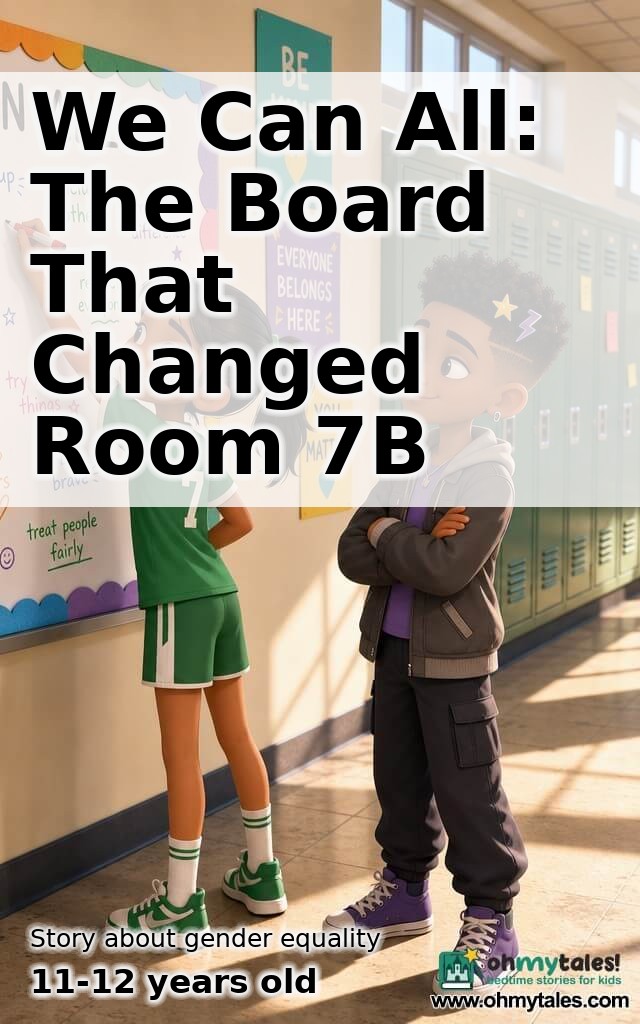
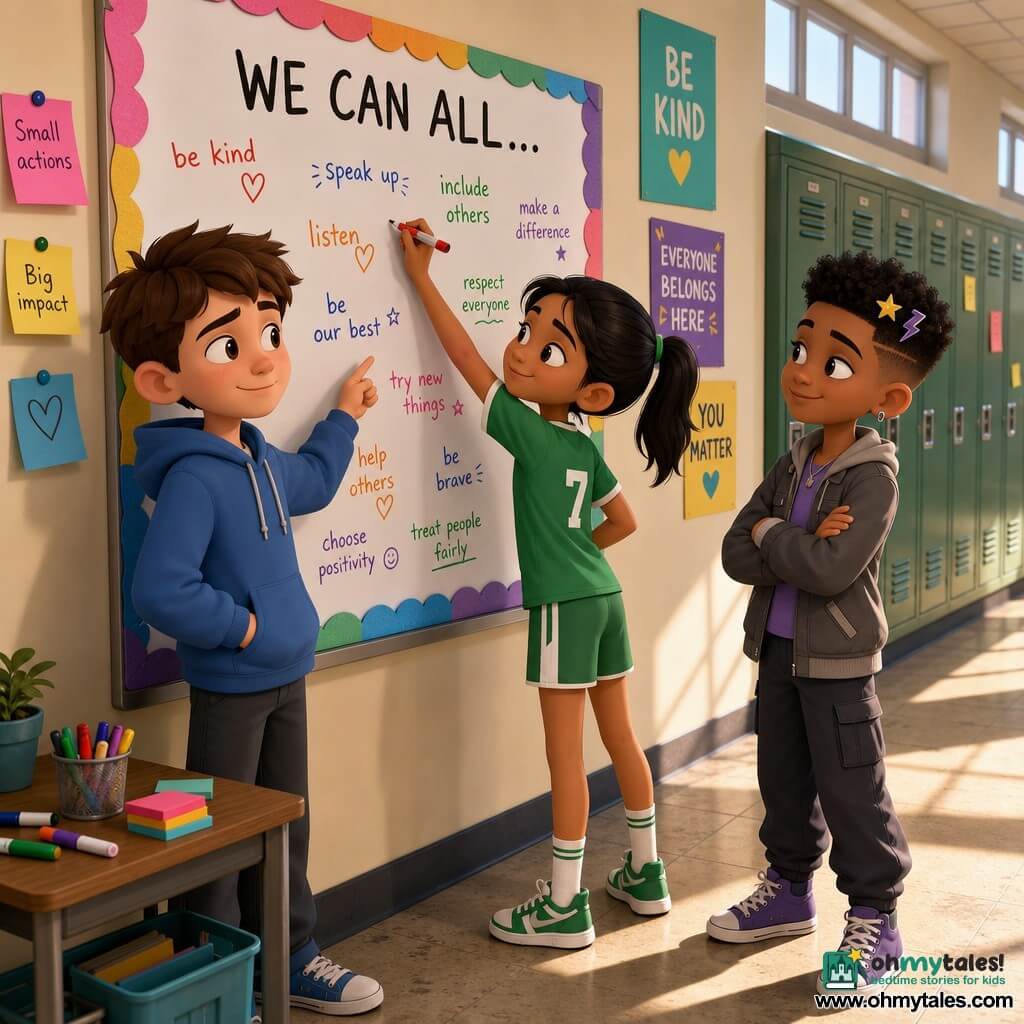
By the end, the board looked simple and bold:
WE CAN ALL…
Under it, three blank columns waited like clean pages.
Milo stepped back. The board wasn't magic. It wouldn't fix everything. But it was a start you could see.
Chapter 4
The next morning, the line outside Room 7B felt different—not quieter, not perfect, but like people were aware they were being watched by something other than a teacher.
Milo stood in his spot, hands tucked into his hoodie pocket, listening.
“Did you see the board?” Priya asked someone.
“Yeah,” another kid said. “It's kinda… nice.”
Jayden wandered up, glancing at Lina. “So you really want to play soccer at recess?”
Lina grinned. “I really want to win.”
Jayden laughed, but it wasn't mean this time. “Okay, okay. I'll pick teams fair.”
Nova leaned toward Milo. “Fair is doing a lot of work in that sentence.”
Milo whispered back, “At least it's a start.”
In line, a kid behind them pointed at Nova's barrettes. “Still wearing those, huh?”
Nova's shoulders stiffened.
Before Milo could think, Lina turned around. “Yep. And I'm still wearing socks. Should we have a meeting about it?”
The kid blinked, confused.
Nova's lips twitched. “They're just barrettes,” they said, voice steady now. “And I like them.”
The kid shrugged, suddenly bored, as if confidence had sucked the fun out of teasing.
When they entered the classroom, kids drifted toward the board like it was a new vending machine.
Someone had already added:
We can all be brave in our own way.
We can all say sorry.
Milo felt his throat tighten, not with sadness, but with something softer—relief, maybe. Proof that other people were thinking too.
Priya wrote carefully:
We can all build.
A boy named Connor paused, marker in hand, then wrote:
We can all cook.
A couple of kids snorted.
Connor shrugged. “My dad cooks. He's better than my mom. Don't tell her.”
That made even Ms. Reyes laugh as she walked in. “I heard nothing,” she said, hanging her coat. “All right, everyone. Seats.”
During group work later, Ms. Reyes paired them up for a short engineering challenge: build a paper bridge that could hold a stack of textbooks.
Lina cracked her knuckles like she was about to fight the bridge personally. Nova studied the paper like it had secrets. Milo organized the tape strips by size.
At the next table, Jayden started grabbing all the materials.
“I'll do it,” he announced.
His partner, Priya, calmly held onto the ruler. “We can do it,” she corrected.
Jayden paused, then nodded. “Fine. You measure. I'll fold.”
Milo watched that moment closely. It wasn't huge. No dramatic apology. Just a tiny shift from I to we.
Their bridge held three textbooks before sagging. Lina groaned. “Our bridge has anxiety.”
Nova snickered. “Same.”
They adjusted the folds, added supports, tried again. Four books. Then five.
Ms. Reyes walked by and gave a small thumbs-up. “Nice teamwork.”
Milo didn't say anything out loud, but inside he thought: This is what fairness looks like. Not perfect. Just practiced.
Chapter 5
By Thursday, the board was crowded with handwriting styles—bubble letters, sharp slants, careful printing. It looked like the class had stitched a quilt out of sentences.
Some were funny:
We can all enjoy weird music.
We can all miss the trash can sometimes.
Some were serious:
We can all feel nervous.
We can all ask someone to stop.
Milo liked that mixture. Life was like that too.
But not everyone loved it.
After lunch, Milo came back to find a new sentence written in dark marker at the bottom:
We can all stop being so sensitive.
Milo stared at it. His face went hot.
Nova arrived beside him, reading it. Their mouth went flat. “That's… not it.”
Lina marched up, hands on hips. “Who wrote that?”
A few kids hovered, pretending not to hover.
Milo's first instinct was to erase it silently, pretend it never happened. Quiet was his usual shelter.
But the board wasn't just his. And the sentence sat there like a pebble in a shoe, daring everyone to keep walking.
Ms. Reyes noticed the cluster. She came over, eyes scanning. “All right,” she said, calm but firm. “Let's talk.”
The room went still.
Ms. Reyes didn't shout. She didn't accuse. She simply asked, “What do you think this sentence means?”
A boy shrugged. “People get offended over everything.”
Priya spoke softly. “Or maybe it means ‘don't talk about feelings,' which isn't fair.”
Nova lifted their chin. “Being sensitive isn't bad. It's how you notice when someone is hurt.”
Lina added, “Also, if someone steps on your foot and you say ‘ouch,' are you being sensitive or are you having a normal human foot experience?”
A few kids laughed, but it was gentle laughter.
Milo surprised himself again by raising his hand. “I think,” he said slowly, “sometimes people call others sensitive when they don't want to think about what they did. But the board is supposed to help us include everyone, not shut them up.”
Ms. Reyes nodded. “That's well said.”
She turned to the class. “We're not here to blame. We're here to learn. Whoever wrote it—if you want to talk privately, you can. For now, we'll adjust it together.”
She handed Milo the eraser, but Milo shook his head. “Can we… rewrite it instead? Like, not erase the person, just change the idea?”
Ms. Reyes's expression softened. “That's a thoughtful approach. Class?”
Nova picked up a marker. “What if we write: ‘We can all listen when someone is hurt'?”
Lina added, “And: ‘We can all joke without being cruel'?”
Jayden, who had been quiet, cleared his throat. “Um. Maybe: ‘We can all think before we tease.'”
Milo looked at him, surprised. Jayden didn't meet his eyes, but he didn't take it back either.
Together they erased the old sentence and wrote the new ones neatly in its place. The board looked better—not because it was perfect, but because the class had repaired it together.
That afternoon, as they lined up to go home, Nova leaned toward Milo. “You didn't disappear,” they said.
Milo blinked. “What?”
“When it got uncomfortable,” Nova said. “You didn't disappear.”
Milo's ears warmed. “I guess… I didn't want the board to become another place where people feel small.”
Lina bumped his shoulder lightly. “Look at you, being quietly heroic.”
Milo almost smiled. “Please never say that sentence again.”
Chapter 6
Friday arrived with pale sunshine and the smell of sharpened pencils. It was share circle day.
Ms. Reyes moved the chairs into a wide ring. In the middle, she placed a small basket filled with paper slips.
“New ritual,” she announced. “This is our ‘We can all…' circle. Each person will pick one slip. It might be something you wrote, or something someone else wrote. You'll read it out loud, then say one small action you can take today to live it.”
A couple of kids shifted, unsure. Ritual sounded serious. But Ms. Reyes's voice was warm, like she was offering cocoa, not homework.
Milo's heart beat faster. He didn't love speaking in circles. Still, he liked the idea of actions, not just words.
They went around.
Priya read, “We can all build,” and said, “Today I'll ask Jayden to show me that fold he used for the bridge, and I'll show him how I measured it.”
Jayden read, “We can all say sorry,” and after a pause said, “Today… I'm going to stop saying stuff like ‘girls can't play' even as a joke.” He scratched his neck. “Because it wasn't funny.”
Lina read, “We can all be brave in our own way,” and said, “Today I'll invite someone new into our soccer game. Not because they're ‘good enough,' but because they want to play.”
Nova picked a slip and read, “We can all like what we like.” They glanced down at their lightning-bolt barrette like it was cheering them on. “Today I'm not changing my style to make other people comfortable. But,” they added, looking around, “I'll also try to be patient when someone is still learning.”
A few kids nodded. Someone whispered, “Fair.”
Then it was Milo's turn. He reached into the basket and pulled out a slip. His fingers trembled a little as he unfolded it.
He read: “We can all listen when someone is hurt.”
The room felt quiet, but not scary quiet. Waiting quiet.
Milo took a breath. “Today,” he said, voice steady, “I'm going to say something when I notice an unfair moment. Not a big speech. Just… a sentence. Like, ‘That wasn't cool,' or ‘Let them choose.' Because being silent doesn't help.”
Ms. Reyes smiled. “Thank you, Milo.”
After the circle, the class didn't rush away like usual. A few kids walked to the board and added fresh lines for next week.
Milo watched Lina and Nova write together, their shoulders almost touching, laughing about whether “We can all survive cafeteria pizza” counted. Jayden stood nearby, thinking hard, then wrote:
We can all make room.
Milo stood back, hands in his pockets, and felt something settle into place. The school still had unfair moments. People would still mess up. But now they had a way to notice, to talk, to repair—and a simple sentence that kept the door open.
We can all.