The Spark on the Playground
The announcement was taped to the school fence, flapping against the chain links whenever the breeze picked up. Bright Ideas Weekend, it said in big bubble letters. Create something that helps our town. All ages. All teams welcome.
Maya read it once, then twice. She kicked a stray pinecone toward the swings and watched it bump over the bark chips. Theo came trotting over with his backpack, which always seemed a little too full of pencils and sketchbooks and things he might need later.
“Did you see?” he asked, jabbing a thumb at the poster. “You love projects.”
“I love soccer,” Maya said, grinning. “Projects are fine too.”
They stood side by side, watching second graders share a single jump rope. Three kids jumped in, two kids waited, one jump rope slapped the ground again and again. On the other side of the playground, the soccer ball was stuck in a patch of mud. Two kids poked it with long sticks, arguing about who should step in.
“Why is there only one jump rope?” Theo asked. “There used to be a whole bin of stuff.”
“The lid broke,” Maya said. “Then the ball pump went missing. And the chalk ran out. Stuff disappears.”
Mr. Patel, the neighbor who always walked his elderly beagle in the afternoon, sat down on a bent metal bench with a squeal of protest from the legs. He shook his head and said to the beagle, “I see you, Benny. This bench wobbles more than your tail.”
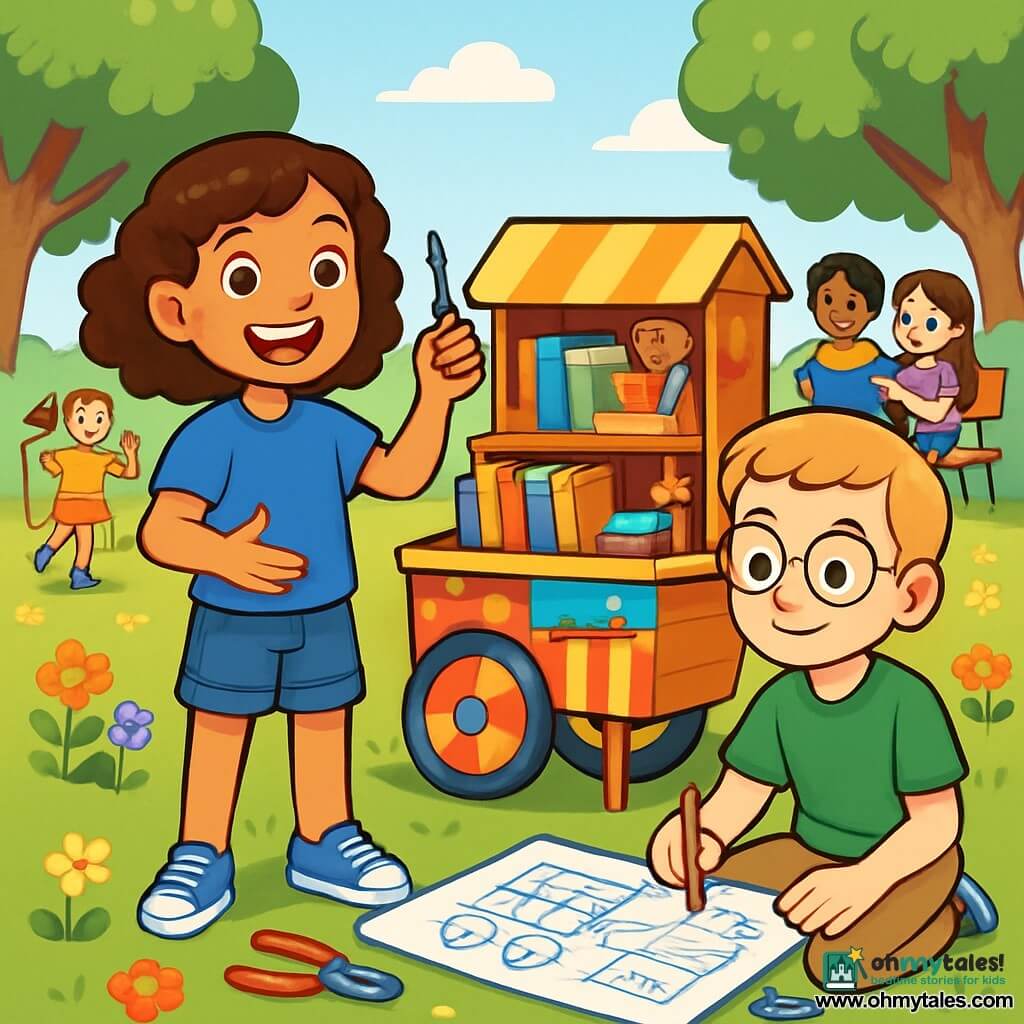
“Imagine,” Theo said softly, “if there was a cart, like a sharing cart, right here. With balls and ropes and chalk and storybooks and maybe even a little tool kit for fixing scooters.”
“A cart?” Maya pictured it—something on wheels with shelves and a roof like a tiny bus stop. “With a sign that says ‘Borrow, Play, Return.' And everyone adds things, not just takes.”
“You're thinking what I'm thinking,” Theo said, eyes bright.
“That we should build it?” Maya asked.
He nodded. “For Bright Ideas Weekend.”
Maya nudged the pinecone toward him. “We can try. We'll need wood. And wheels. And paint. And a way to make sure people actually bring stuff back.”
“And maybe,” Theo added, flipping open a notebook, “a rule board. Not bossy rules. Friendly rules. And a little bell. Bells are happy.”
“Bells are optional,” Maya said, laughing. “But yes. Let's do it.”
Mr. Patel stood up slowly, rubbing his knee. “What are you two plotting?”
“A sharing cart for the park,” Maya said. “We want to make something that doesn't tell people what they can or can't do because they're boys or girls. Just a place for everyone to share.”
Mr. Patel's smile created soft lines at the corners of his eyes. “Sounds like this park could use that. And I might have some old stroller wheels in my shed. They wobble less than my bench, I promise.”
Theo drew a little cart in his notebook, fast and light, adding a tiny flag that said Share Spot. Maya watched the second graders pass the jump rope to the kids who had been waiting. They all cheered together when they got the rhythm right.
“Okay,” Maya said, heart beating a little faster. “We're building a cart.”
The Pact
They met in the school's maker corner after class, where Ms. Alvarez kept bins of mysterious parts: screws sorted by size, Mason jars full of washers, coils of wire, and a wall of tools hanging neatly like metal sunflowers. It smelled like sawdust and orange soap.
“What brings you two to my lair?” Ms. Alvarez asked, pushing her glasses up higher. “Planning to craft a robot that does homework?”
“Better,” Theo said. “A Share Spot. A cart for the park with shelves and a small roof. We want to borrow some materials—if that's allowed.”
“Borrowing is very on theme,” Ms. Alvarez said, smiling. “Let's make a list. The cart needs a base, sides, shelves, a handle, and wheels. We have scrap plywood. And I can teach you to use the drill and the saw. Safety first. Gloves, goggles, and steady hands.”
Maya glanced at the drills. They looked like serious birds with beaks. She liked running fast, doing headers with the soccer ball, and climbing the monkey bars. But the drill felt like a different kind of brave.
“I've never used one,” she admitted.
“I have,” Theo said quickly, then hesitated. “Well, once. In summer camp. For a birdhouse. It wobbled.”
Ms. Alvarez handed them both goggles. “It's okay to be new at things. The drill doesn't care who you are, only what your hands do and whether your brain is focused. Same with painting. Same with measuring. Where do your strengths sit?”
Maya looked at Theo. He could draw any animal without looking at his paper. He could name colors like they were moods. She could run, lift, and didn't mind getting sweaty. She wanted to build it to last.
“What if,” Maya said slowly, “we teach each other? I'll lead the drill work, even though it makes my stomach flutter. You lead the design and painting, even though it's a lot to plan. We'll both help, but we'll try the parts we don't usually choose.”
Theo blinked, then grinned. “A pact.”
They shook hands. It felt like a small risk, like stepping onto a low balance beam.
Ms. Alvarez clapped her hands once. “I like this pact. I'll check your measurements and keep extra band-aids nearby, though I won't need them if you go slow.”
They made a plan on the whiteboard. They drew the cart box and divided it into three shelves: games and balls on the bottom, books and puzzles in the middle, small tools and chalk up top. They drew a sign with friendly rules: Be kind. Share fairly. Return what you borrow. If something breaks, leave a note so we can fix it. Add something if you can.
“We'll need items for the cart,” Theo said. “Not just build it and hope. Let's ask the library for old books. And Claudia's Bakery might give us a bell. Bells are back on the list.”
“You and those bells,” Maya said, shaking her head. “I'll ask Grandpa Ray about the garage—he saves everything. You ask the library.”
“And I'll design the sign,” Theo added. “With colors that say everyone is welcome.”
Maya folded the plan and slid it into her backpack. “Tomorrow, after school. Your house or mine for building?”
“Yours,” Theo said. “Your courtyard has a hose for washing brushes. And your cat only judges quietly.”
“Good,” Maya said, thinking of Luna the cat and how she always sat like a loaf. “She'll supervise.”
They bumped elbows. Outside, the late afternoon light made long shadows in the hallway. Their pact felt like a crisp line in a drawn picture—clear and solid.
Measure Twice, Laugh Once
Maya's courtyard smelled like wet dirt and lemon soap from the neighbor's laundry line. They spread out their supplies on an old picnic table: scrap wood from Ms. Alvarez, a set of wheels Mr. Patel had pushed across the grass in a squeaky wagon, the drill and bits, a sander, a jar of screws, and a stack of old newspapers to catch paint drips.
Grandpa Ray shuffled out with a plate of orange slices. “Builders get hungry,” he said. His eyebrows were impressive grey wings. “I hear you're making something useful.”
“A cart for sharing in the park,” Maya said. “Share Spot. We're starting with the base.”
“Good name,” Grandpa said. “Remember, the first rule of building is measuring twice.”
Maya measured. Theo double-checked. They wrote numbers on masking tape stuck to their sleeves. Maya picked up the drill. It hummed when she squeezed the trigger, a nervous bee sound. She put the bit to the wood and looked at Theo.
“You've got this,” he said. “You run faster than anyone I know. This is just a different kind of steady.”
She took a breath. The bit bit down. The first hole was perfect.
“The wood didn't even cry,” Maya said, half laughing.
“The second might,” Grandpa Ray said, playful. “Don't get cocky.”
The second hole came out angled like a tiny ramp. Maya groaned.
“We can fix that,” Theo said, tapping the wood. “We'll use a washer to make it sit right.”
They problem-solved with small adjustments until the base sat flat. Theo sanded the edges, dust floating up like glitter. He popped open the can of paint and stirred. The color was something between sky and ocean.
“Blue is friendly,” he said. “Not too loud.”
Maya lifted the base and felt her arm muscles warm. “Your turn. Make it pretty.”
Theo brushed on the first swath of blue, and it looked so good that he smiled at his own hands. He got really into it, leaning over the plank, until his elbow knocked the paint tray and a blob splashed onto his sneaker.
“Uh-oh,” he said, peeling his shoe off the ground.
Maya burst out laughing. “Your shoe looks like it fell into the sky.”
“Then I'll call it fashion,” Theo said. He added cloud-like swirls to the corners of the base so the accident looked intentional. “Cloudy corners. Very modern.”
Luna the cat jumped onto the picnic table and sat in the center of the newspapers, pretending to read the screw sizes. Maya gave her a gentle tap and Luna stayed exactly where she was.
They measured shelves, drilled, sanded, and painted. They worked with care, learning each other's moves. Maya started to trust the drill. Theo started to use the sander like a magician smoothing rough places into something kind.
When the sun tilted low, Grandpa Ray said, “Time to wash brushes. And yourselves.”
Theo held up his blue-splattered hands. “I look like a summer storm.”
They washed at the hose, the water shockingly cold. Maya let out a yelp that made Luna twitch her ear. They ate more orange slices and looked at what they had made: a base with four sides, the hint of a roof started, two shelves drying on bricks so they wouldn't stick to the table.
“This is happening,” Maya said softly. “This is really happening.”
Theo nodded. “Tomorrow: wheels and sign.”
“And asking for stuff to fill it,” Maya added. The thought made her stomach flutter again, the good kind. “I'll talk to Claudia. You go charm the library.”
“Me? Charm?” Theo said, putting a hand to his chest. “I'll try.”
“Pact,” Maya reminded him, and they bumped elbows with paint still drying on their sleeves.
Rain, Wheels, and a Little Speech
The morning it rained, it didn't just rain. It poured the way someone pours cereal when they're not paying attention—too fast, too much, all at once. The cardboard sign they had written SHARE SPOT (temporary, just for planning) sagged and then turned into a softened curl. One of the stroller wheels, which had seemed just fine the day before, wobbled like a toddler after a nap.
Maya and Theo stared at the wheel. Maya pushed the cart gently. It wobbled, squeaked, and then the axle slipped out of place. The cart tilted. A corner scraped the concrete.
“I want to say ‘no big deal,'” Maya said, looking at the wheel like it had betrayed her, “but this feels like a big deal.”
Theo squinted up at the sky, where the rain was getting that sideways slant that meant no one was going to the park today. “Maybe we need someone who knows wheels.”
Mr. Patel, as it turned out, knew wheels. He knelt carefully beside the base, traced the metal rod with his finger, and nodded. “You need a spacer here and a locking nut. The stroller design wants to be a stroller. You're making it be a cart.”
“Can we fix it?” Maya asked.
“Together,” he said. “I've got a box of bicycle bits that might work.”
He returned with a shoebox smelling like oil and old rubber. They sorted through nuts and bolts until they found two that fit with a satisfying, safe feeling. Mr. Patel showed them how to tighten without pinching the wheel, how to make sure it spun, how to check it again after a few spins.
“You'll be the wheel supervisor,” Maya said to Theo, and her voice shook sort of like the drill had. She was nervous about the rain, about the weekend date already circled on her calendar, about things not getting done in time.
“I can supervise,” Theo said. Then, surprising himself, he added, “And I'll talk to people about donating things today. Even if we can't go to the park, I can talk. People still have ears in the rain.”
That was his soft risk. He didn't love speaking up in front of people he didn't know, especially not grown-ups who might ask questions he hadn't planned for. But he pulled up his hood, took the sign design (the new one in a folder, not the soggy cardboard), and went to the library anyway.
Inside, it smelled like paper and quiet. Ms. Greene, the librarian, looked up with a smile. “Theo! Did the sky follow you in?”
“I think it did,” he said. He explained Share Spot, how they were building a cart to live in the park, how they wanted the library's old books that kids might like to read outside. He showed her his design: friendly blue, round letters, little drawings of hands passing a ball, a book, a wrench.
Ms. Greene tilted her head. “I like that wrench,” she said. “Tools belong to anyone who learns how to line them up. That's good work you two are doing.”
“Could the library help?” Theo asked. His voice didn't shake as much as he thought it might.
“We can,” Ms. Greene said. “We can donate a small box of paperbacks that are ready for a new home. And I'll put a note on our bulletin board asking for board games with all the pieces, and puzzles, and maybe a few folding cones.”
“That would be amazing,” Theo said. He felt lighter walking back out into the smell of wet asphalt.
Maya, meanwhile, was at Claudia's Bakery. The window was foggy with steam from fresh bread. Claudia herself wiped her hands on her apron and listened while Maya explained. Maya didn't let her eyes wander to the tray of cinnamon rolls too much.
“So a bell?” Claudia asked, warm eyes crinkling. “To announce the cart?”
“Or just to sound cheerful,” Maya said. “And maybe a day-old loaf to feed volunteers.”
Claudia laughed. “You know how to ask well. The answer is yes to both. And do you need a small toolbox? I have a tiny one behind the counter for fixing the pastry case. My nephew outgrew it.”
Maya blinked. “Really? That would be perfect.”
“Perfect things are better when they're shared,” Claudia said, handing over a bell with a little wooden handle that felt right in Maya's palm. “And the bread is a thank-you for being the kind of kid who builds instead of just wishing.”
By late afternoon, the rain slowed to a drizzle. They gathered under the awning of Maya's building and spread out their finds: wheels fixed and spinning true, a box of books with bright covers, a jump rope with new handles someone from the library drop-off had added, a little toolbox with a snugly fitting wrench, and two coloring books with only a few pages missing, which felt honest and just right.
“We still need our sign,” Theo said. He had drawn the words Share Spot in letters that looked like they were passing things to each other, each letter leaning toward the next. He outlined everything with a weatherproof marker Ms. Alvarez had lent them.
“Let's seal it with clear coat,” Maya said. “No more soggy curl.”
“And then,” Theo added, swallowing, “we have to tell people how it works. Out loud. Tomorrow.”
“We can do it together,” Maya said. “I'll start. You finish.”
“Pact,” he said, and this time the elbow bump was blue, and a little sticky, and exactly right.
Grand Opening, Small Steps
Saturday morning arrived with sunlight that felt like a clean page. They pushed the cart toward the park. The wheels rolled, making a soft thrumming sound on the sidewalk. The bell on the handle rang once, not too loud. People walking dogs turned to look. One of the second graders waved like the cart was a float in a parade.
They set up on a flat piece of concrete near the swings. The Share Spot sign fit into brackets Theo had painted white. The rules were simple and kind. The box of books took the middle shelf. The jump rope and a soccer ball sat on the bottom with cones. The small toolbox and chalk went up top.
“Ready?” Maya asked, glancing around. Kids had started to drift over. A mom with a stroller slowed. Mr. Patel and Benny ambled across the grass. Ms. Greene arrived with a tote bag. Even Claudia showed up, carrying a bag with a ribbon on it.
Maya took a breath and rang the bell. It made a sound like a spoon tapping a mug.
“Hi,” she said, and her voice carried better than she expected. “We're Maya and Theo. We built Share Spot because we noticed the park had fewer things to play with. This cart is for everyone. You can borrow a thing. You can bring something to share if you have it. If you take something out, please bring it back so someone else gets a turn.”
Theo stepped forward. He held the sign as if it might fly away, but it didn't. “The only rule is kindness. And fairness. If two people want the same thing, we take turns. We can use a sand timer.” He held up a tiny hourglass he'd found in his game box at home.
A little boy with a dinosaur shirt pointed at the toolbox. “Can I fix my scooter?”
“Let's see what it needs,” Maya said. They knelt together. The boy's front wheel was loose and clacked when it spun. She showed him how the wrench hugged the nut, how to turn it gently and check again. The boy's eyes went wide. “You're strong,” he said.
“I've been practicing,” Maya said. “You can be strong too. It's not a boy thing or a girl thing. It's a practice thing.”
Two girls reached for the jump rope at the same time. Theo walked over with the sand timer. “Three minutes each,” he said. “Deal?” They nodded and started to count down together, laughing when one of them got tangled and had to untie her sneaker laces.
Ms. Greene set the tote bag down and took out two bright paperbacks, a book of riddles, and a worn cookbook with a photo of soup on the cover. The cover had a bent corner that made it look like it was smiling.
“Soup?” Theo asked, curious.
“Cooking can be shared too,” Ms. Greene said. “Boys and girls can make soup. Or cookies. Or anything.”
Claudia opened the bag with the ribbon and took out a frosting spreader, a rubber spatula, and a note: For kids who want to help in kitchens. Share with care. She winked at Theo. “You want to try a recipe later? I'll give you tips.”
Theo blushed and nodded. “I… maybe yes.”
A boy in a football jersey picked up a book about a girl who sailed across a lake. He looked like he might put it back, and then he didn't. He sat down and started to read. Maya felt something warm in her chest that had nothing to do with the sun.
“Do you think people will respect it?” Theo whispered to her. “Take care of it?”
“We'll show them how,” Maya whispered back. “We'll be patient. We'll fix things when they break. We'll ask others to help us watch. We'll make it normal.”
A skateboard clattered nearby. Someone bumped the cart and the bell rang gently all on its own. People smiled and made room for each other.
They spent the morning helping. Maya taught three kids to pump a soccer ball, then handed the pump to one of the kids and said, “Show him what you learned.” Theo painted a small star on the rule sign where a little scratch had happened and told a story to a group of kindergarteners about a friendly cloud who liked to share shapes. He did sound effects with his mouth. The kids pointed at his blue shoe and giggled. “The sky stepped on you,” one girl said. “Lucky.”
At lunchtime, they unwrapped Claudia's bread and ate it with butter from a picnic cooler. They passed slices to anyone who wandered close. “Sharing,” Maya said with her mouth half full, “applies to bread too.”
“Especially to bread,” Theo agreed.
What Stays
By afternoon, the judges from Bright Ideas Weekend had visited five different projects in the park: a pollinator garden with a bee hotel, a recycling station made from old crates, a mural about kindness, a bench someone had painted with vibrant fish, and their cart.
The judge with the clipboard asked careful questions. “Who worked on what?” she asked.
“We both did,” Maya said, looking at Theo. “Even the parts we were nervous about.”
Theo nodded. “We made a pact to try the things we didn't usually do. Maya used the drill. I painted and asked the library for help and told people about the rules out loud—even though my stomach tried to hide.”
The judge smiled. “And how will it keep working?”
“We made a caretaker calendar,” Maya said, holding up a sheet of paper with names. “We asked other kids to help check on it after school. We'll fix things. People have already brought stuff.”
A kid in a knit hat tugged on Theo's sleeve. “Can I add my old puzzle?” he asked. “It's only missing one piece, but I drew a picture of the missing piece so you can pretend it's there.”
“That's very thoughtful,” Theo said. He saw the judge write something down that looked like a plus sign.
When the awards were given out at the gazebo, there was no big drum roll, just claps and a lot of smiling. The pollinator garden won first prize, which made sense because bees were in trouble. The mural got a special ribbon for beauty. And then the judge turned toward Maya and Theo.
“For community heart,” she said, “for building something that lets everyone share and learn from each other, for fairness and courage and care, the Share Spot gets this.”
She pinned a ribbon to the corner of the sign. It fluttered in a tiny breeze. Theo stared at it. Maya stared at it. Then they looked at each other and laughed because it wasn't first or second, and somehow it felt like exactly the right prize.
After the crowd drifted away, a boy who had been quiet all morning stepped up to the toolbox. He picked up the wrench and held it gently, as if it might break. “Can I try to fix my skate?” he asked. “It keeps turning when I don't want it to.”
“Let's do it,” Maya said.
A girl in a pink hoodie picked up the cookbook. “Soup sounds good,” she said. “Our house is loud. Soup might be calm.”
“I'll teach you my favorite,” Theo said, surprising himself. “Claudia promised advice. We can try, and even if we mess up, we can eat toast.”
Mr. Patel patted the bench near them. “I'm going to bring my drill next week,” he said. “We can show anyone who wants to learn. Tools are for learners. And so are books. And recipes.”
They added the caretaker calendar under the sign with Velcro dots. Kids wrote their names in markers that didn't smear. Theo put his name on Tuesday. Maya took Friday. The second graders insisted on adding a sticker of a star next to their team day.
As the sun leaned toward evening, parents called kids home. The last jump rope came back to the bottom shelf without them having to ask. The cookbook went into a backpack, signed out on a clipboard with a simple list and a note: return next Sunday. The bell sat quiet, but it felt—this was how Theo thought of it—like it was smiling.
They pushed the cart toward the small storage space near the community center where it would sleep at night. The wheels hummed. The sign ribbon made a soft shush in the wind.
“That was a lot,” Theo said, tired and happy. “My legs are noodles.”
“Good noodles,” Maya said. “We did it.”
“We did it because we shared the work,” Theo said. “And the courage.”
Maya looked at her hands, which had a fine line of blue in the creases she hadn't washed away. “I liked the drill,” she admitted. “I was scared and then I wasn't.”
“I liked speaking,” Theo said. “I was scared and then my words arrived anyway.”
They stopped at the corner and looked back at the park. Some chalk lines glowed on the pavement. Someone had drawn a big sun with the words: Take turns. Be kind.
“Do you think it will last?” Theo asked.
“People will make it last,” Maya said. “We started it. That's our part. The rest is everyone.”
They pushed on, and the bell gave one small, cheerful ring as if it agreed. They passed Claudia's Bakery. She waved a spatula. They waved back with their free hands.
At Maya's building, Grandpa Ray leaned out of the window. “Builders!” he called down. “Dinner in ten minutes. There's soup.”
Theo laughed. “Of course there is,” he said.
“Want to stay?” Maya asked.
He nodded. “And then I'll go home and draw a comic about a brave drill and a shy bell who become friends.”
“I'd read that,” Maya said, and she meant it.
They put the cart away gently. The lock clicked with a sound that felt like safe and steady. The CARETAKER CALENDAR fluttered once and settled.
On the walk back to Maya's kitchen, their steps matched without them trying. It wasn't that the day had been perfect—there had been rain and a wobbly wheel and nervous hearts. It was that the day had been shared.
And shared things, they had learned, made brave things easier.