Chapter One: The Quiet Clock Garden
Toby the tortoise lived in a garden where clocks grew like flowers. Tiny pocket clocks hung from moss. Big sun clocks turned slowly on fence posts. Toby liked to sit still and listen. He counted ticks like pebbles. He watched the hands move with his slow, careful eyes.
One bright morning, a small silver seed fell on a leaf beside him. It pinged like a tiny bell. Toby nudged it with his nose. The seed opened like a mouth. A warm voice whispered, "Would you like to wait?"
Toby blinked. He was patient by nature. He had learned patience from watching raindrops and snails. "Wait for what?" he asked.
"For minutes," said the seed. "The waiting room of minutes. It keeps time safe. Come in. Just for a little hop."
Toby took one slow step forward. The seed unfolded, and a door of soft light appeared between two dandelions. The garden looked the same. The air smelled like lemon and old stories. Toby's shell shone. He felt his heart whisper, "Curious."
He stepped through.
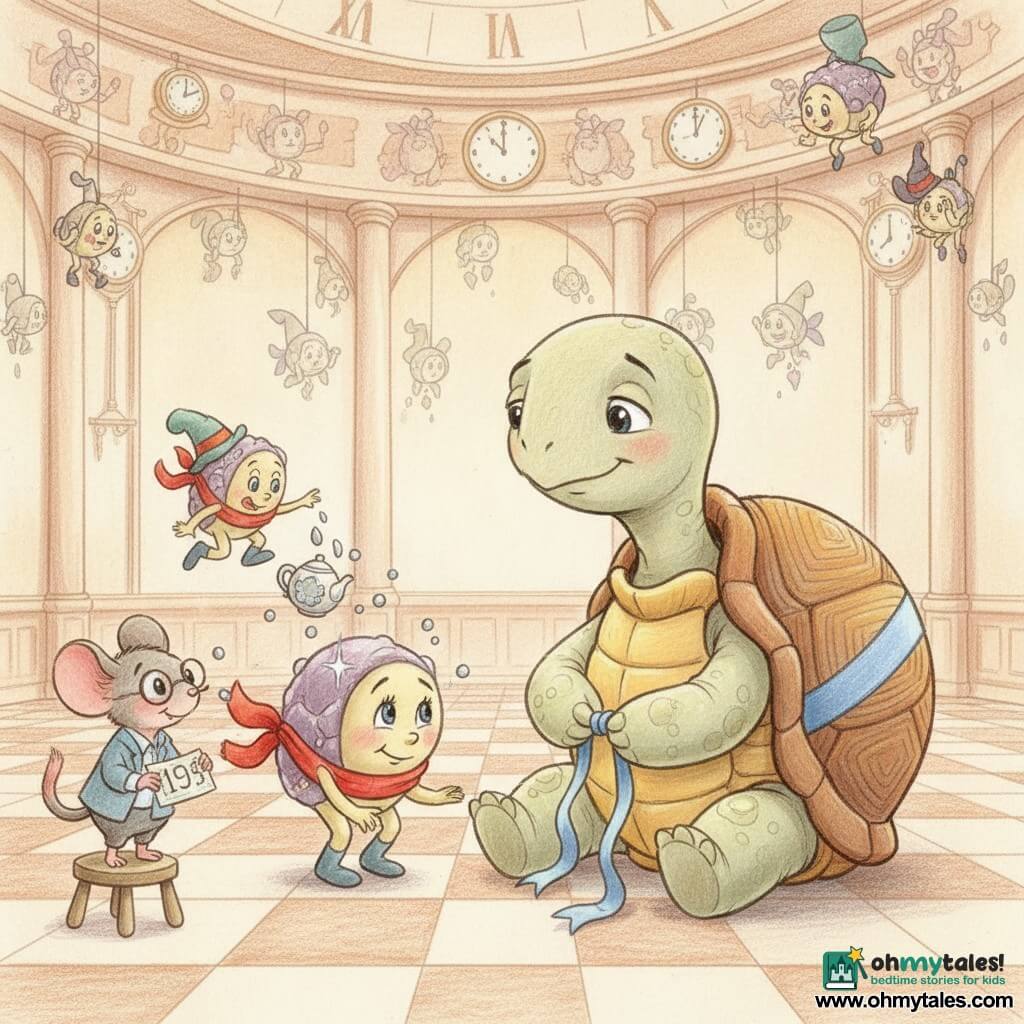
The room was not a room like he had seen. It was a wide, round place, and on every wall hung a different kind of minute. Some minutes were painted blue. Some minutes hummed with tiny bells. One minute wore a hat and read a tiny newspaper. The floor was checkered with seconds that felt like stepping stones. A clock at the center had hands that moved backwards for fun. Everything was gentle and soft.
A waiting chair squeaked. A little mouse in glasses waved a paper ticket. "Number 42," she said. "Welcome to the Waiting Room of Minutes."
Toby smiled his slow smile. He liked numbers. They were tidy. He sat in a chair that smelled faintly of pine. He listened to the minutes breathe. Each minute seemed tiny and important, like a new leaf.
"Why do minutes wait?" Toby asked the mouse.
"They wait for moments," she said. "And sometimes moments get lost. We hold them until someone remembers."
Toby thought of memories in his shell. He remembered a warm rock, a brook's song, the first time he met a beetle who sang. "Can I see a memory?" he asked.
The mouse clicked her teeth. "Only if you are patient and careful. Minutes are shy."
Toby nodded. He had patience like old tree roots. The minutes noticed. One bubbly minute rolled forward. It smelled like honey and the sea. "I am from a picnic minute," it said. "I remember ants marching and lemonade laughing."
Toby leaned close. The minute showed him a tiny picture. He saw himself as a young tortoise, smaller than a pebble, stepping into puddles for the first time. He felt a warm ache in his chest. He smiled and whispered, "I remember that puddle."
"Good," said the minute. "Keeping a memory makes the world kinder."
Toby's ticket buzzed. It was small and polite. "Next," the mouse said.
A hush fell. The minutes watched. The clock hands moved with gentle pomp. Toby was ready to wait and learn.
Chapter Two: The Mischievous Paradox
A minute wearing a tiny scarf rolled up. It had a twinkle that looked almost like mischief. "I want to play a trick," it said.
Toby tilted his head. He did not like tricks that hurt. But he liked puzzles. "What trick?"
"This is a paradox minute," said the scarf-minute. "It likes to hide things in times. It can make a memory seem to happen twice."
Toby blinked slowly. "Twice?"
The minute snapped its little fingers. Suddenly the room felt like a ribbon, and the walls shimmered. A small scene popped up like a picture book. It showed a crow stealing a crumb at the garden gate. Then the picture rewound. The crumb flew back to the crow's beak. The garden gate mended itself.
Toby saw two very similar things happen, but one carried a tiny difference. In one scene the crow had a blue feather missing. In the other, the feather was there. Toby thought of all the moments he had kept in his shell. He wondered which one was the true one.
"Paradoxes are curious," said the scarf-minute. "They test memory. They ask, 'Which version do you hold?'"
Toby thought of being small and stepping into puddles. He had a clear memory of the puddle and a beetle. Yet now he saw two puddles. One had sunshine bubbling in it. The other had moonlight.
He felt a small worry. If he picked the wrong memory, would the garden change? The mouse in glasses saw Toby's brow move. She offered a small biscuit. "Memories are like marks on a map," she said softly. "You can look and compare. Sometimes you must ask the people in your map."
"People?" Toby repeated. He realized animals were people too. He could ask them.
He wandered the room. He met a rabbit who kept recipe minutes. He met a fox who saved story minutes. Each minute had a hint. The rabbit told Toby, "I baked in the day that had the bouncing sun. My minute is warm."
The fox said, "I read a story in the moon-minute when owls were whispering."
Toby began to collect small clues. He touched a minute and listened. He placed two minutes side by side. The minutes hummed. Slowly, a truth brightened like a lantern. Some moments could look different, but a memory carried its feeling. His puddle memory felt like laughter and a cold splash.
Toby whispered to himself, "The puddle was warm because the sun was laughing." He touched the puddle-minute and nodded. The other puddle melted like sugar. The paradox-minute sighed, pleased and slightly embarrassed. "You solved a small knot," it said. "Well done, patient one."
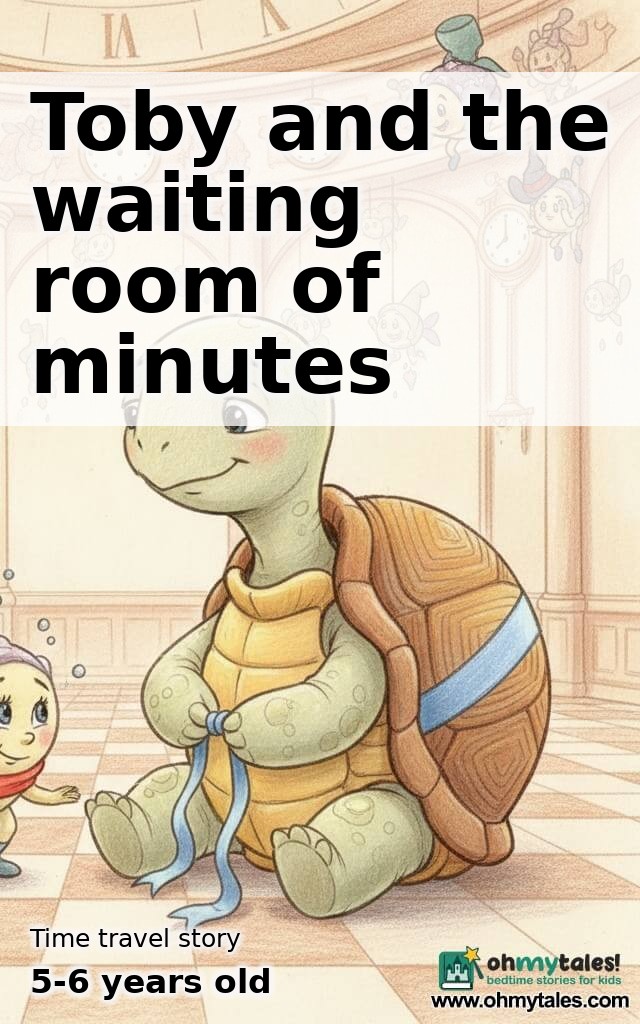
Toby felt proud. He had used small steps and kind questions. The waiting room clapped with soft tick-tocks. The mouse handed him a ribbon. It read: Rememberer.
"Keep this ribbon on your shell," she said. "It helps you find your way back."
Toby tied the ribbon with a careful knot. It sat between his plates like a small sun. He felt a warmth from the ribbon, like memory feeling safe.
Just then, a minute with a lopsided hat knocked over a teacup of time. It spilled little silver droplets that shimmered into tiny twins of minutes. The room giggled. A small flip of disorder, but not dangerous. Toby watched the droplets; each one held a second of a song. When the droplets fell, the song sounded slightly off and then right again. Toby tapped his foot. He liked listening to the tune find itself.
"Sometimes time tumbles," said the hat-minute. "It needs patient hands to put it back."
Toby found a small comb and gently lined up the fallen seconds across the floor like stepping stones. The seconds began to sing in order. The tune returned to the room. Rabbits hummed. The fox smiled. The minutes felt pleased.
Toby felt something else, a gentle tug. The central clock winked. The hands pointed toward a soft door of light. It was time to go back soon. The ribbon warmed. Toby had learned, and he had found feelings of the past. He had stitched a small puzzle. He had listened.
Chapter Three: Home with the Ribbon
A hush came over the waiting room. The mouse in glasses cleared her throat. "The trip must end," she said. "Minutes wait to be remembered, but they cannot stay forever."
Toby sat still. He felt like a shell full of sunlight. He touched the ribbon. The knot was steady. He wanted to take a last look.
He walked to a window that looked like a watch face. On the other side was his garden. He saw moss, the fence, and a small stream. He also saw younger versions of himself stepping and wobbling through puddles. He saw the beetle that sang. He felt a sparkling memory—so strong that it touched his toes.
"Will I forget?" he asked the mouse, and his voice was small.
"You will remember the feeling," she said. "Memories are not boxes. They are lanterns. You will carry light."
Toby breathed in. He breathed out slowly. He thought of the crowd of minutes. He thought of the paradox that taught him to ask questions. He thought of the ribbon and the little knot.
The central clock chimed once, soft like a bell tucked into cotton. A path of seconds opened. "Follow the path," said the scarf-minute. "When you step through, keep the ribbon tied. Let your mind be patient and your heart be curious."
Toby stepped. The path of seconds felt warm and tickly under his feet. The light wrapped him like a blanket. He remembered the picnic minute and the crow. He remembered the puddle. He remembered the beetle and the song. He remembered small kindness from a mouse with glasses.
He slid through the door and arrived by the lemon tree in the garden. The seed was a small silver shell on the leaf where it had been. The pocket clocks ticked in a tidy row. Nothing seemed changed, but Toby felt different. His shell shone with a new stripe—the ribbon's light had left a faint mark of blue.
Nearby, the beetle sang the same tune. It stopped and lifted a tiny leg in a bow. A small child—no, not a child, a kitten named Pip—sauntered by and dropped a crumb. Toby smiled. He had the ribbon tucked between his plates. He held his memories like a lantern.
He walked slow and steady to the little brook. He stepped into a puddle. The water splashed cold and bright. He remembered being small and feeling the splash. He hummed the tune.
The sun moved and the garden smelled like warm bread. Toby met the rabbit who had been in the waiting room. She had a pocket full of carrot notes. "Did you return?" she asked, her ears perking.
Toby nodded. "I remembered a puddle and a song," he said.
"You are a Rememberer," she said, impressed. "That is important."
Toby lay on a warm rock and opened his eyes to the blue sky. He felt memory like a soft blanket. He knew that if ever a minute looked lost, he could be patient and listen. He knew he could ask gentle questions. He knew memories could be different but the feeling in his chest could show the way.
That evening, the clocks in the garden sang a low lullaby. The ribbon's mark glowed faintly, like a small moon. Toby closed his eyes. He dreamed of the waiting room. He dreamed of minutes rolling like marbles and dancing back into order.
In the morning, the silver seed lay closed, waiting for the next patient heart. Toby munched on a leaf and remembered the fox's story and the mouse's biscuit. He felt brave and calm. He had been on a gentle adventure through time. He had learned that remembering is like tending a garden: you watch, you water, you keep small knots tied.
Toby opened his eyes, stretched his neck, and smiled. The present felt bright. The past felt safe. He kept the ribbon snug and carried the memory like a lantern, ready to help any minute that might lose its way.