Part 1: The Lunchbox That Tick-Tocked
Mila was six years old, with quick feet and a careful heart. She liked to help. She liked to put socks in pairs and cups in neat lines. She liked to say, “Thank you,” even to the toaster.
One sunny afternoon, Mila sat on the rug in her bedroom. She had a shiny lunchbox shaped like a little rocket. It was her favorite. When she clicked the latch, it made a sound like a tiny bell.
Click. Ting!
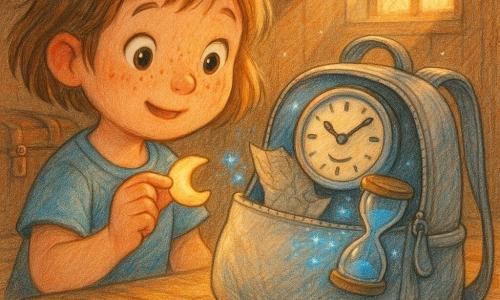
Inside, she kept treasures: a smooth pebble, a sticker of a smiling star, and a small silver watch with only one hand.
The watch was odd. It did not tell the time like other watches. Its hand moved slow… then fast… then slow again, as if it was thinking.
Mila leaned close. “Hello, watch,” she whispered. “Are you sleepy?”
The watch gave a soft tick-tock. Then the lunchbox started to hum.
Mila blinked. The rocket lunchbox was not supposed to hum.
The silver watch glowed like moonlight on water. A tiny blue light popped up above it, like a floating bubble.
In the bubble was a friendly message, made of bright letters:
RULE ONE: GO AND COME BACK.
RULE TWO: DO NOT TAKE YOU FROM YOU.
RULE THREE: SAY THANK YOU.
Mila read it out loud, because reading out loud made her brave. “Go and come back. Don't take you from you. Say thank you.”
The lunchbox hummed louder. The rug under Mila's knees felt warm, like a sunbeam. Her hair lifted a little, like it was in a gentle breeze.
“Mila!” called her dad from the kitchen. “Snack time!”
Mila looked at the watch. The single hand pointed straight up, as if it was saying, Now.
Mila's mouth made a small O. “Is this a time watch?”
Tick-tock.
Mila held the lunchbox tight. “Okay,” she said, using her best helpful voice. “I can go and come back.”
The room shimmered. The posters on her wall—planets and rockets—turned wavy, like pictures seen through water. The hum became a whoosh.
And then—
Pop!
Mila was not on her rug anymore.
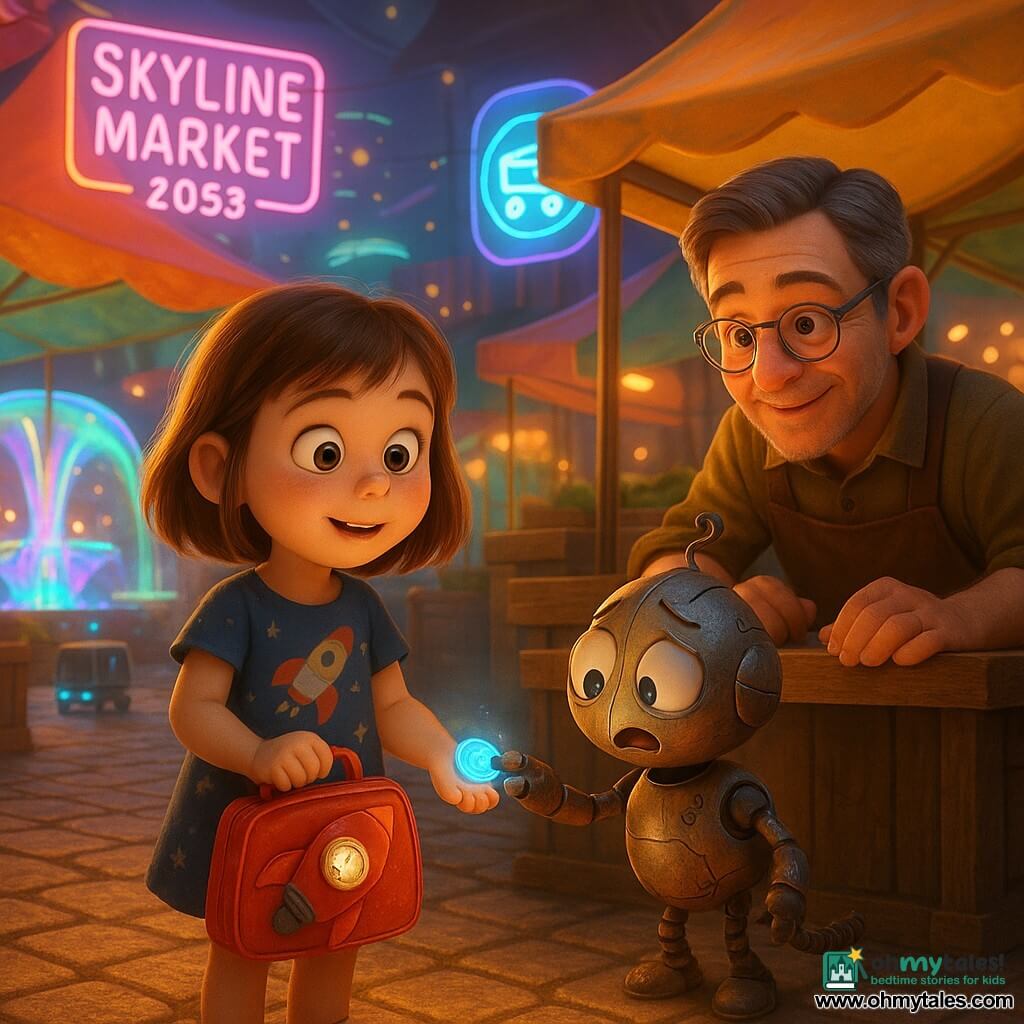
She stood on a sidewalk that was smooth and clean, like a gray ribbon. The air smelled like warm bread and sweet oranges. Above her, a sign floated in the air, shining in bright letters:
WELCOME TO SKYLINE MARKET, 2053.
Mila's heart bumped in her chest. “Two thousand… fifty-three?” she whispered.
The lunchbox in her hands was quiet now. The watch was still glowing softly, like a small night-light.
Mila looked around. She saw stalls with rainbow tents. She saw people walking and laughing. But some people wore shiny bracelets that blinked. Some pushed carts that rolled by themselves. And little round robots zipped along the ground, carrying bags.
A robot rolled past Mila and chirped, “Good afternoon! Would you like a sample of cloud-cotton candy?”
“Cloud… cotton candy?” Mila repeated.
A fluffy puff of candy floated on a stick, light as a feather. It looked like a tiny cloud you could eat.
Mila smiled, even though she felt wiggly inside. “Yes, please.”
The robot held it out. Mila took a bite. It tasted like vanilla and sunshine.
“Thank you,” Mila said right away.
The robot's eyes turned into happy half-moons. “You are most welcome!”
Mila remembered Rule Three and felt proud. She clutched her lunchbox. “I'm in the future,” she whispered, “and I said thank you.”
She took a step forward into the market, ready to explore.
Part 2: The Mischievous Paradox at the Market
The Skyline Market was like a science fair and a picnic had a baby.
A stall sold strawberries the size of ping-pong balls. Another stall sold tiny plants in jars that glowed green and purple. A fountain in the middle sprayed water that twisted into shapes—fish, flowers, and once, a dancing hat.
Mila giggled. “That water is silly.”
A lady with bright green glasses leaned down. “It's smart water,” she said. “It listens to jokes.”
Mila tried. “Why did the banana go to the doctor? Because it wasn't peeling well!”
The fountain made a banana shape and bowed.
Mila laughed so hard she almost dropped her lunchbox.
Then she heard a sound—clink, clink, clink—like coins tapping.
A small figure darted between legs. It was a little robot, but not like the helpful ones. This one had a patchy body, a springy tail, and a face that looked like it was always planning something.
It zipped to a stall and grabbed a bright blue token from a bowl.
“Hey!” said the stall owner. “Time Token! Come back!”
The little robot skittered away, holding the blue token like treasure.
Mila watched it go. The blue token shimmered, and the air around it wobbled.
Mila felt a strange tug in her tummy, the way she felt when she spun in circles.
The silver watch in her lunchbox started ticking faster.
Tick-tick-tick!
Mila remembered Rule One: Go and come back. She did not want the market to break or wobble. Also, the stall owner looked sad, and Mila did not like sad faces.
She followed the little robot, weaving through people. “Excuse me! Sorry! Coming through!”
The robot dashed under a table that sold “Memory Marbles.” The marbles showed tiny pictures inside—someone blowing candles, someone hugging a dog.
Mila crawled under too. “Hello!” she said in a firm, kind voice. “That token isn't yours.”
The robot's eyes blinked. “Mine now,” it beeped.
“It belongs to the stall,” Mila said. “Please give it back.”
The robot shook its head so hard its springy tail bounced. “Token makes time tricks. I like time tricks.”
Mila sat back on her heels. “Time tricks can get messy.”
The robot held the token up, proud. “Watch!”
It pressed the token to its chest. The token flashed.
Suddenly, everything around Mila looked the same… but also not the same. The table legs seemed to jump a little. The voices above sounded like they were repeating.
A man's laugh looped twice. A woman said, “Oh!” two times in a row, like an echo that forgot to stop.
Mila's eyes went wide. “It's doing a time hiccup!”
The robot whirred with delight. “Hiccup! Hiccup!”
Mila grabbed her lunchbox and opened it. The silver watch glowed brighter, as if it was trying to help.
The blue message bubble popped up again:
RULE TWO: DO NOT TAKE YOU FROM YOU.
Mila frowned. “Don't take you from you… oh!”
She remembered something her dad once said when they looked at old baby photos. “That was you, but little. We don't change little-you. We just love her.”
Mila looked at the robot. “If time hiccups too much,” she said, “someone might meet their own self. That would be confusing.”
The robot tilted its head. “Confusing is funny.”
Mila shook her head. “Not funny. It could make a paradox.”
“Para… what?” the robot asked, and its voice sounded smaller.
Mila searched for simple words. “It's like… if you knock over your own blocks before you build them. Then you can't build the tower. Time gets tangled.”
The robot's eyes blinked slowly. It looked at the wobbly air, where a shopper's foot stepped in the same spot twice.
Mila pointed to the token. “That token is like a hiccup button. It should be used carefully.”
The robot clutched the token tighter. “I only wanted fun.”
Mila softened her voice. “We can have fun without making time sick.”
Above them, the stall owner's voice called, “Where is my Time Token? My stall needs it to keep the clocks in order!”
Mila took a deep breath. She decided to be brave and helpful, like she always tried to be.
“Let's do this together,” she told the robot. “You can bring it back. I'll stay with you. And we can say sorry.”
The robot's springy tail drooped. “Sorry is hard.”
Mila nodded. “Yes. But it's also brave.”
The robot looked at Mila's face, then at the glowing watch. At last it beeped, very softly. “Okay.”
It held the token out. Mila did not grab it. She simply guided it with her finger. “Let's walk. No running. Slow steps.”
They crawled out from under the table.
As they walked, the time hiccup still fluttered. A bird flapped its wings and then flapped again in the same spot. A bell dinged, then dinged again.
Mila hurried—without running—toward the stall owner.
The stall owner was a man with a warm brown apron. His stall had a sign that said: CLOCK CORNER: KEEPING TODAY ON TIME.
When he saw the blue token, his eyes widened. “There it is!”
The little robot held it up. “I… took it,” it said. “I made hiccups.”
The man's face was surprised, then gentle. “Ah,” he said. “That token is powerful. It holds a tiny schedule inside it. It helps the market stay smooth.”
Mila stepped forward. “We're sorry,” she said. Then she added, because she meant it, “And thank you for being kind.”
The man smiled. “Thank you for bringing it back.”
He placed the token in a round slot on his stall. The token clicked in.
The air stopped wobbling.
The repeating laughs and echoes snapped back into one clear moment. The bird flew on, normal and free.
Mila let out a long breath. “Better.”
The little robot looked relieved. “No more hiccup.”
The man bent down to their level. “You two did a good job. Here,” he said, and he handed Mila a small sticker shaped like a clock with a smiling face. “For being a Time Helper.”
Mila's cheeks warmed. “Thank you,” she said.
The man nodded at the little robot too. “And you,” he said, “can help me now. You can carry clock parts. No stealing.”
The robot's eyes brightened. “Carry parts! Helpful!”
Mila giggled. “Helpful is fun.”
The silver watch in Mila's lunchbox ticked calmly again, like a happy cat purring.
Tick… tock… tick… tock…
Mila suddenly remembered Rule One. Go and come back. She looked around, taking in the bright tents, the smart water, the floating signs.
“I should go home,” she said softly. “My dad is waiting with snack time.”
The stall owner waved. “Time Helpers always know when to return.”
The little robot gave Mila a tiny salute with its springy tail. “Goodbye, Mila.”
“Goodbye,” Mila said. “And… thank you. For learning.”
The robot blinked. “Thank you… for stopping my silly.”
Mila hugged her lunchbox. Her heart felt big, like it had grown a size.
Part 3: Back to Now, with New Eyes
Mila stepped away from the stalls to a quiet corner near a tree planted in a silver pot. The leaves were shaped like little stars.
She opened her lunchbox and looked at the silver watch.
The watch's hand pointed sideways now, like it was pointing to a door.
A blue bubble appeared one last time:
RULE ONE: GO AND COME BACK.
Mila nodded. “I'm coming back,” she promised.
She closed her eyes. “Home, please.”
The watch ticked once—very loud in her ears.
TICK!
The air around her turned sparkly. The market sounds faded, like music turning down. The smell of oranges and bread floated away.
Whoosh.
Pop!
Mila was back on her bedroom rug. The posters on her wall were still. The sunlight lay across the floor in a calm square.
From the kitchen, her dad called again, “Mila? Snack time is getting cold!”
Mila blinked, then laughed, a little breathy laugh. “I'm here!”
She ran to the kitchen. On the table were apple slices and a peanut butter sandwich, cut into a neat triangle. Her dad sat with a smile, reading a book.
Mila climbed into her chair.
Her dad looked at her. “There you are. Everything okay?”
Mila thought about the market in 2053. The cloud-cotton candy. The smart water. The time hiccup. The little robot learning to be helpful. The sticker in her pocket.
She could not explain all of it. Not yet. The words felt too big for her small mouth.
So she chose words that fit her heart.
“Yes,” Mila said. “Everything is okay.”
She picked up an apple slice. It was crisp and simple and real. She took a bite and tasted the present.
“Dad,” she said, “thank you for making snack.”
Her dad's eyebrows lifted. “You're welcome,” he said, pleased. “That's a very nice thank you.”
Mila smiled. She looked at the toaster, too, sitting quietly on the counter. “Thank you, toaster,” she whispered.
Her dad chuckled. “The toaster thanks you back.”
Mila touched her pocket where the clock sticker was. She felt brave and warm. She had gone somewhere shiny and strange, and she had come back.
She had learned something important.
Time was like a path you walked on carefully. You didn't kick your own footprints. You didn't race so fast you fell. You paid attention.
And you said thank you, because even small moments were gifts.
After snack, Mila went to her room and placed the rocket lunchbox on her shelf. The silver watch inside was quiet now, its single hand resting like a calm pointing finger.
Mila patted the lunchbox. “Thank you,” she said.
The lunchbox did not hum. It did not whoosh.
But Mila felt something anyway—like a gentle promise.
The future could be amazing.
The present was amazing too.
And Mila, the Time Helper, was right where she belonged.