Part One: The Little Dream in a Slow Shell
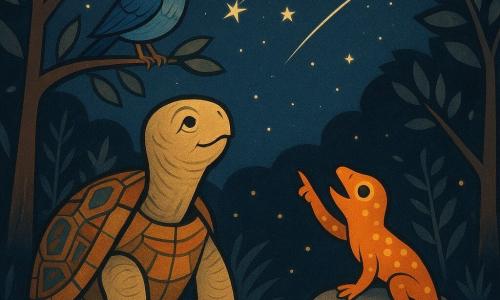
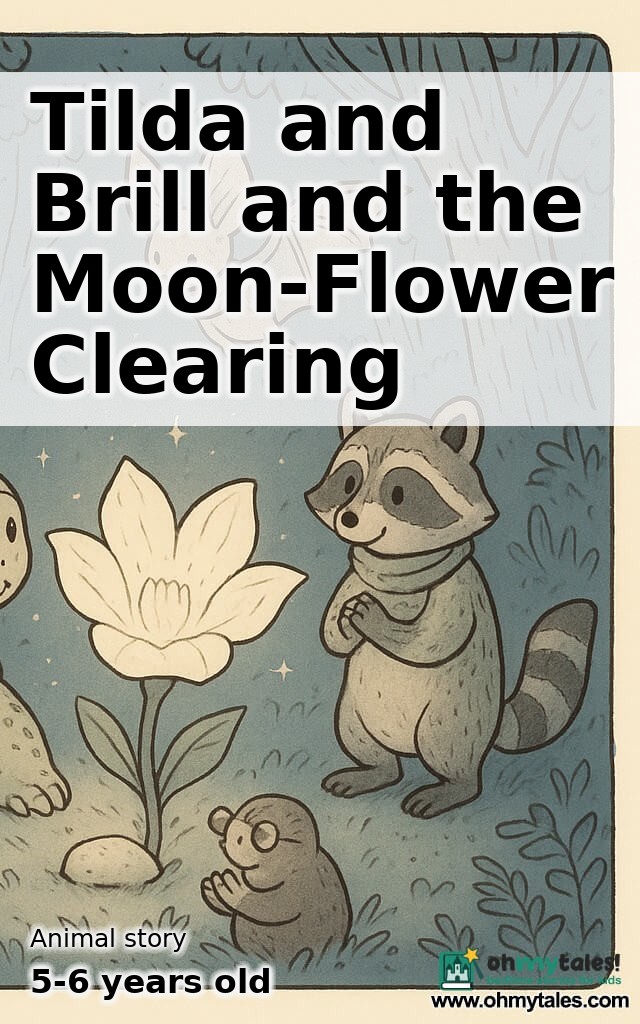
In the kind valley where the air tasted like honeyed rain, there lived a turtle named Tilda. Her shell was the color of warm moss after a shower, and her eyes shone like two small buttons sewn onto morning.
Tilda was known for being generous. If a beetle lost its way, she offered a ride on her back. If a squirrel dropped an acorn, she helped roll it home. If a hedgehog was grumpy, she listened until the grumps turned into giggles.
Yet inside her steady heart, Tilda held a simple dream, small as a seed and bright as a candle.
“I want to see the Moon-Flower,” she whispered to herself each night.
The Moon-Flower was a rare blossom that opened only when the moon was high and the world was quiet. It grew, people said, on the far side of the Misty Brook, in a clearing where the grass glittered like silver fish. No one in the valley had seen it in a long time. Some animals said it was only a story, stitched from fog and wish.
Tilda did not argue. She simply smiled, the way you smile at a song you know is true.
One evening, as the sky put on its purple coat, Tilda shuffled toward the brook. Her feet made tiny, patient sounds: tap… tap… tap. Crickets played their fiddles, and a fox yawned like a red ribbon loosening.
At the edge of the water, Tilda paused. Mist curled above the brook like sleepy milk.
“Hello?” she called, politely.
A voice answered from the reeds. “Hello yourself. Who is knocking on the night?”
Out popped a bat, upside down at first, then right side up in a twirl. Her wings were neat as folded umbrellas. Her nose looked like a tiny leaf.
“My name is Brill,” said the bat. “I was listening to the brook's gossip. It says someone wants to cross.”
Tilda blinked. “I do. I'm Tilda. I want to see the Moon-Flower.”
Brill's ears perked up. “The Moon-Flower? That shy, shining thing? Oh, I adore shy, shining things. I am one myself. People often think bats are spooky.”
“You're not spooky,” said Tilda, warmly. “You're… you're like a night ribbon.”
Brill laughed. “That might be the nicest thing anyone has said to me. Most creatures see my wings and say, ‘Eek!' Or they see my teeth and say, ‘Yikes!' As if I nibble bedtime stories.”
Tilda's smile grew. “Different does not mean dangerous.”
Brill dipped in the air like a curtsy. “Then, dear turtle, I will help you. I can fly ahead and guide you where the mist is thick. But you must help me too.”
“How?” asked Tilda.
Brill looked down at the water. “I get lost when I listen too hard. The brook makes many sounds. Sometimes my ears chase the wrong one. You are slow and steady. You can remind me to be calm.”
Tilda nodded. “We can be a team.”
So they became a team right there, under a sky that was turning on its first stars, like lamps in a long hallway.
Part Two: The Bridge of Murmurs
Crossing Misty Brook was not as simple as hopping. There was an old wooden bridge, thin as a wishbone, with rails that wobbled when the wind sighed.
Brill darted up and down, peeking at the boards. “Some of these planks look as tired as a sleepy snail.”
Tilda placed one foot on the bridge and tested it. The plank complained with a creak.
“Good bridge,” Tilda murmured, as if speaking to an old friend. “We will be gentle.”
Brill fluttered close. “You talk to bridges?”
“I talk to many things,” Tilda said. “It helps me remember they matter.”
They stepped forward, little by little. The mist wrapped around them like a soft scarf. The brook below chuckled and bubbled, as if it were telling jokes only fish could understand.
Halfway across, a gust of wind swished through the mist and made a long, spooky sound: “Woooooo…”
Brill jolted. “Did the bridge just moan at us?”
Tilda's head peeked out of her shell a little further. “It is only the wind. The wind likes to pretend it is a ghost. It is a playful friend.”
But Brill was nervous. She flew in circles, listening, listening. “I hear whispers. I hear splashes. I hear… oh dear, I hear my own heart.”
Tilda stopped. “Brill, come sit on my shell for a moment.”
“Sit?” Brill squeaked. “On a turtle?”
“Yes,” said Tilda. “My shell is a small island. Islands do not hurry.”
Brill landed lightly. The bat's claws tickled, but Tilda did not mind.
They stayed still while the bridge swayed. The mist slid by, and the moon climbed higher, like a pearl rolling up a black cloth.
“Breathe with me,” said Tilda. “Slow. Like a leaf floating.”
Brill tried. In… out… in… out…
The wind's “wooooo” became just “whooooo,” then only “hoo,” then nothing at all.
Brill sighed. “You are right. When I rush, the sounds chase me. When I slow down, the sounds settle.”
Tilda nodded. “And when sounds settle, they become stories instead of scares.”
They went on.
At the far end of the bridge, a small figure blocked the path. It was a raccoon, wearing a scarf that looked borrowed from a rainbow. His eyes were bright and curious.
“Password!” he demanded, trying very hard to sound serious.
Brill whispered, “Oh no. A bridge guard.”
Tilda leaned forward. “Hello. What are you guarding?”
“The path to the Moon-Flower clearing!” said the raccoon. Then, in a smaller voice, he added, “At least… I think so. I heard something wonderful grows there, and I wanted to protect it. But I don't know the real password.”
Brill blinked. “So you are guarding without knowing how?”
The raccoon scratched his head. “Yes. Is that bad?”
Tilda chuckled softly. “It is not bad. It is just a bit silly.”
The raccoon puffed up. “I can be very scary if I want.”
Brill leaned close to Tilda's ear. “He is about as scary as a pudding.”
Tilda looked at the raccoon kindly. “What is your name?”
“Pip,” he said. “Pip the Protector.”
Tilda said, “Pip the Protector, we are not here to take or harm. We are here to see, to admire, and to leave things just as lovely as we find them.”
Pip's nose twitched. “You promise? Cross your heart?”
Tilda gently tapped her shell. “My heart is inside here, and it is crossed with kindness.”
Brill added, “And I will even tell the moon to shine extra on your scarf.”
Pip giggled despite himself. “All right. If there is no password, then you may pass if you answer one question.”
Tilda nodded. “Ask.”
Pip asked, “Why do you travel with a bat? Bats are… um… different.”
Brill's wings froze.
Tilda answered without a pause. “Because different can be brave, and different can be wise, and different can be my friend. Brill sees at night. I see slowly. Together we see more.”
Pip's face softened, like butter on warm bread. “That is a good answer. You may go.”
Brill whispered, “Thank you, Tilda.”
Tilda whispered back, “Thank you for being you.”
And with that, they walked into the deeper woods, where tree trunks stood like tall, quiet guardians, and the stars peeped between leaves like curious children.
Part Three: The Lantern Tree and the Pocket of Dark
The path turned twisty. It wriggled between ferns and over roots. It was like following a green ribbon through a giant's garden.
Brill flew ahead, then back, then ahead again. “This way. No, that way. Wait—both ways look like ways!”
Tilda laughed. “The woods are playing a trick.”
Brill landed on a branch, upside down. “I hear something. A drip, drip, drip. That means water. Water means the clearing must be near.”
They followed the sound until they reached a tree unlike any other. Its leaves were pale and glowing, as if someone had hung little lanterns there. The light was gentle, not bright, like a bedtime lamp.
Tilda gasped. “A Lantern Tree.”
Brill hovered, amazed. “I have heard of these. They shine for lost travelers.”
At the base of the tree sat a small stone with a carved message. Tilda squinted and read it slowly:
“IF YOU WANT TO SEE WHAT OPENS,
HELP WHAT IS CLOSED.”
Brill tilted her head. “What does that mean?”
Before Tilda could answer, a tiny whimper floated from a bush. It was a young mole, his paws muddy, his glasses crooked.
“I can't find my burrow,” sniffled the mole. “I went out to look at stars, and now the path is all wrong. Everything smells like the wrong place.”
Brill whispered, “Moles smell their way. Poor little fellow.”
Tilda moved close. “Hello. I am Tilda. This is Brill. What is your name?”
“Mo,” said the mole, wiping his nose. “Mo the Lost.”
Tilda's voice was as soft as moss. “We can help you.”
“But you're going to the Moon-Flower,” Mo said. “Everyone says it is far. You will be late.”
Brill's wings trembled. “The Moon-Flower opens only for a short time.”
Tilda looked at the lantern leaves. “The message says we must help what is closed.”
Brill sighed. “A burrow is closed.”
Tilda nodded. “Then our path is clear.”
Brill hesitated, then smiled. “All right. I promised to be a team. And besides, if the Moon-Flower is truly magical, perhaps it likes kindness more than hurry.”
So they helped Mo.
Mo sniffed the air. “My burrow smells like… like wet stones and old roots and my mother's soup.”
Brill flew low, fanning the ground with her wings. “I can find the cool air that leaks from underground. Burrows breathe differently.”
Tilda, slow and steady, pressed her ear to the earth. “I can feel tiny vibrations. The ground speaks, if you listen politely.”
They searched together. At last, Tilda's foot found a patch of soil that was a little softer.
“Here,” she said.
Mo's nose wiggled wildly. “Yes! Yes! That is it! That's my soup smell!”
But the entrance was blocked by a fallen branch, heavy and stuck.
Mo pushed. Nothing.
Brill pushed with her paws. “I am strong for my size,” she huffed, “but I am not a cart horse.”
Tilda slid her shell under the branch. “Stand back.”
She lifted—slowly, patiently—using her sturdy back like a gentle lever. The branch rose bit by bit, grumbling the whole way.
Mo squealed with joy. “You did it!”
Brill whooped. “Hooray for turtle power!”
Mo rushed inside, then popped back out. “Please, take this.” He offered a small, smooth pebble that shimmered faintly. “It's a Glow-Stone. It keeps a little light in its belly.”
Tilda tried to refuse. “Oh, no, kindness is free.”
Mo insisted. “It is not payment. It is a thank-you. Thank-yous are also free.”
Tilda accepted it and tucked it carefully beside her heart, as if placing a tiny star in her pocket.
Then Mo pointed down the path. “The Moon-Flower clearing is close. Follow the silver grass. And if you hear the owls arguing, turn left.”
Brill laughed. “Owls argue?”
Mo nodded solemnly. “About everything.”
They hurried—well, Brill hurried and Tilda traveled as quickly as a turtle can when she truly hopes.
Soon the woods thinned. The air changed. It smelled like clean water and fresh dreams.
They reached the clearing.
But something was wrong.
The grass was dull, not silver. The flowers drooped. Even the moonlight seemed shy, as if hiding behind a curtain.
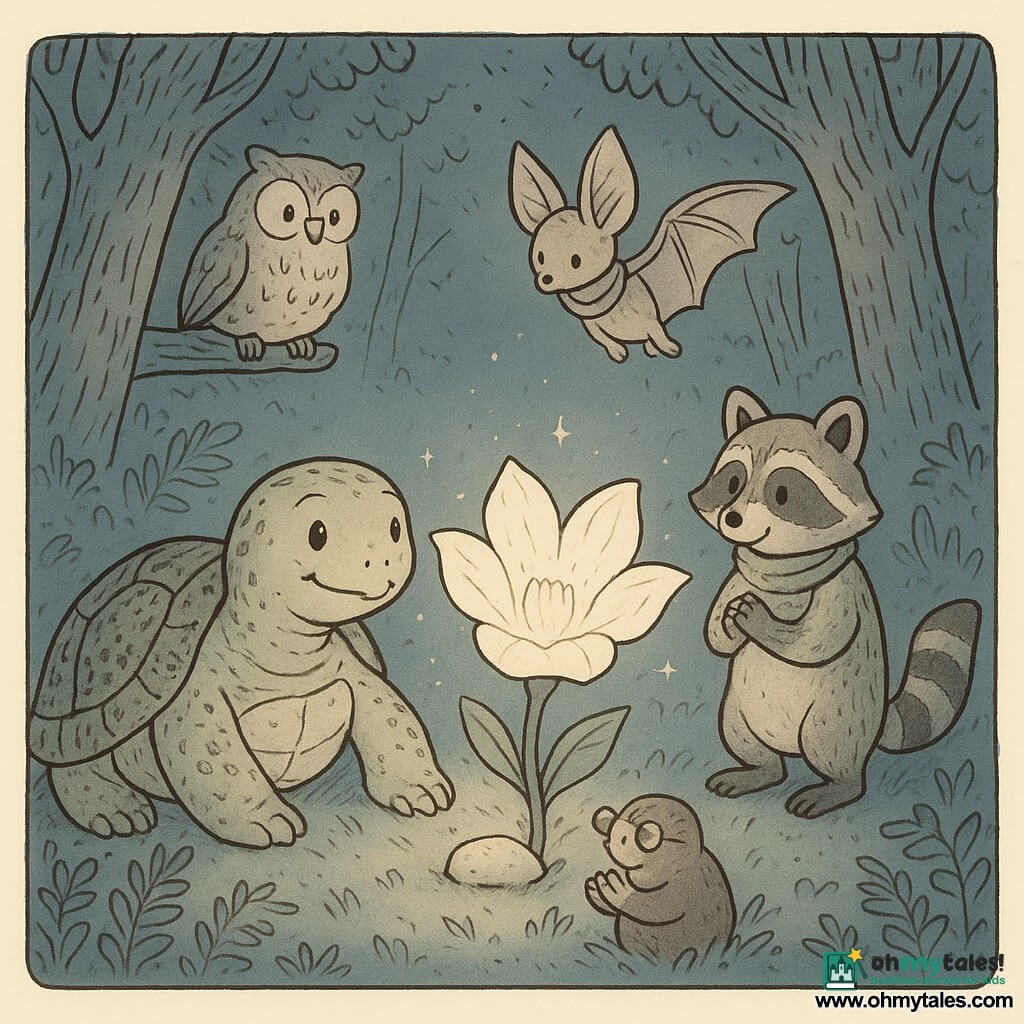
In the center stood a single bud, closed tight as a fist.
“The Moon-Flower,” whispered Tilda.
Brill circled it. “Why won't it open?”
A cough came from a nearby stump. An old owl sat there, feathers like worn velvet. He looked stern, but his eyes were kind.
“It will not open,” said the owl, “because the clearing has forgotten how to be welcoming.”
Tilda stepped closer. “What do you mean?”
The owl tapped the stump with his claw. “Some animals come here and say, ‘This place is mine.' Some say, ‘Only certain creatures belong.' They argue and grumble. The clearing grew tired. So it closed its bright heart.”
Brill lowered her head. “Is it because I am a bat?”
The owl blinked slowly. “It is because too many have been unkind to those who are different. The Moon-Flower listens. It is a symbol, you see. It opens when the night feels safe for all.”
Tilda's throat felt tight. Her dream was right there, like a cookie behind glass, and yet she could not reach it.
Then she remembered the Lantern Tree message.
Help what is closed.
Tilda placed the Glow-Stone on the ground beside the bud. Its gentle light pooled like milk.
She spoke to the clearing as she had spoken to the bridge. “Dear place,” she said, “we are sorry you have heard harsh words. We did not come to claim you. We came to admire you. We came to share your quiet beauty.”
Brill fluttered down and folded her wings neatly. “And I am Brill,” she said, voice small but steady. “Some think I am scary. I am not. I am just night-shaped.”
The owl nodded. “Go on.”
Tilda turned to the trees and the grass, to the moon itself. “Let there be room,” she said, “for paws and hooves, for wings and shells. Let there be room for those who crawl and those who fly. Let there be room for the slow and the swift.”
Brill added, with a tiny grin, “Even for owls who argue.”
The owl snorted. “Hmph. Fair enough.”
A breeze stirred. It smelled like new leaves.
From the edge of the clearing, Pip the raccoon appeared, peeking. “I followed,” he admitted. “I wanted to see if you were truly kind.”
Mo the mole popped up too, his glasses clean now. “I came to say thank you again,” he whispered.
More animals arrived: a shy skunk, a nervous mouse, a proud deer, a curious frog. They stood together, close but not crowded.
Tilda looked at them all. “We can all watch,” she said, “quietly and kindly. No pushing. No shouting. The Moon-Flower is not a prize. It is a gift.”
The animals nodded.
Even the air seemed to nod.
Part Four: The Moon-Flower Opens, and the Valley Blooms
The moon climbed to the very middle of the sky, round as a white drum.
The bud trembled.
A soft sound came—like a sigh, like a lullaby turning its page.
And then, slowly, the Moon-Flower opened.
Its petals unfurled like pale satin ribbons. They caught the moonlight and turned it into something even gentler, as if the moon had learned to smile. The center glowed with a calm silver fire, not hot, only warm to the eyes.
All the animals gasped at once, a small chorus of wonder.
Brill's voice shook. “Tilda… it's real.”
Tilda's eyes filled with happy tears that did not fall, but shone. “It is,” she whispered. “And it is even kinder than my dream.”
The owl spoke, quietly. “See? When the clearing feels safe, it gives its beauty freely.”
Pip stepped forward, then stopped himself. “May I come closer?” he asked politely, suddenly not a guard at all, just a friend.
“Yes,” said Tilda, “but gently.”
Mo sniffed. “It smells like moonlight and soup,” he said.
Brill giggled. “Everything good smells a little like soup.”
The Moon-Flower's light spilled over the dull grass. The grass drank it like thirsty green tongues. One blade shimmered, then another, until the whole clearing glittered silver again.
Then something more magical happened.
Tiny buds, hidden in the soil, began to wake. They popped up like little thoughts. Bluebells, daisies, and golden buttercups opened their faces. Vines lifted themselves and found the old tree trunks. Ferns uncurlled like sleepy fists turning into waving hands.
The clearing, once tired, became bright and blooming, as if spring had been tucked under the moon's cloak all along.
Tilda felt as if her heart were blooming too.
Brill nudged her. “You did it. You found your dream.”
“We did it,” said Tilda.
The owl cleared his throat. “Your dream was simple, turtle. Yet you reached it by a wise road.”
Tilda asked, “What road is that?”
The owl looked around at the gathered animals—so many shapes, so many ways of being. “The road of kindness,” he said. “The road of patience. The road of making room.”
Pip raised a paw. “I have a question.”
“Yes, Pip?” said Tilda.
Pip said, “If the Moon-Flower opens when we are welcoming… then we should be welcoming all the time, shouldn't we?”
Brill smiled. “That is a very bright thought for a raccoon in a rainbow scarf.”
Pip beamed. “Thank you. I try.”
Mo asked, “What if someone is scared of someone different?”
Tilda answered softly, “Then we speak gently. We learn. We listen. Fear is a shadow, and shadows shrink when you bring a lamp.”
Brill tapped the Glow-Stone with one claw. “Like this little lamp.”
The animals stayed a long time, watching the Moon-Flower glow. They told quiet jokes. They shared small stories. The skunk even offered a mint leaf, saying, “I know I smell strong, but my heart is sweet.” Everyone laughed kindly, not meanly.
At last the moon began to drift toward the treetops. The Moon-Flower, having shared its light, slowly closed again, like a book that had been read with care.
No one felt sad. They felt full.
Tilda and Brill started home. Pip walked with them to the bridge, chattering happily. Mo waved from a soft mound of earth. The owl watched from his stump, pleased as a teacher when a lesson is learned.
On the bridge, Brill said, “Tilda, you were brave.”
Tilda shook her head. “I was afraid I would not see it.”
“And you still helped Mo,” Brill said. “That is brave.”
Tilda thought about it. “Maybe courage is not loud,” she said. “Maybe courage is a quiet voice that says, ‘Do the kind thing anyway.'”
Brill hummed. “I like that.”
When they reached the valley, dawn was painting the sky with peach and gold. The dew on the grass looked like tiny pearls scattered by a careless queen.
Tilda noticed something wonderful. Along the brook and near the bridge, new sprouts were pushing up. Little flowers nodded in the morning breeze.
Brill gasped. “Look! The Moon-Flower's light followed us!”
Or perhaps, thought Tilda, kindness followed us.
In the days that came, the valley grew more blooming than anyone remembered. Bees danced. Butterflies wrote colorful letters in the air. Even the old bridge seemed less wobbly, as if it stood straighter when it knew it was spoken to with respect.
And the animals changed too.
When Brill flew overhead, no one shouted “Eek!” They waved and said, “Good evening, Brill!” When Tilda crossed the path, no one hurried her. They walked beside her, matching her pace, and discovered they could notice more: a ladybug's tiny shoes, a snail's shining trail, the secret smell of mint under a stone.
Sometimes, on clear nights, Tilda and Brill returned to the clearing. Not to take, not to claim, but to sit together under the moon, as friends.
And every time the Moon-Flower opened, the grass glittered, the flowers lifted their heads, and the world seemed to whisper a gentle truth:
There is room for everyone in a kind heart, and when we welcome what is different, the whole garden grows.