Part One: Clover and the Whispering Pond
Clover was a young horse with a coat the color of warm toast and a mane like a soft, black ribbon. He lived in a meadow where daisies winked and the wind sang lullabies.
But Clover had a secret: he was fearful.
Not of big, roaring things—oh no. He was afraid of little questions.
“What if I say the wrong thing?” he worried. “What if I don't understand?”
When the geese honked above, Clover wondered, “Are they laughing at me?”
When the rabbits thumped their feet, he thought, “Is that a warning for me?”
So Clover stayed close to the old oak tree, whose branches were like gentle arms.
One evening, the sky turned pink as a peach, and a silver path of moonlight slipped into the meadow. From far away, Clover heard a sound—soft and splashy, like a secret being told.
He followed it, step by careful step, until he reached the Whispering Pond.
At the pond's edge sat a frog on a lily pad, puffing his cheeks like a tiny green balloon.
“Good evening,” Clover said, voice small as a crumb.
The frog blinked. “Good evening, tall toast-horse!”
Clover flinched. “Toast-horse?”
“It's a compliment,” the frog said. “You look cozy.”
Clover tried to smile, but his thoughts tangled like vines. “Frog… how do you know what other animals mean? When they honk or thump or chirp?”
The frog chuckled. “Oh, I don't. I just ask! Words are like stepping-stones. You hop from one to the next.”
Clover's ears drooped. “Asking feels like jumping into deep water.”
“Then perhaps,” said the frog, pointing with a webby finger, “you should meet someone who knows deep water well.”
In the pond, moonlight shimmered and swirled, and for a moment it looked like the pond was opening an eye.
The frog whispered, “A sea turtle visits the shore beyond the reeds. If you want to understand others, maybe begin with one who travels far and listens long.”
Clover swallowed. The shore beyond the reeds sounded… unknown.
Unknown was a shadowy cave in his mind.
Still, a tiny spark flickered in his chest, like a firefly deciding to be brave.
“All right,” Clover said. “I will try.”
Part Two: The Sea Turtle with Starry Eyes
The next morning, Clover tiptoed through the reeds. They brushed his sides like whispering feathers. Beyond them lay a sandy path leading to the sea.
Clover had never seen the ocean.
It was huge—like the sky had fallen down and decided to wave.
The waves hissed and sighed, and Clover's knees wobbled. “Hello, big water,” he murmured, as if greeting a giant.
A voice answered, slow and friendly. “Hello, small horse.”
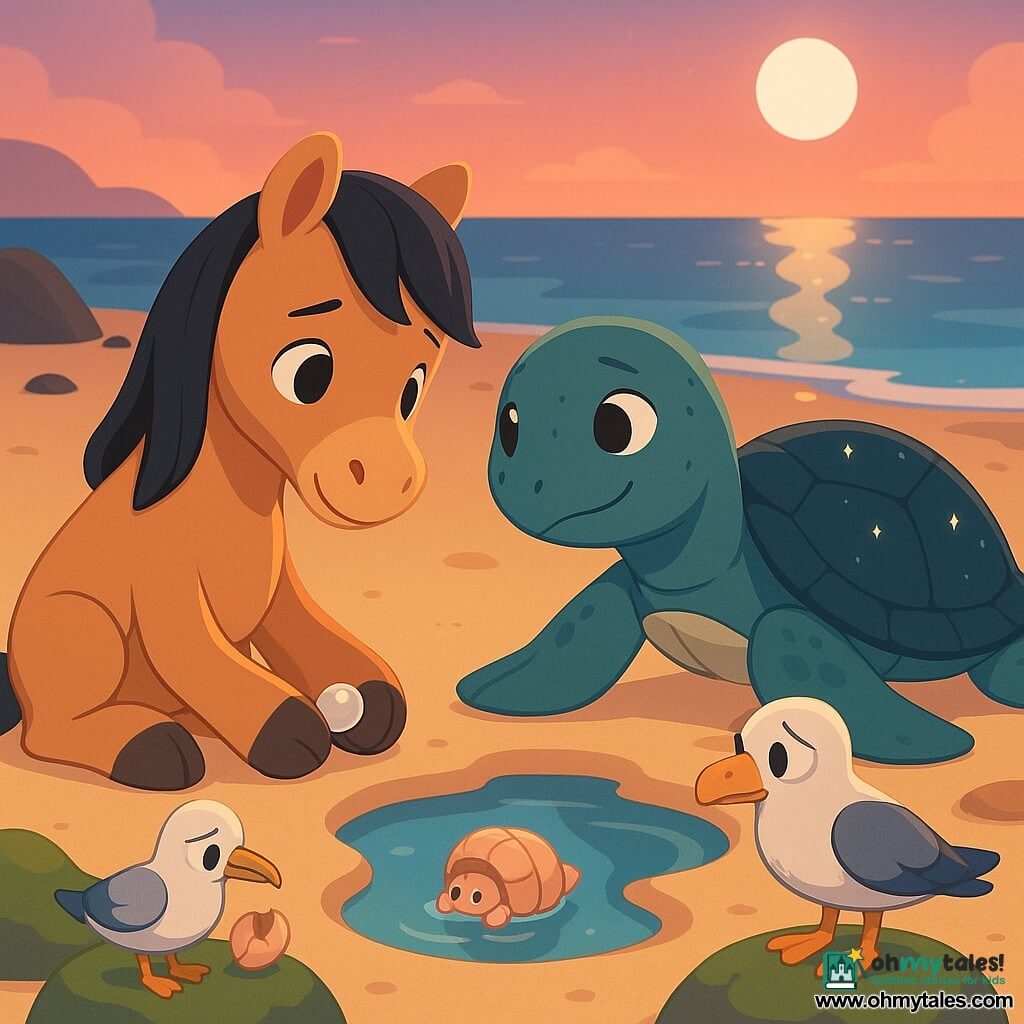
Clover turned and saw her: a sea turtle resting near a tide pool. Her shell was dark and round, and it shone as if it carried bits of night sky. Her eyes were kind, like two patient stars.
“I am Marina,” she said. “And you look like someone carrying a heavy thought.”
“I'm Clover,” he replied. “I… I want to understand others. But I'm scared I'll get it wrong.”
Marina nodded, as if his fear were a normal little bird perched on his shoulder. “Understanding is not a race. It is a voyage.”
“A voyage?” Clover repeated, staring at her flippers.
“Yes,” said Marina. “Sometimes you meet sharp words like rocks. Sometimes you meet silence like deep water. But you can still travel with a gentle heart.”
Clover watched a crab shuffle sideways. “Do you understand everyone?”
Marina smiled. “No. But I practice. I listen. I ask. And when I make mistakes, I mend them.”
Just then, a gull swooped down, snatched a shiny shell from the tide pool, and squawked, “Mine!”
Clover jumped back. “That gull is rude!”
Marina did not snap or shout. She only called, calm as a steady drum, “Little flyer, that shell is not yours. It belongs to the sea, and the sea shares with care.”
The gull circled, stubborn as a knot. “I needed it!”
Clover felt anger rise like a hot bubble. “Give it back!”
The gull startled, dropped the shell, and flapped away.
Clover puffed proudly. Then he saw Marina's face—still kind, but thoughtful.
“You were brave,” Marina said. “But tell me, Clover: do you think the gull felt safe enough to learn?”
Clover's pride wilted. “I… I don't know.”
Marina pointed to the tide pool. “Look.”
In the water, the dropped shell had cracked a little. Inside was a tiny hermit crab, shaking.
Clover's stomach flipped. “Oh no! I scared everyone. I tried to help, but I hurt.”
Marina's voice was soft as sea-foam. “Courage without kindness can bump like a clumsy wave. But kindness can steer courage, like a lighthouse.”
Clover lowered his head. “I want to fix it.”
“Then begin,” Marina said, “with three simple treasures: a sorry, a listening ear, and a forgiving heart.”
Part Three: The Pearl of Forgiveness
The next day, Clover returned to the shore. He found the gull perched on a rock, looking smaller than before, feathers ruffled.
Clover's hooves felt heavy, but he stepped forward anyway.
“Gull,” he said, “I'm sorry I shouted. I was scared and angry. I wanted to help, but my voice pushed like a storm.”
The gull blinked. “I… I was hungry,” the gull muttered. “My little sister can't fly yet. I wanted something shiny to trade for fish.”
Clover's ears lifted. “Oh. I didn't know.”
“That's the trouble,” the gull sighed. “Everyone thinks I'm just rude.”
Marina swam close, her shell glinting. “When we do not understand, we invent stories. Sometimes they are unkind stories.”
Clover nodded. “Can you forgive me?”
The gull hesitated, then said, “Can you forgive me too?”
“Yes,” Clover replied, and the word felt warm, like a blanket.
Together, they visited the tide pool. The tiny hermit crab was still trembling.
Clover spoke gently. “Little one, I'm sorry. Will you forgive us?”
The hermit crab peeked out. “If you promise to be careful.”
“We promise,” said Clover. “Careful as a lullaby.”
Marina dipped her head into the water and nudged a smooth, pale pebble toward Clover. “A gift from the sea,” she said.
Clover stared. The pebble opened—no, it wasn't a pebble at all. It was a pearl, bright as a drop of moon.
Clover gasped. “A pearl!”
Marina's eyes twinkled. “A pearl is made when something scratchy is forgiven by time and patience. The oyster does not fight the grain of sand forever. It covers it with kindness, layer by layer, until it becomes treasure.”
Clover held the pearl close, feeling its cool shine. In it, he saw a happy revelation: his fear was not a wall. It was a door.
He could open it with questions. He could walk through with listening. And when he stumbled, he could mend with forgiveness.
The gull laughed. “Toast-horse, you look less toast and more sunrise!”
Clover laughed too, the sound light as hoofbeats on soft grass. “Maybe,” he said, “understanding is not about never being wrong. It's about being willing to learn—and to forgive.”
That night, Clover returned to the meadow. The geese honked overhead, and he did not flinch.
He simply called, “Good evening! What are you talking about?”
And the meadow, the pond, and even the wide, waving sea seemed to whisper back, “Welcome, brave listener. Welcome.”