Chapter One: The Footprints in the Frost
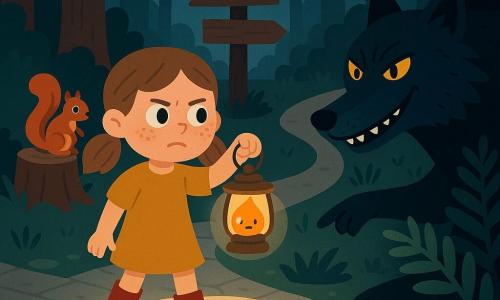
The forest woke like a secret. Frost lay on the fir needles like tiny moons, and the river moved under a silver skin. Eight-year-old Elin slipped from her cottage door with a scarf wound twice around her neck. She carried a small lantern and a notebook with pages that smelled of pine.
"Be careful, little root," her mother called, smiling from the doorstep. "Listen for the wind."
"I'm careful," Elin answered. She was always careful, like someone who keeps a pocket for warm thoughts. She stepped softly between the trees. The path hummed with quiet sounds: the tink of icicles, the slow sigh of an old oak.
Then she saw them—prints in the frost, wide and dark, leading away from Ms. Alder's henhouse and toward the deeper wood. They had a shape like a moon with claws. A hush fell over Elin's chest. The animals in the village had stopped sleeping well. Hens were found near their pens, trembling, and small prints were scattered like questions.
"I will find who made these," Elin whispered. Her voice was a thread, light and steady. "But I will not scare the animals."
She knelt and traced the largest print with her finger, careful not to smudge the frost. "These are like big boots," she told the trees. "But who walks with such boots?"
A red squirrel peered from a branch. "Don't go too far," it chittered.
"I won't frighten anyone," Elin promised. "I'll only ask the forest." She closed her hand around her lantern. The light was a warm coin that kept the dark from feeling hungry.
As she followed the prints, a hush of curiosity walked behind her. Birds watched from high places like notes on a page. Each print led deeper, and each step made a tiny ringing sound in the air, like a bell asking for an answer.
Chapter Two: Questions Under the Pines
The prints took Elin to the place where the trees grew close, their roots tangled like old friends. The air smelled of earth and stories. She sat on a mossy stone and opened her notebook.
"If I were a creature who liked houses without curtains, what would I be?" she asked aloud. The wind answered by shaking a curtain of leaves, and the sound was like a whisper of cloth.
"Maybe the one who prefers to see," said a robin, hopping near. "Or maybe the one who likes to be seen."
Elin smiled. "But seeing isn't always bad," she said. "Sometimes we look to learn."
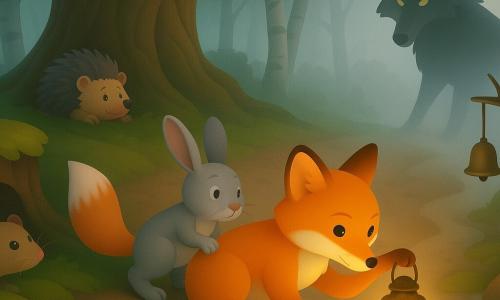
A fox came padding, its tail a brushstroke of rust. "You ask gentle questions," the fox said. "The forest is used to loud feet, but not to gentle faces like yours."
Elin looked up. "Have you seen the footprints?" she asked.
"I have seen many things," said the fox, "but when I saw those prints, I saw a shadow moving like a sad moon. It didn't run. It walked and looked at houses with open windows. It sniffed at curtains and then went on."
"Why curtains?" Elin asked. Her heart felt like a glass bell. "Why would it choose houses without curtains?"
"Because curtains have care stitched into them," the fox answered. "They hide things people wish to keep private. The one who walks with big boots likes to find what is plainly shown. It prefers windows like open eyes."
Elin wrote this down. Her pencil scratched softly. "It sounds lonely," she said.
"Lonely things often leave large prints to be noticed," the fox said. "They want someone to follow them."
"I will follow," Elin said. "Not with anger, but with questions. I will not frighten the hens or the rabbits. I will ask the shadow why it walks." She stood, feeling like a small lamp among great trunks.
"Be brave," said the robin. "Bravery is quiet sometimes."
"Be kind," said the fox. "Kindness is a lantern that does not burn those it helps."
Elin nodded. She tucked the notebook into her pocket and walked on. The prints led to a clearing where a circle of stones waited like witnesses. The moon gilded their edges. There, in the soft grass, she found a scrap of grey fur and a button, dull as a forgotten coin.
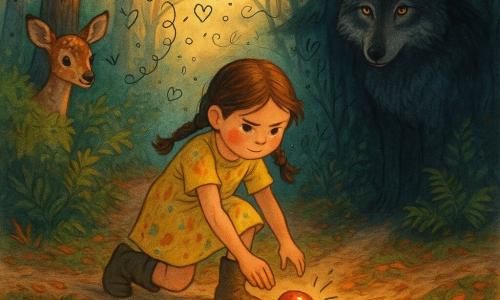
"Someone left a hint," she murmured. She picked up the fur and the button. The button had a pattern like a tiny sun. Elin smiled, because even in the Winterwood little suns were hidden.
Chapter Three: The House Without Curtains
As twilight leaned low, Elin reached the row of cottages at the edge of the forest. Smoke curled from chimneys like writing in the air. Each house had curtains of a different color—some floral, some striped, some plain. But one house near the bend of the lane had no curtains at all. Its windows were bare and wide, and the light within seemed to breathe.
Elin's heart thumped a steady drum. The prints led right to that house. She wrapped her scarf tighter and stepped close. Inside, she could see a single chair, a table, and a shelf of books that looked like a forest of paper. On the hearth there was a kettle singing soft, and no curtains fluttered there.
"Who lives here?" she asked, gently knocking. "May I speak?"
From inside came a voice like leaves turning. "Who asks?" it said.
"It's me, Elin," she said. "I followed prints. I did not want to frighten the animals. I only wished to know."
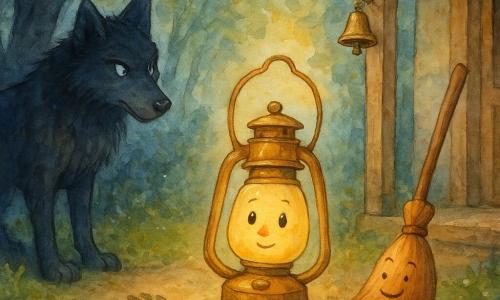
The door opened a little, and a long snout with kind, tired eyes peered out. It was a wolf, but not the kind of wolf that howls under bright moonlight. This wolf's fur was the color of storm clouds. His eyes held an old village's worth of winters.
"You should not come so close," the wolf said. He sounded grave, as if he carried his troubles in a small sack. "People might call me something cruel."
"I won't call you cruel," Elin said. "Only curious. Why do you come to houses without curtains?"
The wolf stepped out fully. He walked with the heavy grace of someone who knows the map of his paws. "I like them because they show me," he answered. "I do not wish to be hidden. I do not mean to frighten. I mean only to be seen."
"But you leave big prints," Elin said. "They scare the hens and frighten little ones."
"I know," the wolf said. "When I am seen, I am noticed for what I am. But when I am seen, I am also shooed, and so I walk in the places that make me feel brave."
Elin listened. The cold air made tiny stars on her breath. "Are you lonely?" she asked softly.
The wolf lowered his head. "Sometimes," he admitted. "Loneliness comes over me like fog. I wander and look for houses where I might be looked at and not chased away. I like the houses without curtains because then I am part of the light."
Elin thought of the button and the grey fur. "You left a button," she said. "Did you lose it?"
The wolf's ears tipped. "Ah," he said. "That was from a coat I once found by the river. I thought to keep a scrap for warmth, and I forgot. The button meant to be seen, too."
Elin's eyes were steady. "If you want to be seen and not chased, maybe you can ask for company instead of looking for empty windows."
The wolf blinked. "How does one ask for company?"
"With words," she said. "With small, kind things. With patience. You could knock and say, 'Hello. I am lonely.' You could leave a small gift, not to take, but to give."
The wolf looked like he'd swallowed a small sun. "I don't know how to be gentle without making people afraid."
"Try being honest with a soft voice," Elin suggested. "And show that you will not take what is not given. If you are kind, people can learn to see you differently."
They spoke a long while in the glow of the auburn lamp. The wolf told stories of moonlit rivers and nights when the stars were so low he could touch them with his muzzle. Elin told stories of her village and the cakes her grandmother baked. Laughter sounded and drifted into the trees like dandelion seeds.
"Will you come with me tomorrow?" the wolf asked at last. "To the henhouse?"
"No," Elin said firmly, but her voice was gentle. "Not to frighten them. But I will help you learn how to ask. We can try to make small things that show you are friendly."
"I will try," promised the wolf.
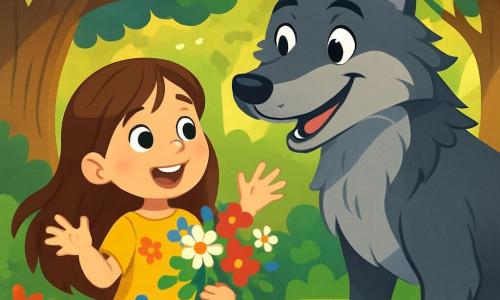
They made a plan. The wolf would bring wildflowers and small pebbles polished like moons. Elin would teach him to leave them on doorsteps, not to take anything that wasn't offered. The wolf would practice soft steps and softer words.
"Persevere," Elin told him. "Kindness takes many tries."
The wolf placed his paw over his chest like a promise. "I will persevere."
Chapter Four: The Lantern and the Lesson
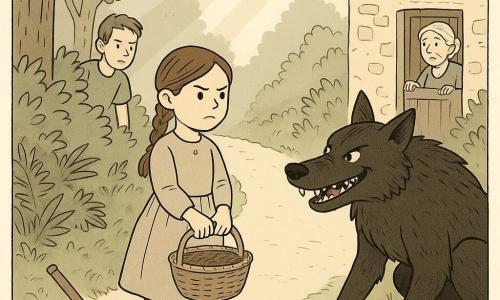
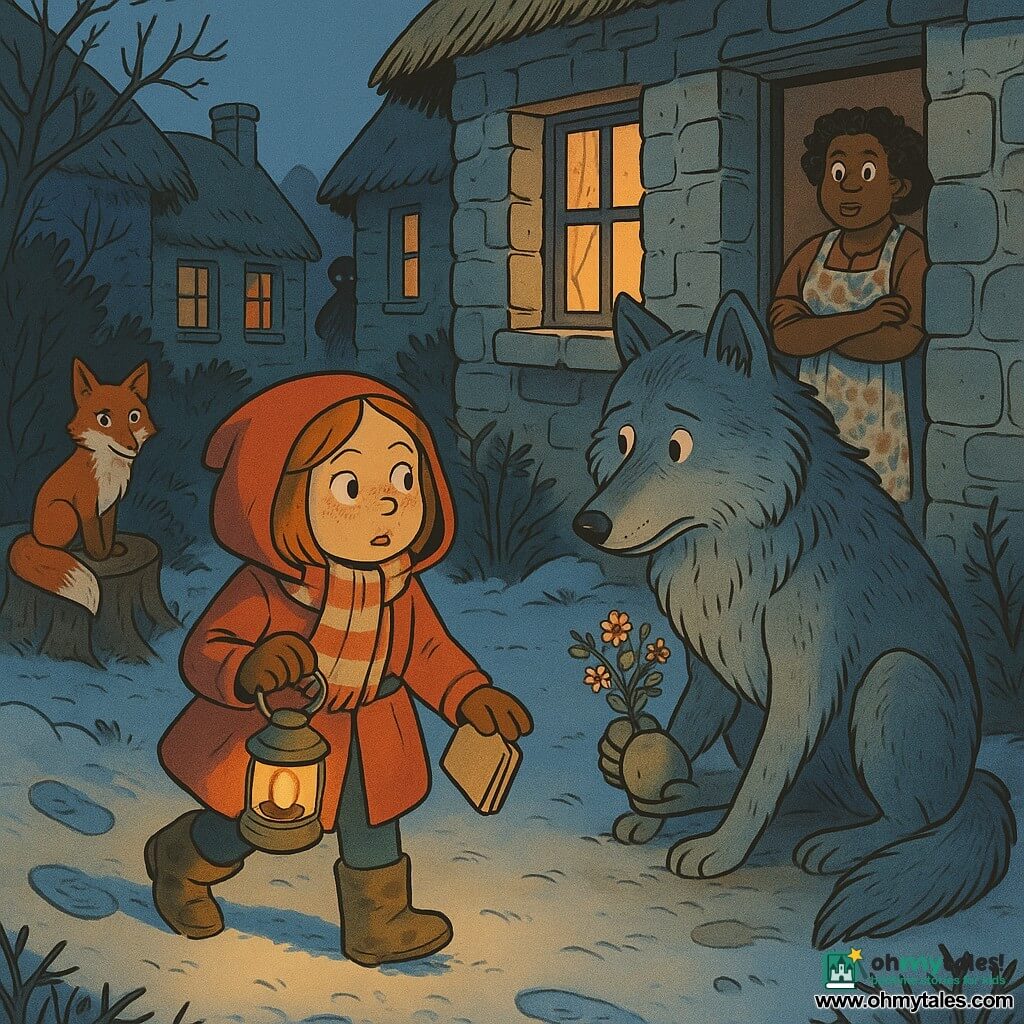
The next morning, Elin walked with the wolf at a careful distance. The henhouse stood quiet. Ms. Alder frowned when she saw them, for the sight of a wolf can pinch the heart. But Elin held her lantern high.
"Please," Elin said to Ms. Alder, "the wolf wishes to show he means no harm. He will leave this small stone and a few flowers, and then he will go. He will not touch your hens."
Ms. Alder peered and saw the carefulness in Elin's face. Her hands were tired but brave. "I will watch," she said.
The wolf stepped forward, clutching a pebble in his mouth like treasure. He moved as if every step was a promise. When he left the pebble and a sprig of bluebell at the door, his tail did not thump like thunder. He sat down and bowed his head.
"Hello," he said in a voice as soft as warm mud. "I am sorry for the fright my steps have caused. I only wanted to be seen. I will not take what is not given."
The hens clucked and bobbed. Ms. Alder opened the door a hair. The hens pewed and pecked at the pebble, more curious than afraid. The dwarf of the village, a small boy, came out and giggled.
"That wolf left flowers!" he cried. "He is polite."
Gradually, the neighbors saw the wolf's attempts. He left kind things on porches: smooth stones, a pinecone polished to a shine, a ribbon wrapped around a stick. The animals watched, and the villagers began to notice the pattern. The wolf did not come to their houses to find food; he came to leave small gifts and gentle words.
One night, when frost painted the roofs silver, Elin found more prints in the yard. They were the same wide prints, but this time there were tiny paw-prints weaving around them, as if someone small had walked beside the big feet.
"Who has walked with you?" Elin asked.
"A hedgehog," said the wolf. "He saw me at the river and followed. He likes the sound of my stories."
"See?" Elin said, smiling. "Company comes when you show you mean no harm."
Days grew like slow bread, warm and rising. The wolf's courage changed. Sometimes missteps happened—the wolf would forget and rustle a curtain—but Elin would be there with a calm laugh and a hand to guide him back.
"Try again," she said once when his head hung low after a mistake. "Perseverance is a brave friend. It stays after the first try."
He tried again and again. The villagers began to leave a window cracked open, a small cup of water on a doorstep. Curtains were drawn more carefully now—some closed, some open a little—like people deciding how much to share.
One evening, Ms. Alder invited the wolf to sit on the edge of her yard while she told him a story about a chicken that wanted to fly. The wolf listened like a moon listening to tides. The people saw he did not lunge for food or hide in bushes. He only sat, heavy as an old promise, and his eyes were patient.
"Thank you," the wolf said after the story, his voice small with wonder. "For listening."
Elin's lantern swung in the wind. "You listened, too," she said. "You helped them see you."
Winter thinned and the first crocus pushed up like a brave finger. The prints in the frost were still sometimes found, but now the prints were often met by small, careful steps. Children would follow at a safe distance, calling, "Hello! Mister Wolf!"
Once, a little girl left a drawstring pouch with seeds at a doorstep. The wolf pressed his nose to it and looked at Elin. "I do not know how to plant," he said.
"Then ask," Elin said. "Ask a gardener. Ask a friend."
He did. He asked a gardener named Tomas, who showed him how to poke small holes and press the seed like a secret into the soil. The wolf watched the tiny green neck of a sprout and felt as proud as if he'd carried the sun.
On a night when the moon was a sliver, the prints led Elin back to the clearing where she had first found the grey fur. There, the wolf stood waiting with a ribbon tied around his neck and a button sewn to his fur where once a scrap had been.
"You have sewn a kind of coat," Elin said, smiling.
"I needed to show I could change," the wolf said. "Your words were stitches."
Elin's heart danced. She had started as a small lantern seeking a truth, and now she stood by a creature who had learned to knock and leave gifts. "Perseverance," she said, "and small, gentle steps."
The wolf bowed. "And kindness," he added. "Kindness like a bridge between two islands."
Elin took his large paw in her small hand. "Promise me something."
"Anything."
"That you will not choose only houses without curtains," she said. "Choose houses with curtains, too. People need time to open up."
"I will," he promised.
They walked back toward the village together. The prints in the snow were not always perfect. Sometimes the wolf slipped and left a muddied mark, and sometimes a child's small shoe joined the line like a comet tail. It did not matter. Each step was an effort, and each effort changed the story.
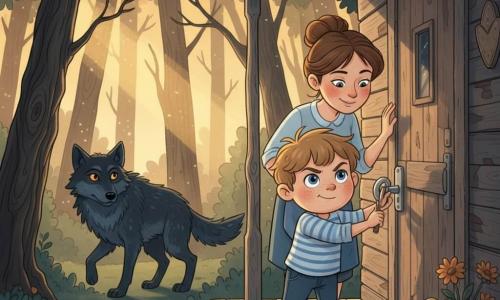
When Elin returned home, her mother hugged her like a warm loaf. "Did you find who made the prints?" she asked.
"I did," Elin said, and in her voice were the hush and glow of a candle. "He is not cruel. He was lonely. But with patience, he learned to be kind."
Her mother kissed her forehead. "You always knew how to listen."
Elin looked out the window at the row of cottages. One house had its curtains open a little, and in its windowsill the wolf's pebble sat like a small moon. The village did not forget how to be cautious, but it learned also how to be brave in tiny ways.
At night, as Elin drifted toward sleep, she pictured prints that led not to fear but to friendships. The wolf slept in the barn sometimes, and the hens pecked near the door like they were learning a new tune. The forest held its breath and let out a soft, satisfied sigh.
The moral was simple and quiet: courage can be gentle, and perseverance can mend what loneliness frayed. If you ask with a gentle voice and offer small, honest gifts, even a shadow that once walked in big boots can learn to walk softly beside you.