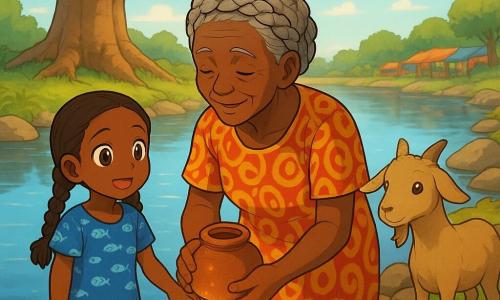
In the warm land where red earth smiles under bright sun, there was a village beside a wide, slow river. The river was a long, shining ribbon. It sang “shhh, shhh” to the reeds. It carried малень boats like toys. It carried stories, too.
In that village lived Kofi, a grown man with kind eyes and a laugh like soft drums. He was strong, but he moved gently, the way you hold a sleeping baby. Kofi listened to the elders. He loved their words, because their words were seeds.
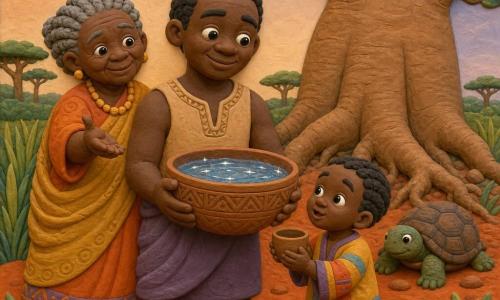
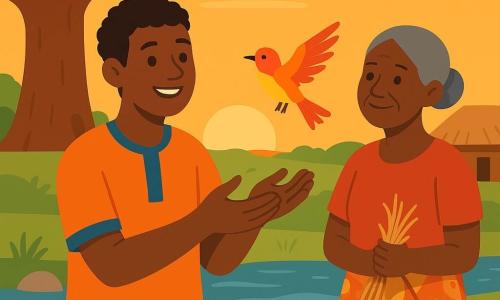
One evening, when the sky turned orange like ripe mango, Old Mama Adwoa sat under the baobab tree. The baobab was a big, old giant. Its trunk was a storehouse of time.
Mama Adwoa said, “Kofi, do you know the legend of the Talking Calabash?”
Kofi leaned closer. “Tell me.”
She tapped her cane on the ground—tap, tap—like a small beat. “Long ago, a calabash bowl was given a voice. Not to chatter. Not to boast. It spoke only when someone showed respect. It spoke to guide the heart. Some say it still waits near the golden stones by the river bend.”
Kofi's eyes shone. “Is it true?”
Mama Adwoa smiled. “A legend is like smoke. You must follow it gently, or it slips away. If you go, go with good manners. Greet the river. Greet the trees. And when you meet an elder on the path, greet them twice.”
“I will,” Kofi promised. “I will go at sunrise. I will check if the legend is true.”
At sunrise, the village woke like a sleepy bird stretching its wings. Kofi took a small bag of roasted groundnuts and a gourd of water. He wore his best cloth, bright as a sunrise of its own. Before he left, he bowed to Mama Adwoa.
“Thank you for your story,” he said.
“Go well,” she said. “And remember: respect is a key. Respect opens doors you cannot see.”
Kofi walked along the river path. The river whispered. The grass danced. A small lizard lifted its head as if to say hello. Kofi smiled and said, “Good morning, little one.”
Soon he met Elder Mensah, sitting on a low stool, carving a wooden spoon. The spoon looked like a tiny canoe.
Kofi stopped. He bent a little. “Good morning, Grandfather.”
Elder Mensah looked up. “Good morning, Kofi.”
Kofi remembered. He greeted twice. “Good morning again, Grandfather.”
Elder Mensah's face opened like a flower. “Ah! Your greeting has two hands. Sit for a moment.”
Kofi sat. The air smelled of fresh wood and clean morning.
Elder Mensah said, “Where do your feet travel so early?”
“To the river bend,” Kofi said. “To look for the Talking Calabash.”
Elder Mensah chuckled softly. “Legends like to test our ears. Take this.” He handed Kofi the carved spoon. “It is small, but it stirs big pots. When you listen, listen like a spoon—quiet, steady, helpful.”
Kofi held the spoon carefully. “Thank you, Grandfather.”
He walked on. Step, step. The sun climbed higher. Birds called “tee-tee-tee,” as if counting his steps.
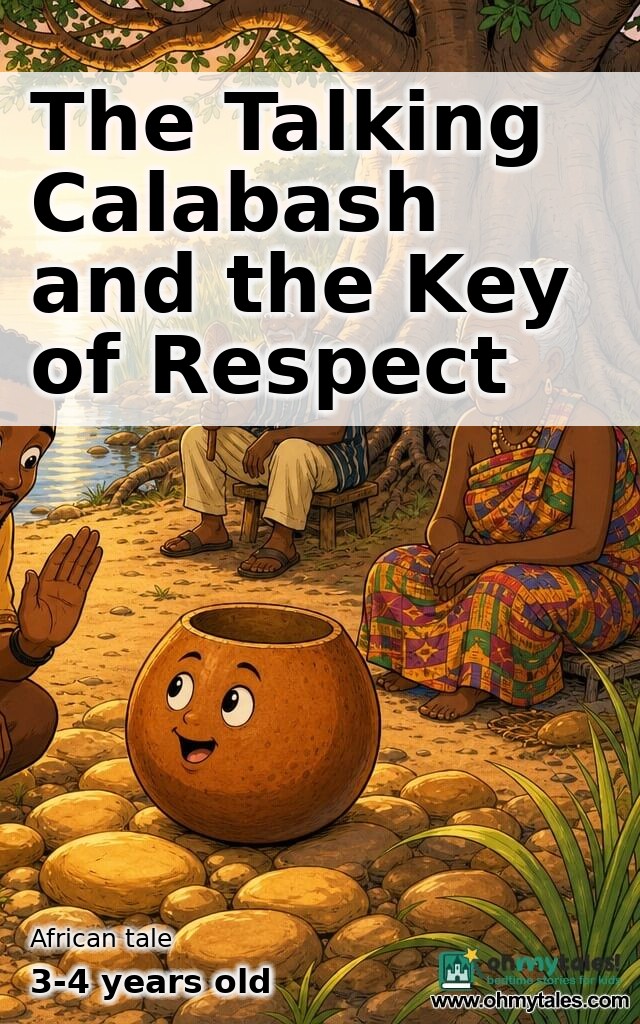
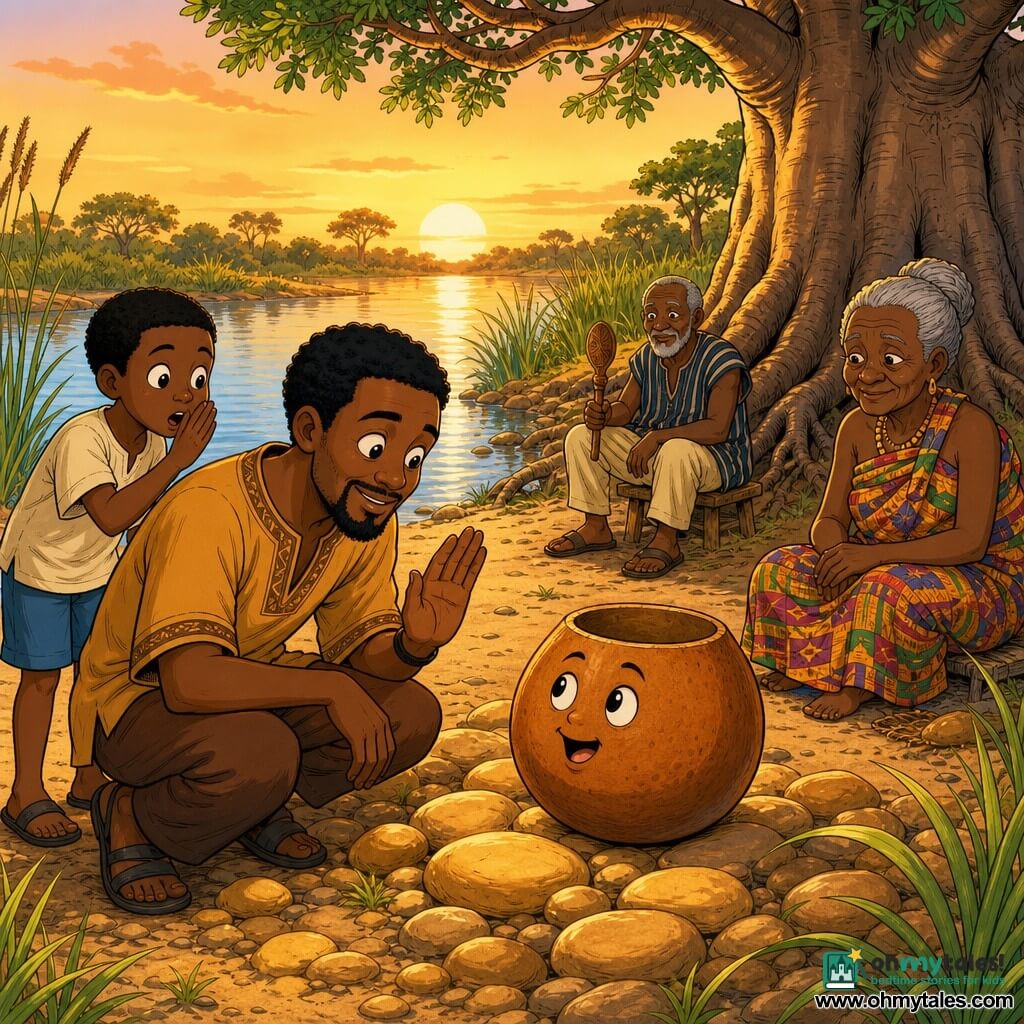
At last Kofi reached the river bend. There, the stones were not just stones. They were golden, warm, and round, like sleeping lions made of light. In the middle sat a calabash bowl, smooth and brown.
Kofi's heart went boom-boom, like a friendly drum. He did not grab it. He did not shout. He bowed.
“Good day, River,” he said. “Good day, Stones. Good day, Calabash.”
The wind brushed his cheek like a mother's hand. The calabash stayed quiet.
Kofi remembered Mama Adwoa's words. Respect is a key.
He set down his bag. He placed a few groundnuts on a leaf. “A small gift,” he said. “For the journey of my spirit.”
Still, the calabash was silent. Kofi did not feel afraid. He felt calm, like shade on a hot day. He sat and waited.
Then he heard footsteps behind him. It was a young boy from the village, racing like a goat. “Kofi! Kofi! Did it talk? Did it talk?”
Kofi put a finger to his lips. “Shhh. Legends do not like loud hands.”
The boy whispered, “Sorry.”
Kofi smiled. “Come. Greet first.”
Together they bowed. “Good day, River,” they said. “Good day, Stones. Good day, Calabash.”
And then—soft as the first drop of rain—the calabash spoke.
“Mm-mmm,” it hummed, like a low song. “A respectful mouth is sweeter than honey.”
The boy's eyes grew round. Kofi's smile grew wide, but he stayed gentle.
The calabash said, “Kofi, you greeted the old ones. You greeted twice. You listened before you asked. This is the true thing. Not my voice.”
Kofi nodded slowly. The words went into him like warm porridge.
The calabash added, “Take a lesson, not a prize. Leave me here for other hearts.”
Kofi bowed again. “Thank you,” he said. “I will carry the lesson.”
He did not take the calabash. He only took the small wooden spoon from Elder Mensah, and the soft new feeling in his chest.
On the way back, Kofi walked with the boy. They greeted everyone they met. Once. Twice. With smiles. With calm voices. The path seemed shorter. The sun seemed kinder.
When they reached the village, Mama Adwoa sat under the baobab, waiting like a patient story.
Kofi bowed. “Mama Adwoa,” he said, “the calabash spoke.”
Her eyes twinkled. “And what did it say?”
Kofi lifted the spoon. “It said respect is sweeter than honey. It said listening is a gift.”
Mama Adwoa nodded. “Yes. The elders' words are bridges. When you walk them with care, you do not fall.”
That night, the village felt like a big blanket. The river sang “shhh, shhh.” The baobab held the stars. And in Kofi's heart, the legend did not end. It became a warm rule for every day: greet with kindness, listen with patience, and honor the old ones—because respect makes even quiet things speak.