The Small Lantern and the Star Book
Lumen lived on the windowsill of a weathered clock tower. Tiny and round, with a brass handle like a smiling eyebrow, Lumen had a glass belly that glowed like a warm pebble. Each night it watched the town below and liked to mark small things: a cat's shadow, a drifting leaf, the way rain tapped Morse messages on the roof. Lumen was modest. It did not shout or sing. It simply kept gentle watch.
One morning a parcel arrived, balanced on the sill as if a breeze had decided to be helpful. Inside was a slim notebook wrapped in blue paper and a cheerful note stuck to the front: For the nights you feel lost. The notebook smelled faintly of stars and lemon. When Lumen opened it, pages were blank except for a sheet of golden star stickers tucked in the back.
Lumen pressed a sticker on the first page and drew a tiny dot of light beside it with the tip of its warm glow. The dot seemed to pulse, and for a second Lumen imagined the night stretching into a smile. The notebook felt like a promise. Lumen decided to call it the Star Book and promised—out loud, in case the promise might stick better if spoken—to collect stories of places where light could be kind.
That afternoon, an odd humming drifted past the tower. It sounded like a kettle trying to remember a song. Lumen peered down, curiosity bulging its glass belly. Far off, beyond the Elm Row and the silver river, something round and shiny was settling into the town square. It was not a carriage, nor a bird, nor a cloud. It was a small ship shaped like a music box ribbon.
Lumen felt a little flutter. The Star Book's first unfilled page blinked with expectant white. Perhaps this was a story.
The Music Kiosk and the Waiting Tune
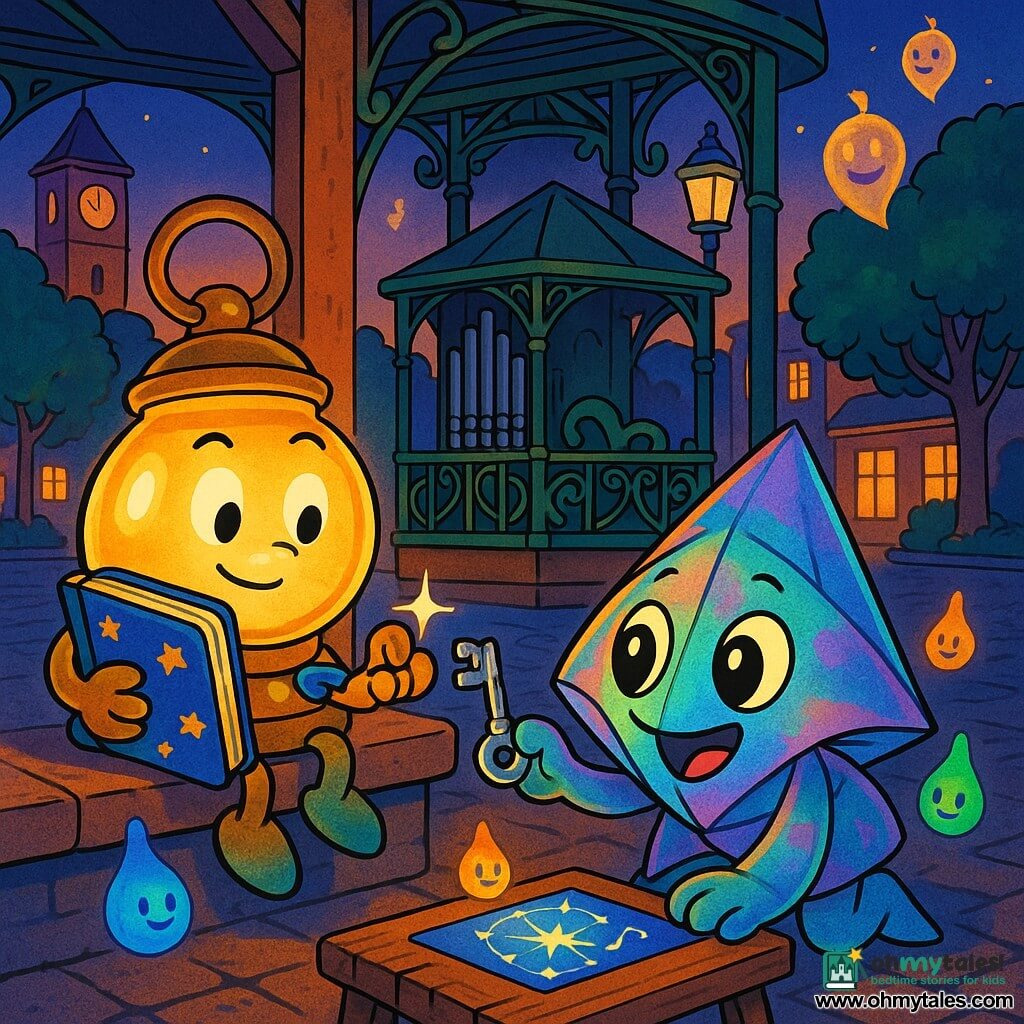
The town's music kiosk stood in the middle of the square, a painted gazebo with curled iron and a brass bell. Music always drifted from it during festivals, but today its pipes were silent. The ship had landed beside the kiosk, and from its open hatch spilled tiny notes like marbles of light.
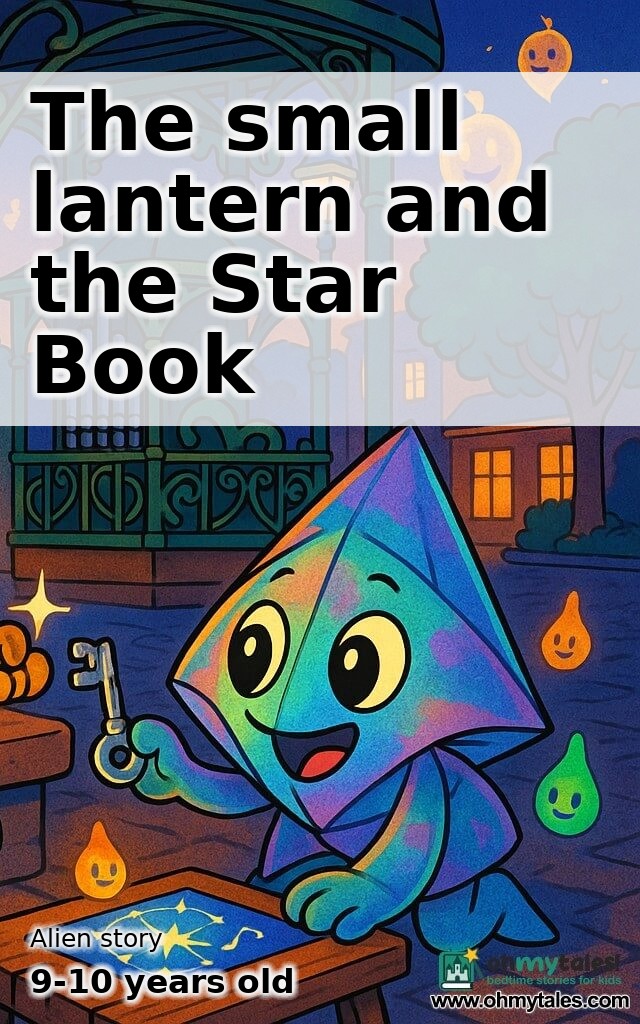
As Lumen approached, the ship's hatch opened wider and out hopped a creature as strange as a wish. It was shaped like a folded paper lantern with four thin legs and eyes like polished buttons that reflected everything twice. Its skin rippled colors like spilled oil and its voice clicked pleasantly, as if it spoke using handbells.
The creature was trying to wind up the kiosk. Its little legs tapped the crank, and the crank bumped against something stiff inside. The kiosk's pipes needed a tune, and the tune needed a key. The creature pulled from its pouch a small, gleaming object — a tuning key, but unlike anything Lumen had seen. It hummed with a softness that made the cobblestones feel friendly.
"Hello," Lumen said, surprising itself with how round the word sounded. The creature clicked once and tilted its head.
They worked together. Lumen's glow warmed the key; the creature's button-eyes shone instructions in quick, bright flashes. But each time they wound the crank the kettle-hum returned, like the kiosk knew a joke it had not finished. The pipes arched but stayed silent.
The creature looked sadly at the ship, then at Lumen. Its pouch rustled, and from it spilled a handful of tiny tools. None fit. Lumen flipped through the Star Book to the blank page with the lonely sticker. It pressed another star sticker into the corner and decided to keep trying. Persuasion, thought Lumen, can be like a small habit of kindness: nudge, nudge, until the lock rolls open.
So they tried again. And again. The sun slid toward the square's lamps. People did not appear to help; the town was quiet that hour. The creature hummed different tones, tapping the key like someone coaxing a shy tune. Lumen glowed brighter and slower, like a metronome of patience. On the fifth try, the kiosk coughed: a single note poured out, thin and puzzled, and then stilled.
They cheered in the small way of those who have no human voices—Lumen by flickering, the creature by ringing a bell in its chest. The kiosk had not been fixed, but it had agreed to argue a bit with music. The Star Book received a sticker and a careful sketch of the kiosk bell, made from the light that pooled on Lumen's glass.
The Night Visitors and the Puzzle of the Sky Map
That night the stars felt close enough to lean on. The ship stayed by the kiosk, its hatch soft-lit like a friendly eye. The creature, who introduced itself with a sequence of happy clicks and a name translated roughly as Nori, invited Lumen to explore the ship.
Inside, the ship smelled of metal and warm paper. It was filled with tiny compartments and a tall window showing the square upside down. On a table lay a map of the sky, not like a map of roads but a puzzle made of tiny tiles, each tile a different color and humming like a bee. Some tiles were missing.
Nori tapped the empty spaces with a finger that left trails of glow. "We came looking for a missing melody," Nori said. Lumen understood that melodies could sometimes live in tiles, like seeds waiting for sunlight. The ship had followed a whisper of music across the dark, tracking notes that had been scattered.
"We can look," Lumen offered. It turned the pages of the Star Book, which seemed to watch like a patient friend. They matched tiles to the memory of the kiosk's single note. One tile matched the hum of the crate—they placed it back. Another matched the tinkling of raindrops on the clock tower's face—another sticker.
Working together was a cozy business. Lumen would shine on a tile while Nori hummed. The tiles lit up when matched. Neighbors' windows blinked as if thinking. The missing pieces were not all in the ship. Some were scattered around town: a chime trapped in the old windmill, a bell rusted inside a gate, a lullaby stuck in a forgotten music box at the attic of the bakery (no humans, but the bakery oven kept warm tales of doughs and clocks). Each time they found a piece, Lumen pressed a star sticker into the Star Book and drew the memory.
But not everything came easy. The attic was high and hidden behind vines. The windmill's chime had been mistaken for a crow and tucked under a stone. The rusted bell needed gentle coaxing so as not to break. Sometimes the pieces required waiting for the right hour, sometimes patience in patience's teeth. Lumen learned to be steady like the moon and clever like a soft breeze. Its light did not panic; it blinked like a promise.
On the second night, after much searching and a small rescue of a piece from a puddle (Nori dangled a leg and Lumen shone like a lantern on a rope), they found the last tile beneath the kiosk bench. It sang a note that smelled like warm bread and the sea. When they placed it on the map, the entire board hummed and a soft melody spilled into the air—gentle and round like a pebble in a pond.
The Concert and the Gift of a Star
The kiosk woke properly at dusk the following evening. Lumen and Nori stood side by side, their reflections doubled in the brass. Nori wound the key with careful clicks; Lumen's glow slid along the pipes like a ribbon. As the music unrolled, it was as if the town remembered how to breathe. Notes threaded through windows, brushed against lampposts, and made the clock's hands swing a little more kindly.
On the ship's deck, other visitors that Nori had called hovered—beings of soft light, each humming a different color. They had faces like friendly question marks. They nodded at Lumen. The creature-button-eyes blinked with something like gratitude.
When the last note faded, the ship lowered a small parcel toward the kiosk. Inside was a tiny box engraved with a pattern of constellations: a token from Nori's people. Nori offered it to Lumen. The box contained a single sticker, not gold like the others, but a living one that shimmered with moonlight. It would stick only once and only to a heart that had learned to wait.
Lumen thought of every attempt, every time it did not give up. It felt the weight of the Star Book in its glass belly—a collection of small victories. It placed the living sticker on the book's cover, where the other stars had started the story. The sticker glowed, and the book hummed like it had been waiting.
Nori and the ship did not stay forever. They had a path to follow across the dark sky, a ribbon of songs still searching for lost notes. Before they left, Nori pressed a tiny finger to Lumen's glass belly. The touch was like a bell inside Lumen, bright and warm. Nori clicked quietly, a phrase that needed no words: thank you.
Lumen tucked the memory into the Star Book with a sticker and a careful drawing of Nori's button eyes and the ship like a curled ribbon. It felt small and important at once.
When the ship rose, the town's lamps blinked like applause. Lumen watched until it could only see a ribbon of light where the ship had been. Then the Star Book felt a turn of wind across its pages—adventure was now a habit; another promise waiting to be opened.
A week later, Nori returned with a jar of sky-sound—tiny, bottled notes that chimed when tipped. The ship landed briefly, the hatch opening into the cool evening. Nori and the other visitors stepped out, tiny, respectable, like guests arriving politely for tea. They handed the jar to Lumen. Inside it shimmered a melody that sounded like laughter after the rain.
Lumen did something shy. It peeled a star sticker from the book and pressed it gently onto Nori's chest. The sticker stuck, and Nori's colors blossomed like a sunrise. "Friends," Nori clicked. The word cracked open like a shell and something warm spilled out.
The gesture was small, honest, and brave. Lumen had given away a piece of its promise.
As the ship lifted and became a stitch in the sky, Lumen watched with a satisfied glow. The Star Book had more stickers now, like small moons across its pages. Lumen knew there would be more lost melodies, more nights that needed careful light. It had learned that perseverance was not a heavy thing but a soft habit: trying, again, then again, until a locked tune remembers how to sing.
And so, each evening after, Lumen sat on its windowsill with the Star Book open. Sometimes it traced the stickers with the tip of its glow, sometimes it closed the book and hummed in memory of a friend. When the wind passed and the town slept, Lumen would whisper a promise into its brass handle, and somewhere far above, a ship would answer with a ribbon of light.
A small act of kindness had turned into a friendship that wrapped around the square like a melody. In the morning, the town would find seeds of music tucked into odd places, and nights would grow gentler because a lantern had chosen to keep trying.
The Star Book rested on Lumen's belly, its living sticker shining like a secret. Lumen understood that adventures did not always require great leaps; sometimes they began with a small glow and a stuck piece of music. In the end, the greatest gift was simply the act of reaching out and sharing it back—a tiny sticker, a touch, a song sent home.
The town listened. The kiosk remembered. And high above, between stars that smelled of lemon and tin, other ships set their courses toward small, patient lights.