Chapter 1: The Night the Sky Came Low
Pip the hare woke to a soft humming that made the clover tip its head. The sound was not wind, not rain—something round and bright had come down and sat in the hollow beyond the old oak. Pip padded over, ears up and nose twitching. The thing was smooth and silver, with little blue windows that blinked like hilltop stars. It was smaller than the barn but larger than a basket. Beside it, in the damp grass, lay a tiny brass ring that hummed in the same gentle way.
Pip knew every thing that belonged in the meadow: stones, feathers, old boots, a robin's lost button. He knew no one's brass ring. It tugged at his curiosity like a breeze tugged at his ears. He reached to pick it up and found it warm—not hot, just as if it had been held by something with a friendly paw.
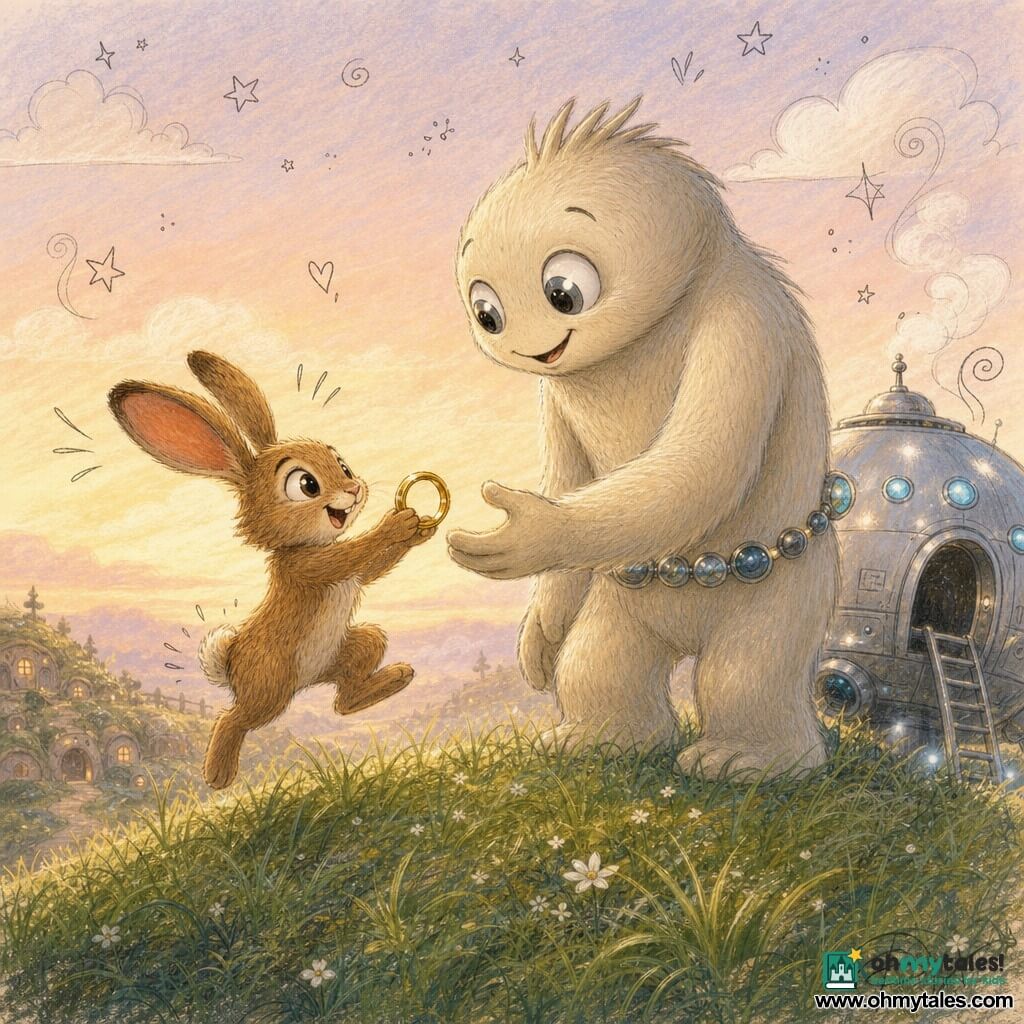
A hatch on the silver thing opened with a sigh. A small shape stepped out. Not a fox, not a badger—someone else. It was an alien, if one could call it that, about the height of a sapling and covered in soft, pale fur. Its eyes glowed like polished pewter. It wore a belt of glass beads and carried a gentle smile.
"Hello," it said, and the word sounded like a bell. Pip bowed—a habit rabbits have when meeting anyone new. The alien bowed too, in a way that made Pip's whiskers twitch with delight.
They both looked at the brass ring. Then the alien's eyes dipped like moons into water. It pointed one trembling finger at the ring and at itself. Pip understood: the ring belonged to the visitor.
The alien made a small sound, like a sad teapot. The ring was important. Pip decided then to help. He had found many lost things in his life. This would be a new kind of finding.
Chapter 2: The Search in the Long Grass
The silver ship had left a faint path through the meadow. Pip hopped along it, the alien close behind, their shadows bouncing together. The brass ring had slipped from the alien's belt when the ship landed, the alien explained in little squeaks and gestures. It pressed its hand to its chest and a soft light blinked: it was a map, a memory-spark, of where the ring had been.
Pip led the search. The early moon lit the grass in silver threads. The hill rolled gentle and green, like waves frozen in sleep. They searched under clover, beneath dew-damp rocks, among the roots of the bent hawthorn. The alien peered with an instrument that looked like a thin leaf; when it touched the ground, tiny lights spread like fireflies, showing places they had already looked.
They found other things. A lost thimble, a child's marble turned to a tiny planet, a feather that smelled of the sea—strange in a land without tides. Each find made the alien's face brighten. It clapped a paw with quiet joy, and Pip felt warm inside. Helping was its own star.
But the ring did not appear. The hill kept its secret tight.
When the search went on and the sky got paler, the alien sat on a rock and sang. The song was simple and curious; notes that made the grass sway as if it remembered something. It sang a story of distant stone planets and blue winds and of a tiny ring that could hold the names of those you loved. The song lifted Pip's heart. He imagined the ring full of names—names of moons, names of suns, names that meant home.
The alien's map pulsed, then dimmed. The last light blinked toward the hilltop.
"Up?" the alien said, pointing. It meant the very top—where the grass is short and the view opens to the whole world.
Chapter 3: The Hilltop and the Hidden Place
They climbed. The hill was gentle, sweet as a lullaby, and the path smelled of chamomile. Pip's breath came in soft puffs; the alien made little mechanical sighs that sounded like the turning of a clock. At the top, the meadow opened like an ocean, and below it the village of burrows sat like small, cozy moons. Above, the sky was pale and streaked with the first thin light of dawn.
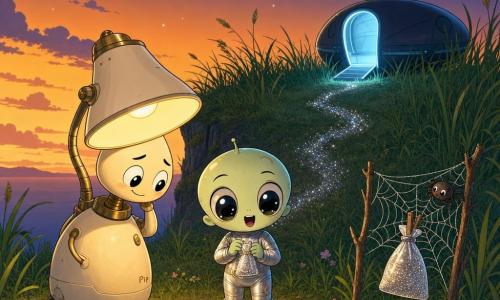
Near the crest, where the grass was very short, Pip saw something glittering in a tuft. He darted forward on long rabbit legs, scattering a family of beetles into the air. The glitter was small, round and brass. It lay nestled against a tuft of grass, as if the earth itself had chosen to keep it warm.
Pip picked up the ring and held it high. The brass hummed and pulsed with a soft light. The alien's eyes widened like two bright plates. It touched the ring and its entire being shimmered. The ring spun once, and then from it flowed a thin thread of light that painted a tiny map in the air—sketches of the silver ship, the hill, Pip's paw prints. Pip watched, astonished. The ring had a memory, and it had kept a piece of the journey inside.
They laughed—Pip in a chirpy rabbit way, the alien in a sound like wind through glass. Then a light wind came and made a small bell of the ring's hum. It played the memory again, but this time the memory was not just pictures; it was a soft message in the alien's language. Pip did not understand the words, but he felt the meaning: thank you. You did not give up.
On the hilltop, the morning came full and warm. The silver ship rested with gentle breathing. The alien placed the ring back on its belt, and a small light blinked across its face like a smile. It turned to Pip and offered something—a tiny bead from its belt, shining with a color Pip had never seen. Pip took it. It was cool and smooth and fitting between his paw pads. It hummed slightly, and Pip felt it whisper of long nights and new friends.
Chapter 4: Farewell and a New Beginning
The ship's hatch opened. The alien made a few soft noises, and Pip realized it wanted to say more. The alien pointed to the bead on Pip's paw, then to the hill, then to the wide world. Pip understood. The gift was a promise: if ever Pip needed a friend from the stars, the bead would glow, and the hill would be a place to meet.
Pip hopped to the edge of the hill and looked out over the meadow. All around, animals stirred—the badger blinking, a mole popping its head, a family of mice stretching in their doorway. Pip felt the bead warm on his paw, like sunlight. He felt proud that his small search had been part of something larger, woven from curiosity and kindness.
Before the ship could leave, the alien reached into a pocket and drew out a tiny seed—no larger than a bean, but silver and humming. It placed it in Pip's paw. "Plant," it said, tapping the soft turf. Pip nodded. He dug a small hole with his paws and tucked the seed into the earth, covering it with the meadow's loam. The alien made a small ceremony with its hands, as if the planting were a promise both of them could keep.
Then the ship lifted. It did not roar; it rose like a bird holding a secret in its beak. Pip watched until the silver was just a speck. The alien waved with a hand like a leaf. Pip waved back with his long ears, which felt suddenly like flags of something brave and new.
The meadow settled into its waking; dew gave itself to the sun, beetles resumed their tiny errands, and the hill kept its secret safe. Pip's bead glowed softly. He thought of the small brass ring, the alien's eyes, and of the seed curled in the earth below the grass.
That evening, when the light was right and the shadow of the hill lay long and soft, Pip hopped back toward his burrow. He had made new friends and found an important thing. He had planted a promise in the soil and carried a bead that hummed of stars. Hope felt like that bead—small, steady, warm.
At his burrow, Pip paused on the little stone step. He held the bead in his paw, then put it in a small hole he kept by the door. He tapped it three times, a little ritual of thanks, and felt the tiny glow answer. Then he lifted his paw and set it down. The final motion was simple, so small and so ordinary: a step on the doorstep.