Chapter One: The Silver Morning
Snow lay like sifted sugar over the village as Nora and Tom opened the curtains. At ten years old they moved as a pair of bright-eyed explorers: Nora with a knitted hat that had one long pom-pom, Tom with boots that squeaked when he ran. The calendar on the kitchen wall had a star drawn around today—Christmas Eve—and their plan was as carefully simple as a promise: make the perfect thermos for their evening walk and bring warmth to anyone they met.
Their grandmother hummed an old carol while stirring cocoa on the stove. The kitchen smelled of cinnamon and orange peel. Nora held up the thermos—shiny, a little dented from last winter—and Tom checked the lid, which clicked but still leaked a whisper of cold. “We can fix it,” Nora said, and Tom's grin was all the answer they needed.
They wrote a list, as if assembling a tiny expedition: hot cocoa, crushed ginger biscuits, a sprig of mint from the windowsill, a ribbon to tie around the thermos so it would look like a present. Then they set off into the hush of the afternoon, their cheeks blooming pink, the village bells far off and steady like heartbeats.
Chapter Two: The Song by the Pond
Their first stop was the old pond at the edge of town, where reeds wore hats of frost and the ice blinked like glass. Children had left a ring of pebbles around a small evergreen. Nora and Tom sat on a bench and began to sing, not loudly but with a warmth that rolled out over the ice—a gentle carol their grandmother had taught them, adding new silly lines as they went. Their laughter scattered like silver coins.
A lost mitten floated down from the path on a ribbon of snow. Anxious footsteps approached; it was Emma, a neighbour, carrying a little wooden sleigh. She had been looking for the mitten—belonging to her younger brother—and the cold had made her cheeks redder than usual. Nora offered the thermos plan right away: “We're making a warm drink for our walk. Would you like to help?” Emma's face brightened. She joined their song and together they shook the peppermint candies into the cocoa, counting beats of the melody.
As they worked, the pond produced a small surprise: the ice under an old willow cracked in a pattern that looked like a smile. A duck appeared at the edge, as if the pond itself were listening. The three children tied a ribbon around the thermos and Tom tightened the lid with a tool he'd borrowed from his father's shed. It was still wobbly. “We need someone who knows tinkering,” Tom said.
Chapter Three: The Tinker on the Hill
They climbed the hill where Mr. Alvarez lived, a gentle man who mended clocks and bicycles and, legend said, could fix almost anything with a sock and tea. Lights twinkled in his window like tiny stars. He opened the door before they knocked, because music had reached his porch—their carol, now including Emma's silly lines—and he loved a good tune.
Mr. Alvarez invited them in. His workshop was a wonder of tins and spools and little jars labelled “sparks” and “sunshine” (or so the children believed). He examined the thermos lid as if it were a small planet with a secret. “It needs a seal and a song,” he declared, smiling. He rummaged, found a rubber ring that fit like a hug, and asked the children to sing while he worked. Singing made his hands steadier, he said, and it made the tools behave.
They sang softly around the workbench: verses that spoke of snowy paths and warm hands. With each chorus, Mr. Alvarez pressed the seal in place and tightened the lid. When the last note drifted away, the thermos was proof against cold—no more leaks, only the promise of heat inside. He added a small brass bell to the handle. “So it will jingle when you pass,” he said. The children imagined every jingle bringing someone a smile.
Before they left, they packed the thermos with cocoa, a dash of cinnamon, and a handful of crushed ginger biscuits. Nora slipped in the mint sprig; its green looked like a secret between frosted windows. They wrapped it in fabric and tied the ribbon. Outside, the snowfall had begun again, each flake falling like a tiny feather.
Chapter Four: The Walk of Little Lights
As twilight folded over the village, Nora, Tom, and Emma set out. The thermos jingled like a song and a bell. They walked the lane that led to the old stone bridge, singing as they went, their voices rising and falling like a candle flame. People looked up from windows, and a dog barked once as if to keep time.
They met Mr. Jensen, who had slipped on the gate and needed both hands to steady himself. Together they helped him sit by the roadside and poured a cup from the thermos into three paper cones—careful not to scald. The steam twisted into shapes that looked like tiny dancers. Mr. Jensen's grateful laughter joined their chorus. “A perfect cup,” he said, wrapping his scarf like a ribbon around his neck.
Further on, they found a little girl building a snow fort but missing a mitten. It was Emma's brother, cheeks puffed with effort. He shared a ginger biscuit, and they all clapped when he waved, victorious. At each doorstep, with a polite knock and a careful bow, they offered a sip or a smile. The thermos kept giving, as if it were bottomless, because what it held most of all was the children's kindness.
Sometimes the songs slowed to whispers so they could listen: the pond's soft murmur, the creak of an old tree, the far-off chime of church bells. The village seemed wrapped in a blanket of music and hush. Snow caught in Nora's eyelashes and sparkled like sugar crystals; Tom hummed a tune his grandmother used to sing and remembered a story she'd once told about stars falling into pockets.
Chapter Five: The Lantern Bench
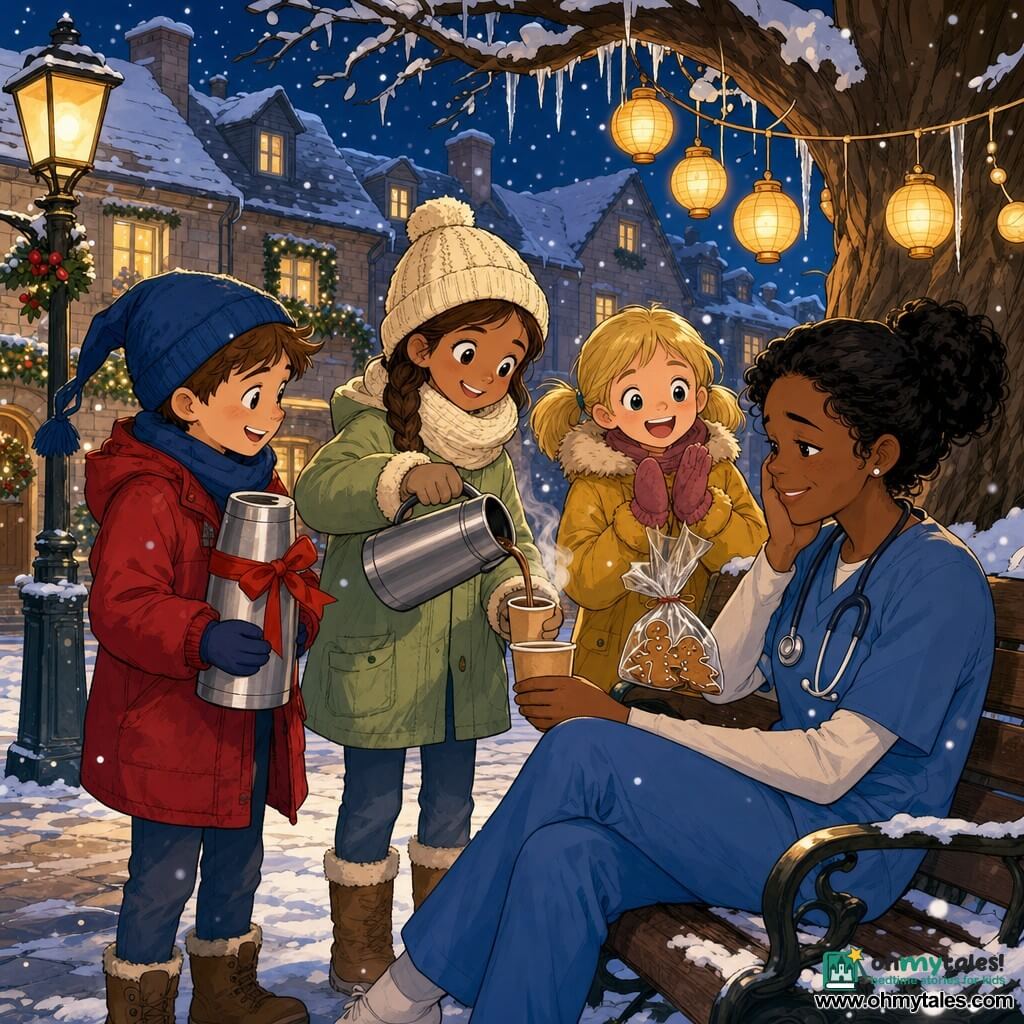
They came upon a bench under a lantern tree—its branches drooped with frosty baubles that chimed when wind passed. Beneath it sat a young nurse, exhausted from her night shift and waiting for a bus. Her hands were cold, and her eyes were bright with tiredness. Nora offered the thermos. The nurse accepted the cup, and the heat seemed to settle inside her like a warm note.
“You've warmed more than my hands,” she said softly, and her smile was a little like sunrise. She told them, in brief sentences that smelled of peppermint and duty, about people she had helped that day. The children listened, and when she had finished they sang a lullaby she recognized from her own childhood. The nurse's shoulders relaxed, the kind of relaxation that comes after a long climb when one finally reaches the top and can breathe.
They left the lantern bench quieter than when they arrived, the night deepening into a velvet coat scattered with stars. The thermos had only a little left now—a gentle warmth for the cups that remained. They saved the last share for a special surprise.
Chapter Six: The Quiet Ending
At the top of the hill, where the village lights looked like a handful of warm coins, they spread a blanket and sat close. The moon poured silver over the snow and the world seemed to hold its breath in a very content way. Nora poured the final cup, and they drank slowly, letting the cocoa fill them with warmth that pushed away the cold and touched the places inside where kindness lives.
They sang one last song, gentle and small, the kind meant for good nights. Their laughter was soft and full, like the rustle of wrapping paper. Then they wrapped the thermos in its ribbon and left it at the little free shelf outside the village hall with a note that read: “For anyone who needs a warm cup tonight.” It was their way of saying the magic of the evening could stay.
On the walk home, they met their grandmother waiting at the doorway with hot bread and a quilt. She listened to their story with bright eyes, and when they finished she tucked their hands into hers and said, “You have been very good helpers.” The three children felt proud and sleepy at once.
They climbed into bed with the windows open just a little, letting the winter air carry the last notes of their songs into the night. Outside, stars stitched a slow lullaby. Inside, the house smelled of cinnamon and home.
As they drifted, they imagined the thermos on its shelf, the ribbon fluttering like a small banner. People would pass by, perhaps sing softly, perhaps take a cup. The thought was like a warm ember in each of their chests: that a single thermos, made with song and laughter and a small band of friends, could spread a quiet kind of light.
When sleep took them, it was peaceful—a deep, soft sleep filled with the gentle echo of carols and the hush of falling snow. The village held its breath in a happy way, and the world felt, if only for a moment, like a place where small hands and warm cups could make everything brighter.