Part 1: The Green Canal
Mr. Rowan Quick was an explorer, but not the kind who ran without looking. He was a measured man. He took slow steps, made careful notes, and listened before he acted.
One bright morning, he stood at the edge of a canal he had never seen on any map. The water was covered with thick, silky algae, like a green blanket. It smelled wet and earthy, like rain on old stones.
He opened his notebook and wrote, “Unknown canal. Surface hidden by algae. Quiet. Watchful.”
A small wooden boat waited by the bank. Its paint was chipped, but it looked steady. Mr. Rowan stepped in and pushed off with a pole.
The algae brushed the pole with a soft hiss. Somewhere under that green cover, water moved.
“Easy now,” Mr. Rowan said to himself. “Slow and steady.”
As he glided forward, reeds whispered along the edges. Dragonflies zipped over the canal like tiny blue arrows. The sun was warm, but the canal felt cool, as if it kept secrets.
Mr. Rowan had a special wish today. He wanted to describe an old wooden landing stage—a dock—said to be hidden deep in this canal. In French, the old note called it an estacade. The word felt mysterious in his mouth.
“An estacade of wood,” he murmured. “I will find you, and I will write you down, just as you are.”
Then the boat bumped something. Thump.
He froze. The canal went very still.
Mr. Rowan leaned over the side. Under the algae, something long and dark lay across the waterway.
“A log?” he guessed.
He used the pole to nudge it. The algae parted like curtains, and he saw not a log, but a line of stones, placed carefully, one after another, like a low, hidden wall.
His heart tapped faster. “That's not natural,” he said softly.
He steered around it, making a small drawing in his notebook. “Stone line. Ancient? A marker?”
The canal narrowed. The reeds grew tall, and the air smelled of mint and mud. Mr. Rowan kept going, watching the shadows, listening for anything strange.
And then he heard it: a gentle creak.
Wood, moving against wood.
He smiled. “That sounds like a dock,” he whispered.
But the green algae was so thick now that he could not see where the canal ended, or what waited ahead.
Part 2: The Whispering Dock
The boat slid forward until it could go no more. The pole touched something firm.
Mr. Rowan pushed the algae aside with his hand. It was cool and slippery. Beneath it, pale water shone like glass.
There, rising from the canal, stood the estacade.
It was a wooden landing stage, made from thick planks and old posts. The posts were dark from time and water, but they stood straight, like brave soldiers. Some planks were missing, leaving small gaps. Moss clung to the wood in soft green pillows. A faint, sweet smell came from the wet boards.
Mr. Rowan's eyes widened with wonder. “Hello,” he said, as if greeting an old friend.
He climbed from the boat onto the first plank. It groaned under his boot.
“Careful,” he told himself. “Test each step.”
He pressed his weight slowly. The plank held.
He took out his pencil and began to write, neat and calm.
“Estacade: wooden structure. Four main posts visible. Planks worn, edges rounded. Moss present. Smell: wet cedar? Sound: creaking, like a sleepy door.”
As he worked, the canal seemed to listen. The reeds swayed even though there was no wind.
Then—crack.
A plank near the middle snapped. Not under his feet, but close enough to make him jump.
Mr. Rowan's stomach fluttered. He stepped back, breathing in and out.
“Don't panic,” he said. “Think.”
He knelt and looked at the broken wood. Inside the plank, the timber was soft and pale, like bread. Water had eaten it away.
He could not cross the middle safely. But he still wanted to describe the far end, where the old note said there might be a carved mark.
Mr. Rowan looked around. The algae floated thick in the water below, but near the posts it was thinner.
He had an idea.
From his bag, he took a small coil of rope, a metal hook, and a measuring tape. He tied the hook to the rope with a strong knot—one his grandpa had taught him.
“A wise knot,” he whispered. “It holds because it is patient.”
He tossed the hook toward the far post. It clinked, then caught.
Mr. Rowan tugged gently. The rope held. He pulled himself closer, not walking on the weak planks, but sliding his hands along the rope while keeping his feet on the safer edge.
His arms worked hard. His face grew warm. But he kept going, one careful move at a time.
Halfway across, the dock gave another unhappy creak.
Mr. Rowan paused. He listened. The sound was not a crack this time. It was a slow groan, like the dock was warning him.
“Thank you,” he said quietly. “I hear you.”
He shifted his weight back, then moved forward again, lighter and slower.
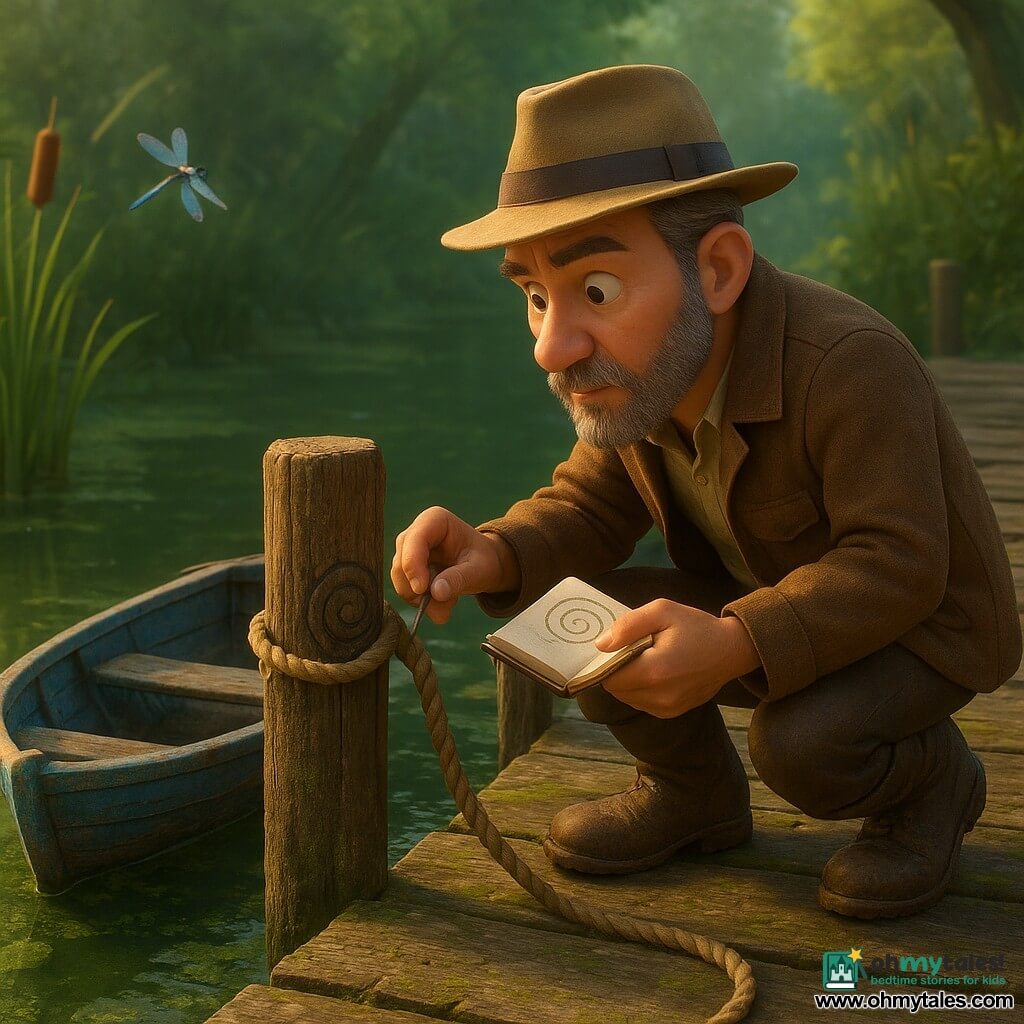
At last he reached the far end. On the last post, just above the waterline, was a carving: a simple spiral with three dots.
Mr. Rowan traced it with his finger. The wood felt rough, like old bark.
“A sign,” he breathed. “Someone was here before me.”
A mini-thrill ran through him—mystery, right under his hand.
Then, behind him, something splashed.
He turned. The algae rippled. The boat bobbed, tugged by a gentle current that had begun to move.
“If the boat drifts away, I'll be stuck,” Mr. Rowan said, and his voice stayed calm, even if his heart did not.
He pulled the rope, fast but steady, and slid back toward the boat.
The dock creaked again, louder now.
“Hurry,” he told himself, “but don't rush.”
Part 3: The Hidden Map and the Way Home
Mr. Rowan reached the safer planks and stepped off the dock into the boat. Just in time. The current had started to pull the boat toward the narrow bend.
He pushed the pole down through the algae. It met the canal floor with a soft thud. He steadied the boat and breathed.
“Courage is not being loud,” he said. “It is being careful when you feel afraid.”
He looked back at the estacade. The far post with the spiral sign was still there, strong and quiet.
Now he wanted one more thing. A better look at the spiral.
He could not cross again, not safely. So he used wisdom instead of speed.
Mr. Rowan took out his small hand mirror, shiny and square. He held it so it caught the sunlight. A bright spot of light danced across the dock. He moved it slowly until the light rested on the spiral carving.
Then he took his pencil and drew the spiral and three dots in his notebook, copying it carefully.
“Recorded,” he said with a satisfied nod. “No need to risk more.”
As he turned the page, something fell out from between the sheets of the old note he had brought. It fluttered onto his lap.
It was a thin piece of paper, folded many times.
“A hidden page?” Mr. Rowan murmured.
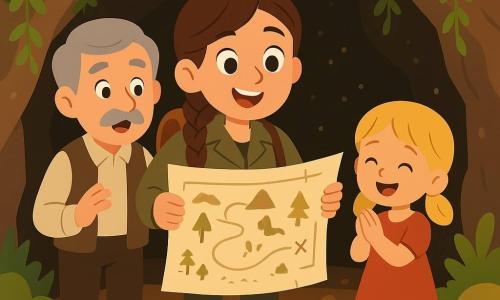
He unfolded it gently. On it was a tiny map, drawn in brown ink. It showed the canal, the stone line, the estacade, and—past the dock—a short path marked with a star.
Mr. Rowan's eyes shone. “So the dock was not the end,” he said. “It was a doorway.”
But the sun was already moving toward the trees. The shadows were longer now. The canal felt cooler.
Mr. Rowan touched the map, thinking. Adventure tugged at him like the current. But wisdom held him like an anchor.
“I could go on,” he said. “But a wise explorer knows when to return. I will come back with daylight, and maybe a friend.”
He tucked the map safely into his notebook. Then he guided the boat away from the dock.
As he passed the stone line again, he noticed something he had missed before. One stone was shaped like an arrow, pointing back toward the estacade.
“A marker,” he whispered, pleased. “They wanted it to be found, but only by someone who pays attention.”
The canal widened. The algae grew thinner. The air warmed. Soon, the bank where he had started came into view.
Mr. Rowan stepped onto land and looked back one last time. The canal lay quiet, green, and secret, as if it had never moved at all.
He smiled, tired but happy.
That night, by lamplight, he wrote his report in clear, kind words.
He described the whispering reeds, the silky algae, the careful stones, and the brave old wooden estacade. He drew the spiral sign and the three dots. He added the most important note of all:
“Discoveries are best kept when you keep yourself safe. Slow steps, sharp eyes, calm heart.”
Mr. Rowan closed his notebook with a soft thump.
Tomorrow, the adventure would continue.
But tonight, he felt proud—because he had explored with courage, intelligence, and wisdom, and he had come home.