Chapter 1: The Jar That Wouldn't Fall
Mira Oakes was twelve years old, which meant she was old enough to be trusted with scissors and young enough to use them for totally the wrong reasons.
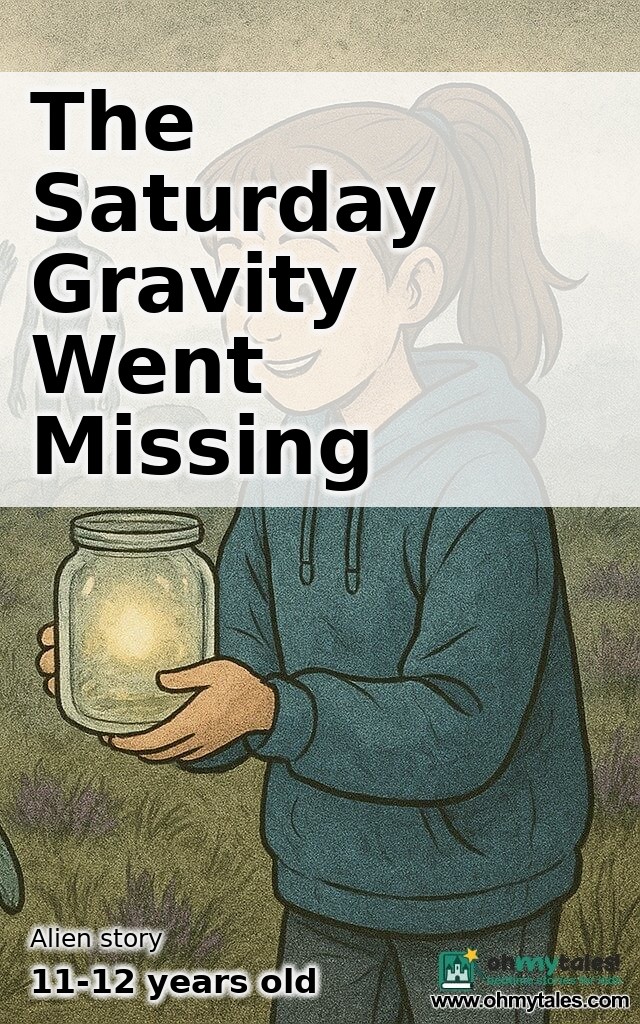
On Saturday morning she crouched in her bedroom, tongue poking out in concentration, tying a string around a glass jar.
Her friend Wes watched from the doorway, trying not to look impressed.
“You're making a… hanging jar?” he asked.
“It's a gravity jar,” Mira said, as if that cleared everything up. “If I drop it, I'll measure how long it takes to fall. Then I'll know if my hallway is secretly taller than it looks.”
Wes blinked. “That's not how hallways work.”
Mira stood, held the jar at arm's length, and let go.
The jar didn't fall.
It just hovered. Right in front of her nose, swinging gently like it was thinking about it.
Mira froze. “Okay. That's new.”
Wes's mouth opened, then shut, then opened again. “Did you— did you glue it to the air?”
The jar made a quiet humming sound. A thin, pale ring of light wrapped around it like a bracelet made of moonshine.
Mira reached out and tapped the glass. It was solid. Real. Cool.
From inside the jar came a soft, polite knock.
Mira leaned close. “Hello?”
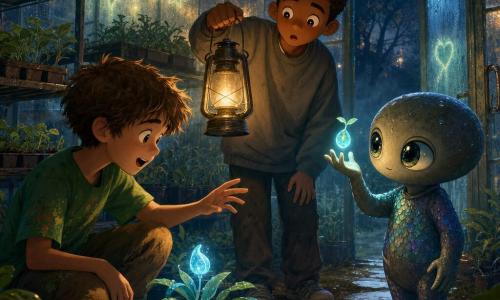
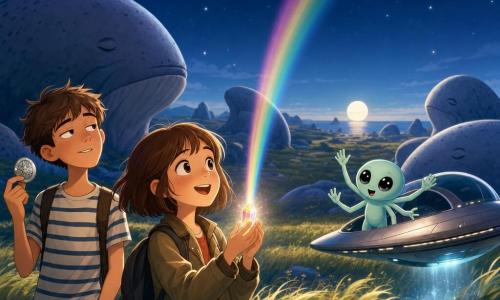
The lid flipped open by itself with a tiny metallic click. Something no bigger than a plum rose up, blinking. It looked like a squishy starfish wearing a tiny backpack. Its skin shimmered between green and silver, like a fish deciding what colour it wanted to be.
It cleared its throat. Actually cleared it. Like a tiny librarian.
“Apologies,” it said in perfect English. “I seem to have arrived inside your containment vessel.”
Wes squeaked. He would deny this later.
Mira, because she was mischievous and tender in equal measure, grinned as if she'd been hoping for this her entire life. “You can come out. I'm not the ‘containment vessel' type.”
The alien's eyes widened. “How generous.”
It hopped onto Mira's desk with a springy boing, looked around at posters and pencils and a half-eaten biscuit, and nodded solemnly.
“I am Ploof,” it announced.
Wes found his voice. “Ploof is not a name.”
Ploof's skin flashed a mild offended purple. “It is where I'm from and what I do. Names are practical.”
Mira pointed at the hovering jar. “Can you explain why gravity is taking a nap in my room?”
Ploof gazed at the ring of light. “Ah. That would be the local gravity stitch. It seems to have snagged on your jar. Gravity is very clingy.”
Mira's eyes sparkled. “So… aliens mess with gravity.”
Ploof made a small bow. “We do experiments. We try not to explode. Mostly we succeed.”
Mira grabbed her notebook. “Show me.”
Chapter 2: A Foggy Invitation
Ploof's backpack unzipped itself and produced a smooth pebble the size of a sweet. It hovered above its little arm, bobbing like it was on invisible water.
“This is a mass pebble,” Ploof said. “It remembers how heavy it should feel.”
Wes leaned in. “That's cheating.”
Ploof tilted its head. “Science is polite cheating.”
Mira laughed. “Okay, Ploof. What's the first experiment?”
Ploof looked thoughtful, then pointed at Mira's window. Beyond it, the day was turning grey. Fog was sliding in like a quiet animal, licking at the garden fence.
“Outside,” Ploof said. “Less breakable things. More sky.”
Wes crossed his arms. “We can't just go outside because your— your gravity stitch is having feelings.”
Ploof's eyes softened. “I did not mean to cause trouble. If you wish, I can leave.”
Mira's grin faded into something gentler. She thought of her jar, her floating hallway mystery, and this small alien who had knocked politely from inside glass.
“Don't leave,” she said. “Just… come with us. We'll do experiments somewhere safe.”
Wes muttered, “Define safe.”
Mira grabbed her hoodie and her torch. “The moor.”
Wes groaned. “The foggy moor?”
“The foggy moor,” Mira confirmed. “Nobody goes there except sheep and people who have lost their GPS.”
Ploof looked delighted. “A mist land! Excellent for dramatic entrances.”
They sneaked out through the back gate, Mira carrying the jar like it was a precious lantern. The gravity ring followed, keeping it hovering a few inches above her palms.
As they climbed the path, the fog thickened. The world became a soft, grey room with wet grass underfoot. The heather on the moor was dark and spiky, like the ground had grown eyebrows.
Wes shivered. “This is how horror films start.”
“This is how adventures start,” Mira said.
Ploof stretched its little arms. “My sensors are pleased. There is much space to… how do you say… do foolish things.”
Mira beamed. “Exactly.”
Chapter 3: The League of Floating Socks
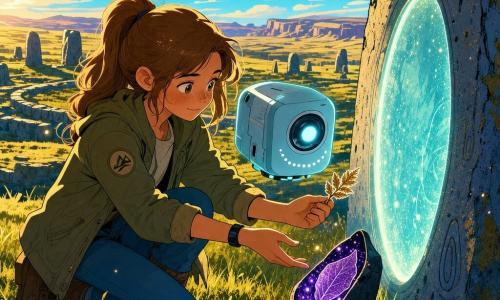
They reached a flat patch of moorland where a single stone stood up like a stubborn tooth. Fog curled around it, making it look ancient and mysterious, which was silly because it probably just sat there all day thinking about lichen.
Mira set down her backpack. “Right. Gravity experiments. Rule one: we do not launch anything at someone's face.”
Wes raised a hand. “What about launching something near someone's face?”
“No,” said Mira and Ploof together.
Ploof rummaged in its backpack and produced three thin discs that looked like clear coins. It slapped one onto the stone. The disc clung with a faint pop.
“Gravity patch,” Ploof explained. “It can make things feel lighter or heavier. Like telling the universe to put its elbow on the scale.”
Wes stared. “That's… not a thing.”
Ploof's skin flickered smug gold. “Now it is.”
Mira pulled off her sock—just one, because she was not a monster—and held it over the disc.
“Sock, meet alien science,” she said, and dropped it.
The sock fell… slowly. Not like a leaf. Slower. Like it was remembering every moment of its life on the way down.
Wes's eyes went round. “It's falling in slow motion!”
Mira jogged under it and poked it upward. The sock floated back up, drifting lazily.
Ploof clapped. It made a sound like two jellybeans meeting.
“Excellent! Your textile is now a sky-fish.”
Mira giggled. “Okay, my turn again.”
She took a pebble and dropped it on the patch. The pebble hit the ground with a heavy thunk, as if it had suddenly decided it was made of regret.
Wes hopped back. “Whoa!”
Ploof nodded. “Heavier setting. Useful for—”
“Staying grounded?” Mira offered.
“Not being blown away by wind,” Ploof said. “Or for making a point.”
Mira scribbled notes, her handwriting wobbling in excitement. “Gravity patch. Two settings. Light and heavy. What else?”
Ploof's eyes darted to the hovering jar. “The gravity stitch is unstable. It got tangled when I arrived.”
Mira glanced at Wes. “You arrived. Like… crashed?”
Ploof's skin dimmed to a shy sea-green. “I was meant to land at our training site. I pressed the wrong coordinate. Your planet has… enthusiastic numbers.”
Wes snorted. “So you got lost and ended up in her bedroom jar.”
Ploof bowed. “Correct. I am grateful you did not… scream me into a corner.”
Mira stuck her sock back on. “You knocked politely. That helps.”
Fog thickened around them, swallowing the path they'd come from. Mira didn't mind. The moor felt like a blanket over the world, making the strange feel secret and safe.
Then something in the fog flashed—a pale blue wink.
Ploof stiffened. “Oh.”
Wes leaned closer to Mira. “What does ‘oh' mean in alien?”
“Usually,” Mira whispered, “it means something interesting is about to happen.”
Chapter 4: More Aliens, Less Panic
A shape glided through the fog. Not walking. Not flying. More like it was being carried by the air the way a boat is carried by water.
Then another.
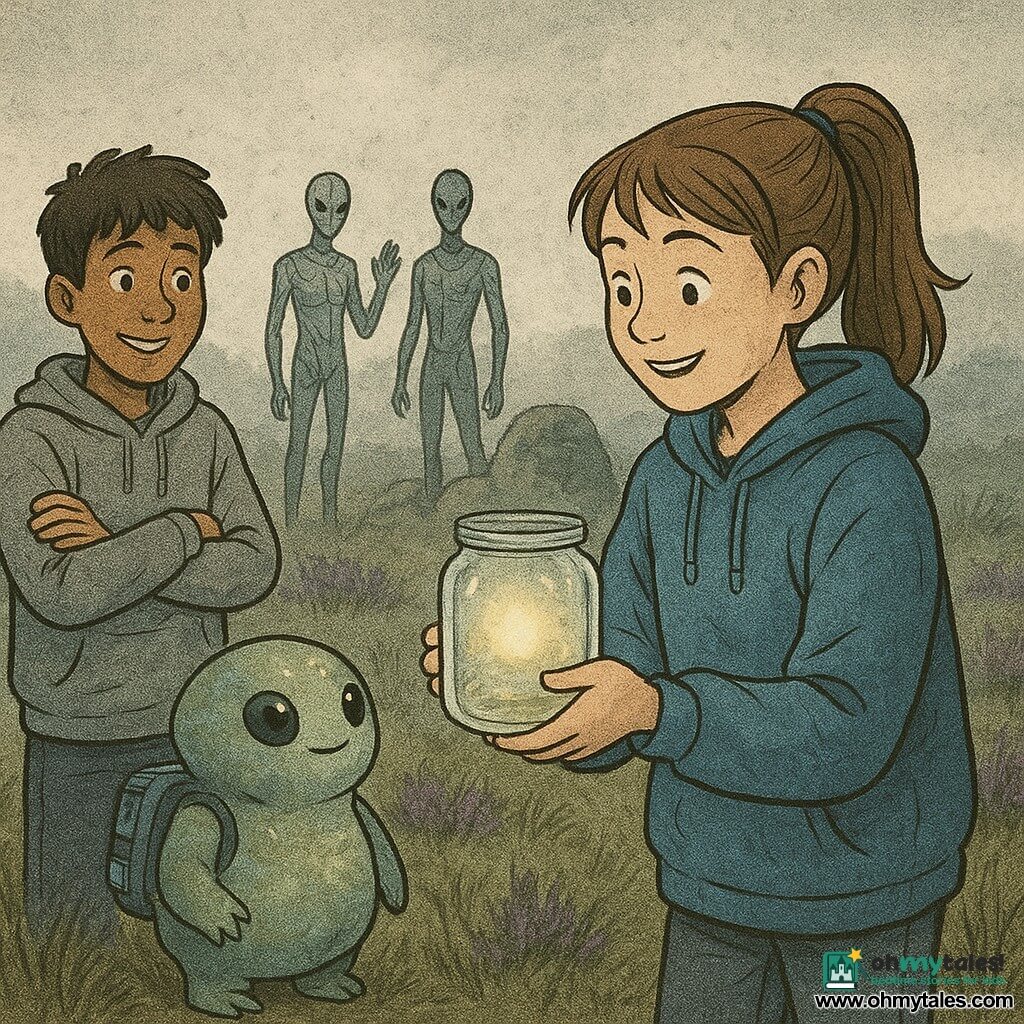
Three figures emerged and stopped in a neat line, as if the fog had produced them on purpose.
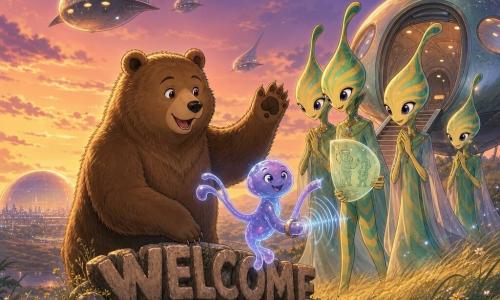
They were taller than Ploof and slimmer, with long limbs and soft, smooth faces. Their eyes were huge, but not scary—more like curious lamps. Their suits looked like shiny raincoats, except the material rippled with faint patterns, like maps.
The middle one raised a hand. “Ploof?”
Ploof hopped forward. “Instructor Vela! I did not mean to—”
Vela's eyes narrowed. “You activated a stitch near an unregistered planet. Again.”
Wes whispered, “Again?”
Mira whispered back, “Shh.”
Ploof's shoulders drooped. “The coordinate wheel spun. The numbers were… energetic.”
The alien on the left—shorter, with a dent in one sleeve—leaned toward Mira and Wes.
“Hello,” it said brightly. “I'm Glint. That's Vela. That's Rook. You are the local young humans, yes?”
Mira lifted her chin. “I'm Mira. This is Wes. We're doing gravity experiments.”
Rook, who looked like he'd been built out of patience, glanced at the floating sock still drifting around the stone.
“That appears… controlled,” Rook said. “Surprisingly.”
Wes puffed up a bit. “We have rules.”
Glint leaned closer, eyes sparkling. “May I try?”
Mira shrugged. “Rule one still applies.”
Glint produced a small cube and set it on the gravity patch. The cube didn't fall. It sat in the air, perfectly still, like a paused video.
Glint sighed happily. “Ah. Home physics.”
Vela stepped forward, voice calm but firm. “We must retrieve the stitch. This fog is masking our signal, but not forever.”
Mira hugged her notebook to her chest. “Will it hurt anything?”
Vela looked at her for a long moment, as if measuring her bravery.
“It might confuse your planet's gravity in a small area,” Vela admitted. “Your sock may never forgive you.”
Mira grinned despite herself. “It already hasn't.”
Ploof bounced anxiously. “I am sorry. I did not mean to bring trouble. You have been kind.”
Mira felt a warm pinch in her chest. Kind. She hadn't thought of it as kindness. She'd just… chosen not to be mean to a lost creature in a jar.
Wes cleared his throat. “So how do we fix it?”
Rook lifted a wrist device that looked like a smooth band of dark glass. “We anchor the stitch. We need a stable mass point.”
Mira gestured at the standing stone. “How about that rock? It's been stable for, like, a million years.”
Glint clapped. “Excellent human logic!”
Vela nodded once. “We will work together. Carefully.”
Mira adjusted her hoodie, trying to ignore the way the fog pressed in, listening.
“Okay,” she said. “Let's be careful.”
Chapter 5: The Jump That Went Sideways
They placed three gravity patches around the standing stone in a triangle. Glint handed Mira a small sensor bead that pulsed with soft light.
“Hold it near the stitch,” Glint instructed. “If it hums, step back. If it sings, run.”
Wes frowned. “What does singing sound like?”
Glint considered. “Like… happy danger.”
“Great,” Wes muttered.
Ploof climbed onto the stone and held up the mass pebble like an offering. Rook adjusted his wrist band, and a thin thread of light stretched from it to the hovering jar, as if the jar had suddenly become the end of a glowing fishing line.
The jar trembled.
Mira held her breath. The fog seemed to pause too, as if the moor itself wanted to see what happened next.
Vela spoke calmly. “Mira, bring the bead closer.”
Mira stepped forward. The bead warmed in her hand and began to hum, low and steady.
“So far, so good,” Wes whispered.
Then the hum shifted. It didn't get louder. It got… cheerful.
The bead started to sing. A tiny, bright melody like a ringtone from space.
Glint's eyes widened. “Oh! That is—”
“Happy danger,” Wes finished, and grabbed Mira's sleeve. “Run!”
They scrambled back. Ploof squealed, “I did not mean to—!”
The triangle of patches flickered. The jar bobbed. The glowing thread snapped tight—
—and gravity on the moor decided to try something creative.
Mira felt her stomach rise into her throat as her feet lifted off the ground.
For one ridiculous second she was floating, hair lifting, hoodie strings waving like seaweed.
Wes floated too, arms windmilling. “I hate this! I hate this a lot!”
Glint whooped. “Wheee!”
Vela stayed grounded by sheer authority, boots pressed down as if she was telling gravity, absolutely not.
Rook steadied Ploof with one long hand. “Hold your pebble. Anchor.”
Mira tried to laugh but it came out as a squeak. She reached for the standing stone, fingers brushing cold rock, and managed to pull herself closer.
“Okay,” she gasped, “this is officially the weirdest Saturday.”
The fog swirled wildly, dragged by invisible currents. Loose bits of heather lifted and spun like tiny dancers. Mira's notebook fluttered open, pages flapping.
Ploof's voice wobbled. “Instructor Vela, the stitch is— is doing a fancy knot!”
Vela's eyes sharpened. “Rook. Anchor now.”
Rook pressed his wrist band against the stone. The dark glass flared with a steady light. The thread of light re-formed, calmer this time, and wrapped around the standing stone like a ribbon tied neatly.
Mira's feet sank back to the ground. Wes landed with a dramatic little hop and immediately pretended he'd meant to do that.
The fog settled. The moor sighed.
Glint looked disappointed. “No more floating?”
Mira rubbed her arms, half from cold, half from excitement. “Maybe later. When we're not accidentally un-gravity-ing the countryside.”
Ploof slumped, relieved. “I am very grateful you did not get angry.”
Mira looked at Ploof's worried face and felt something steady inside her.
“Thanks for trusting us,” she said. “And… thanks for not leaving when you could have.”
Ploof's skin glowed a soft, happy green. “Gratitude accepted. I will store it safely.”
Chapter 6: The Bracelet Promise
With the stitch anchored, the hovering jar finally dropped into Mira's hands with a normal, satisfying weight. Mira cradled it like she'd just caught a falling star.
Vela examined the standing stone and nodded. “The stitch is stable. Our ship can now retrieve us without bending your planet's rules.”
Wes exhaled, long and loud. “Good. Because I like my rules unbent.”
Glint walked around Mira, peering at her like she was a fascinating museum exhibit. “You were brave. Also you have excellent sock technology.”
Mira laughed. “It's called ‘cotton.' Very advanced.”
Rook turned to Mira, his voice gentle. “You helped correct our mistake. That matters.”
Vela stepped closer, and for the first time her stern face softened.
“In our training,” Vela said, “we practise how to meet new worlds without harming them. Today, you taught Ploof something important.”
Ploof tilted its head. “I did?”
Vela nodded. “You learned to ask for help.”
Ploof looked at Mira, eyes wide and shiny. “Yes. And I learned humans can be kind even when confused.”
Wes said quickly, “I was not kind. I was alarmed.”
Mira nudged him. “You came anyway.”
Wes's ears went pink. “I did not want you floating off into the fog alone.”
Glint made an exaggerated sniff. “Aww. The humans are pack creatures.”
“Quiet,” Wes said, but he was smiling.
Vela raised her hand, palm up. A thin band appeared—smooth, silver-black, with tiny specks inside like trapped starlight. It floated to Mira's wrist and gently clicked closed.
Mira startled. “Uh— what is this?”
“A stabiliser link,” Vela said. “A bracelet. If you ever encounter stray gravity effects, it will steady them. And it can signal us. Only if you choose.”
Mira ran her thumb over the cool surface. It felt warm where it touched her skin, like it had already decided she belonged with it.
Ploof bounced. “It is also a thank-you.”
Mira swallowed. She wasn't used to gifts that came with galaxies attached.
“I… thank you,” she said carefully. “But I didn't do it for that.”
Vela's eyes gleamed. “That is why you deserve it.”
The fog began to thin, as if the moor was done with secrets for the day. Somewhere far off, a sheep bleated, sounding annoyed that space had visited without asking.
Glint waved. “Goodbye, Mira! Goodbye, Wes! Please do not throw socks into the sky without supervision.”
Wes called back, “No promises!”
Rook gave a small nod, respectful. Ploof hesitated, then hopped close to Mira's boot.
“May I say something?” Ploof asked.
Mira crouched. “Of course.”
Ploof's voice became very serious for such a squishy creature. “Thank you for not making me feel like a mistake.”
Mira's throat went tight in a way she didn't expect. She smiled anyway, because smiles were easier than big feelings.
“You weren't a mistake,” she said. “You were… a surprise.”
Ploof glowed bright green. “I like that.”
A soft light bloomed in the fog behind the aliens, a doorway made of shimmering air. One by one they stepped into it, and the light folded shut like a quiet curtain.
Mira and Wes stood alone on the moor again, just two kids and a standing stone and the smell of wet heather.
Wes glanced at Mira's wrist. “So. You've got an alien bracelet.”
Mira lifted her arm and watched the starlight specks shift. “Yep.”
Wes nudged the grass with his shoe. “Does it… do anything?”
Mira thought of the floating jar, the singing bead, the way Ploof had looked when he said thank you.
She held her wrist up, and the bracelet gave the faintest, warmest pulse—like a friendly heartbeat.
Mira smiled into the thinning fog. “It reminds me,” she said, “to be grateful for weird Saturdays.”
Wes snorted softly. “And to keep your socks on.”
“Also that,” Mira agreed, and together they walked home, the moor behind them calm and ordinary again, as if it had never let gravity take a nap at all.