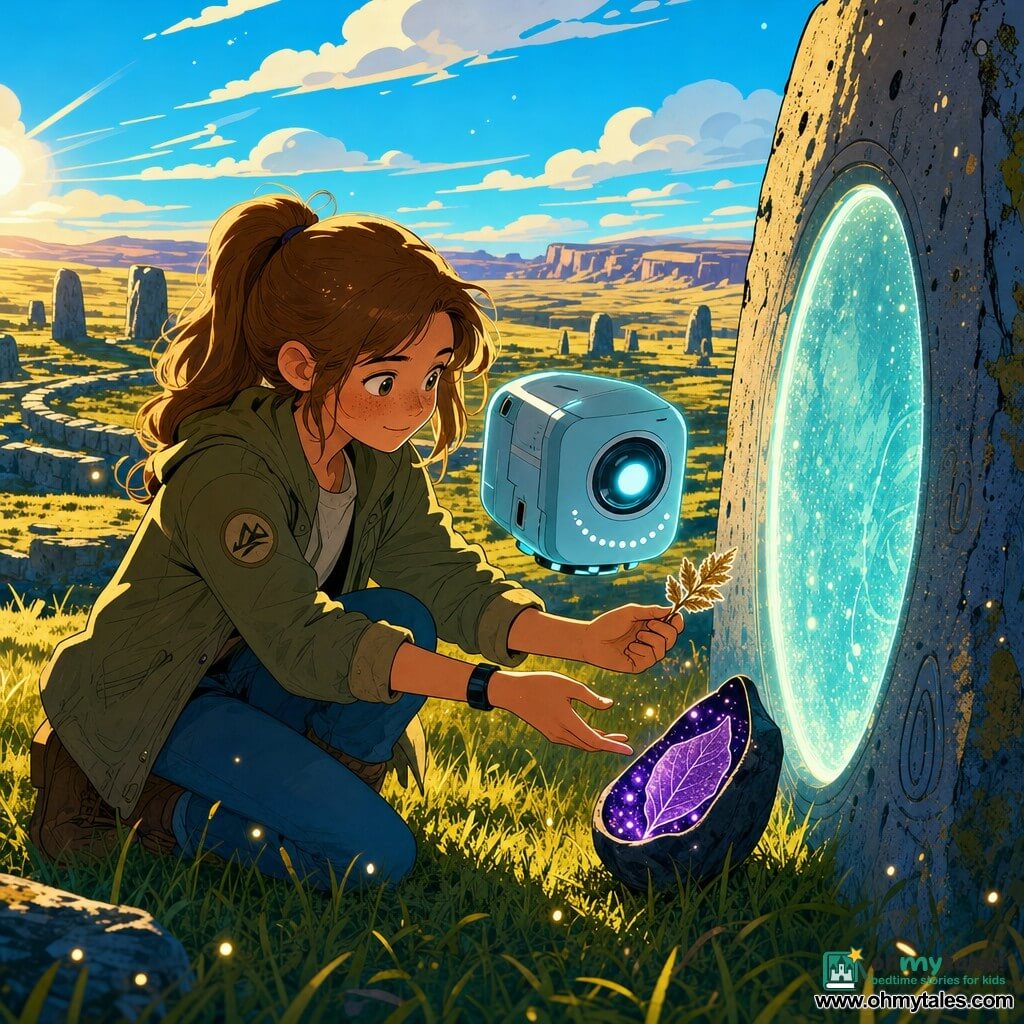
Chapter 1 — The Herbarium with Pressed Sunlight
Mira's herbarium smelled like paper, glue, and a little bit like summer.
She had built it the careful way: thick notebook, cardboard covers, and inside, pages where plants lay flattened as if they were sleeping. Each one had a label written in her neat, patient handwriting.
—“Daisy. Found by the playground fence. Smelled like honey.”
—“Fern. From the creek shade. Felt like tiny hands.”
Her parents teased her gently about it.
“Most kids collect stickers,” her dad said one evening, leaning on the kitchen counter. “You collect… leaves that look like they've been run over by time.”
Mira lifted her chin. “They're not run over. They're preserved.”
Her mom smiled. “And you preserve them beautifully.”
That was what Mira liked best: the small act of saving something. Not to own it, but to remember it properly.
The next day, her science teacher announced an outdoor assignment.
“We're visiting the plateau,” Mr. Lorn said, pushing his glasses up. “It's calm, windy, and full of hardy plants. You'll sketch what you see. If you're like Mira, you can add to your collection.”
Mira's cheeks warmed when the class turned to glance at her. She didn't mind. Being known for something steady was better than being known for nothing at all.
On Saturday, the school bus climbed the long road up to the plateau. The city fell away behind them. Up here, everything felt wide and clean. The air had a crisp taste, like water from a cold bottle.
The plateau was a broad, quiet table of land. Short grass waved. Flat stones lay scattered like forgotten stepping-stones. The sky seemed closer, as if you could touch it if you stood on your toes.
Mira walked a little apart from the noisy group. Not because she didn't like her classmates, but because the plateau asked for listening.
She knelt by a patch of pale flowers that looked almost silver. Wind brushed her hair into her eyes. She tucked it behind her ear and opened her herbarium carefully, shielding the pages from the breeze.
That was when she noticed the humming.
It was faint at first. Not like a bee. Not like a phone. More like a whisper made of light.
Mira froze, one hand still holding the notebook open. The humming seemed to come from behind a flat rock nearby, half sunk into the earth.
She hesitated. Then, as if her curiosity had its own gravity, she stood and walked toward the rock.
“Just a look,” she told herself. “Just one.”
The humming grew clearer, like a secret getting braver.
Behind the rock, the air shimmered.
And in that shimmer, something blinked—soft and green—like a little star learning how to be seen.
Chapter 2 — The Door That Wasn't a Door
Mira didn't scream. Not because she was fearless, but because her throat forgot how.
The shimmer was shaped like a tilted oval, about as tall as she was. The grass around it leaned away, as if the air had become oddly heavy there. Tiny grains of dust floated upward, like they'd changed their mind about gravity.
Mira reached out slowly. The humming tickled her fingertips before she even touched anything.
Her brain offered a list of sensible options:
1) Walk away.
2) Find Mr. Lorn.
3) Pretend this never happened and become the kind of person who sleeps well forever.
Her hand chose option 4) Touch it.
The surface felt like cool fog holding itself together. It didn't feel wet. It didn't feel dry. It felt like the moment right before you sneeze.
The oval brightened, and a line of symbols rippled across it. They weren't letters, but they looked organized, as if someone had taught them to behave.
Mira whispered, “Hello?”
A pause. Then the shimmer folded inward, silently, like fabric being pinched. A round opening appeared. Not a hole in the ground—more like a hole in the air.
And through it, Mira saw… a room.
A small chamber, lit with a gentle blue glow. Smooth walls curved like the inside of a shell. A table sat in the center, and on it lay a book.
Mira's heart gave a heavy thump.
A book.
It looked thicker than her herbarium, with a cover that shimmered faintly, as if dusted with tiny scales.
She looked back over her shoulder. The class was far away, scattered across the plateau like pepper. Their voices were distant, carried off by wind. Mr. Lorn was pointing at something and talking, his arms drawing big shapes in the air.
Mira's feet stepped forward before she made a full decision. The air-door didn't feel like crossing a border. It felt like stepping into shade.
The moment she entered, the oval behind her closed with a soft sigh. The humming became quieter, like it had moved inside her ears.
The room smelled like nothing. Not sterile, not warm, not cold. Just… blank.
Mira approached the table. The book waited there, calm as a sleeping pet.
On its cover was an emblem: a circle inside a triangle, inside another circle. It was simple, and it made her think of maps and orbits.
She set her herbarium down beside it, as if introducing a friend.
“I'm Mira,” she said, because silence made her nervous. “I like plants.”
The blue light shifted. A panel in the wall slid open, and something rolled out—no, not rolled. It glided smoothly, like it didn't believe in friction.
It was about the size of a beach ball, shaped like a rounded cube with soft edges. One side had a lens that looked like an eye. Another side had small holes arranged in a smile. The smile made Mira's stomach unclench.
The cube-thing chirped. Then it spoke in a voice that sounded as if it had practiced in private.
“Hello. Mira.”
Mira blinked. “You know my name?”
“Sound sample detected,” the cube said. “Pattern matched. Greeting appropriate.”
It paused, then added, “I am Sift.”
“Sift,” Mira repeated, tasting the word. “Like sifting flour?”
“Like sorting,” Sift said. “Like finding what matters.”
Mira glanced at the alien book. “Is this yours?”
Sift turned its lens toward the table. “This is the Field Archive.”
Mira's fingers hovered over the shimmering cover. “A field archive… like a herbarium?”
Sift made a pleased little trill. “Yes.”
Mira's eyes widened. Her careful, pressed plants at home suddenly felt like a tiny boat next to an ocean.
“Can I… see it?” she asked, because her manners held on even when her world didn't.
Sift's smile-holes brightened. “Gratitude protocol noted. Permission granted.”
The cover lifted itself, as if the book had been waiting to open for someone who asked kindly.
Chapter 3 — Leaves That Remember Stars
The pages weren't paper. They were thin sheets that looked like glass but bent softly when the book moved. Images floated inside them, not printed on top—more like memories trapped in ice.
Mira leaned closer.
On the first page was something that made her laugh, just a little, out of surprise.
It looked like a plant… if a plant had decided to become a chandelier.
A stalk rose from dark soil, then split into branches made of translucent tubes. Along each branch hung tiny glowing pods, pulsing gently, like they were breathing light.
Mira whispered, “It's beautiful.”
Sift's lens blinked. “Name: Lumen Reed. Habitat: Silent Marshes, third moon of Veyra.”
Mira turned the page carefully. Another specimen appeared: a spiral vine with leaves shaped like small sails. Even in the image, the leaves fluttered, as if a wind lived inside them. A note in symbol-shapes ran along the edge of the page. As Mira stared, the symbols rearranged themselves into English.
“Adaptive translation engaged,” Sift said. “To support understanding.”
Mira read aloud, slowly. “—‘Sailvine: drinks starlight during long nights. Used to weave tents that do not tear.'”
She looked up. “You use plants like we do.”
“Plants use us,” Sift corrected mildly. “We learn. We thank. We share.”
Mira thought of how she sometimes pulled a stem too quickly, impatient, and felt a pinch of guilt. She swallowed.
“I try to be careful,” she said. “I don't take rare ones. And I always leave some flowers. So there are seeds.”
Sift hummed. “Gratitude behavior. Good.”
Mira's cheeks warmed again, but this time it wasn't from being noticed by classmates. It was from being understood.
She turned another page.
This specimen made her eyebrows rise.
It was a flat, round plant like a pancake, stuck to a rock. From its center, thin filaments reached out, tapping the air. When a small insect-like creature landed nearby, the filaments trembled, and the plant's edge rippled, sending a soft wave across its surface.
Mira made a face. “Is it… eating the bug?”
Sift's smile-holes dimmed thoughtfully. “It is… persuading the bug to carry spores.”
Mira snorted. “So it's bribing it.”
Sift paused. “Yes. Bribing.”
Mira giggled. The sound bounced off the smooth walls and came back to her, smaller and friendlier.
The more she turned the pages, the more the room felt less strange. The technology wasn't loud or sharp. It was calm, like the plateau outside. The blue light held everything like a gentle hand.
Then she found a page that made her breath stop.
In the center floated a specimen that looked like a fern, except each frond was a thin strip of shimmering metal. Between the strips, tiny dots of light moved, like fireflies trapped in a net.
The translation formed itself on the page:
“—‘Echo Fern: stores sounds. Releases them when touched. Used in lullaby gardens.'”
Mira's fingers trembled. “It stores sounds?”
Sift rolled closer. “Yes. Would you like demonstration?”
Mira hesitated. “What kind of sounds?”
“Whatever it hears,” Sift said. “Wind. Voices. Water. Sometimes… jokes.”
Mira smiled. “Okay. Let's hear alien jokes.”
Sift made a proud chirp. A small compartment opened in its side, and a delicate tool extended—like a silver twig with a soft tip. It touched the image gently.
A sound spilled into the room.
At first it was wind, deep and slow. Then a chorus of voices—high, low, chirping, clicking—layered together in a rhythm that made Mira think of people laughing around a campfire.
And then, clear as a bell, a voice said in translated English:
“Why did the comet refuse to share its tail? Because it was too attached!”
Mira stared.
Then she laughed, really laughed, and even Sift's smile-holes brightened like it had won a prize.
Mira wiped her eyes. “That's… terrible.”
“Humor acknowledged,” Sift said. “Terrible is sometimes excellent.”
Mira turned the page again. She couldn't stop herself.
But as she did, she noticed something tucked into the binding—something physical, not a floating image.
A thin, pressed sheet.
A real specimen.
It looked like a leaf, but it was not green. It was deep purple, with veins that shimmered faintly, like the night sky painted into lines.
Mira's mouth went dry. Her fingers moved toward it the way they moved toward her own plants—slow, respectful.
Sift's voice softened. “That one is missing its label.”
Mira whispered, “Where did it come from?”
Sift's lens tilted. “Unknown. It arrived recently.”
Mira glanced toward where the air-door had been. The room suddenly felt a little smaller.
“Recently,” she repeated. “As in… from here?”
Sift hummed again, and this time the hum sounded worried.
“We detected a new signal,” Sift said. “On this plateau.”
Mira's stomach dipped.
“What kind of signal?” she asked.
Sift's smile-holes flickered. “A call. And a reply.”
Outside, through no window at all, Mira imagined the calm plateau—and something calling across it, hoping someone would answer.
Chapter 4 — The Plateau That Listens
Sift guided Mira back the way she came. The air-door opened with a quiet sigh, as if it had been holding its breath.
The plateau greeted Mira with wind and sunlight. For a second, she wondered if she'd imagined everything—until she saw the faint shimmer behind the rock, like a mirage that had decided to stay.
Sift floated beside her, but now it looked less like a gadget and more like a companion that had chosen to be brave.
“Your group is near,” Sift said. “We must remain unseen.”
Mira nodded. “My teacher would faint. Or he'd write a very long report and faint later.”
Sift's smile-holes glowed. “Long reports are dangerous?”
“They can be,” Mira said. “Especially if you have to read them.”
They moved along the edge of the plateau, where the grass grew in tight, stubborn tufts. The wind made everything lean in the same direction, like the land was listening to the sky.
Sift stopped near a ring of stones. They were arranged too neatly to be random, like someone had played a careful game long ago and never finished.
“The signal was here,” Sift said.
Mira crouched, touching one of the stones. It was warm from the sun.
“What am I looking for?” she whispered.
Sift's lens narrowed. A soft beam of light swept over the stones. For a moment, nothing happened.
Then the ground between the stones shimmered.
Not like the air-door. Smaller. Thinner. Like the beginning of a drawing.
A symbol appeared on the soil, glowing faintly: the same emblem from the book—circle, triangle, circle.
Mira's heart thudded. “That's from the Field Archive.”
Sift hummed. “Yes. Someone else knows our marker.”
Mira straightened slowly. The plateau felt suddenly huge again. Too many directions. Too much sky.
“Is another alien here?” she asked, trying to keep her voice steady.
Sift's smile-holes dimmed. “Possibly. Or a probe. Or an echo.”
“An echo can reply?” Mira asked.
“Some can,” Sift said. “Old signals. Lost messages. The universe repeats itself sometimes.”
Mira thought of her herbarium, of how pressing a flower kept its shape but stole its scent. A kind of echo. Beautiful, but incomplete.
She swallowed. “What do we do?”
Sift rolled closer to the symbol. “We answer. But politely.”
Mira blinked. “Politely?”
Sift's voice became very serious, like it was reciting a rule carved into metal.
“Rule of First Contact: begin with gratitude.”
Mira's throat tightened. Gratitude. For the plateau, for the plants, for the chance to be here. For the fact that she wasn't alone in this strange moment.
She knelt again, feeling the grass tickle her knees.
“Okay,” she whispered. “How?”
Sift projected a small circle of light onto the ground, like a blank page. Mira watched as it waited, patient.
“Speak,” Sift said. “I will encode.”
Mira looked at the ring of stones. The wind slowed, as if it leaned closer.
She took a breath and said, “Thank you… for reaching out. Thank you for not hurting anything here. We share this place today.”
Sift's light circle rippled. The words became patterns, then symbols. They sank into the soil like seeds.
For a moment, nothing happened.
Then the emblem on the ground brightened, and a second symbol appeared beside it.
A simple shape: a leaf.
Not like a human leaf exactly—more like a teardrop with branching veins—but close enough that Mira felt a jolt of recognition.
Mira whispered, “A leaf. Like… like my herbarium.”
Sift's voice softened. “They understand you.”
The leaf symbol pulsed twice.
And then, from beyond the ring of stones, a tiny object rose from the grass.
It floated up slowly, as if it was shy.
It was no larger than Mira's palm, shaped like a seedpod made of smooth dark material. A thin line of light ran along it like a heartbeat.
Mira held her breath. Sift hovered at her shoulder, quiet.
The seedpod drifted toward Mira and stopped in front of her face.
A small panel opened, and a faint smell reached her—clean and green and strange, like rain falling on a rock that had never been wet before.
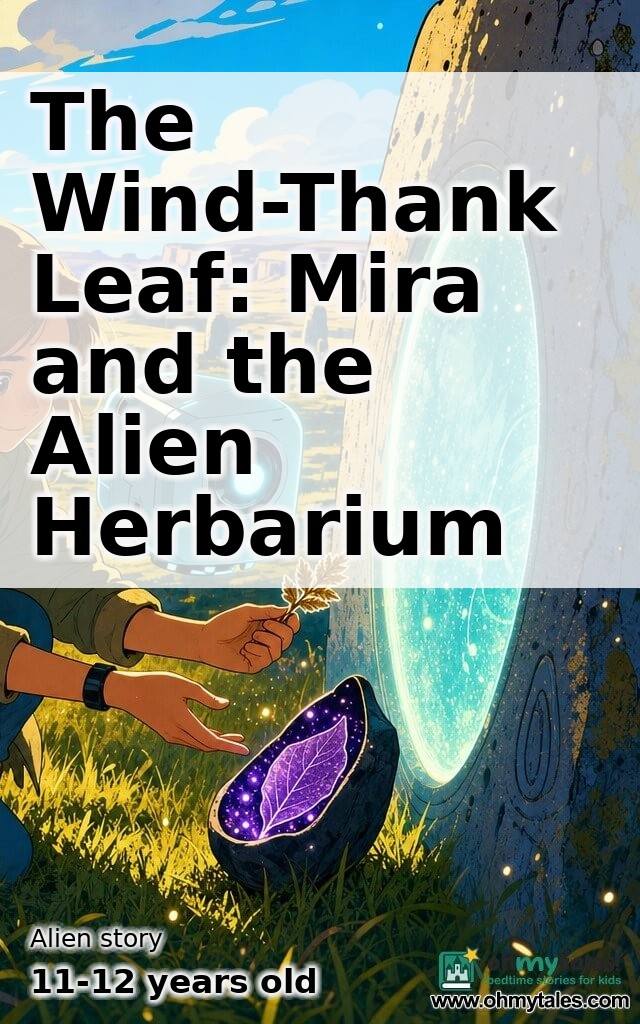
Inside lay a pressed specimen.
A leaf, almost identical to the purple one in the Field Archive.
Mira's hands lifted instinctively, careful as if she were holding a baby bird.
Sift whispered, “An exchange.”
Mira's mind raced. She couldn't just take it. Not without giving something back. That felt wrong.
She glanced at her herbarium in her bag. Her own pressed plants. All so ordinary… and suddenly, not ordinary at all.
Mira opened her herbarium to a page she loved: a simple sprig of thyme from her grandmother's garden. It still held a faint scent, stubborn and brave.
She spoke softly, “This is from someone I'm grateful for.”
Then, with shaking fingers, she gently slid the thyme specimen free. The page looked emptier, but Mira felt lighter.
She placed the thyme into the seedpod.
The pod's light line brightened, like it had smiled.
It closed and drifted back into the grass, disappearing as neatly as a secret.
Mira sat back on her heels, stunned.
Sift hummed, almost tenderly. “You gave a memory.”
Mira swallowed hard. “I hope they take care of it.”
“They will,” Sift said. “Your gratitude was clear.”
The wind picked up again. The class's voices drifted closer. Mira snapped her herbarium shut and stood.
Sift's lens turned toward the plateau's open stretch. “We should return to the Archive chamber. There is more.”
Mira nodded, heart racing, and followed Sift back toward the rock where the air shimmered.
Behind them, the ring of stones looked ordinary again.
But Mira knew better.
The plateau was calm.
And it was listening.
Chapter 5 — The Alien Herbarium
Back in the blue-lit chamber, Mira placed the new purple leaf carefully on the table beside her herbarium.
Side by side, the two books—hers and the Field Archive—looked like cousins from different worlds.
Sift floated above them, as if guarding a treasure.
Mira touched the purple leaf lightly. It was thin and delicate, but it didn't feel fragile. It felt… prepared. Like it had traveled before.
“Do you think they're nearby?” Mira asked.
Sift's smile-holes flickered. “Unknown. But their exchange was gentle.”
Mira exhaled. Gentle. That mattered.
She opened the Field Archive again, flipping to the section where the pressed purple leaf had been hidden.
Now the empty space in the binding looked like a missing tooth.
Sift projected a label onto the page, but it stayed blank, waiting for information.
Mira stared at it. “You don't know its name.”
Sift hummed. “We have not catalogued it. Yet.”
Mira tilted her head, thinking the way she did when she tried to identify a plant from its edges and veins.
“It looks like it holds light,” she murmured. “Like it drank night.”
Sift's lens brightened. “Observation noted.”
Mira smiled. “In my herbarium, I write where I found the plant, and what it felt like. Not just facts.”
Sift paused. “Feelings are… data?”
Mira shrugged. “They're part of the story. If you only write the facts, it's like pressing a flower and forgetting the smell.”
Sift considered this. The room's blue light seemed to deepen, as if it was thinking too.
“Then,” Sift said slowly, “you may help name it. As guest archivist.”
Mira's eyes widened. “Me?”
“Your gratitude and care qualify you,” Sift said. “Also: you made laughter. Laughter is rare data.”
Mira snorted. “I can't believe that's on your list.”
“It is,” Sift said, very serious.
Mira leaned over the blank label. She held a pencil, then hesitated. Writing inside an alien book felt like drawing a mustache on a museum painting.
“Are you sure?” she asked.
Sift's smile-holes glowed. “Yes. This Archive grows through respectful hands.”
Mira wrote carefully on the hovering label, which accepted her words and shaped them into a clean, glowing script.
“Plateau Leaf,” she began, then crossed it out with a tiny shake of her head.
Too plain.
She tried again.
“Wind-Thank Leaf.”
She paused. That sounded silly, but also… true. The plateau wind. The exchange. The gratitude.
Mira looked at Sift. “Is it okay if the name is… a bit poetic?”
Sift hummed approvingly. “Poetry is compressed meaning.”
Mira smiled and wrote:
“Wind-Thank Leaf — exchanged on the calm plateau. Smells like rain on stone. Given with kindness.”
The label settled into place. The empty tooth in the Archive felt filled, not with the leaf itself, but with its story.
Mira's chest warmed. It wasn't just about discovering aliens. It was about making room for them in the way she understood the world.
Sift glided closer to Mira's herbarium. “May I view yours?”
Mira hugged it for half a second without meaning to. Then she loosened her grip. “Yes. But… be gentle.”
Sift's voice was solemn. “Always.”
Mira opened her herbarium to the first pages. Pressed daisies. Ferns. Clover. Notes in her tidy handwriting. Sift's lens moved slowly over each specimen.
“Species: common,” Sift said.
Mira's eyebrows shot up. “Hey! Common doesn't mean boring.”
Sift paused. “Correction. Species: familiar. Value: high. Because you cared enough to keep it.”
Mira's grin returned. “That's better.”
Sift examined the empty spot where the thyme had been.
“Specimen removed,” Sift said.
Mira nodded, and a soft ache tugged at her. “I gave it away.”
“Do you regret?” Sift asked.
Mira thought about her grandmother's hands smelling like herbs, about the way she said thank you for small things—warm tea, sunlight, a neighbor's smile.
“I miss it,” Mira admitted. “But I don't regret it.”
Sift hummed, and the hum sounded satisfied.
“Gratitude includes letting go,” Sift said.
Mira blinked. She hadn't expected an alien cube to say something that felt like advice her grandmother might give.
Outside—somehow, through the walls—Mira heard a distant shout. A human voice.
“Mira! Where are you?”
Her stomach flipped. “Oh no.”
Mr. Lorn was calling. The class was probably gathering.
Mira snapped her herbarium shut and looked at Sift, panic rising like bubbles.
“I have to go,” she whispered. “They'll be worried.”
Sift's smile-holes dimmed, but its voice stayed calm. “You can return. The plateau is a quiet meeting place.”
Mira grabbed her bag. “Will the door open again?”
“It will recognize you,” Sift said. “And your herbarium.”
Mira hesitated, then reached out and touched Sift's smooth side. It felt cool, steady.
“Thank you,” she said, meaning it in every way.
Sift made a soft trill. “You are welcome, Mira. Thank you for naming.”
The air-door opened.
Mira stepped back onto the plateau, the wind immediately catching her hair as if it had been waiting to tease her.
She ran toward the class, heart pounding, cheeks flushed, carrying a secret that felt like a pressed leaf between pages—delicate, real, and impossible to forget.
Chapter 6 — The Book That Closes Softly
Mr. Lorn spotted Mira and hurried over, his face tight with worry.
“There you are!” he said. “You wandered off. I was about to—”
“I'm sorry,” Mira blurted, and she meant it. “I got distracted by… plants.”
Mr. Lorn sighed, the anger melting into relief. “Of course you did.”
Mira held up her herbarium like proof. “I found something unusual.”
Mr. Lorn's eyes narrowed with interest. “Unusual how?”
Mira's mind raced. She couldn't show him the purple leaf. She couldn't explain Sift. Not yet. The secret felt too new, too tender. Like a sprout that would die if you pulled it up to check the roots.
She chose the safest truth.
“Unusual for this plateau,” she said. “Different veins. Different texture.”
Mr. Lorn nodded, already thinking like a scientist. “We'll examine it at school.”
Mira's stomach tightened, but she forced herself to stay calm. “Maybe… later. It's delicate. I want to press it properly first.”
Mr. Lorn studied her face, then softened. “All right. But no more disappearing acts.”
“I promise,” Mira said.
And she did mean that too—at least the part about not making people worry.
On the bus ride home, the plateau shrank behind them, becoming a flat line under the sky. Mira watched it until it vanished.
Her classmates chatted, shared snacks, complained about sunburn. The world sounded normal again.
Mira kept her herbarium on her lap like a quiet animal. Every now and then, she placed her palm on the cover, feeling the steady shape beneath.
At home, she went straight to her room, shut the door, and sat at her desk. The late afternoon light slanted through the window, turning dust into gold.
Mira opened her herbarium slowly.
Between two pages, tucked carefully where no one would look, was a thin sheet of smooth material—Sift's gift. The purple leaf. It shimmered faintly, as if it remembered another sky.
Mira stared at it for a long time.
Then she reached for her pencil and wrote on a new label in her own book:
“Wind-Thank Leaf (copy of name). Exchanged on the plateau. Reminds me to say thank you—especially when I'm amazed.”
She paused, chewing the end of her pencil.
Thank you to the plateau for being calm enough to hide a door.
Thank you to Sift for being kind enough to teach.
Thank you to her grandmother for thyme and lessons that traveled farther than they seemed.
Mira carefully placed the leaf into a protective sleeve. She didn't press it flat the way she did with Earth plants. It felt wrong to force it into her method.
Instead, she let it rest as it wanted to rest.
From her desk drawer, she took out a small notebook and wrote one more thing, just for herself:
“If I go back, bring something to give. Always.”
Outside, the neighborhood sounds drifted in—dogs barking, a lawn mower, someone laughing. The ordinary world held her gently, like a blanket.
Mira closed her herbarium.
The cover met the pages with a soft, final thump.
For a second, she imagined the Field Archive closing too, somewhere beyond the rock on the plateau, its blue light dimming into a patient hush.
Two books, on two worlds, both holding leaves that remembered.
Mira rested her hands on the closed cover and whispered, “Goodnight.”
And the book stayed shut, keeping its secrets the way a safe place does—quietly, gratefully, and whole.