Part One: The Little Boy and the Night Path
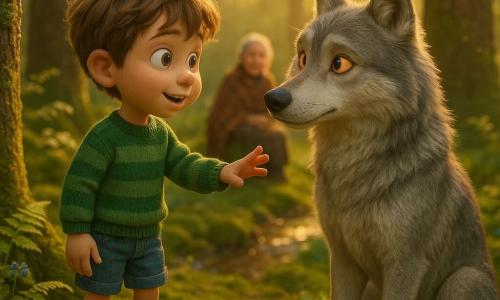
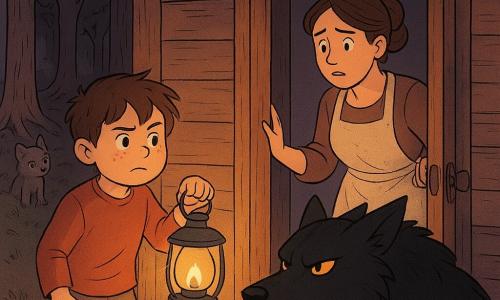
In a village tucked under the ribs of a dark forest, a little boy named Tom lived in a warm house of yellow stone. He was five years old. His hair was the color of dry straw and his pockets always held a small handful of seeds for the birds.
The forest around the village was like a great green sea. Trees rose like old, quiet giants. Their leaves whispered secrets. At night, the forest breathed cool air like slow waves. People in the village told stories by the fire. They spoke in low voices about a shadow that walked in the deep trees. They called it the Great Bad Wolf.
The wolf was not like a wolf of fur and teeth only. It was a long cold shadow that moved between the trunks. It came on silent paws and wore the hush of old nights. When it passed, the moon seemed to hide its face. The stars blinked down quickly, as if they were shy. Mothers drew their curtains tight and held their children close.
Tom listened to the stories with wide eyes. He did not sleep sometimes because his head was full of far paths and the smell of pine. He wanted to know the paths of the forest. He wanted to find a song that would let him remember the way home.
Every night Tom would dream of a small light in the trees. It was like a lantern, bobbing gently. He said to his mother, "I want to walk to the light and sing a song so I never lose my way." His mother kissed his brow. "Little one," she said, "some paths are like riddles. The forest keeps a kind of hush. But if your heart is brave, you will find a way."
So Tom decided to make a rhyme. He thought that words could be like stepping stones. If he had a rhyme, he could say the steps out loud and the way would shine like the lantern. He made a list in his head: stones that hummed, a brook that chuckled, an old oak with a hollow like a door, and the hill that looked like a sleeping giant.
He tried a rhyme that sounded like a march:
"Left at the stone with the round green moss,
Right past the brook where the frogs count cross,
Three steps for the owl, one bow for the tree,
Home is a lantern, wait and see."
He sang it softly. The words felt like bright pebbles in his hands. For a moment the night felt kinder. But when he sang the rhyme in the dark, the air grew thin. The stories said the Great Bad Wolf listened to plans. When Tom whispered his first rhyme into the night, a wind passed through the chimney. A small ache of fear sat in his chest like a pebble. He kept the rhyme and refused to be frozen by fear. He would try again.
Part Two: The Rhyme That Holds the Way
Tom practiced his rhyme every day. He walked in the fields and nailed the words to the sky like bird calls. He made new lines, cut others, and mixed them like berries in a bowl. He would sit by the hollow oak and clap the rhythm on his knees. He would stand by the brook and listen to how the water beat the tune.
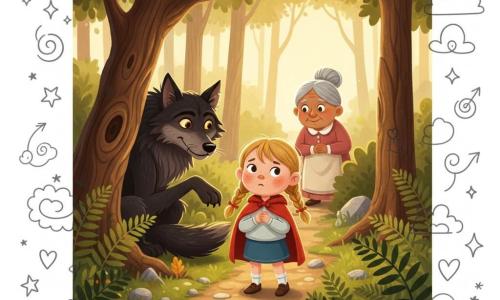
One afternoon, an old woman from the village saw Tom near the path. She wore a cloak that smelled of thyme. Her eyes were bright like clean coins. She said, "What are you doing, small one?"
Tom told her. "I want to make a rhyme that will keep me safe in the night. I want to remember the path and the way home."
The old woman smiled but not like a bird. She put a knuckle to her chin. "Words can be bridges," she said. "But words can also be doors. When you name the path, you must be kind and steady. Do not shout your path like a bell. Sing it like a seed."
She handed him a small stick. It was smooth and dark. "If you carry this, your steps will leave soft marks. And if your rhyme is true, the wolf will not follow when you say your way aloud. But one more thing: your rhyme must be honest. It must be yours and it must speak of the light, not of fear. The Great Bad Wolf grows when you call it by your worries."
Tom held the stick as if it were a compass. He thanked the old woman. He practiced with the stick like a captain practicing at a wheel. His rhyme became simpler. He put in the brook and the oak and the hill that slept.
He changed the words softly:
"Stone with moss and a quiet ring,
Brook that chuckles and frogs that sing,
Oak with a door and a giant's knee,
Lantern at the hill will bring me to me."
Each night Tom would try the rhyme near his window. When he said the line for the stone, the moonlight made a small, silver patch on his floor. When he said the brook, he could almost hear the water answer. When he said the oak, the house smelled like old bark. When he said the lantern, a warm thought came up in his chest like a little bird.
Yet the stories said the Great Bad Wolf slept under bridges and behind leaves. It was cunning and clever. One evening a hunter returned from the wood and spoke of a new darkness. The hunter's eyes were tired. He warned, "It moves when it knows your path." The villagers shivered. Tom felt his little palms sweat. He did not stop. He pulled his rhyme close, like a blanket.
Then the wind changed. On a night silvered with frost, Tom heard a sound like a long breath. He crept to his window. Far away, in the black line of trees, a shape moved. The shape was thin as a thought. The Great Bad Wolf was walking, and it was following a path as old as the roots.
Tom took the stick and stepped outside in his slippers. The air was clean and sharp. He walked with quiet feet. He walked the first step to the moss stone. He felt brave and afraid, a strange pair of birds. He whispered the first line. The stone under his foot hummed like a small bell.
He did not run. His voice was small but steady. He spoke each line like he planted seeds:
"Stone with moss and a quiet ring.
Brook that chuckles and frogs that sing.
Oak with a door and a giant's knee.
Lantern at the hill will bring me to me."
When he said the last line, the wind stopped for a breath. The shadow that had moved in the trees unraveled like loose thread. Where the Great Bad Wolf had been, there was only a darker patch of night. The shadow did not leap or howl. It leaned back as if someone had closed a book. It folded into itself and got smaller until it was no more than a thin line on the earth. The night seemed to nod.
Tom blinked. He felt a wave of something warm. The lantern of his courage glowed. He walked on and followed his rhyme to the brook. The water glittered in the moon like silver coins. He followed each line and the forest made a path for him. Owls blinked their round eyes. Foxes watched from behind ferns. The trees kept their great watch.
But the Great Bad Wolf was not wholly gone. In the hush of the leaves, a small voice like an old wind sighed, "You named the path, little one. You walked it true. That is why I fade for now. But remember: I come when the road is forgetful, when the rhyme is broken."
Tom listened to the whisper as if it were a second bell. He understood in a place under his ribs. He must keep his rhyme true. He must not forget. He must be patient and steady. The wolf would try to creep back when words were lost like socks.
Part Three: The Rhyme and the Promise
Tom returned to the village with his pockets empty of seeds but full of small stones. He told his mother in the morning light about how the shadow had shrunk when he said his rhyme. She held him and hummed a tune he liked. "You were brave," she said simply.
In the days that followed, Tom taught the children in the lane his rhyme. They walked behind him like a procession of tiny lights. They learned the steps by saying them together. The rhyme grew roots in their small mouths. With each chorus, the path seemed safer and the forest less sharp. The adults watched and felt something soften in their chests.
One afternoon the sky turned the color of old pewter. A strange cold moved in. News came that a merchant would cross the forest and needed help. He had a heavy cart and a small lamp. The villagers were wary. The hunter said, "I will go." But his eyes were thin with worry. The merchant needed more hands.
Tom asked, "May I go too?"
The hunter looked down. "You are small, Tom."
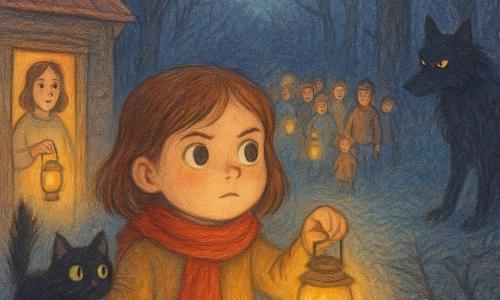
Tom took the old stick and the list of his rhyme. He tied a scarf around his neck. The village watched him go. Some thought it was only a child's daring. Others felt a warmth like a low fire in their bellies. The merchant smiled when he saw Tom by the cart.
They moved through the trees. The sky was thick. The shadows were long and clever. Once, the cart's wheel slipped and the merchant swore. The hunter grunted and pushed. Birds scattered. Tom spoke the rhyme to steady his steps. The wheel found its track again.
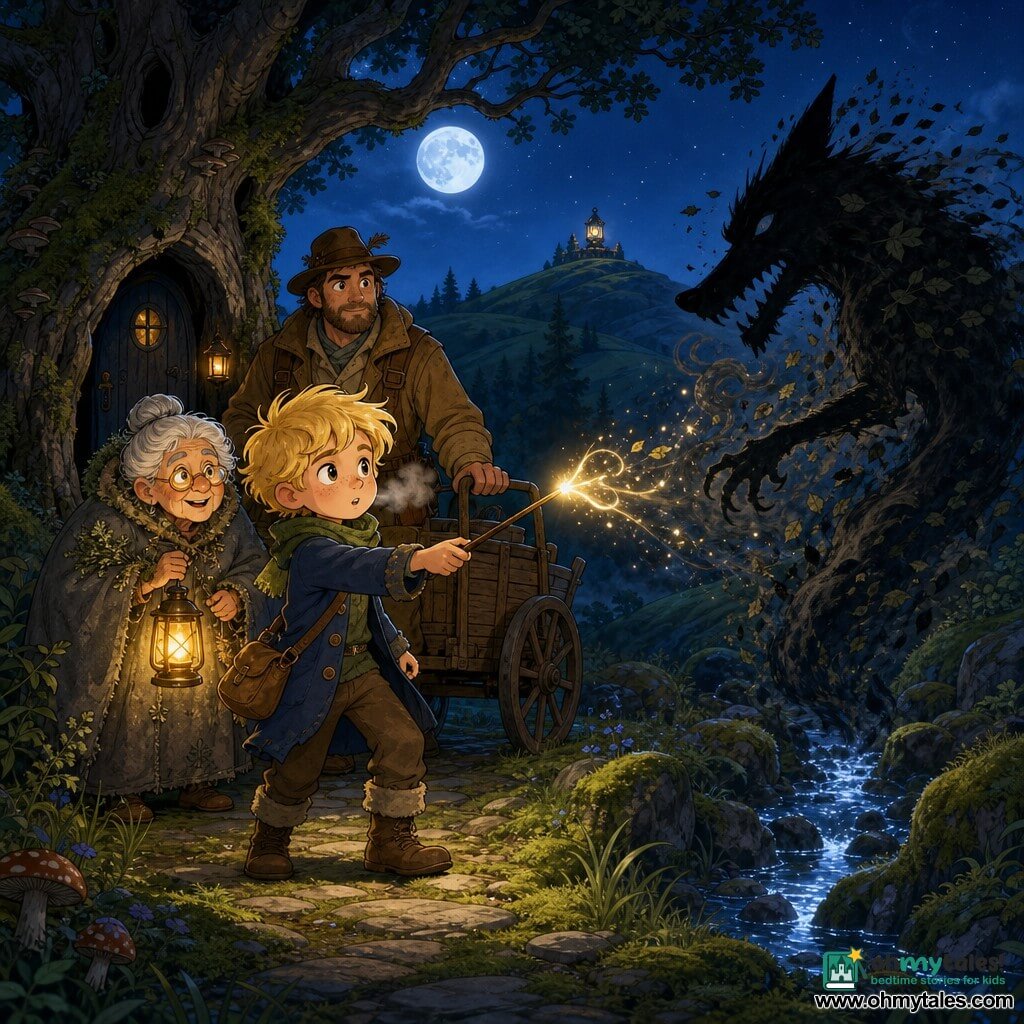
Near the hollow oak, a hush fell like a blanket. The leaves did not move. A small sound like paper folding came from the branches. The Great Bad Wolf reached up with its long, slow voice. It tried to find fear in the children's eyes and the merchant's lamp. It smelled for forgetfulness and doubt.
Tom stepped forward. He put his hand on the cart. He looked at the oak and at the hill and at the brook that he had named. His breath was steady. He held the stick like a small staff of truth.
He said the rhyme aloud so the whole way could hear:
"Stone with moss and a quiet ring.
Brook that chuckles and frogs that sing.
Oak with a door and a giant's knee.
Lantern at the hill will bring me to me."
The wind came in and the wolf shivered. It had been called and then named and then shown that the name did not belong to it. The wolf could not walk where the rhyme made the road shine. The shadow folded and shrank and was like a sound swallowed by a pillow. It did not cry. It only slid away to the far dark like a shadow behind the moon.
The cart rolled on. The merchant clapped his hands. The hunter grinned and tipped his hat. The children laughed like small bells. Tom felt his heart beat in a steady drum. He had not only made a rhyme for himself. He had given the path to others. He had given them a way to remember.
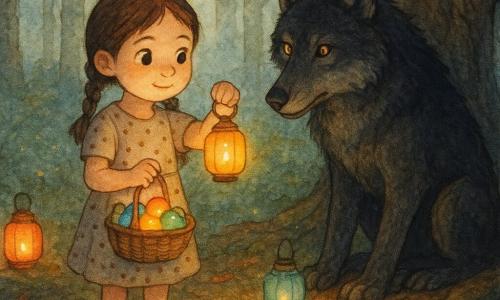
That evening, the villagers lit lamps outside their doors. They walked the paths with songs in their mouths. The Great Bad Wolf was still a story, but it was smaller. The stories said that when people sing true and steady, the wolf must hide. The wolf grows only when words are lost and when voices fall silent.
Time moved like a slow river. Tom grew a little, and the rhyme held like a rope. He never shouted his path like a trumpet. He kept it soft and steady, and every night he would whisper the steps like a promise. Sometimes he stumbled. Sometimes he forgot a line and turned once or twice. Each time he would breathe, try again, and find the words. He learned that to remember is to try again.
On a winter night when frost painted the window with lace, Tom stood at his sill and thought of the forest. He pressed the stick to his lips and said the rhyme once more. The lamp on his table flickered and did not go out. He felt a warm calm like a blanket.
In the hush between breaths, he heard a faint voice. Not the wolf, but the old woman's whisper in his memory: "Words are bridges. Keep them kind. Keep them steady."
Tom smiled. He tucked the stick under his pillow and slept. Outside, the trees kept their watch. The stars blinked slow and safe. In his dreams, his rhyme was a ribbon of light that wrapped the paths and the people in a warm glow. The Great Bad Wolf moved in the far places where night forgets to be kind. But as long as small voices kept the rhyme, the wolf could not grow tall.
And so the village learned a quiet lesson. Courage is a small lamp. It is not always loud. It is a steady step and the will to try again. Words that remember make paths that never vanish. The wolf may return when songs are lost, but for each small voice that remembers, the shadow will fold away and the night will come soft and kind.