Part One: The Boy Who Wanted a Lantern
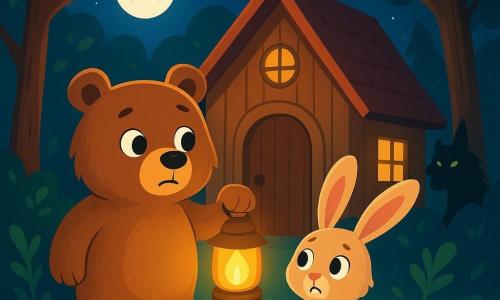
Once, at the edge of a whispering forest, there stood a small wooden house with a roof like a folded brown leaf. In that house lived a little boy named Oliver. He was six, and his thoughts were quick as sparrows.
All day, Oliver had one deep wish in his chest, like a warm coal: to make a lantern.
Not just any lantern. A lantern to use wisely.
Outside, the evening began to pour itself across the trees. The sky turned the color of plum skin. The forest leaned closer, dark and listening. In the Grimm-old tales, the forest was never only trees. It was a mouth of shadows. It was a place where fears wore fur.
Oliver gathered what he needed: a small jar of clear glass, a short candle, a strip of paper, and a bit of string. He worked at the table where the wood was smooth from many hands. He hummed softly, because humming made courage feel closer.
Tap. Tap. Tap. He tied the string.
Fold. Fold. Fold. He wrapped the paper.
Shine. Shine. Shine. He imagined the light.
His mother watched, kneading dough for tomorrow's bread. “A lantern, Oliver?” she asked.
“Yes,” said Oliver. “A lantern for the path. A lantern for the night. A lantern so the dark won't push.”
His mother's eyes were kind but careful. “The dark can be loud,” she said.
Oliver nodded. “Then I will be louder with light.”
When the lantern was nearly done, someone knocked.
Not a friendly knock.
Not a soft knock.
A hard knock, like a stone against a door.
Knock. Knock. KNOCK.
Oliver's mother wiped flour from her hands. “Stay close,” she whispered.
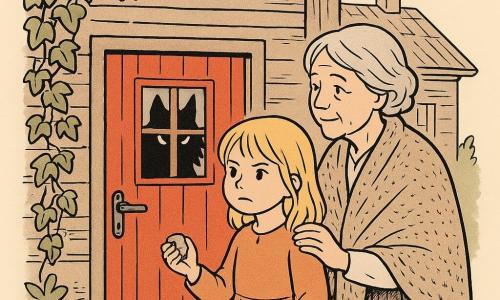
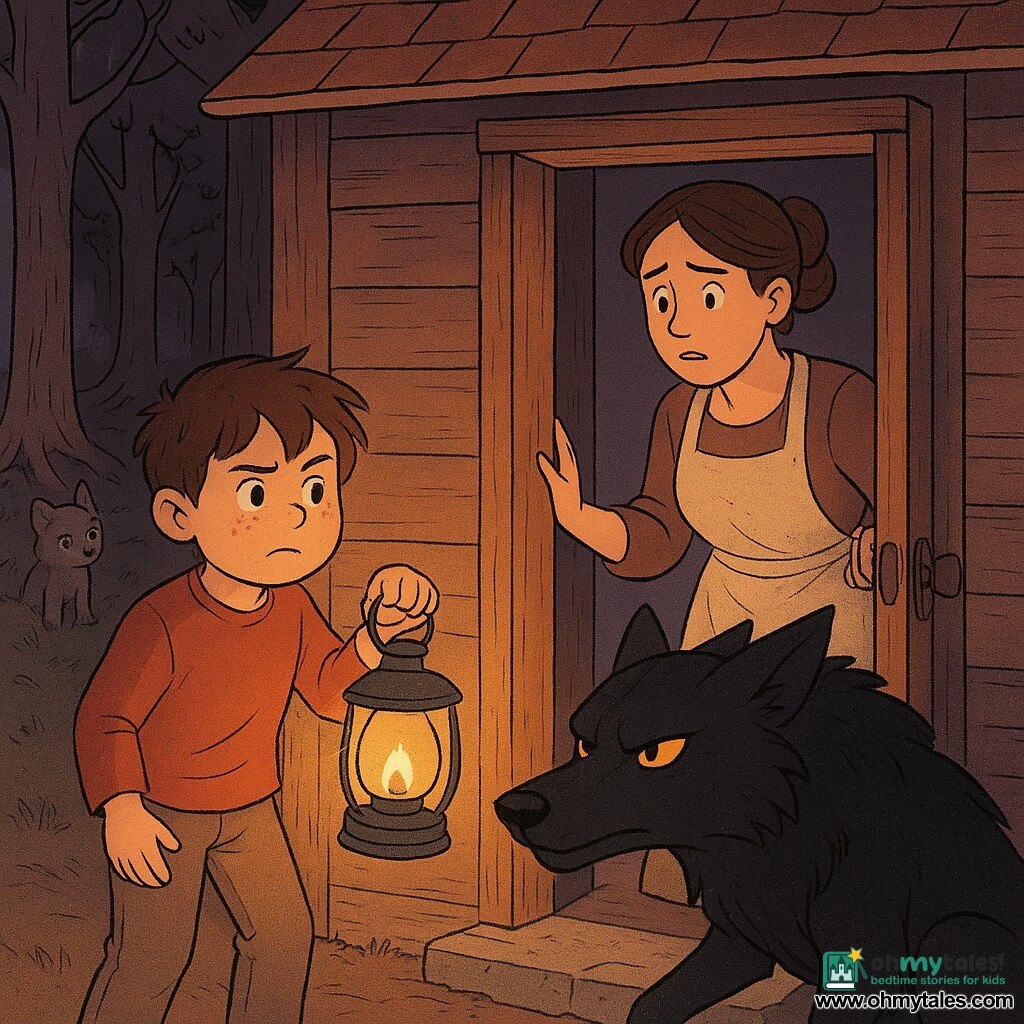
She opened the door just a crack.
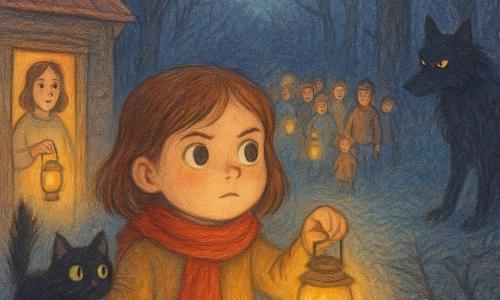
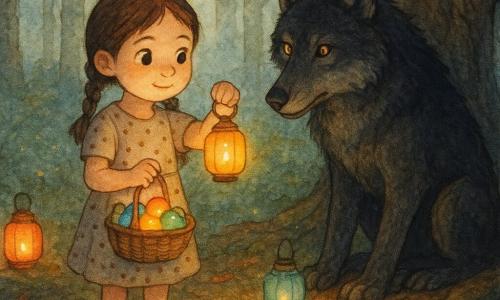
There, filling the doorway like a shadow that had learned to stand up, was the Big Bad Wolf. His fur was black as wet ink. His eyes were two cold coins. His breath was a wind that smelled of old leaves and hungry nights.
“I smell bread,” growled the Wolf. “And I smell boy.”
Oliver's mother held the door firm. “We have no bread for strangers,” she said. “And no boy for wolves.”
The Wolf's lip curled, sharp as a sickle. “Then let me come in to warm my paws,” he said. “I do not like waiting.”
Oliver's mother's voice stayed steady. “Wait outside. The oven is hot. The house is small. Waiting is what wise creatures do.”
At the word wait, the Wolf's eyes flashed. His tail thumped once, angry as a drum.
“I do not wait!” he snarled. “The forest obeys me. The rabbits run. The crows hush. Even the moon watches!”
Behind the door, Oliver's lantern was still unlit. His candle was still sleeping. He felt fear rise in him like cold water. But he remembered his warm coal of a wish.
A lantern to use wisely.
Oliver stepped forward, small but straight. “Mr. Wolf,” he called through the crack, “if you wait, I will bring you something.”
The Wolf's ears lifted. “Something?” he hissed.
“A light,” said Oliver. “A tiny light. So you can find your way back.”
The Wolf snorted. “I do not need a boy's toy.”
Oliver swallowed. “Then wait and prove you are strong,” he said. “Only strong creatures can wait.”
The Wolf blinked. No one spoke to him like that. It was as if the boy had held up a mirror, and the Wolf had seen something he didn't like: his own wild impatience.
But pride is a hook, and the Wolf was caught.
“Fine,” he growled. “I will wait. But not long.”
Part Two: The Lantern and the Listening Woods
Oliver closed the door and leaned on it. His heart tapped in his ribs.
His mother knelt beside him. “Why did you promise him a light?” she whispered.
Oliver looked at his lantern pieces. “Because I want to use it right,” he said. “Not to make shadows dance, but to make danger blink.”
He set the candle in the jar and tied the paper around it. On the paper, he drew simple shapes: a house, a path, and a sun. The drawings were symbols—little promises. House meant safety. Path meant choices. Sun meant hope.
His mother struck a match. The flame sprang up like a tiny golden bird. Oliver lit the candle, and the lantern woke. Warm light filled the jar and pushed back the gloom in a gentle circle.
The house felt smaller and safer inside that circle.
Oliver carried the lantern to the door. He did not open it wide. He opened it only enough to let the light spill out like honey.
The Big Bad Wolf sat on his haunches. His claws dug lines in the dirt. His eyes were narrowed, and his patience was crumbling like dry bark.
“Too slow!” he snapped. “I told you, I do not—”
He stopped.
Because the lantern's light touched his face.
The glow did not burn him. It did not shout. It simply showed him clearly, as if the light were saying, Here you are. Here is your anger. Here is your hurry.
For a moment, the Wolf looked less like a monster and more like a lost thing.
Oliver held the lantern out, both hands steady. “Here,” he said. “A light for your way.”
The Wolf leaned close and sniffed. “Why would you help me?” he asked, suspicious as a thorn.
Oliver's voice was soft. “Because I don't want you to be in the dark,” he said. “And because I want you to leave our door.”
The Wolf's ears twitched. He did not like being told what to do. He did not like being offered kindness. Kindness felt like a trap, and traps made him angry.
His tail lashed. “You think you can control me with a candle?” he roared.
The lantern trembled a little in Oliver's hands, but he did not drop it. Courage is not a sword. Sometimes courage is simply holding on.
“I can't control you,” Oliver said. “But I can choose what I do. I choose light.”
The Wolf's mouth opened, showing a row of bright knives.
Then—mini twist, small and strange—the wind shifted.
From the forest came a sound: a low, lonely howl. Not the Wolf's howl. Another wolf's howl, far away. It sounded tired, like a long road.
The Big Bad Wolf froze. His fierce eyes flickered.
Oliver noticed. “Someone is calling you,” he said.
The Wolf's anger wobbled, as if it stood on one leg.
“That is… that is my little brother,” the Wolf muttered. His voice was quieter now, like gravel under snow. “He is small. He gets lost.”
Oliver lifted the lantern a bit higher. “Then take the light,” he said. “Use it. Find him.”
The Wolf stared at the lantern, as if it were a riddle. He wanted to grab. He wanted to smash. He wanted to refuse.
But the forest was dark, and the howl came again, thinner this time.
The Wolf swallowed. “I hate waiting,” he said, almost like a confession.
Oliver nodded. “Waiting is hard,” he said. “But it can be brave.”
Slowly, the Wolf reached out. His paw was huge. The claws were curved like sickles. Yet he took the lantern carefully, as if it were a fragile egg.
The light made his fur look softer. Not soft, but softer.
He grunted. “If you trick me—”
“No tricks,” said Oliver. “Only a path.”
Part Three: A Brave Wait and a Wise Light
The Wolf turned toward the trees. The lantern swung from his paw, painting golden patches on roots and stones. The forest, which had looked like a mouth, now looked like a hallway.
Oliver stood at the door with his mother. They watched.
The Wolf walked a few steps, then stopped. He looked back.
“Boy,” he called, gruffly. “What do you want for this?”
Oliver thought of many things: sweet buns, shiny marbles, a red scarf. But his deep wish was not for taking. It was for using.
“I want you to wait,” Oliver said. “Not at our door. In your own heart. When anger says ‘now,' you say ‘later.' Just a little.”
The Wolf's ears tilted. He seemed offended, then puzzled, then… thoughtful.
He gave a short snort. “Hmph.”
And he went into the forest.
Oliver and his mother closed the door. They did not lock it with trembling hands. They latched it with steady hands. Inside, the darkness seemed less heavy.
Minutes passed. The fire in the hearth crackled. The dough rose in its bowl like a sleepy moon.
Oliver sat on a stool and listened. In tales, listening is important. Listening is how you hear danger coming. Listening is also how you hear it leaving.
At last, from far away, there came a different sound: two howls together. One deep, one small. Not hungry. Not angry. Just together.
Then footsteps returned—slow, not rushing.
The Big Bad Wolf appeared at the edge of the yard. Beside him padded a smaller wolf, gray as ash, with bright, worried eyes. The little one stayed close, like a shadow that wanted to be held.
The Big Bad Wolf placed the lantern on the ground carefully. The candle inside was still burning, steady as a patient star.
He cleared his throat, as if the words were stuck. “Your light… helped,” he said.
Oliver's mother stood tall, but her face was gentle. “Then go in peace,” she replied.
The Wolf looked at Oliver. “I waited,” he said, as if saying it cost him something. “I waited, and the forest did not win.”
Oliver felt his warm coal glow brighter. “That is courage,” he said.
The Big Bad Wolf gave one stiff nod. “And you,” he said, “are a small boy with a large spine.”
The little gray wolf peeked at Oliver, then at the lantern. “Thank you,” he whispered, barely louder than a leaf.
Then the two wolves turned away. The lantern's light guided them to the first line of trees. When they reached the shadows, the Big Bad Wolf lifted the lantern one last time, like a signal, and the golden circle floated among the trunks.
And then it was gone.
Oliver's mother brought the lantern back inside when the wolves were far away. She blew out the candle, and a ribbon of smoke curled up like a goodbye.
In bed, Oliver pulled his blanket to his chin. The night outside was still dark, but it did not feel like a monster now. It felt like a big coat the world wears to sleep.
His mother kissed his forehead. “What did you learn?” she asked softly.
Oliver's eyes grew heavy. “That fear is a forest,” he murmured. “But light is a choice.”
“And waiting?” she asked.
Oliver yawned. “Waiting can be brave,” he said. “Even for a wolf.”
His mother smiled. “That is a wise lantern you made.”
Oliver drifted toward sleep, thinking of the lantern's warm circle, thinking of the Wolf's angry eyes turning thoughtful, thinking of a small howl becoming two.
And in the quiet house at the edge of the whispering forest, courage sat like a gentle flame—small, steady, and bright.