Morning Notes
Ben woke to the soft patter of rain on his window and the smell of toast from downstairs. He padded to the kitchen in bare feet, hair messy, and found his mum humming over the toaster. On the table lay a small stack of Post-it notes in bright blue and yellow.
"Good morning, Ben," his mum said, handing him a note. "A little list for today?"
Ben peeled the note open. In careful handwriting it said: Remember to say thank you. Share your sketchbook. Take turns on the scooter. Be kind.
He smiled. Gratitude was a warm habit he'd learnt last year after helping at the school garden. Saying thank you felt like closing a small door on worry and opening a window to the rest of the day.
At breakfast he scribbled a reply on the back of the note: I will. Then he tucked the Post-it into the corner of his sketchbook, where he kept little reminders.
His best friend Rosa was meeting him after school for a project on local history. They were both eleven, both keen on sketching, and both good at turning ordinary afternoons into little adventures. Today Ben felt especially thankful for that. He zipped his jacket, slung the sketchbook over his shoulder, and headed out into the wet street that smelled of earth and rain.
Sharing the Plan
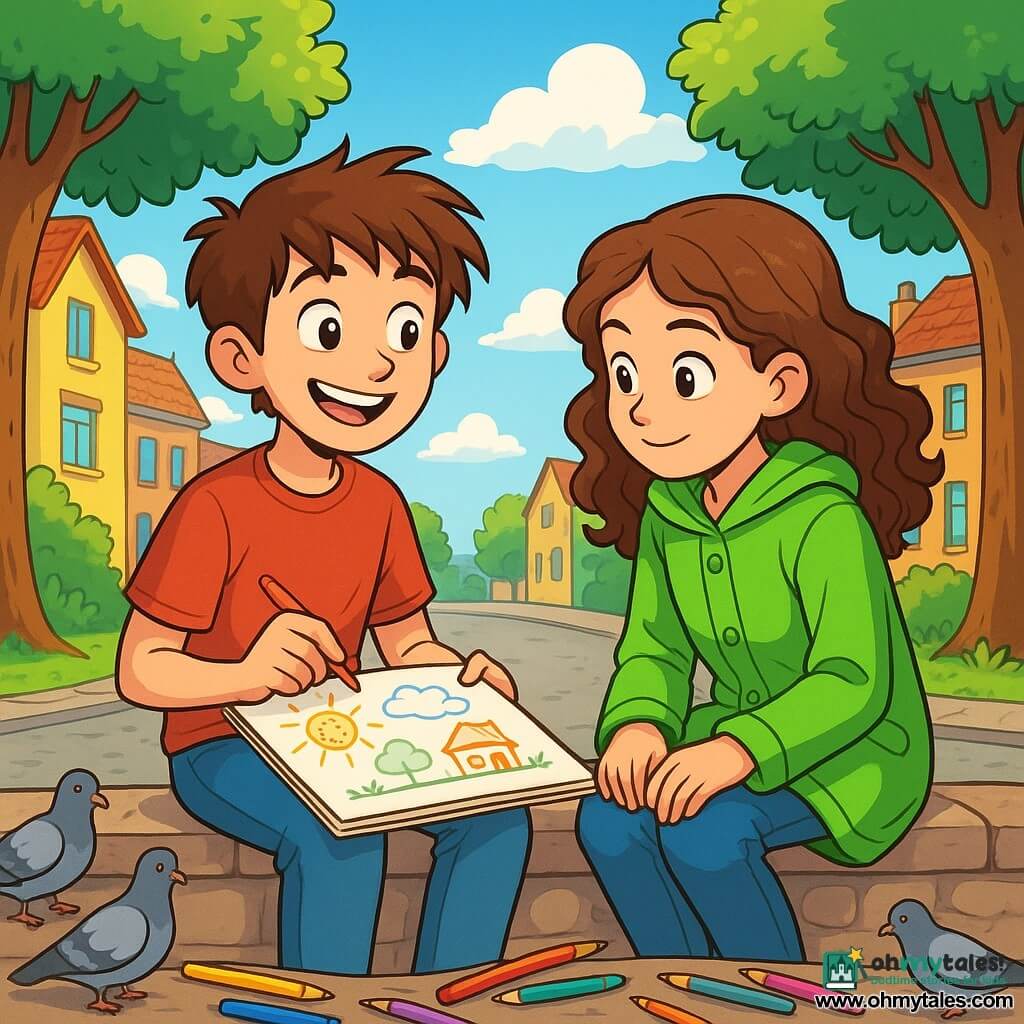
At the school gate, Rosa was waiting under a bright umbrella, wearing a green raincoat that made her look like a friendly frog. She waved the project sheet.
"We need sketches of the old bakery and the clock tower," she said. "Two subjects, two artists. What do you think?"
Ben opened his sketchbook and showed her a quick drawing of the bakery's windows. "We could split the work. You do the clock tower from the square; I'll sketch the bakery from the alley. Then we swap pages later and finish each other's drawings."
Rosa's eyes lit up. "I like taking turns. It feels fair."
They planned the route together. Taking turns was something they had been practicing—on games, on ideas, on who would read aloud when it rained. It made things smoother and kinder. Ben felt thankful for the way Rosa suggested things without pushing, and for how she always noticed when someone else should have a go.
"Also," Rosa said, folding the map, "we should note down one thing about each place that makes it special. Not just how it looks."
"Good idea," Ben said. He enjoyed the idea of gratitude woven into their project—thankful for the people and stories hidden in everyday places.
Alley of Small Things
The bakery sat down a narrow alley, its window fogged and warm. An elderly man, Mr. Ortega, was sweeping crumbs. He looked up when Ben and Rosa approached.
"Hello, kids," he said, smiling. "Sketching today?"
"Yes," Rosa said. "We'd love to draw your window if that's okay."
Mr. Ortega puffed a little, his breath soft like the smell of cinnamon. "Be my guest."
Ben set up on a low wall, pencil steady between his fingers. He watched the way light pooled on the glass and the pattern of flour on the counter. He noticed a small jar of blue pins near the register—useful and ordinary—and wrote it down in his sketchbook's margin: little things matter.
Rosa stood near the door and sketched the bakery bell. When she finished her first lines, she nudged Ben. "Your turn to add the people," she said.
Ben laughed. They were splitting the tasks like a pair of friendly detectives. Sharing the turns made each drawing better, because they could both add details the other might miss. Ben drew Mr. Ortega moving, the crumbs under the broom like tiny stepping stones. When they swapped pages, Rosa added the steam and the shine on the wooden counter. They both paused and said, "Thank you," to the bakery owner, who gave them a small biscuit each.
"Take turns, take care," Mr. Ortega said, winking as they left.
As they walked to the square, a neighbour waved from her garden. Ben waved back, feeling his gratitude grow with every small nod and smile.
The Quiet Street
On the way to the square, they turned down a quiet street lined with maples, their leaves still wet and glossy. The houses stood close but content, curtains half-open like sleepy eyes. The street was calm—no cars rushing, just the soft footsteps of late walkers and a bicycle bell in the distance.
They stopped in the middle of the street where the pavement widened into a small patch of light. Ben and Rosa both sat on the curb to compare pages. The quiet felt like a blanket; their voices were small as they talked about composition, light, and how the clock tower's face seemed kind when seen at a certain angle.
"Do you ever think people in houses can see us and imagine our pictures?" Rosa asked.
Ben considered. "Maybe. They could be thankful too, for us noticing. It's like giving a little gift."
They took turns reading aloud notes they'd written—observations, a small story from Mr. Ortega about the bakery when he first opened it, a line about a child who used to climb the clock tower's steps decades ago. Each turned into a tiny treasure shared between them.
The quiet street felt like a pause in a longer sentence. They breathed in, and the cool air felt honest. Ben felt grateful for the silence, for the slow rhythm of steps, and for the way taking turns made their project feel cooperative, thoughtful, and more truthful.
Learning to Listen
At the square, the clock tower stood steady. A group of pigeons took off, a soft flutter like paper wings. Rosa climbed a low wall to get a better angle; Ben settled on the grass. They began to sketch.
A girl from school, Amira, joined them with a camera slung over her shoulder. "Mind if I watch?" she asked.
"Of course," Ben said. "We can take turns with the bench too—first your shot, then ours?"
Amira smiled. "Great. I love the way you two work together."
As they took turns—Amira with the camera, Rosa with the high lines, Ben with the shaded bricks—they talked about the clock's history. They listened to a man who fed the pigeons; he told a quiet story about how the clock once lost an hour during a storm and how the town came together to fix it. Ben felt the small pattern again: when people listen, a place reveals itself gently.
At one point, a younger boy ran up and asked if he could try the sketchbook for a minute. Ben hesitated, then pushed it toward him. "Sure. Just a few lines," he said.
The boy's face brightened. He drew a crooked bench and a cheerful sun. Ben praised the drawing. "Thanks for sharing," he said.
Rosa nudged him. "You were nervous for a second," she said softly. "But you did it."
Ben thought of the list in his sketchbook corner and felt glad he had been flexible. Taking turns wasn't only about fairness; it was about opening space for others. That afternoon, listening quietly—really listening—to stories and to each other's ideas felt like learning the slow art of friendship.
Evening Applause
As the sun began to drop, painting the square in honeyed light, they gathered their sketches. The town's history group was meeting at the community hall to look at everyone's work. Ben's heart thudded with a warm nervousness. He was grateful for how his drawings had turned into something shared.
At the hall, people spread out papers and photographs. Mr. Ortega arrived with a box of pastries and took a seat near the sketches. He pointed at the page where Ben had drawn the jar of blue pins.
"You saw that," he said, chuckling. "Most people don't notice the pins."
Ben grinned. "Little things are important."
One by one, people spoke about what they loved. The older man who fixed the clock told the story of the storm again, and a woman from the library read a note from a resident who could no longer walk down to the bakery but said she could almost taste the bread when she looked at the drawing. The room was full of small, true moments. Each listening face made the room warmer.
Then, in a soft, unexpected way, someone began to clap. A few more hands followed. The applause wasn't loud or showy; it was like the closing of a kind, appreciative circle. Ben looked at Rosa and Amira and the way their smiles were quiet and steady. He felt gratitude swell—thankful for the chance to share, for the turns they'd taken, for the way the town noticed small things.
They stood in the calm after the applause, the room glowing from warm light and friendly voices. Ben's chest felt light. He realised that the day's truth was simple: friendship grows when people notice each other, when they share turns, when they listen, and when they say thank you.
On the walk home, under street lamps that made the puddles look like mirrors, Ben and Rosa silently agreed to meet again the next day. They split their time evenly—who carried the sketchbook, who picked the path—small acts that mattered.
At his front door, Ben paused, pulled out his blue Post-it, and stuck it on the first page of his sketchbook where he could see it always: Thank you. He felt the quiet strength of being grateful and the warmth of friends who made space for one another.
When he closed the door behind him, he heard the soft thud of footsteps in the hall and a distant voice say hello. He smiled, thinking of the day's gentle applause, and felt ready to sleep with a heart peaceful and full.