Chapter 1
Milo liked routines. He liked how the school gates squeaked at the same note every morning, how the hallway smelled faintly of pencil shavings, how the lunch bell always sounded a little too excited.
That Thursday, though, the routine wobbled.
In art class, Mr. Dalloway rolled a cart of supplies to the front and clapped once. “New project,” he announced. “A poster for the Community Kindness Fair. Real event, real audience. Your work will be displayed at the library.”
Whispers swept the room like paper in a breeze.
Milo's two best friends—Jae and Oliver—leaned toward him at the same time.
“Library wall,” Oliver said, eyes wide. “That's… official.”
Jae, who always spoke like he was already halfway to a plan, tapped his pencil. “We should do it together. Three of us.”
Milo nodded. “Team.”
Mr. Dalloway added, “One rule: your poster should teach something useful. And please—respect each other's space and ideas. The best posters come from good listening.”
Milo wrote the rule down in the corner of his sketchbook, underlined twice.
At the end of class, they carried their supplies outside. The sky was pale blue, and the air felt like it had been rinsed clean. Their backpacks thumped against their shoulders as they walked.
“Okay,” Jae said, already steering them toward the courtyard bench. “We need a message. Something simple. Like: Be kind.”
Oliver grimaced. “Too plain.”
Milo thought of the fair. Kids, parents, teachers. He imagined a poster that didn't just say something, but helped people do something.
“What about ‘Small Steps, Big Help'?” Milo suggested. “Like checking if someone wants a high-five before you touch them, or asking before borrowing stuff.”
Jae smiled. “That's actually good.”
Oliver's eyebrows lifted. “Wait. Asking before borrowing? Like… asking before stealing. Great, Milo.”
“It's not stealing if it's an accident,” Milo said, but he smiled too. Oliver's jokes often landed like pebbles—small, harmless, a little noisy.
They agreed to meet at Oliver's house on Saturday to design the poster. Oliver's parents were fine with it, and Oliver promised snacks “that won't taste like cardboard, unlike the school biscuits.”
Milo walked home lighter than usual, the kind of light you get when something good is waiting for you.
He didn't know yet that a wobble was turning into a bump.
Chapter 2
Saturday afternoon, Oliver's living room became an art studio. A clean sheet of newspaper covered the coffee table. Markers stood like soldiers in a cup. A bowl of pretzels sat between them, already missing a few.
Oliver's dog, Pickle, circled once and flopped down with a sigh that sounded like an old man settling into a chair.
Milo opened his sketchbook. “I drafted a layout,” he said, careful and hopeful. “Big title on top. Then three panels: ‘Ask,' ‘Listen,' ‘Check In.'”
Jae leaned in. “Nice. Clear.”
Oliver reached for a black marker. “Let's make it bold. Like—giant letters, lightning bolts, comic style.”
Milo hesitated. He liked comic style too, but he had imagined calmer, softer shapes, like the kind you could read right before bed.
“What if we keep it friendly?” Milo said. “Big letters, but round. Less… zap.”
Oliver twirled the marker. “Friendly is boring. We need attention.”
Jae held up both hands. “We can blend both. Round letters, but with a bright border?”
They started sketching on scrap paper, switching ideas back and forth. It was going well, mostly. Milo even laughed when Oliver drew Pickle wearing a superhero cape labeled “Captain Consent.”
But then Oliver slid Milo's sketchbook closer to himself.
“I'll just copy your layout,” Oliver said, and before Milo could answer, he tore out the page. A clean rip. A fast rip. A rip that sounded like a tiny door shutting.
Milo's throat tightened. He stared at the ragged edge left behind.
“Hey,” Milo said, trying to keep his voice steady. “Could you not tear pages out of my sketchbook? I— I don't like that.”
Oliver blinked. “Relax. It's paper.”
“It's my paper,” Milo said, sharper than he meant. “And I didn't say yes.”
The room went quiet except for Pickle's sleepy breathing.
Oliver's ears turned red. “Fine. Sorry I tried to help.”
“It didn't feel like help,” Milo muttered.
Jae cleared his throat. “We can just tape it back—”
Oliver pushed the torn page across the table. “Here. Take it. I don't even want it.”
Milo reached for it, but his fingers shook with embarrassment. He hated that his voice had gone sharp. He also hated that Oliver had acted like his sketchbook was public property.
Oliver stood up. “I'm going to get more pretzels.”
He walked to the kitchen a little too loudly, each step an announcement.
Jae looked from Milo to the doorway. “Milo,” he said softly, “I get it. But maybe we should talk about it.”
Milo swallowed. “I didn't want to yell.”
“You didn't yell,” Jae said. “But Oliver heard it like you did.”
Milo stared at the torn edge again. It looked like a jagged coastline. He wished he could smooth it flat with his palm.
When Oliver returned, he placed the pretzels down without looking at Milo. They worked after that, but their teamwork felt stiff, like wearing a shirt that didn't fit right.
By the time Milo went home, the poster was only half done, and the friendship felt the same.
Chapter 3
On Sunday, Milo tried to distract himself by doing chores. He folded laundry. He fed the neighbor's cat while Mrs. Nguyen was away. He even cleaned his desk, which was brave, because his desk was basically a museum of unfinished plans.
Still, his mind kept replaying the rip.
He knew Oliver should have asked. Milo also knew he had snapped instead of explaining calmly. Both things could be true at once, like two hands holding the same rope.
Milo's dad found him staring at the sketchbook.
“Thinking hard,” his dad said.
Milo nodded. “I had a fight with Oliver. Sort of.”
His dad sat on the edge of the bed. “Want to tell me what happened?”
Milo explained, including the part where he had said, It's my paper, like it was a slap.
His dad listened without interrupting, the way Milo appreciated. When Milo finished, his dad said, “It's good you told him your boundary. That matters. But it's also okay to repair the moment after. Repair is part of friendship.”
Milo rubbed the torn edge. “How?”
“Start with a clear apology for your part,” his dad said. “Not for having a boundary. For how you said it. Then say what you need in the future. And ask what he needs too.”
Milo's stomach fluttered like a page turning.
That evening, Milo texted Jae first.
—Do you think Oliver's still mad?
Jae replied almost immediately.
—He's annoyed. Also he misses you. He just won't admit it.
Milo stared at the screen, then typed slowly.
—Can we meet tomorrow at lunch? I want to fix it.
Monday, the cafeteria was loud enough to be its own weather. Milo spotted Oliver at the end of a table, poking at his apple slices like they had offended him.
Jae sat between them like a careful bridge.
Milo took a breath. “Oliver? Can we talk? If you're okay with it.”
Oliver shrugged, but it wasn't a full shrug. It was more like a door half-open. “Sure.”
Milo kept his hands in his lap so he wouldn't fidget too much. “I'm sorry for snapping on Saturday. I was upset, but I should've said it calmer.”
Oliver glanced up. His expression shifted, just a little. “I shouldn't have torn the page out. I didn't think.”
“I know you didn't mean to be rude,” Milo said. “I just… I like my sketchbook the way it is. If you want a page, ask first. Even if it's for our project.”
Oliver nodded slowly. “Okay. I can do that.”
Milo added, “And I'll try to say things without sounding like I'm biting.”
Oliver snorted. “You do have a bitey face.”
“That's not helpful,” Milo said, then he smiled. Oliver smiled back, relieved.
Jae exhaled, dramatic on purpose. “Finally. My job as Friendship Referee is exhausting.”
Oliver tossed Jae a pretzel. “You love it.”
They sat for a moment, chewing, the tension loosening like a knot untied carefully.
“So,” Oliver said, “we still doing the poster? At my house again?”
Milo paused. He wanted to be honest and respectful. “Yes. But can we meet in the dining room instead of the living room? The coffee table was cramped. And I don't want Pickle stepping on the markers.”
Pickle wasn't there, obviously, but the memory of his wagging tail made Milo smile.
Oliver nodded. “Dining room. And I'll put the markers in a tray so they don't roll off.”
Jae grinned. “Look at us. Practicing what we preach.”
Milo felt something warm in his chest—simple, steady. Repair, he realized, didn't erase the rip. It taped it carefully, and sometimes the tape held even stronger than the paper used to.
Chapter 4
On Wednesday after school, the three boys met at Jae's house instead. Jae's mom answered the door and greeted them like they were important guests, which made Oliver whisper, “Your house smells like actual food, not just toasted bread.”
Jae's room had a big corkboard on the wall, covered in neat notes and a few funny doodles. There was space on the floor, and Jae laid down a clean sheet like a picnic blanket for art supplies.
“Rules,” Jae said, holding up a marker like a microphone. “One: Ask before using someone's stuff. Two: If someone says no, you don't argue. You accept it. Three: Snack breaks are mandatory.”
Oliver saluted. “I accept my destiny.”
Milo laughed. “And four: We check in if anyone looks stressed.”
Jae pointed at him. “Yes. That one.”
They pulled out their half-finished poster. The title read: SMALL STEPS, BIG HELP. The letters were round, with a bright border that satisfied Oliver's love of boldness without turning the whole thing into a lightning storm.
Now they needed the panels.
Milo sketched the first: a kid holding a soccer ball, asking, “Do you want to play?” The other kid replies, “Not today.” The first kid says, “Okay!” and walks away without pouting.
Oliver leaned in. “Make the kid walking away look proud. Like he did something brave.”
“Because he did,” Milo said, and shaded the shoulders a little straighter.
Jae started the second panel: two friends on a bench. One says, “Do you want advice or do you want me to listen?” The other says, “Just listen.”
Oliver blinked. “People actually say that?”
Jae shrugged. “My sister does. It works.”
Milo added a tiny speech bubble: “I'm here.” Simple words. Real words.
For the third panel, Oliver drew a scene at a sleepover: one boy holding a phone, asking, “Can I take a photo?” The other boy says, “No thanks.” The first boy puts the phone away and says, “Cool.”
Milo nodded. “That's perfect.”
Oliver looked pleased, then hesitated. “Is it too… serious?”
“It's real,” Milo said. “And it's kind. That's the point.”
They worked in a gentle rhythm: draw, check, ask, color. Sometimes someone would say, “Can I use the green?” and the other would answer, “Sure,” like it was the easiest thing in the world.
At one point, Oliver reached toward Milo's sketchbook, then stopped himself mid-air. “Can I see your notes?”
Milo felt a little spark of pride. “Yes. Thanks for asking.”
Oliver read, then nodded. “We should add a line at the bottom: ‘Kindness includes caution.'”
Jae's eyes brightened. “That's good. Like… don't rush people.”
Milo wrote it neatly: KINDNESS INCLUDES CAUTION.
When they finally leaned back, their hands were stained with marker ink, their shoulders tired, and their faces calm.
“Looks like we actually know what we're talking about,” Oliver said.
Milo glanced at the poster. It looked inviting, like a door you'd want to walk through.
“Now we just have to live it,” Milo said.
Oliver groaned playfully. “Homework never ends.”
Chapter 5
Friday evening, the Community Kindness Fair began at the library. The building glowed from inside, windows bright like squares of honey. A banner at the entrance waved gently: WELCOME.
Milo arrived with Jae and Oliver, their posters rolled carefully in a cardboard tube. Milo held it like it was breakable, which, in a way, it was. Not just paper—effort. Friendship. Repair.
Inside, the library smelled like books and quiet excitement. Tables displayed projects from different schools: a recycling guide, a “buddy bench” plan, a map of safe walking routes.
They found the wall reserved for posters.
Mr. Dalloway stood nearby, wearing a name tag that said HELLO, I'M MR. DALLOWAY, as if anyone could forget. He beamed when he saw them.
“You made it,” he said. “Ready to hang your work?”
Oliver glanced at Milo. “You want to do the honors?”
Milo considered. He didn't want to grab the moment like it belonged only to him. “Let's do it together,” he said. “One corner each.”
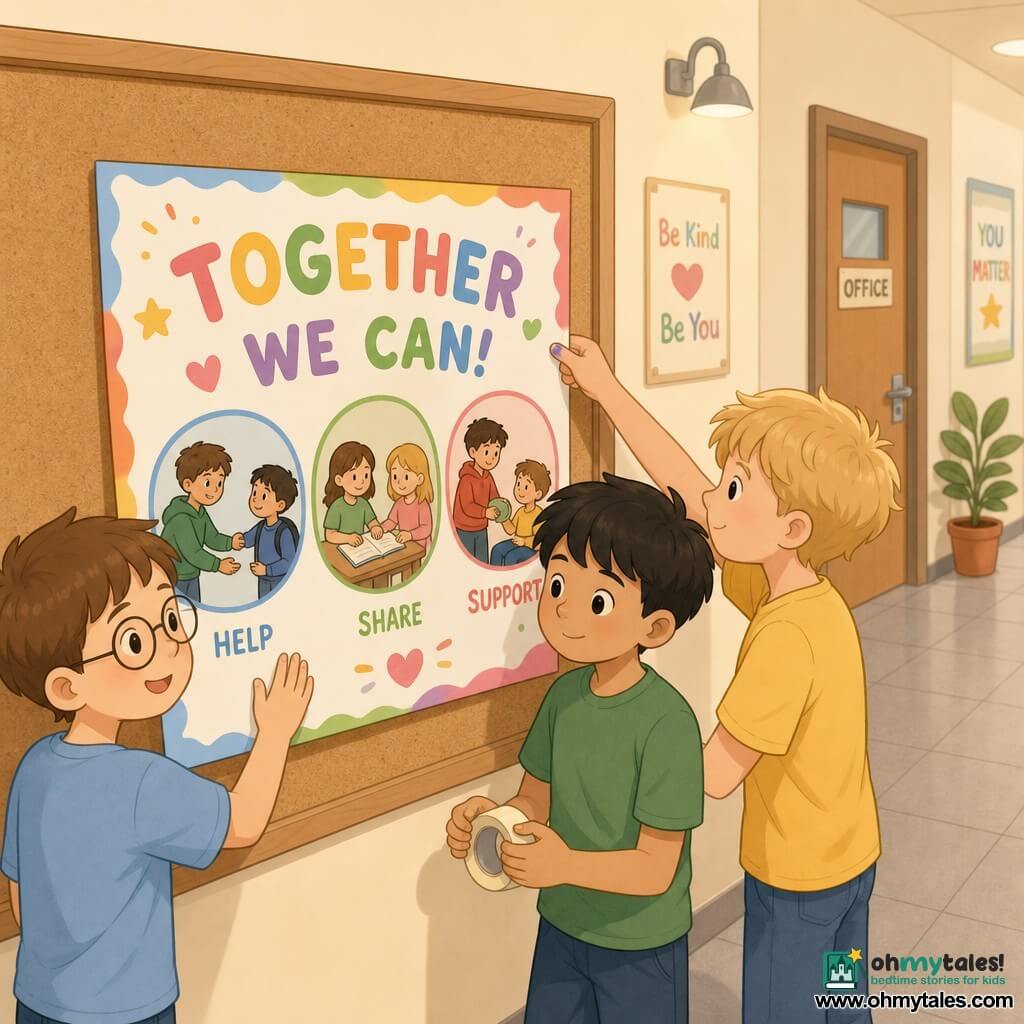
They unrolled the poster carefully. Jae held the top left, Oliver held the top right, and Milo smoothed the center so it lay flat.
A volunteer offered tape. Milo asked, “Is it okay if we use this tape on the wall?” The volunteer nodded, smiling, and Milo felt oddly proud of such a small question.
As they taped the corners, a younger kid wandered up with his mom. The kid stared at the drawings.
“Mom,” he said, pointing at the soccer panel, “that kid said okay even when the other kid said no.”
His mom nodded. “That's respectful.”
The kid looked up at Milo and the others. “Did you draw this?”
“We did,” Jae said.
The kid squinted at the third panel. “So if someone says no to a photo, you just… don't take it?”
Oliver answered gently, “Yep. Because it's their face, their choice.”
The kid considered that, then nodded like he'd stored it carefully in his brain.
Milo watched the kid walk away and felt something soft settle in him. Their poster was doing what it was supposed to do: teach something useful without scaring anyone.
Later, the three boys wandered through the fair. They tried free samples of fruit skewers. They signed a pledge to “Use Kind Words Online.” They played a cooperative game where you had to build a tower from paper cups while taking turns.
Milo noticed how often they checked in with each other without making it a big deal.
“Too loud in here?” Jae asked Oliver at one point.
Oliver shrugged. “A bit. But I'm good.”
Milo smiled. “If you want a break, we can step outside.”
Oliver looked surprised, then pleased. “Thanks. Maybe later.”
It felt like their friendship had grown an extra sense—like hearing a small sound you used to miss.
When it was time to leave, they stood once more in front of their poster. Under the library lights, the colors looked brighter. The words at the bottom stood out clearly:
KINDNESS INCLUDES CAUTION.
Jae read it out loud. “Sounds like something a wise turtle would say.”
Oliver nodded solemnly. “A turtle with a tiny clipboard.”
Milo laughed, and the laugh felt easy.
Chapter 6
On Monday, Mr. Dalloway returned the posters in class, but he kept theirs a moment longer.
“I got an email from the librarian,” he said. “Your poster was one of the most talked-about displays. She said people liked how practical it was.”
Oliver's grin was immediate and unstoppable. Jae looked proud in a quiet way, like he was saving the feeling for later.
Milo felt warm, but also thoughtful. “Can we keep it up somewhere?” he asked. “Like… not rolled in a closet.”
Mr. Dalloway nodded. “If you can find a spot the principal approves.”
At lunch, they marched to the office with the careful confidence of kids who had a good reason. Jae did the talking, because Jae could make a request sound like a plan the universe had been waiting for.
The principal, Ms. Ardent, listened, then said, “Hallway near the counseling office. That seems appropriate.”
Oliver whispered, “Appropriate is principal code for yes.”
After school, the three boys carried the poster down the hallway. The counseling office area was quieter, with softer lighting and a plant that looked like it had survived many secrets.
They stood in front of an empty space on the wall.
Milo held the poster up. “Straight?”
Jae tilted his head. “A tiny bit left.”
Oliver adjusted. “Now?”
“Perfect,” Milo said.
They taped it carefully. Milo pressed each corner twice, not because he didn't trust the tape, but because he liked the certainty of it.
When they stepped back, the poster looked like it belonged there, bright and calm at the same time. Students passing by slowed down to read. One seventh grader pointed at the panel about listening and nudged his friend, as if to say, Hey, maybe we should try that.
Oliver folded his arms, pretending to be very serious. “Our masterpiece is complete.”
Jae leaned closer to read the bottom line again. “Kindness includes caution.”
Milo watched their poster, then watched his friends. He thought about the torn page, the apology, the asking-before-taking, the small checks and small choices.
“Guess what,” Milo said quietly.
Oliver raised an eyebrow. “What?”
Milo nodded toward the wall. “That's basically a drawing of us.”
Jae smiled. “Not the superhero dog part.”
Oliver looked offended. “Especially the superhero dog part.”
They stood there a moment longer, proud in a gentle way. Not loud pride. The kind that sits on your shoulders like a warm hoodie.
Then Milo said, “Want to walk home together?”
Oliver nodded. “Yeah. But—can we take the long way? Past the bakery?”
Jae laughed. “Only if you ask nicely.”
Oliver cleared his throat dramatically. “May we please take the long way past the bakery?”
Milo and Jae answered at the same time, “Yes.”
And they went, side by side, the poster behind them hanging straight and steady, like a promise kept.