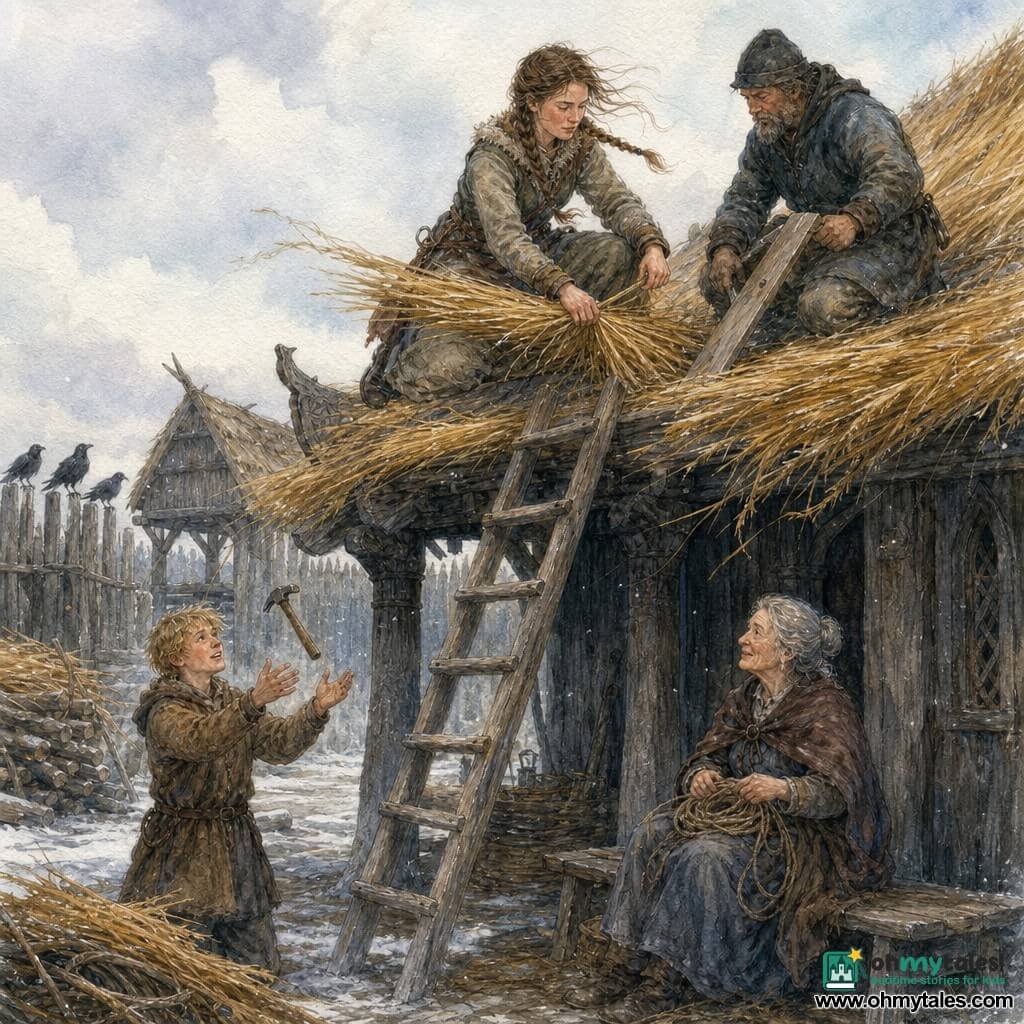
Chapter 1: The Grain-Scented Promise
In the time when clans stitched their lives together with oaths and iron, when the sea was a dark mirror and the mountains watched without blinking, a woman named Astrid walked the yard of her longhouse and listened.
She listened the way you listen to a sleeping friend—quietly, respectfully, as if sound itself might crack.
Above her, the grain loft crouched on its timber legs. It was not beautiful, not like a carved prow or a bright shield. It was simply necessary, like breath. Inside, sacks of barley and rye waited for winter's teeth.
And on the roof, a hole the size of a hungry mouth chewed at the thatch.
A thin line of daylight fell through it, bright as a spear-tip. When the wind came, it whistled through the gap and made the loose straw shiver. Astrid imagined snow blowing in, soft at first, then heavy, then cruel. Grain would spoil. Hungry mouths would multiply. Pride would taste like ash.
Her younger cousin Leif sauntered over, a grin on his face as if it had been nailed there.
“Look at that,” he said, pointing up. “The roof is trying to become a doorway for ravens. Maybe it wants to fly away.”
Astrid snorted. “If it flies, you can chase it.”
Leif made a dramatic bow. “I would chase it bravely. Then I would write a saga about my heroic running.”
Astrid tilted her head. “And who would store grain in a saga?”
Leif's grin softened. “So you will fix it.”
“I will,” Astrid said, and her words were a small stone dropped into deep water—simple, and rippling outward. “Today.”
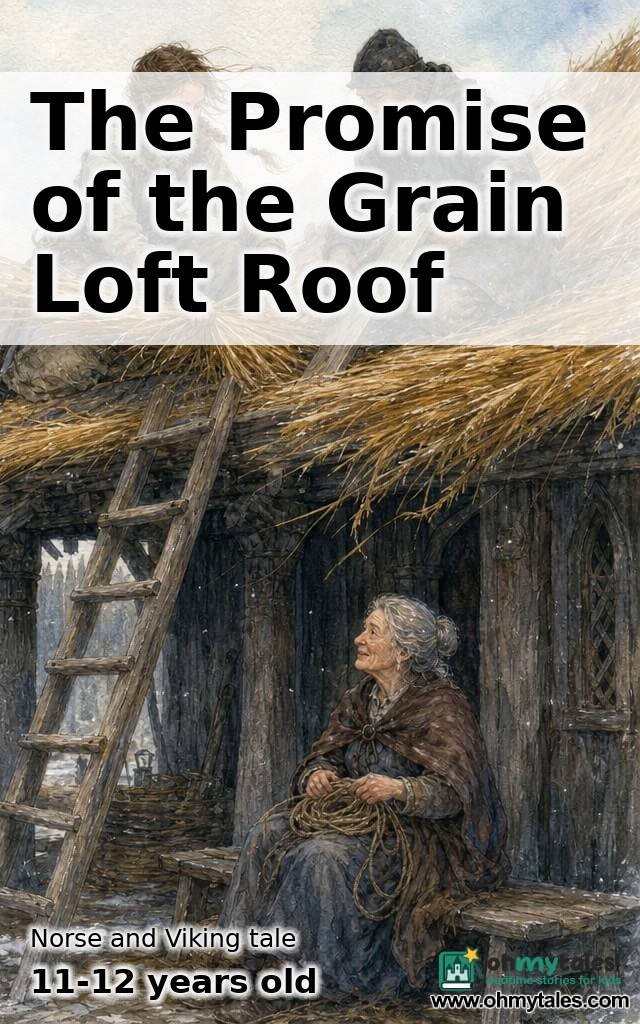
Old Sigrun, who had seen more winters than anyone counted, sat on a low bench by the wall, plaiting rope. Her hands moved like patient birds. Without looking up, she said, “A roof is a promise. Keep it, and the house keeps you.”
Astrid nodded, feeling the weight of that promise settle onto her shoulders. She was strong, yes. She could haul nets and split kindling and stand steady in a storm. But a roof was higher than pride, and pride was a slippery rung.
She looked up again. The hole seemed to blink at her.
“Well,” Astrid murmured, “I see you.”
Chapter 2: The Ladder and the Laughing Wind
Astrid gathered what she thought she needed: a bundle of fresh thatch, a hammer, wooden pegs, and the long ladder that always felt like it had its own opinion.
Leif insisted on carrying the hammer. He held it like a royal scepter. “If anyone asks, I am the Master of Tools.”
“You are the Master of Getting in the Way,” Astrid said, but she let him carry it. The yard was bright with cold sun, and even chores felt lighter when the light was clean.
They set the ladder against the grain loft. The wood groaned. The wind tugged at Astrid's braid as if it wanted to borrow it.
Up close, the roof looked worse. Straw had been torn away in a ragged circle. A few thin boards beneath had dark stains where rain had kissed them too often.
Astrid tested a rung with her boot. It held. She climbed, slow and steady, and each step made the ladder creak like an old story being told again.
Leif called from below. “Don't fall. It would be very inconvenient. I would have to carry you, and my heroism would be exhausting.”
Astrid leaned over the edge. “If I fall, I will land on your ego. It is large and soft.”
Sigrun's voice floated up, calm as smoke. “Keep your eyes on the work, not on your words. The wind loves a distraction.”
As Astrid reached the roofline, a gust slapped her cheek—sharp, playful, rude. It rattled the loose thatch and made her blink tears into her eyelashes.
“The wind is laughing,” Leif said.
“It can laugh,” Astrid muttered, “but it will not eat our grain.”
She swung a leg onto the roof and crawled like a careful bear. The thatch shifted under her palms. The hole yawned. She could see the dim loft beneath, the sacks like sleeping animals.
Astrid laid out the new thatch and began to pull away the rotten straw. Her hands worked, and the rhythm soothed her. Pull, place, peg. Pull, place, peg. It was almost like weaving.
Then her hammer slipped from her fingers.
For a heartbeat it hung in the air—an iron bird with no wings—then it tumbled off the roof.
Leif yelped and hopped back as the hammer thudded into the dirt.
Astrid's face burned hotter than a hearth. She had climbed up thinking she could do this alone, quickly, neatly, like a hero in a tale. But heroes in tales never mention the dropped hammer. They never mention the trembling knee when the wind pushes.
Leif picked up the hammer and held it over his head. “The Master of Tools has rescued the tool!”
Astrid sighed. “Throw it up. Carefully.”
“I am careful,” Leif said—and then he threw it like a stone for skipping.
Astrid snatched it midair with a gasp. The impact jolted her arm.
From the bench, Sigrun chuckled. “You two could start a war with a spoon.”
Astrid looked down, swallowed her pride, and called, “Leif. Stop joking. I need you to tie the rope around the ladder. It's shifting.”
Leif's grin faltered into seriousness. “Yes. Right away.”
Astrid watched him knot the rope, his fingers suddenly steady. The ladder stopped wobbling. The wind still laughed, but quieter now, as if it respected a good knot.
Astrid returned to her work, feeling a small lesson settle in: even a strong hand needs another hand nearby.
Chapter 3: The Hidden Rot
The patch looked good at first. New straw lay golden against old gray, like a fresh page in a worn book. Astrid pressed down and peered along the ridge.
But when she crawled a little farther, her palm sank into a soft spot. The roof sagged with a tired sigh.
Astrid frowned and pulled back the thatch. Underneath, a board had gone punky and dark. Rot had been nibbling there for a long time, silent as a mouse. The hole was only the loudest part of the problem.
She sat back on her heels. The sky above was pale blue, a cold bowl turned upside down. Her breath puffed out in small clouds.
“This is more than a patch,” she said.
Leif craned his neck from below. “Is it worse than your face says?”
“My face says nothing.”
“Your face says, ‘I will fight the roof and win, even if it takes all day and half my patience.'”
Astrid huffed a laugh despite herself. Then she called down, “We need new boards. And tar. And someone who knows how to set them properly.”
Leif looked toward Sigrun.
Sigrun had stopped plaiting rope. Her eyes were narrow, sharp as winter stars. “Call Eirik,” she said. “He built half the barns in this valley. He is stubborn, but so are you. You will get along like two goats on one bridge.”
Astrid's mouth tightened. Eirik was not family, but he was respected—an older craftsperson with hands like knotted roots. Astrid had always wanted to prove she could fix things without borrowing someone else's skill. Asking for help felt like stepping out of a warm cloak and into wind.
Yet the roof sagged under her like a warning. Pride could not hold boards in place.
She slid down the ladder, boots thumping each rung. When she hit the ground, she shook out her hands as if shaking off a thought she didn't like.
“I'll go,” Astrid said quietly.
Leif put a hand to his chest in mock shock. “You? Asking for help? The sagas will tremble.”
Astrid pointed at him. “Come with me. And if you sing about this later, I will replace your soup with seawater.”
They set off along the packed path between longhouses. The air smelled of smoke and cold earth. Ravens perched on fence posts, looking like black commas in a sentence only they understood.
As they walked, Astrid's mind kept returning to the grain loft. It wasn't a glorious task—no sword, no enemy, no treasure. Just a roof. But winter did not care about glory. Winter respected preparation.
Leif skipped a stone along a frozen puddle. “Why do you look like you're arguing with yourself?”
Astrid answered slowly. “Because I wanted to be enough.”
Leif's voice softened. “You are enough. But enough doesn't mean alone.”
His words landed gently. Astrid found she could carry them without bruising.
Chapter 4: Eirik's Measure
Eirik lived at the edge of the settlement where the wind had more room to run. His yard was full of wood offcuts and stacked planks, neat as a well-kept beard.
He opened the door before they knocked, as if he had heard their footsteps through the ground.
Astrid straightened her shoulders. “Eirik. I need your help.”
Eirik's gaze moved from her face to the hammer at Leif's belt, to the straw caught in Astrid's sleeve. “The grain loft roof,” he said. It wasn't a question.
Astrid blinked. “How did you—”
“The wind tells me,” Eirik said dryly. Then his mouth twitched, almost a smile. “And the ravens. They gossip.”
Leif whispered, “Even his jokes are made of wood.”
Eirik fetched a coil of tarred cloth, a hatchet, and a small bag of iron nails. “Show me.”
They returned to the loft. Eirik walked around it slowly, palm brushing the timbers, eyes scanning like a hunter's. Then he climbed the ladder with no rush, as if he and heights were old friends.
Astrid followed, feeling the roof's unevenness through her knees. Eirik pulled back the thatch and tapped the rotten board with his hatchet. The wood gave a dull, sad sound.
“This board has been dreaming of being earth again,” Eirik said. “You can't argue it back into strength.”
Astrid swallowed. “Can we replace it without tearing the whole roof?”
Eirik nodded. “Yes. But you must be patient. And you must listen.”
Leif, below, called up, “She can listen! Sometimes she even listens to me!”
Astrid shot down, “Mostly I listen to you being ridiculous.”
Eirik began to work, and Astrid worked beside him. He showed her how to lift the thatch without breaking it, how to wedge a new board in place, how to lay tarred cloth like a dark river under the straw so water would run away instead of creeping in.
Astrid tried to copy his movements. Her hands were quick, but quickness wasn't the same as accuracy. Once, she set a nail crooked. Eirik stopped her gently.
“Slow,” he said. “The nail is small, but it decides if the storm gets in.”
Astrid's cheeks warmed again. She pulled the nail out and tried again, breathing in the smell of tar—sharp and honest.
Below them, Sigrun watched, her rope forgotten. “Look at that,” she said to no one in particular. “A young oak learning from an older oak. The forest approves.”
Leif leaned against the ladder. “Astrid, tell him you are the Master of Roofs.”
Astrid kept her eyes on the work. “I am the student of roofs.”
Eirik's grunt might have been approval.
As the sun began to tilt toward afternoon, the sagging spot grew firm. The hole disappeared beneath neat layers of straw, laid like careful hair over a scar.
Astrid pressed down with her palm. Solid. The roof felt like it could hold secrets again.
She exhaled slowly, as if she had been holding her breath for days.
Chapter 5: The Storm's Small Test
They had just climbed down when the sky changed its mind.
Clouds rolled in from the fjord, low and gray, like a herd of heavy sheep. The wind picked up and began to pace the yard. It prodded the corners of the buildings, sniffing for weakness.
Leif looked up and frowned. “It's coming fast.”
Eirik wiped tar from his fingers onto a rag. “Good. Let the roof meet its first visitor.”
Sigrun rose from her bench, joints creaking like old timber. “A roof that hasn't met a storm is only a hat. Let us see if this one is a helmet.”
Astrid's stomach fluttered. She had done the work, yes—but the storm was the judge, and storms were not known for kindness.
The first flakes of snow arrived—small, tentative, like scouts. Then came a sudden burst of wind that flung them sideways. Snow slapped against Astrid's cheeks. The air tasted sharp.
They stood together and watched the grain loft.
The roof did not shiver. The thatch did not lift. The patched place held firm, the tarred cloth hidden beneath like a quiet oath.
Leif cupped his hands around his mouth and shouted at the wind, “Not today! Find another roof to bother!”
A gust pushed his hair straight up, and Astrid laughed—a real laugh that loosened something in her chest.
Eirik eyed the roof and nodded once. “It will hold.”
Astrid's shoulders dropped. Relief washed through her, warm as broth.
Then she noticed something else: the storm was not only testing the roof. It was also testing her. Would she boast now? Would she claim the victory alone?
She looked at Eirik's hands—scarred and steady. At Leif's rope work on the ladder. At Sigrun's quiet advice that had kept her from rushing. The roof was not her triumph. It was a shared shield.
Astrid turned to them. “Thank you,” she said. The words were simple, but they landed true.
Leif blinked as if the snow had stung his eyes. “You're welcome,” he said, and then added quickly, “But also, I saved the hammer earlier. Let's not forget the important parts.”
Astrid bumped his shoulder. “Never. Your heroism will echo for generations.”
Eirik's mouth twitched again. “If it echoes, it will be in an empty room.”
Sigrun laughed, a sound like dry leaves dancing. “Good. Humor is also a roof. It keeps the heart from getting soaked.”
The snow thickened, and they stepped back inside the longhouse. The fire crackled. Outside, the grain loft stood steady, quiet and proud—but not too proud.
Chapter 6: The Rune in Ash
Night came early, as it does in northern lands. Darkness pressed against the walls, and the wind spoke in low sentences along the eaves. Inside, the clan ate stew and bread, and someone told a story about a bear that stole a fisherman's boots. The laughter was soft, like wool.
Astrid sat near the hearth with a small bowl of ash beside her. The warmth made her fingers flexible again. She watched the sparks rise—tiny bright wishes—then vanish.
Sigrun sat across from her, eyes half-lidded. “You did well today,” the old woman said.
Astrid shook her head. “We did well.”
Sigrun's gaze sharpened with approval. “A roof is a promise,” she repeated, “and a promise is easiest to keep when it is carried by more than one back.”
Astrid dipped a fingertip into the ash. It clung to her skin like a shadow.
Leif leaned in, whispering, “Are you writing a secret spell to make roofs fix themselves?”
Astrid whispered back, “Yes. It requires silence and hard work. Two things you fear.”
Leif clapped a hand over his mouth in mock horror.
Astrid smiled, then turned serious again. She thought of the roof: the hidden rot, the dropped hammer, the moment she had swallowed her pride and asked for help. Humility was not kneeling in the dirt. It was standing tall without pretending you were taller than everyone else.
She traced a rune on the hearthstone with her ashy finger: ᛗ
The shape was simple—two strong lines joined, like two hands meeting. The rune of Mannaz: the human, the self and the community, the “I” that becomes “we.”
Astrid looked at it until the ash began to fade at the edges.
“May our roof hold,” she murmured, “and may our heads stay low enough to learn.”
Outside, the storm prowled and grumbled, but the grain loft kept its promise. Inside, the rune rested like a quiet smile in the ash, and Astrid felt the steady comfort of work done with others—stronger than pride, warmer than boasting, as humble as bread.