Chapter 1: The Man with Two Kinds of Strength
In the days when longhouses breathed smoke and sea-salt into the same cold air, there lived a man named Einar of Stoneford. He was not the loudest voice at the fire, nor the quickest fist at a feast. Yet people noticed him the way they noticed a sturdy bridge: not flashy, but always there when the river ran wild.
Einar was supple and firm at once—like a young birch that bends under snow but does not break. He could lift a barrel with calm shoulders, and he could listen to an old widow's worries without looking away. His laughter came rarely, but when it came it was warm, as if a small sun had rolled out from behind a cloud.
Across the narrow fjord lived Haldor Black-Knife, a neighbor with a temper as sharp as his nickname. Haldor had been wronged—everyone agreed on that. Last spring, a storm had snapped Einar's clan's mooring rope, and their drifting boat had slammed into Haldor's fish racks. His dried cod, his winter pride, had tumbled into the brine like pale leaves into a dark pond.
Einar's clan had paid what they could: a goat, a bolt of wool, two iron nails that were precious as teeth. But Haldor's anger did not eat goats or wear wool. It sat in him like a stone in a boot.
“Payment is not peace,” Haldor had said, eyes hard. “I still walk with pain.”
Einar nodded that day, though he had wanted to say, We all do.
Since then, the fjord felt narrower. The gulls still screamed their jokes above the waves, but when Haldor's boat passed, even the gulls seemed to quiet.
Einar carried a secret dream, folded inside his chest like a letter he had not yet dared to open: he wanted to soothe Haldor's anger. Not for praise. Not to look noble. Because anger, left alone, grew like a weed through floorboards. It would split the whole house.
That evening, Einar sat by the fire while his clan's voices rose and fell like waves. His younger cousin Runa—sharp-eyed, always smirking as if she had a private joke with the world—threw him a piece of dried apple.
“You've been staring at the flames,” she said. “Trying to see your future in them?”
“Only trying to see if they're hungry,” Einar answered. “Fire always wants more.”
Runa tilted her head. “And what do you want, Einar of Stoneford?”
He could have said: a better axe. A faster boat. A song with his name in it. Those were safe wants, like stones you could keep in your pocket.
Instead he said, softly, “I want the fjord to stop holding its breath.”
Runa's smirk faded into something steadier. “Haldor?”
Einar looked at the fire. The embers glowed like small red eyes. “Yes.”
Runa whistled. “That anger is a bear. You don't pet it. You spear it.”
Einar smiled. “Or you guide it away from the village.”
“Guide a bear?” Runa said. “With what, a polite bow?”
“With pride,” Einar said, and surprised himself with the word. “The kind that stands up straight without stepping on others.”
Runa tossed another apple piece into her mouth. “If you try, you'll need luck.”
“I don't trust luck,” Einar replied. “I trust work.”
Outside, night poured itself across the sky. The fjord lay black and glossy, like a blade laid flat. Somewhere across the water, Haldor's longhouse fire flickered. Einar watched it until his eyelids grew heavy.
He slept, and the secret dream stayed awake inside him, tapping its foot, waiting its turn to walk into daylight.
Chapter 2: The Riddle on the Shore
The next morning was bright with cold. Frost had stitched silver patterns on every rock, and the world looked freshly forged.
Einar went down to the shore, where nets hung like dark curtains and the smell of fish clung to everything, even the wind. His clan's old skald, Torfi One-Eye, sat on an upturned boat and carved a bit of driftwood. Torfi's missing eye made his gaze seem even more direct, as if he had one eye for the world and one for the truth behind it.
“Going somewhere, birch-man?” Torfi asked without looking up.
“I'm going to see Haldor,” Einar said.
Torfi's knife paused. “To fight?”
“To speak.”
Torfi snorted. “Words are arrows too. Some are poisoned.”
“I'm not bringing poison,” Einar said. “Only respect.”
Torfi set the driftwood down. “Respect is good. But Haldor's anger is not only about fish racks.”
Einar frowned. “What else, then?”
Torfi leaned forward, and his voice dropped into the rhythm of old tales. “Haldor's father was mocked once. A small thing—someone laughed at his poor catch. But the laughter stuck to him like burrs. When he died, Haldor inherited more than a boat and a knife. He inherited a bruise.”
Einar felt the shape of that in his mind. Bruises you could not see could still make a man flinch.
Torfi held up the driftwood. He had carved it into a simple figure: a bear with a tiny bird on its back.
“Here's a riddle,” Torfi said. “Which is stronger: the bear or the bird?”
“The bear,” Einar answered. “It could crush the bird.”
Torfi shook his head. “The bear is strong in its body. The bird is strong in its choice. It can leave.”
Einar stared at the carving. The bird's beak pointed forward, as if it knew where it was going.
Torfi tapped the bird with his knife handle. “If you want to soothe a bear, do not challenge its claws. Offer it a path that lets it keep its pride. A bear hates being trapped.”
Einar felt the advice settle into him, heavy and useful.
He thanked Torfi and walked along the shore until he reached the small pier where his boat was tied. It was a plain vessel, scarred from use, but it floated true.
Runa appeared behind him, wearing a thick cloak and a grin like a dagger that had learned manners.
“You didn't think I'd let you row into danger alone,” she said.
“I thought you liked watching me struggle,” Einar replied.
“I do,” Runa said cheerfully. “But I like you alive more.”
Einar sighed, but it wasn't a real complaint. “Then keep your tongue as sharp as your eyes.”
“No promises,” Runa said, stepping into the boat.
They pushed off. The fjord took them in, cold as a metal cup. Their oars dipped and rose, and the water whispered along the hull. Above, clouds drifted like slow herds. The world felt wide and watchful.
Halfway across, Runa leaned closer. “What will you say to him?”
Einar breathed in the sea air. “I'll tell him the truth.”
Runa squinted. “That's a dangerous habit.”
Einar's mouth twitched. “I'll tell him I'm proud of my clan, but I'm not proud of the harm we caused. I'll ask him what he needs to feel whole again.”
Runa nodded, and for once she didn't joke. “If he throws you into the water, I'll throw his pride in after you.”
“Don't,” Einar said. “Let him keep it. That's the point.”
The far shore came closer. Haldor's land looked the same as Einar's—rocks, pines, stubborn grass—but it felt different, as if the air itself held a grudge.
They pulled the boat up and walked toward Haldor's longhouse. Smoke rose from its roof in a thin, steady line. It looked like a finger pointing toward the sky, accusing the gods.
At the door stood Haldor Black-Knife.
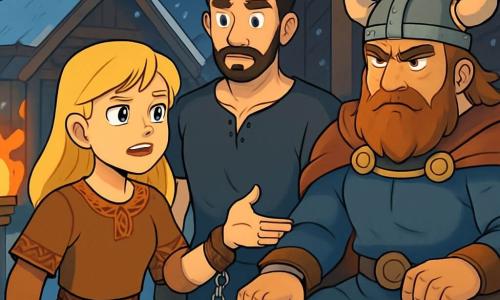
His hair was the color of wet ash. His eyes were pale, like ice that had learned to stare. The knife at his belt was not black, but its handle was dark and worn as if it had been gripped a thousand times in anger.
He looked at Einar, then at Runa, and his mouth tightened.
“So,” Haldor said. “The river brought me driftwood.”
Runa opened her mouth.
Einar lifted a hand. “We came to speak, Haldor.”
Haldor's laugh was short and sharp. “Speak, then. Let's see if your words can rebuild fish racks.”
Einar felt the old urge rise—pride's hot cousin, the urge to defend and blame. But he held it like a fish on a line, careful not to let it thrash.
He bowed his head, not too low. “I am Einar of Stoneford. I came because I do not want your anger to live like a wolf between our homes.”
Haldor's eyes narrowed. “Wolves are honest. They bite.”
“I'm trying to be honest,” Einar said. “I'm proud of my clan. We work. We pay our debts. But I'm not proud that your winter store was ruined because our rope failed.”
Haldor's jaw flexed. “Rope doesn't fail. Men fail.”
Einar nodded. “Then I failed, because I was responsible for that boat. If you want blame, take mine.”
Runa shifted, surprised. Einar could feel her staring at him like he'd grown a second head.
Haldor took a step closer, like thunder deciding whether to strike. “And what does your pride say, birch-man? That you'll kneel until I forgive you?”
Einar met his gaze. “My pride says I can stand and admit my fault. It also says I won't crawl. I won't trade my spine for peace. But I will work for it.”
For a moment, the only sound was the wind slipping around the longhouse corners.
Haldor's voice came out lower. “Work, then. Talk is cheap. Cheaper than fish.”
Einar nodded again. “Name it.”
Haldor's eyes flicked to the fjord. “In three days, there's a gathering at Frost-Hill. Traders, contests, boasting—people with too much noise in their mouths. I will bring a new rack I've built, and I will sell my first dried fish of the season.”
He leaned in, his breath pale in the cold. “You will carry that rack there for me. In front of everyone. So they see I am not weak, not ruined. So they see my hands still make winter.”
Runa bristled. “You want him to be your pack mule?”
Haldor looked at her like she was a gnat. “I want him to be seen.”
Einar's stomach tightened. Pride could be a sail or a stone. He heard Torfi's riddle in his head: offer a path that lets the bear keep its pride.
He thought of walking through a crowd while people stared. He thought of whispers: Einar carries Haldor's burden. Einar is paying for shame.
But then he thought of a different whisper: Einar is not afraid to mend what was broken.
He straightened. “I will carry it,” he said.
Runa's eyes went wide. “Einar—”
He held her gaze for a heartbeat, asking her without words: trust me.
Haldor's mouth twitched, almost a smile, but it didn't reach his eyes. “Good. Meet me at dawn on the third day.”
Einar nodded. “At dawn.”
As they turned to leave, Haldor added, “And if you drop it, birch-man, you'll pay twice.”
Einar looked back. “I don't plan to drop what I've agreed to carry.”
Haldor snorted. “We'll see.”
They walked away. The air felt slightly less tight, as if the fjord had released a small breath.
Runa exploded as soon as they were out of earshot. “You agreed to be humiliated!”
“I agreed to be tested,” Einar said.
“By a man who enjoys stepping on people.”
“By a man who needs to feel steady,” Einar corrected. “His pride is cracked. He thinks he must prove it with anger.”
Runa crossed her arms. “And you're going to fix it by carrying wood?”
Einar looked at the cold sea. “Not just wood. A message.”
Runa groaned. “I hate messages. They're always heavy.”
Einar smiled. “Then you understand exactly what I'm carrying.”
Chapter 3: Frost-Hill and the Weight of Watching Eyes
The third day came with a sky the color of polished steel. Dawn bled slowly over the mountains, and the world woke with the creak of ice and the cough of ravens.
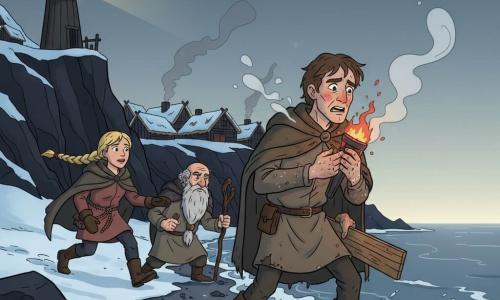
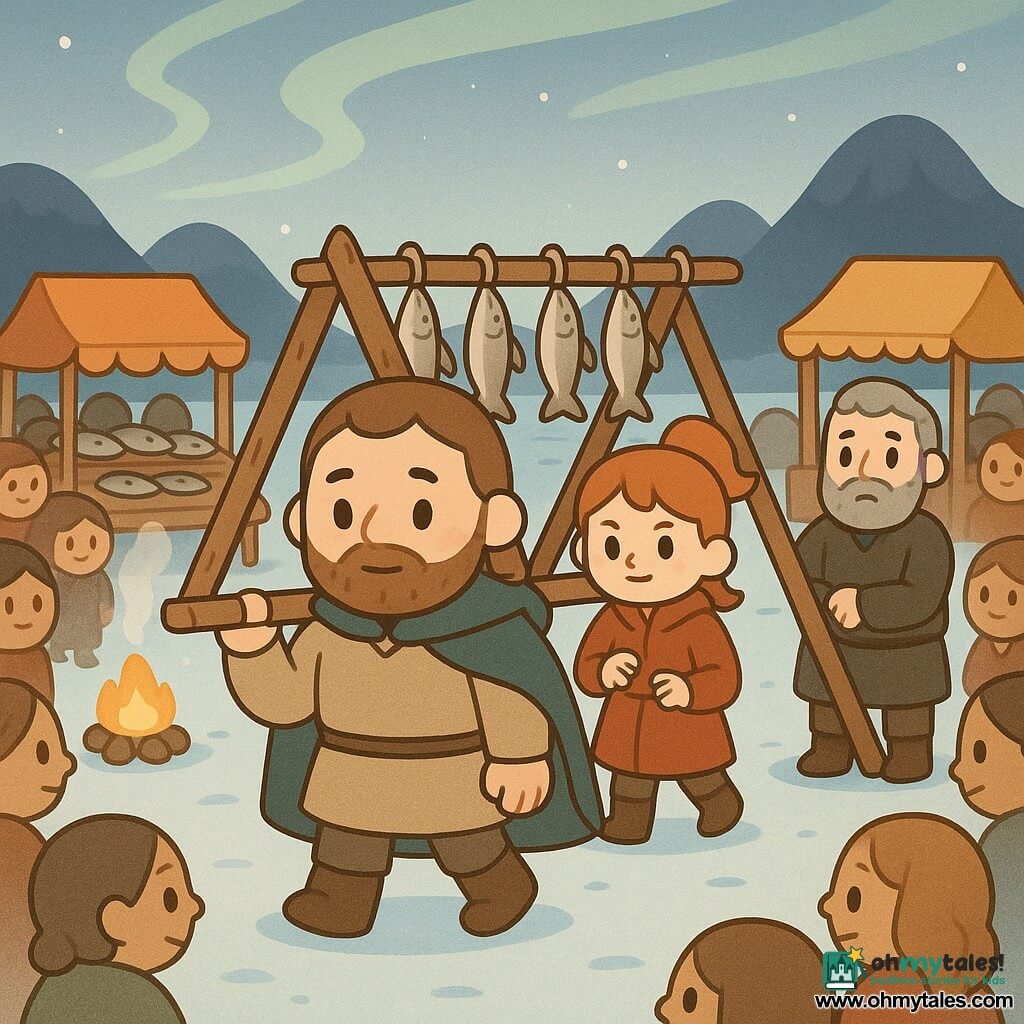
Einar and Runa rowed early, meeting Haldor on his shore. Haldor stood beside a new fish rack: long, sturdy poles bound with fresh rope. It smelled of pine sap and effort. It was not beautiful, but it was strong, like a promise.
Haldor pointed at it. “Lift.”
Einar tested the weight. The rack was awkward more than heavy; it fought his arms with angles and sharp corners. He adjusted his grip, finding balance like finding a rhythm in a drumbeat.
Runa muttered, “If anyone laughs, I'm throwing snowballs at their pride.”
Haldor ignored her. “We walk.”
They set off toward Frost-Hill, where the gathering would be. The path rose through pines that stood like dark guardians. Underfoot, frost cracked softly, like tiny bones. The rack creaked with every step, talking in wooden language about strain and stubbornness.
After a while, Haldor spoke without turning. “Why did you really come to my door?”
Einar kept his eyes on the path. “Because I don't want our children to inherit a feud the way you inherited a bruise.”
Haldor's shoulders stiffened. “You don't know what I inherited.”
“No,” Einar said. “But I see what you carry.”
Haldor said nothing. His silence was a closed fist.
When they reached Frost-Hill, the noise hit them like a wave. People from many shores crowded the open ground: traders with bright cloth, smiths with soot on their arms, hunters with fresh hides, boys trying to look older than their years, girls laughing like they owned the air. Fires crackled. Dogs darted between legs like living shadows.
And there were contests, too: wrestling, stone-throwing, boast-singing. Pride was everywhere, walking around in fine boots.
As soon as Einar stepped into the open with the rack on his shoulders, heads turned. Conversations stumbled. Eyes followed him like arrows.
“Is that Einar of Stoneford?” someone said.
“Why is he carrying Haldor's rack?” another asked.
A boy with freckles whispered loudly, “Maybe Einar lost a bet.”
Runa leaned close to Einar's ear. “Say the word. I'll ‘accidentally' trip that freckled windbag.”
Einar exhaled slowly. “Let them look.”
Haldor walked beside him, chin lifted. His face was hard, but something in his eyes flickered—uneasy satisfaction, like a man who has lit a torch and is not sure what it will reveal.
They reached a spot near the trading lines. Haldor pointed. “Set it there.”
Einar lowered the rack carefully. His arms trembled, but he did not let the wood slam the earth. He placed it as gently as a sleeping child.
A group of men from another fjord approached, smelling of tar and loud opinions.
One of them, broad as a door, grinned at Haldor. “Black-Knife! New rack? I heard your old one went swimming.”
Laughter popped like sparks.
Haldor's jaw tightened. The old stone in his boot began to grind.
Einar stepped forward before Haldor could speak. His voice rose clear but not sharp, like a horn call that chose peace.
“It went swimming because my clan's rope failed,” Einar said. “I was responsible. Haldor lost fish because of my mistake. Today I carry what he built because he is a craftsman worth seeing, and because my pride is not too delicate to do honest work in daylight.”
The laughter faltered. The broad man blinked, as if he'd expected a fight and had been handed a mirror instead.
Someone murmured, “He admitted it.”
Another said, quieter, “That's… rare.”
Haldor stared at Einar. For a heartbeat, his eyes looked almost startled, like a bear finding honey where it expected a spear.
The broad man cleared his throat. “Well,” he said, trying to recover his swagger, “that's… fair.”
He patted the rack. “Sturdy work, Haldor.”
Haldor's shoulders loosened a fraction. The crack in his pride did not vanish, but it stopped widening.
Runa, behind Einar, whispered, “You just made his anger trip over its own feet.”
Einar murmured back, “Keep watching.”
Haldor began to trade. People came, inspected the rack, nodded. They asked about fish, about weather, about ropes and knots. The talk shifted from mockery to craft. The gathering's attention moved on, like a tide turning.
Einar thought it was done. He let his hands rest, flexing his sore fingers.
Then a young man, drunk on mead and attention, stumbled up. He wore a bright brooch shaped like a wolf's head and looked proud of it, as if a piece of metal could grow him a spine.
He pointed at Einar and laughed. “Look! Stoneford's man carries another's burden. Is that your new saga, birch-man? ‘Einar the Servant'?”
A few people chuckled, eager for easy entertainment.
Runa's eyes narrowed into blades. “Now?”
Einar felt heat rise in him, quick and dangerous. His pride wanted to lash out, to prove itself by crushing the insult. His fists tightened. The old saga-path was clear: an insult answered with blood, a blood answered with more, until the fjord itself turned red in memory.
He looked at Haldor. Haldor's face went rigid, waiting. Perhaps hoping Einar would fight, so Haldor could say, See? He's just like all of them.
Einar inhaled. He pictured Torfi's bird—strong because it could choose.
Einar smiled at the drunk young man, not kindly, but steadily. “If you think carrying wood is shameful,” Einar said, “then your shoulders have never met real work. A man's worth is not in how loudly he brags. It's in what he can lift without dropping his honor.”
The young man blinked, confused by the lack of violence. “I—”
Einar continued, voice calm as a river under ice. “But if you want a contest, there is one suited to you. Help Haldor sell his fish. If your tongue is strong, use it for trade, not for tearing.”
The crowd laughed again—this time at the young man. The humor was gentle but firm, like a hand guiding someone away from a cliff.
The young man flushed. He muttered something and backed away.
Haldor let out a breath he seemed to have been holding for years.
Runa leaned toward Einar, grinning. “You hit him with a speech. That's worse than a punch.”
Einar's mouth twitched. “Punches heal fast. Words can learn manners if you train them.”
Haldor's gaze stayed on Einar as if he was seeing him clearly for the first time. Not as an enemy. Not as a debtor. As a man.
Still, anger does not leave like a guest asked politely. It must be shown the door, and sometimes the door sticks.
Chapter 4: The Knife and the Knot
Late afternoon brought a thin snow, light as sifted flour. The gathering began to thin. Fires burned lower. Traders packed their goods, grumbling about numb fingers.
Einar stood near the rack, watching Haldor count his trade items. Haldor had sold well. His chin sat differently now, less forced.
Runa wandered off to “accidentally” win a small wrestling match against a boy who had underestimated her. The boy limped away with his pride bruised but intact, and Runa returned looking pleased.
“Any more fools?” she asked.
“Not today,” Einar said. “The day is saving them for tomorrow.”
Haldor finished his counting and looked up. “You carried it well.”
Einar nodded. “You built it well.”
For a moment, that was all. Two simple truths, laid between them like shared bread.
Then Haldor's hand went to his belt. He pulled out his knife. The handle was dark, polished by years of grip. People nearby noticed and quieted, like animals sensing a change in wind.
Runa stiffened. “Einar—”
Einar did not move. He kept his hands open at his sides.
Haldor held the knife out—not pointing, not threatening. Offering.
“This was my father's,” Haldor said. His voice sounded rough, as if it had scraped its throat on old memories. “He carried it when men laughed at him. He never laughed again.”
Einar listened.
Haldor swallowed. “When your boat wrecked my racks, it felt like that laughter returned. Like the world was mocking my house.”
Einar nodded slowly. “I understand.”
Haldor's eyes narrowed, but not with anger—more like fear of being seen. “Do you?”
Einar stepped closer, just enough to show he wasn't running. “My pride used to be a shield,” he said. “Then I learned it can be a lamp. It can light the path instead of blocking arrows. Your father's knife is a shield. But shields get heavy.”
Haldor's hand trembled almost invisibly. “What are you saying?”
“I'm saying you don't have to carry his bruise forever,” Einar said. “Keeping your pride doesn't mean keeping your pain.”
The snow fell softly between them, a quiet audience.
Haldor looked down at the knife. Then, in a motion that surprised everyone, he turned the handle toward Einar.
“Take it,” Haldor said.
Runa inhaled sharply. A knife offered could be a trap—or a trust.
Einar did not reach for it immediately. “Why?”
Haldor's voice came out strained. “Because I am tired of gripping it like a threat. I want to grip it like a tool. If you take it, it means… it means I'm not guarding my father's shame alone.”
Einar felt the weight of the moment. A knife was not just iron. It was history sharpened.
He remembered Torfi's bear and bird. Give the bear a path.
Einar lifted his hands slowly and took the knife by the handle. He did not raise it. He did not test its edge. He simply held it, respectful as a man holding another's story.
Then Einar reached into his pouch and pulled out a coil of rope—new rope, thick and clean, made from good fibers twisted tight. His clan had spent time on it, fingers raw from work. It smelled of hemp and salt.
“I brought this,” Einar said. “Not as payment. As a promise. The rope that failed will be replaced by rope that holds.”
Haldor stared at the coil as if it were a strange animal. “You carried that here?”
“Yes,” Einar said. “Because some things should be carried before they are needed.”
Haldor let out a small, bitter laugh. “You're a stubborn man.”
Einar's eyes warmed. “So are you.”
Haldor reached for the rope. His fingers brushed it, testing. Then his hand tightened, and he nodded once, sharp and final like an axe stroke.
“Come,” Haldor said. “Help me tie the rack for the journey home.”
Einar handed the knife back carefully. Haldor accepted it, but his grip looked different now—less like a warning, more like a habit he could change.
They knelt by the rack together. Einar worked the rope into strong knots, each twist neat and sure. Knots were honest. They didn't care about pride. They either held or they didn't.
Haldor watched, then joined in, his own hands quick. Their fingers moved in rhythm, like two drummers finding the same beat.
Runa crouched nearby, pretending to inspect a pebble while actually listening with all her sharp attention.
Haldor spoke quietly. “When you spoke earlier… in front of them… why did you do it?”
Einar tightened the final knot. “Because I would rather be laughed at for honesty than praised for silence.”
Haldor's mouth twitched. “That sounds like a line a skald would steal.”
“Let him,” Einar said. “I'll charge him a goat.”
Runa snorted. “Make it two.”
Haldor actually smiled—small, reluctant, but real. It was like seeing a crack in ice reveal running water beneath.
The rack was secured. The snow eased. The light began to slant toward evening.
Haldor stood and looked at Einar as if weighing him—not in anger now, but in thought.
“My father used to say pride is a fire,” Haldor said. “If you feed it wrong, it burns your house.”
Einar rose. “Feed it with truth,” he said, “and it warms everyone.”
Haldor nodded once, slow. “Row with me tomorrow. Across the fjord. Eat at my fire.”
Runa's eyebrows shot up.
Einar's chest felt oddly tight, as if a knot inside him was loosening. “I will,” he said. “And you will eat at ours the day after.”
Haldor grunted. “Don't push your luck.”
“I don't trust luck,” Einar replied. “I trust work.”
Haldor looked away, but Einar saw the corner of his mouth lift again.
They parted for the night. The gathering ground emptied, leaving only trampled snow and fading smoke—proof that even loud days become quiet stories.
Chapter 5: A Dawn with Fading Northern Fire
They rowed home the next day under a sky brushed with pale clouds. The fjord was calmer, as if it, too, had decided to stop sharpening itself.
Haldor sat in his boat, and Einar sat in his own beside him. They didn't race. They didn't show off. They moved at the same pace, oars dipping like steady heartbeats.
Runa, of course, rowed slightly ahead just to prove she could. “Try to keep up, old men!” she called back.
“We're not old,” Einar called.
“You're acting sensible,” Runa shouted. “That's the same thing!”
Haldor made a sound that might have been a chuckle. “Your cousin is a storm in a cloak.”
“She's useful,” Einar said. “Storms clear the air.”
When they reached Stoneford's shore, Einar's clan watched from the longhouse door. Faces were curious, cautious. Feuds were familiar, and peace was suspicious—like a quiet dog you weren't sure you could pet.
Einar stepped onto the shore and spoke first, voice carrying. “Haldor Black-Knife comes as a guest.”
His clan's leader, Sigrid Broad-Brow, studied Haldor. Then she nodded once. “Then he will be treated as one.”
Haldor's shoulders eased. He followed Einar into the longhouse.
Inside, warmth wrapped around them. Smoke curled up to the rafters. The fire crackled like friendly gossip. Bread and stew appeared, because in those days, food was a language everyone understood.
Haldor ate at Einar's fire. He spoke little, but he listened. When someone mentioned last spring's storm, Haldor's jaw tightened—but then Einar, without making a show of it, set a fresh piece of fish on Haldor's wooden plate.
Not as a bribe. As a simple act: You are here. You belong at a table, not at a battlefield.
Later, as the clan settled into quieter talk, Haldor stood near the door, looking out at the night.
Einar approached him. “How does it feel?” Einar asked.
Haldor's voice was low. “Strange. Like walking without a stone in my boot.”
Einar nodded. “You'll still remember it was there.”
“I will,” Haldor said. “And maybe that's good. It reminds me not to laugh at other men's catches.”
Einar's eyes softened. “Your pride isn't smaller for letting go of anger. It's cleaner.”
Haldor looked at him sharply. “Don't make me into a story.”
Einar's mouth twitched. “Too late. Runa is already planning to exaggerate everything.”
As if summoned, Runa appeared with a cup. “Exaggerate what? I only tell the truth, but louder.”
Haldor stared at her.
Runa sipped and said, “So. Are you done being angry?”
Haldor blinked, then huffed. “I'm learning.”
Runa nodded solemnly. “Good. Learning is less messy than fighting.”
Haldor looked toward Einar. “Your pride… it's a strange thing.”
Einar leaned against the doorframe. “It used to be a wall. Now I try to make it a mast.”
“A mast?” Haldor asked.
Einar glanced outside. The night sky had begun to change. In the north, faint ribbons of light stirred—green and pale, like silk waking up.
“A mast holds the sail,” Einar said. “It doesn't move much. But it lets you go somewhere.”
Haldor followed his gaze. The aurora strengthened, spreading across the darkness like a quiet song. Everyone drifted outside, drawn as if by a gentle command. Even the dogs stopped to stare.
The lights rippled overhead, a river in the sky. Green shifted to blue, blue to a soft white. It was as if the heavens were weaving a blanket for the world.
Runa whispered, “Looks like the gods are showing off.”
Einar murmured, “Or reminding us we're small.”
Haldor stood beside Einar, both men looking up. The aurora's glow reflected in Haldor's pale eyes, making them less icy.
“I thought pride meant never bending,” Haldor said quietly. “My father bent once, and men laughed. So I swore I would be hard.”
Einar's voice was calm. “A tree that never bends snaps in the first great storm.”
Haldor breathed out. The sound fogged in the air. “Then maybe I will be… birch, like you.”
Einar chuckled softly. “Try it. It's uncomfortable at first.”
The aurora began to pale. Its bright ribbons thinned, fading like a story reaching its final lines. The sky's great fire dimmed into a shy dawn.
As the first gray light crept up from the horizon, Einar felt something settle inside him—not triumph, not superiority, but a steady pride like a well-built hearthstone.
He had not won a fight. He had not crushed an enemy. He had carried a burden, spoken truth, and offered a path where pride could walk without dragging anger behind it.
Haldor turned to him and held out his hand. “Across the fjord,” Haldor said, “let there be no wolf between our homes.”
Einar clasped it. Their hands were rough, honest hands.
“No wolf,” Einar agreed.
Runa yawned loudly. “Wonderful. Now that you've solved the world, can we have breakfast?”
Einar laughed, and even Haldor's mouth curved again. Above them, the aurora faded further, paling into morning—soft, quiet, and sure.
And in that new light, pride did not look like a crown. It looked like a man standing straight, owning his mistakes, and choosing to mend what he could.