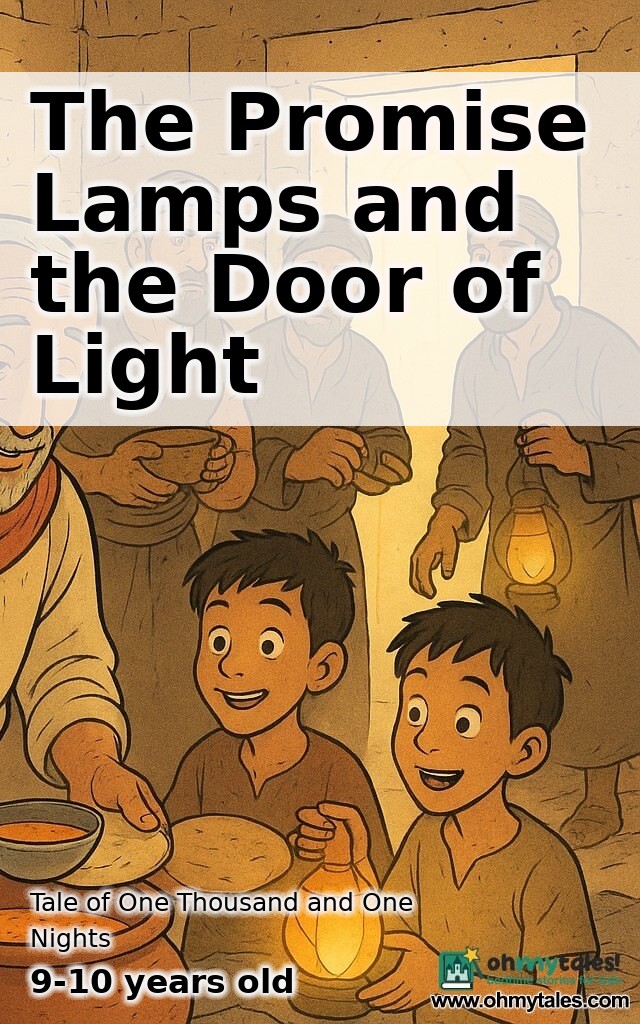
Chapter 1: The Promise-Lamps of Qamar
In the city of Qamar, the nights did not simply arrive—they unfolded like velvet cloth, and on that cloth people hung promises.
Every evening, families climbed to their rooftops and lit small glass lamps. Inside each lamp was a thin strip of paper with a promise written on it: “I will help my sister with her sums,” or “I will return what I borrowed,” or “I will speak kindly even when I am tired.” When the flame kissed the words, the lamp glowed as if it had swallowed a little star.
Yusuf was a man who carried water for a living. His shoulders were strong, but his smile was soft, the way fresh bread is soft before it cools. He walked the alleys with two clay jars swinging from a pole, listening to the city's laughter, the market's chatter, and the gossip that hopped from tongue to tongue like a bold sparrow.
He did not own a rooftop. He rented a corner room with a window so small it seemed shy. Still, Yusuf made promises.
He wrote them on scraps of paper and tucked them into his pocket. When he felt the paper brush his fingers, it was like a hand gently reminding him to stay true.
And Yusuf had a secret dream: beyond the city, past the dunes that looked like sleeping lions, there stood an old desert sanctuary—an oasis shrine with a small dome the color of moonmilk. Travelers said it had been built long ago to offer shade and water to anyone crossing the empty land. Yusuf had visited once as a boy and had never forgotten the coolness of its stones, the hush inside, and the palm trees that waved like kind grandmothers.
But lately, rumors had arrived with dusty boots: pillards were roaming the desert, stealing water, robbing travelers, and breaking sacred places as if they were toys.
Yusuf's heart tightened each time he heard it. He wanted to protect the sanctuary. Yet he was only a water carrier, not a soldier with a shining sword.
One night, as the city's promise-lamps shimmered like a second sky, Yusuf whispered into his pocket-paper, “I will keep the sanctuary safe.”
The words felt too big for his small room. Still, he kept them.
Chapter 2: A Stranger in the Spice Smoke
The next day, the market smelled of cumin, orange peel, and warm dust. Vendors called out like cheerful drummers, and the spice smoke curled through the air like lazy ribbons.
Yusuf delivered water from stall to stall. At the edge of the market, by a man who sold dates as glossy as polished stones, Yusuf noticed a stranger sitting very still.
The stranger wore a plain robe patched in many places, as if it had traveled more than it had rested. His beard was short and silvered, and his eyes were the bright brown of strong tea. In front of him sat an empty bowl, but his posture was so calm it made the noise of the market seem far away.
Yusuf, without thinking too hard, set down his jar and poured water into the bowl.
“Thank you,” said the stranger. His voice was gentle, but it had the weight of a well—deep and steady.
“It's only water,” Yusuf said, suddenly embarrassed, as if he had offered a pebble instead of a treasure.
“Only water?” The stranger's eyebrow lifted. “In the desert, ‘only water' is a king.”
Yusuf chuckled. “Then today my jar is wearing a crown.”
The stranger smiled, and the smile was quick, like sunlight flashing on a knife—bright but not dangerous.
They spoke a little. Yusuf tried to keep his words modest, as his mother had taught him: the best stories taste sweeter when they are not drowned in bragging.
Still, the stranger seemed to notice things Yusuf did not say.
“You carry water,” the stranger murmured, “but you carry a heavier thing too.”
Yusuf shifted. “Perhaps it is just the pole on my shoulders.”
“Perhaps,” said the stranger, “or perhaps it is a promise.”
Yusuf's pocket suddenly felt warm.
Before Yusuf could answer, a shout rolled through the market. Two men were arguing near a carpet seller. One accused the other of stealing, and the crowd leaned in like curious reeds bending toward a river.
Yusuf stepped closer, ready to calm them if he could. The stranger rose too, but he did not push forward. He simply watched, as if reading a book written in movement.
The quarrel ended quickly. It turned out the “stolen” purse had been sitting under a stack of carpets the whole time. The accuser looked ashamed, and the accused looked tired.
Yusuf offered both men a cup of water. “Cool your tongues,” he said. “Hot words burn the mouth first.”
The crowd laughed softly. Even the two men managed a grin.
The stranger nodded. “A heart that pours out water can pour out peace.”
Yusuf scratched his chin. “Peace is cheaper than carpets, thank goodness.”
At sunset, when the market emptied and the promise-lamps began to glow, the stranger approached Yusuf once more.
“Your feet know the path to the desert,” he said.
“My feet know many paths,” Yusuf answered carefully. “But my dreams know one.”
“Then listen,” said the stranger, and he placed something small into Yusuf's hand.
It was a ring, plain as a pebble. No jewel. No engraving. Just smooth metal, cool and quiet.
“What is this?” Yusuf asked.
“A key,” the stranger said. “Not for doors you can see.”
Then, with the crowd flowing between them like water, the stranger was gone.
Chapter 3: The Door Without Wood
That night, Yusuf could not sleep. The promise-lamps outside his window painted trembling gold on the walls. The ring sat on his palm like a question.
“A key,” he whispered, “for doors I can't see.”
Yusuf was not foolish. He knew better than to trust every mystery that walked into the market wearing a patched robe. But he also knew something else: generosity often returned in strange costumes.
Before dawn, he packed bread, dates, and a small waterskin. He tied his scarf tight and slipped out of the city, while the stars still watched like quiet guardians.
The desert greeted him with its wide silence. The dunes rose and fell like waves frozen mid-sigh. As Yusuf walked, he kept his eyes on the horizon and his mind on the sanctuary. In his imagination it stood waiting, patient and vulnerable, like a candle in an empty room.
When the sun climbed higher, Yusuf's throat began to feel like dry cloth. He sipped carefully. A water carrier knows that every drop is a story—once it is told, it is gone.
At last, near midday, the sanctuary appeared: a pale dome, a low wall, palm trees, and the glint of an oasis pool. It looked almost the same as Yusuf remembered.
Almost.
The gate hung crooked. A few stones lay scattered, as if someone had kicked the place in anger. Yusuf's stomach tightened.
He stepped inside quietly. The air under the dome was cooler, smelling faintly of old incense and wet stone. Yusuf knelt, touched the floor, and whispered, “I'm here.”
Then he heard voices outside—rough voices, laughing the wrong kind of laughter.
Pillards.
Yusuf's heart jumped like a frightened rabbit. He peered through a crack in the wall. Three men stood near the pool. One held a sack. Another tossed a coin into the air and caught it, again and again, as if boredom was his favorite game. The third was drinking water as if he owned the sky.
Yusuf's hands began to shake. He had no sword. No soldiers. Only bread, dates, and a plain ring.
He slipped the ring onto his finger, more because he needed to do something than because he had a plan.
For a moment, nothing happened.
Then the air near the sanctuary wall shimmered, like heat above sand. A thin outline appeared—a doorway drawn by light itself. No wood. No handle. Just a shape made of glowing promise, as if the night-lamps of Qamar had come here to write in the air.
Yusuf stared. His breath caught.
The doorway waited, silent and patient.
He reached out. His fingers passed through the light as if through cool water. A soft wind breathed from the opening, carrying the scent of the city at night—warm bread, rooftop smoke, and the hopeful sting of lamp oil.
Yusuf swallowed. “All right,” he whispered. “If you are a door, then I will be a man brave enough to use you.”
And he stepped through.
Chapter 4: Ruse of the Heart
Yusuf found himself in a narrow street of Qamar—right behind the market's date stall. It was early afternoon here, as if the door had folded time like a cloth and tucked him into a different pocket.
He turned back. The glowing doorway floated against a blank wall. He could still see the desert sanctuary through it, like a picture framed in light.
Yusuf's mind raced. A door like this could help him bring soldiers… but soldiers might arrive too late, and the pillards would flee and return another day. He needed something clever, something kind, something that would make them choose to leave and never wish to come back.
He remembered what the stranger had said: a heart that pours out water can pour out peace.
Yusuf hurried into the market and went straight to Auntie Nura, who ran a soup pot large enough to bathe a camel's feet. She was famous for feeding anyone who looked hungry—even if they “forgot” their coins at home.
“Auntie,” Yusuf said, “I need your help. And your biggest pot.”
Auntie Nura squinted. “Yusuf, your eyes look like a boy planning trouble.”
“Not trouble,” Yusuf said. “A lesson.”
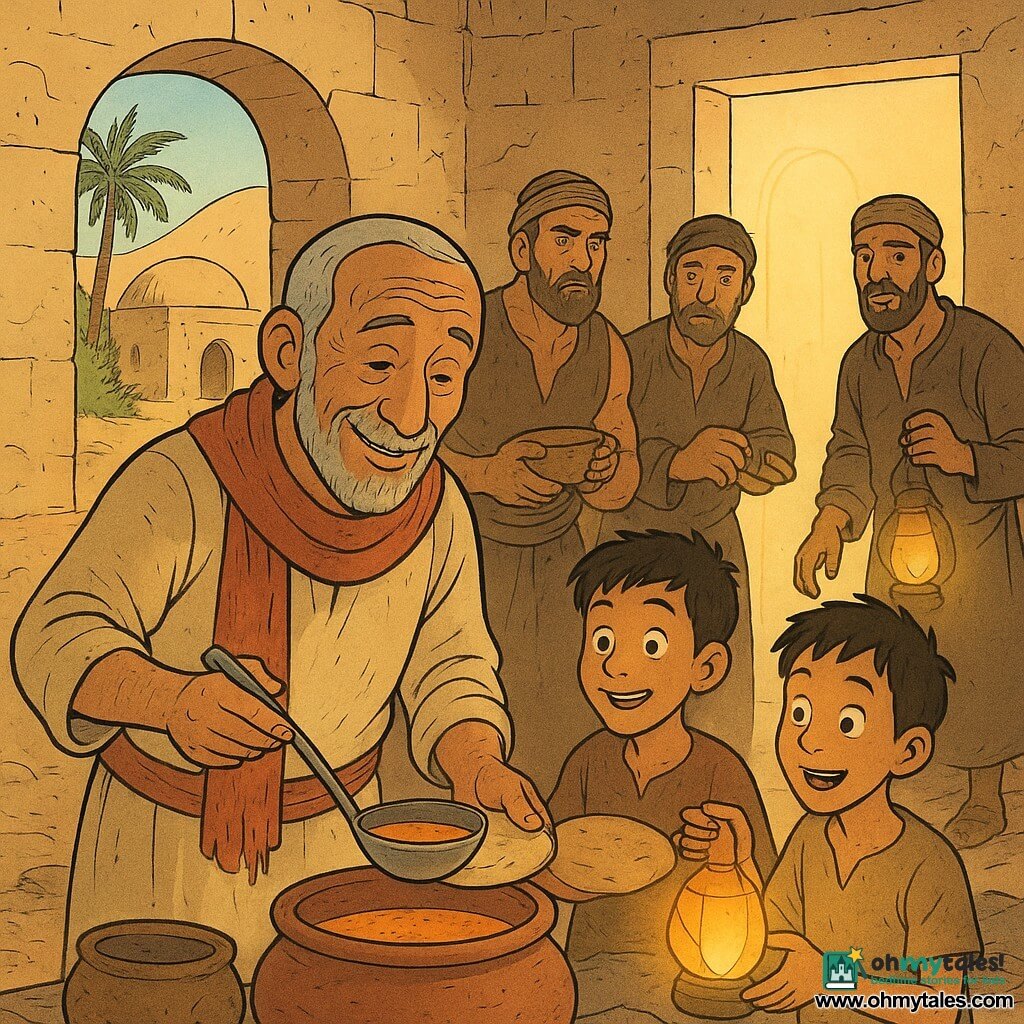
Within minutes, Yusuf gathered what he could: a pot of chickpea stew thick as a hug, flatbreads piled like soft pillows, and a bundle of small promise-lamps—cheap ones from a lantern seller who owed Yusuf a favor and two cups of water.
Yusuf returned to the glowing doorway, balancing the pot with two helpers from the market—thin boys who moved fast and asked questions later.
“Where are we going?” one boy panted.
“To a place that needs kindness with sharp edges,” Yusuf said.
They stepped through.
The sanctuary's heat wrapped around them again. The pillards were still by the pool, lazing like lizards. When they saw Yusuf and the steaming pot, they blinked in surprise.
Yusuf walked forward openly. His knees wanted to wobble, but he kept them steady. He set the pot down with a loud thump.
“Peace on you,” Yusuf called. “Travelers must be starving. You look hungry enough to bite the desert.”
One pillard narrowed his eyes. “Who are you?”
“A man with soup,” Yusuf said. “And a poor sense of danger.”
The second pillard laughed. “That part is true.”
Yusuf lifted a ladle. The stew's smell rose into the air, and even hard men have soft noses. “Eat,” Yusuf said. “The desert is already mean. Let us not help it.”
The pillards hesitated. Hunger argued with suspicion inside them. Hunger won.
They ate. They tore bread. They drank. Their shoulders dropped a little, as if the food untied knots inside them.
Yusuf watched quietly. Then he placed the small promise-lamps on the ground and lit them one by one. Each lamp glowed warmly.
The first pillard scoffed. “What are those? Toys?”
“Promises,” Yusuf said. “In my city, we light them so our words don't wander off.”
The third pillard, the one who had drunk from the pool, stared at the lamps. “Promises are for soft people.”
Yusuf nodded. “Yes. Soft like water.”
The pillard snorted. “Water is weak.”
Yusuf dipped his ladle into the pot and poured stew into a bowl. “Weak things keep you alive,” he said mildly. “Air. Water. Bread. Sleep. Even kindness, when you are lucky.”
The men ate in silence.
Then Yusuf did something that made the boys beside him gasp. He bowed his head slightly.
“I am only a water carrier,” Yusuf said. “I cannot fight you. I cannot chase you. But this sanctuary is not mine to lose. It belongs to every tired traveler, even you.”
The first pillard frowned. The second stopped chewing. The third stared at Yusuf's hands, rough and honest.
Yusuf continued, voice steady as a drumbeat far away. “If you take from here, you steal from the thirsty. And if you break this place, you break something inside yourselves too, even if you pretend you don't hear it.”
The second pillard shifted. “We do what we must.”
Yusuf nodded again. “So do I.”
He pointed gently to the glowing doorway's shimmer in the air behind him. The pillards followed his gesture and saw it—the invisible door now bright as a slice of moon.
“What is that?” the first pillard whispered, suddenly less brave.
“A door,” Yusuf said. “It opens for those who come with a clean purpose.”
The third pillard stood. “You're lying.”
Yusuf shrugged. “Perhaps. But you saw it. And now you are wondering.”
Wonder is a clever hook. It catches even the toughest fish.
Yusuf took one of the promise-lamps and held it out. “Make a promise,” he said. “Not to me. To the light. Promise you will leave this sanctuary as you found it, and never return to harm it. Then the door will show you a safer path—one where you won't have to scrape your life from other people's bowls.”
The first pillard laughed, but it sounded thin. “A lamp and a promise? That's your weapon?”
Yusuf smiled softly. “No. My weapon is your own heart. I'm just knocking on it.”
For a moment, the only sound was the palm trees whispering.
Then the second pillard—whose eyes looked tired, not cruel—reached out and took the lamp.
He cleared his throat, as if speaking a promise hurt more than being hit. “I promise… I will not steal from this place. I will go.”
The lamp flared brighter, and the glowing doorway pulsed like a living thing.
The first pillard's grin slipped. “What trick is this?”
“A simple one,” Yusuf said. “The kind that only works when someone chooses it.”
The third pillard looked from the bright lamp to the calm pool. He swallowed. “If we leave,” he muttered, “we leave empty-handed.”
Yusuf lifted the pot lid. “Take bread,” he said. “Take stew for the road. Take water. Take what is given.”
The boys beside Yusuf stared at him as if he had grown a second head.
Yusuf kept his voice low. “A thief takes and stays hungry. A guest receives and remembers.”
The first pillard's face twitched, as if pride wrestled with fear and lost. Finally he spat into the sand—not at Yusuf, but at his own hesitation.
“Fine,” he growled. “I promise too.”
The third pillard hesitated the longest. Then, very quietly, he said, “I promise.”
Each lamp brightened as each promise was spoken, until the sanctuary glowed as if dawn had moved in.
Yusuf stepped aside. “Go,” he said.
The pillards passed through the door, carrying bread and stew and water, looking over their shoulders as though expecting the light to bite them.
But the light did not bite. It simply watched.
When the last pillard disappeared, the doorway's shimmer faded, like a sigh of relief.
Yusuf sank to his knees. His hands were trembling now, but his smile returned, shaky and real.
The sanctuary was safe—for today.
Chapter 5: The Ring Returns to Silence
The boys helped Yusuf set the sanctuary in order. They straightened the gate, stacked the scattered stones, and swept sand from the cool floor. Yusuf filled a cracked bowl with clean water and placed it near the entrance for any traveler who might arrive.
When the work was done, the afternoon had softened into evening. The desert sky turned the color of apricots, and the first star appeared—small but stubborn.
Yusuf sat by the pool and removed the plain ring. It looked ordinary again, like a pebble that had decided to be metal.
The patched-robed stranger appeared as if he had stepped out from behind the palm trees, though Yusuf was certain there had been no one there a moment before.
“You used it,” the stranger said.
“I did,” Yusuf replied. “But not the way I first imagined.”
The stranger's eyes crinkled. “You imagined swinging a sword.”
“I imagined being important,” Yusuf admitted, and his cheeks warmed. “The hero everyone points at.”
“And instead?”
“Instead I brought soup,” Yusuf said, then added with a tired laugh, “which is a much heavier weapon than it looks.”
The stranger sat beside him. “Tell me, Yusuf the Water Carrier—did you defeat them?”
Yusuf stared at the quiet water. “No. They chose to leave. I only… offered them a different story.”
“A ruse of the heart,” the stranger said, pleased.
Yusuf glanced at the ring. “Why me?”
The stranger shrugged, as if the answer were as simple as breathing. “Because you poured water into an empty bowl without asking for a name. Humility is a lamp that does not boast about its flame.”
Yusuf looked down. “I was afraid.”
“Of course,” said the stranger. “Bravery without fear is just loudness.”
Yusuf turned the ring between his fingers. “Will the door open again?”
“Only when it must,” said the stranger. “Magic is like a guest: if you invite it too often, it starts to eat all your bread.”
Yusuf laughed, imagining magic sitting at Auntie Nura's soup pot, asking for seconds.
The stranger held out his hand. “Now, give it back.”
Yusuf placed the ring in his palm. It vanished like a drop of water sinking into sand.
Before Yusuf could ask a hundred questions, the stranger rose. “Your promise was to protect the sanctuary,” he said. “You did. But remember: you protected it not by becoming bigger than others, but by staying small enough to see their hunger.”
Yusuf stood too, feeling the truth of that settle inside him like a warm stone.
They walked a short way together. At the edge of the sanctuary wall, the stranger stopped.
“One more thing,” he said.
“Yes?”
The stranger pointed to the promise-lamps Yusuf had left inside, still glowing softly. “Light does not shout. It simply shines, and the dark decides what to do.”
Then he was gone.
Yusuf and the boys returned to Qamar under a sky sprinkled with stars. When the city's rooftops appeared, the promise-lamps greeted them like familiar friends.
That night, Yusuf wrote a new promise and held it close to his chest.
“I will do good quietly,” it said, “and let the light speak for itself.”
And if you ever travel near an old desert sanctuary with a dome the color of moonmilk, you might find a bowl of clean water waiting at the door—and, in the air, the faintest shimmer, like a promise that has learned to glow.