The Day of Short Shadows
Ari had never been good at waiting. He measured the world in quick decisions and shorter sighs. If a teacup cooled too slowly, he warmed it with a fizz of accidental sparks. If a shoelace came undone, he would knot it with a flick and a whisper until the knot gleamed with a tiny rune. The village of Vellford had learned to avoid keeping a candle near him when it needed to burn all evening.
On the morning the shadows were unusually short—sitting close to the feet of houses like sleepy animals—Ari arrived late to Master Rowan's courtyard, cheeks flushed and pockets jangling with half-finished charms.
—"You're late," Master Rowan said, not unkindly. His beard smelled faintly of pine and pocketed pages. He handed Ari a small wooden box. "Patience, like the arcanes, takes a texture. You cannot spin it from wish-stuff."
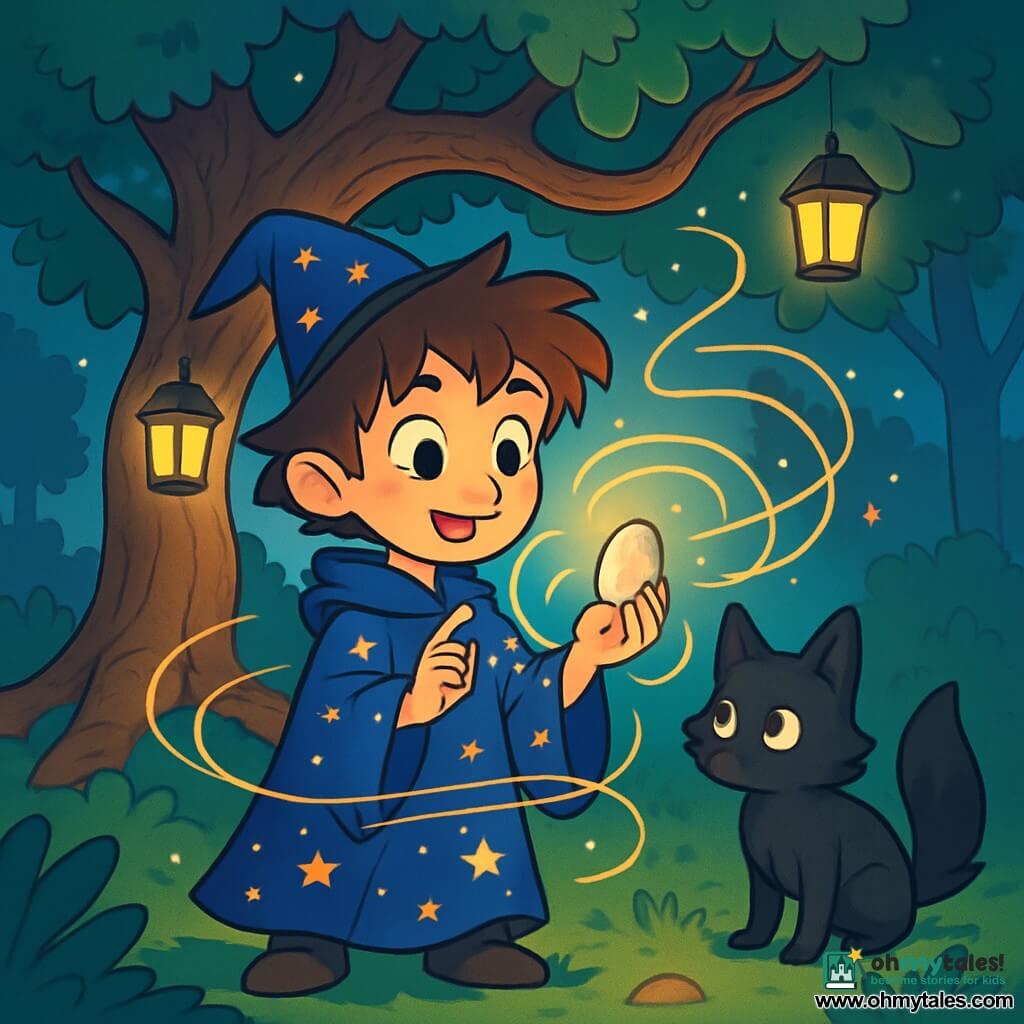
Ari opened the box. Inside lay a pebble as plain and dull as river mud. It hummed faintly against his palm.
—"What am I supposed to do with—" Ari began.
—"Listen to it," Rowan said. "All magic sings in threads. But today you may need something more than a song. A favour to the village first. Mrs. Harrow's grandfather clock stopped at three last night. She wants to know the time. Fix it if you must, but understand: haste unravels more than it mends."
Ari's fingers twitched. The clock's hands had always seemed to him a little too slow, a little too stubborn. He could have whispered a quick winding charm and set the gears to sing. He could have. But the pebble in his hand felt like a small, patient heartbeat. He tucked it into his pocket and promised, with the kind of thinking that thinks of two solutions at once, that he would try the slow way.
He walked to Mrs. Harrow's house with the cloak of patience weighing lighter than his usual impatient thoughts. The clock, when he arrived, sat like a sleeping beetle. He tapped it. No sound. He put his palm to the wood and felt nothing but warmth. Then he found a hairline crack near the pendulum, a place that had been ignored for years. He could have fixed it with flame and a murmured stitch. Instead he fetched a sliver of beeswax, warmed it under a gentle breath, and pressed it into the crack. It took ten minutes. It took twenty. When the clock finally sighed and the hands moved, Ari had learned to hear the clock breathe. His smile tasted like a neat, quiet victory.
Back at the courtyard, Master Rowan nodded, but his eyes were not satisfied. "Patience," he said. "Not only in fixing, but in listening."
Ari pocketed the pebble deeper, thinking he understood. He did not yet.
The Whispering Threads
Outside Vellford, where the hedgerows folded into an old willow grove, the world frayed into threads. They were not threads you would notice until you noticed them. They hung from beetle-legs, braided through the feathers of ravens, and wrapped lazily around the blades of grass like forgotten bandages. Magic, the old villagers said, ran in those threads. The threads tied the ordinary and extraordinary together, and when people pulled hard, the seams complained.
Ari went to the grove that evening because impatience is like a small animal that smells an open door. He wanted to learn to listen to threads, and he wanted to see if listening could be quicker than making. He found, however, that listening made him feel slow as honey.
—"Hello, little listener," a voice said. It belonged to a fox with soot-black fur and clever eyes. The fox sat on Ari's boots as if they were a warm stone and yawned.
—"Soot," Ari said. He knew the fox. It had a habit of appearing where things untied themselves.
The fox gave a sharp laugh and hopped into the web of threads that lay between the willow roots. Ari reached out. The threads sang low, like a lullaby that had been stifled. He touched one and it twined around his wrist. It was not painful; it was curious, like a hand that wants a story.
He tried to pluck a brighter thread that smelled of cinnamon and morning, thinking perhaps a spark of it would make the pebble in his pocket hum louder. The thread tightened like a drawing bow and a small ribbon of shadow wrapped his fingers. Soot barked.
—"You cannot pluck a chord from a song and expect the whole harmony," she said.
Ari yanked, and the ribbon tugged back. For a moment he felt all the little things that were held together by the canopy of threads: the way a grandmother's lullaby kept a child steady, how the baker's dozen always counted, how a child's lost marble found its way under a hedge. When he forced the thread, one of those small things unpicked and fluttered away—a neighbour's lost button that would never quite match now.
Guilt squeezed his chest. He feared he'd broken something irreparable. The thread loosened. Ari breathed slow. He let the ribbon slacken until it slipped free, and when it did, the button rolled back into place on its own, as if relieved. Soot licked his hand.
—"Magic wants attention, not demands," she said. "Sometimes it wants time."
Ari nodded, feeling the pebble in his pocket pulse like a heart attuning itself to the grove. He had not yet learned patience; he had only seen that impatience could cost more than it gained.
The Slow Lesson
Master Rowan's lessons became a series of small, deliberate chores—almost ordinary tasks dressed in slight mystery. "To mould patience," Rowan said, "you must do three things that will not answer to haste."
The first task was to tend the willow's sleeping pond. Ari planted his knees at the edge and watched the water be patient: it did not hurry to mirror the sky. He skimmed the surface of algae with a willow-wand and sang a song that had three long notes and one quiet one. He returned each day, stirring the pond only to listen. Day by day, silver leaves gathered at the water's edge like coins, and the pebble in his pocket grew warmer.
The second task was to steep starlight tea. At midnight, Ari boiled water and waited until the stars reflected in the kettle like scattered stitches. He did not touch the pot. He let it stand until the night itself seemed to become the steam. When he finally drank the tea, the flavour was less like a potion and more like the calm after a storm.
The third task felt the most ridiculous at first: to sew a loose seam in Master Rowan's traveling cloak but with thread that had to be plucked from hemp grown by hand, spun under moonlight. Ari learned to sit with a needle for hours, his fingers learning the tiny choreography of stitch and pull, drop and squint. Each stitch demanded patience; the cloak mended, slowly, as if remembering how to be whole.
Ari grew quieter. He found himself noticing the curl of a neighbour's smile, the rhythm of the blacksmith's hammer hitting metal, the way rain left the roofs like beads on a string. Sometimes he failed—he would rush to fix the pond and upset a dragonfly's nursery, or he would boil the tea for too long and make it bitter. Each time, Rowan would only smile and hand him a fresh cup.
—"Patience isn't polish for mistakes," Rowan said once as they sat under the willow's shade. "It's a surface you grow toward. It will not be perfect the first time. It grows like moss—soft and slow."
Ari began to understand that patience wasn't a thing he could summon like a gust of wind. It was a sort of listening. He started to carry the pebble like a secret, not for power but for reference: a quiet center in his palm when loud choices pressed at him.
The Night the Lantern Forgot to Burn
The night the lanterns forgot to burn, the village woke as if someone had blown out the moon. Fog slid between houses like a curious cat stealing through a threshold. Ari woke to the sound of Mrs. Harrow knocking at doors, a sound like a small drum calling for help.
—"The lanterns!" she cried, eyes wide. "All of them. Even the old harbor lamp. They simply went out."
Panic crouched in the alleyways. People reached for quick spells, for flare-orbs and rushing solutions. Ari felt his old habits pulling like a leash. He could light every lamp with a flourish and a word, make the village blaze so bright it would be praised in three markets. But he remembered the ribbon and the button, the pond and the tea.
Master Rowan gathered a group in the square. The lantern flames had not died because of neglect; they had been smothered. Threads, Rowan said quietly, notched and knotted beneath the town like roots. Someone had tried to force brightness, and the threads had wrapped in protest.
—"We can't hurry this," Rowan told them. "Light grows from tended flame, not plucked sparks."
Ari felt heat in his stomach, old wants surfacing. He also felt the pebble warm like a friendly moss. He offered himself to the task Rowan gave him: walk the lanes and listen. Not to listen for who caused the knot, but to hear the way each lamp remembered its own light.
As he moved down the streets, he pressed his ear to lantern glass, and the magic threads hummed—tiny sobs often because they had been tugged. One lantern whispered a song of lost matches. Another muttered of a wick that had been starved. He could have lit them all with quick flames, but as he crouched at each lamp he performed the small, patient actions he'd learned: he trimmed the wick with a careful blade, he fed it a whisper of beeswax, he hummed a single note he had learned from the pond. He smoothed soot with a thumb. He counted to a hundred as he watched a tiny ember grow.
Neighbors gathered. Some were doubtful. Some muttered about waiting. Children clapped their hands and helped in the way small hands can—holding a lantern steady, passing a comb to tidy a wick. Soot the fox trotted in circles, advising with small barks.
At the far edge of the village, in the oldest lamppost, Ari found a ribbon knotted into the metal. It pulsed with all the impatience the village had ever offered. He almost plucked it free with a flash of temper. Instead, he sat on his heels. He set the pebble on the pavement and breathed.
He felt a small warmth moving from the pebble into the ribbon as a patient wish. He hummed the pond-song, slow and steady. The ribbon loosened like a fist unclenching. It slid out and dissolved into the fog, not with a dramatic burst but with a quiet of a page turning.
By sunrise, the lanterns had workably small flames, and the village was a place with gentle light rather than glaring brightness. The fog rolled away like an apology.
The Long Breath
After the lantern night, something in Ari was different. It was not that he had become infinitely patient—old habits hummed in his bones—but the pebble in his pocket had become something he could touch when choices crowded him. It steadied him, like a compass.
There were other things to be done. The knot that had once bound the threads beneath the village was not entirely gone. Small things still tripped—buttons lost on windy days, words that missed their listener. Master Rowan set Ari another mission: to help someone who was already almost fixed but needed someone to stay.
There was a boy, Tom, who lived on the corner and had been trying to coax a stubborn sapling into growing straight. He had been impatient and salted the soil; the sapling slumped. Ari sat with Tom for three afternoons. They watered with a careful hand; they did not parade heroic magic. They cut a tiny stake and tied the sapling with soft twine. They made a secret of the work, singing little songs to the dirt between their teeth. Tom would fidget, want to rush, and Ari would press the pebble into his palm until the boy breathed in and out like a bell being rung softly.
One evening, when a storm rolled in with the clatter of a thousand small drums, the sapling leaned hard. Ari held his breath and did nothing at first but stay. He felt the tap and pull of old, hurried instincts. Then he wrapped his fingers around the sapling and steadied it. He hummed the pond-song and the tea-song together until the storm seemed less like an enemy and more like a passing thought.
The next morning, the sapling stood straighter. Tom grinned and scooped up a fistful of earth in celebration, which Ari took to mean that sometimes waiting had a small reward.
Another day, Soot got entangled in a tangle of threads while chasing a shiny button. She yelped in a way that made Ari's skin tighten. He could have cut the threads with a sharp spell and freed her. Instead, he sat, untangling with careful fingers, learning how each thread had a memory of the way it liked to be handled. Soot wriggled and complained, but when she was free, she licked Ari's face in a ceremony of gratefulness and left a single black smudge on his cheek.
These moments collected like small coins, and soon the pebble in Ari's pocket felt heavier in a good way—full of the weight of things done slowly and rightly.
A Treasure Plain as Bread
When the season turned and the leaves in Vellford melted into gold, Master Rowan took Ari to the old oak in the center of the village. The tree was riddled with carved names and tiny nests, and beneath it Rowan dug with careful fingers. He produced a plain wooden box, unsplashed by runes, smelling faintly of earth.
—"You thought the pebble would be the treasure?" Rowan said, smiling beneath the tree's shade. "The pebble was only a reminder. The treasure is something you carry without noticing."
He opened the box. Inside lay a single seed—bigger than a bean but smaller than a thumb—brown and utterly ordinary.
—"Plant it," Rowan said. "Tend it. Wait."
Ari blinked. He had expected a scroll, or a shiny talisman, or a boastful orb. He had not expected a seed.
—"This is it?" he asked. "A seed?"
—"Yes." Rowan's voice was as steady as a bell. "Magic is braided with time. It delights in the simple: a bowl of soup passed from hand to hand, a stitch that holds two patches, a light tended through a fog. You learned to listen. You learned to let small acts add up. That is your treasure: the way ordinary things become extraordinary when you stay."
Ari took the seed as if it were the lightest, most honest thing. He planted it beside the sapling he and Tom had tended. He watered it with a cup of starlight tea, because somewhere along the way it had become possible to mix the lessons together.
Weeks passed. The seed did not explode into a tree overnight. It pushed up a small green head like a shy thing peeking from a blanket. Ari learned to wait for shoots. He watched the tiny leaf bellow in the rain and listen when the wind teased its edges. Villagers would pass and nod, sometimes coming by with a damp handkerchief or a story to tell the plant. It grew, patient and unshowy, into a slender tree with leaves that remembered things—names whispered under midnight and the sound of a mother's laugh.
People began to leave small gifts by it—a scraped cookie, a pressed flower, a tiny stone with a smilehole. Ari would smile and set the pebble on the soil sometimes, as if to remind the tree and himself how far they'd come.
At the village festival when the first true frost glinted like powdered sugar, the tree's leaves shimmered in the lamplight. A child drunk on excitement climbed into its branches and burst laughter like a small constellation. Ari sat at the base, leaning back against the bark, and for the first time he looked at his hands and did not itch to do something more. He realized the treasure Rowan had spoken of had crept into his life like a well-loved habit: simplicity.
—"It's plain," Tom said as he tossed a ribbon into the branches.
—"Plain as bread," Ari agreed, and both boys laughed because it's true that bread, warm and rubbed with butter, tastes like everything extra melted into the simple.
Magic, for Ari now, was not about making dazzling things happen that others would marvel at. It was about stitching the world together with care. It was the sound of someone waiting with you while a lantern grows steady, the way a handhold steadies a sapling, or how a stew shared on a cold night heals more than hunger.
Master Rowan watched Ari with eyes that looked like soft coals. "You have learned," he said quietly. "You will still stumble. You will still tug when the world begs for a faster answer. But now you know where to lay the pebble: in your palm, a reminder that magic grows if you feed it steady time."
Ari felt for the pebble and found it worn smooth by his fingers. He set it back in its place in his pocket, where it hummed not with the power to force but with the warmth of small, patient things.
The last thing the villagers did that year was to gather under the simple tree and eat bread. It was not a feast of fireworks or flamboyant spells. It was a warm round of kindness, crusty and plain, passed from hand to hand until every mouth was full and every laugh was low.
Ari watched the faces lit by the tree's gentle leaves, and as he bit into his own piece of bread, he understood—simple things were a kind of treasure that did not glitter, but which kept people bright for a very long time.