Chapter One: A Lesson in Looking
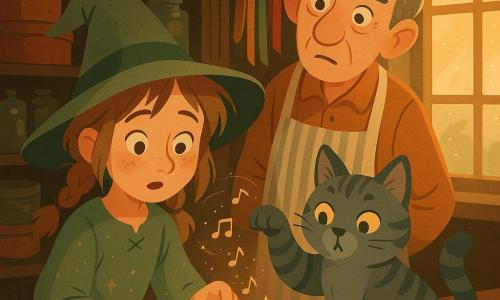
Kit Maple was not supposed to enchant the teaspoons.
“It was only a little spell,” she said as Gran Merrit plucked a silver spoon out of the air. The other five clinked guiltily down onto the table, like fish that had just realized they were in the wrong river.
Gran's eyebrows made a shape that was both stern and amused. “Only a little spell,” she echoed. “Only a little rain can flood a mouse hole. And only a small misstep can send a cart into a ditch.”
Kit wriggled in her chair. She was eleven, which made her Gran's apprentice, and also eleven, which made patience slippery. “They were bored in the drawer,” Kit said. “I could feel it.”
Gran's mouth twitched. “Tools don't get bored. People do. And bored people do untidy magic. Now—tell me what you noticed.”
Kit sighed and pressed her fingers to the tabletop. She remembered the ripple she'd felt when she'd whispered the enchantment, the warm hum of the kitchen rising like yeast in bread. “It felt… honest at first,” she said slowly. “Like stirring porridge. But then it got slippy, the way soap does when it escapes your hands. The teaspoons started dancing because I made them, not because they wanted to help.”
“And?” Gran prompted.
“And if the magic feels slippy,” Kit recited, “stop, breathe, and ask it a question.”
“Good. Ask it what, specifically?”
“If it wants to connect… or show off,” Kit said, cheeks heating. “I messed up.”
Gran placed the rescued spoon back in the jar with the others. The kitchen smelled of apples and cinnamon and a damp leaf blown in from the garden. Steam puffed from the kettle, and the house cat, Captain Biscuit, slept with both paws over his nose, as if even the kettle was too loud.
“You will mess up,” Gran said cheerfully. “That's why you're learning. And you'll learn faster if you stop trying to impress our cutlery. Besides, I have a proper task for you today. One that needs careful looking.”
Kit sat up straighter. “Proper?”
“The Night Market will walk through town at sunset,” Gran said, her eyes going faraway for a heartbeat, as if listening to something Kit couldn't hear. “There's a compass we've been needing. A heart-true compass, to guide spells that hesitate. There will be three on a stall—two false, one real. I need you to bring the right one home.”
Kit's heart did a small cartwheel. The Night Market didn't simply arrive; it threaded itself across Wrenfield in lanternlight, like a needle sewing through cloth. It never stayed in the same street twice. And it shifted. A cart might sell spices in one hour and memories in the next. You had to look carefully.
“How will I know the real compass?” she asked.
Gran smiled. “By asking it a question. And by noticing what connects and what only flashes. Keep your wits warm. Take some coin. Don't trust a bargain that offers more than it asks.”
“Should I take anything with me?” Kit said quickly. It seemed important to be properly kitted for the Night Market, as if that would steady the shake in her stomach.
“Your eyes. Your nose. Your hands. And this,” Gran said, lifting a small amber marble from a dish on the shelf. Light swam inside it. “It's a seeing bead.”
Kit frowned. “I can already see.”
“Not the way this will let you,” Gran said. “Hold it up when you need to tell the glow from the gaudy. And Kit—one more thing. Not everything that twinkles is lying, and not everything dull is true. You have to feel for the subtle threads.”
Kit rolled the marble in her palm. It was warm, like it wanted to be held. “I won't mess up,” she said, which was the kind of promise that probably made the teaspoons snicker in their jar.
“Of course you will,” Gran said, tying a ribbon around Kit's wrist—green, the color of moss. “The trick is keeping your heart humble enough to see it when you do.”
Captain Biscuit yawned, showing a pink tongue and a very small chip in one tooth. “Don't let anybody sell you a ‘True Mirror,'” Gran added. “There's a traveler in the market who's fond of them lately.”
“What's a True Mirror?” Kit asked.
“A noisy lie,” said Gran, her voice low now. “Off with you. If you're back before the kettle boils thrice, there'll be bramble pie.”
Kit grinned. Bramble pie was not magic, which was one reason she loved it.
She tucked the seeing bead into her pocket, the coins into her other pocket, and stepped out into the afternoon, which felt like holding its breath as the first lanterns began to be lit.
Chapter Two: Threads You Can't See
Wrenfield had ordinary streets: cobblestones with familiar wobble-spots; the sweetshop that leaned; the clock tower that never agreed with the smaller clocks. It had ordinary people, too, in sturdy boots and elbow-patched coats, and cats that did as cats do, which is exactly what they want.
Yet if Kit squinted just right when she walked past the bakers, she could make out the faintest silver lines sketched between things: a taut little thread running from old Mrs. Pennyfeather's glove to the pocket of the man she waved at every morning; a thread from the school gate to the river, as if learning and water had a secret friendship; threads from chimneys to the sky, which made sense, and threads from hedgehog dens to milk bottles, which made Kit frown and smile at the same time.
She didn't know if everyone could see them. Gran never explained everything at once. She said it was like learning to hear the instruments inside a song: first the drum, then the flute, then that peculiar bell that only rings if the moon is awake.
Kit wasn't alone for long. “You're out early,” said Jo Finn, falling into step beside her. Jo was the sort of person who always looked as if he'd just been tumbled by a friendly wind—hair half out of place, grin a little tilted, pockets rattling with bits of string and buttons.
“Gran sent me to the Night Market,” Kit said importantly. “I have to find a compass. A real one.”
Jo's eyes widened. “You're very brave.”
“She said it's not about brave. It's about looking.” Kit flushed. “And not buying a True Mirror.”
“What's a True Mirror?”
“A lie that thinks it's clever,” Kit said. “Apparently.”
They turned the corner into the square. The ordinary stalls were packing up, making room for whatever the Night Market would decide to be when it stepped in. The air had that evening taste, like apples kept too long in a cupboard and the very first hint of candle smoke. Lanterns were being hoisted on poles, one by one, each catching and sending along the light as if the town were sharing a secret from house to house.
Kit paused by a street magician with a patched hat. He flicked his wrist, and a flock of butterflies rose around his hands, bright as berries. A cluster of children oohed.
“Do you think they're real?” Jo whispered.
Kit slipped the seeing bead into her fingers and held it up, as if adjusting her hair. Through the amber, the butterflies' wings were paper—cleverly folded, wonderfully painted, spinning on threads as thin as a stubborn cobweb. Not magic, but craft. The sort that wanted applause and earned it.
“Beautiful,” she said, because it was, just a different kind of true.
They moved on. Jo pointed to a stall selling tin whistles carved like birds. “Those look like they want to fly.”
“They'll whistle off your windowsills first,” Kit said, and something about the way the air tasted—saltier, suddenly—made the hair on her arms prickle. She turned her head. Between two shuttered shops, a figure stood very still, as if waiting for someone to notice that they were not moving at all.
The person—if it was a person—wore a long coat the color of oil on a puddle, shifting when you looked and something else when you didn't. A mask covered their face: not full, like a theater mask, but just a stretch across the eyes, silvered so that it showed a warped reflection of whoever stood near. At their feet, a box leaned open. Inside, nested like eggs, were hand mirrors, pocket mirrors, a mirror with a handle as long as a broom's, a sliver of mirror set into a locket.
“True Mirrors,” the figure said softly. The voice curled out, smooth as cream, but something in it made Kit think of ice. “One coin shows you yourself as you are. Another coin shows you as you could be. A third shows you as others see you. Choose.”
A woman at the edge of the crowd pressed a hand to her throat. “Do they work?”
The silver mask tilted. “They work.”
Kit's palm tightened around the seeing bead. She lifted it, slow. Through the amber, the stall did not change. Mirrors still gleamed. Threads ran from the glass to the people nearest, thin and hungry, like lines cast from a fishing pole. Not connecting. Catching.
Jo leaned closer. “Kit…”
“I see them,” she murmured. The dangerous thing about hunger is that sometimes it wears your own face.
“We're looking for a compass,” Jo said, tugging her sleeve. “The market's starting.”
He was right. You could feel when the Night Market woke. It was like the street remembered being a river. Pavement softened into something that felt like moss underfoot, even though it still looked like stone. Stalls unfolded out of nothing, smelling of star anise, hot metal, vinegar, rain. Music came from somewhere that was everywhere at once.
“Let's go,” Kit said, tearing her eyes from the True Mirrors. “Gran says not to trust that sort.”
The masked seller turned, as if they'd heard. The silver eye-strip reflected Kit's face back at her, stretched thin. The voice was pleasant. “When you tire of compasses, girl, come back. There's a mirror here that knows the difference between wishing and wanting.”
“I know the difference,” Kit said, and was a little surprised that she did.
“Do you?” the seller murmured, as if Kit had told a joke. “We'll see.”
Chapter Three: The Compass and the Lanterns
They followed the smell of beeswax and pepper down a lane that didn't exist at noon. A string of lanterns hung low there, and each one held something small and improbable—a feather that spun without wind, a dried leaf that glowed like coal, a pinprick of rain caught somehow mid-fall.
At a stall draped with maps that led to nobody's house, an old man with eyebrows like moth wings sat on a blue crate. In front of him, arranged on velvet, lay three compasses.
“Welcome,” he said. “Maps are shy at first, but compasses are braver. They'll talk to children if the adults leave them alone.”
Jo, who was very proud of being almost twelve, puffed out his chest. The man's eyes twinkled. “Ah, but you, sir, are hardly an adult, so you may stay.”
Kit looked at the compasses, each with a needle that quivered.
The first was heavy, made of shining brass, engraved with swirls. It looked important. It smelled faintly of lemons and polish. It pulled at the eyes, the way a bright thing does, and when she put her finger near it, she felt a little thrill, like standing too close to the edge of a pond on a dare.
The second was small and dark, the metal dull, almost shy. It had a scratch across its face, as if it had been in somebody's pocket with a key. It smelled like beeswax and pencil shavings and a little like rain.
The third was made of some kind of glass that had been melted and cooled so the edges were soft. The needle inside spun restlessly, faster when someone spoke nearby, as if it wanted to be part of any conversation. It smelled like nothing at all.
“Two are fake,” Kit said.
“Or at least untrue to your purpose,” the man corrected. “There are many truths. But only one will try to connect you to what you truly seek. What do you seek?”
“A heart-true compass,” Kit answered, heartbeat drumming in her ears. “For guiding spells that hesitate.”
The man nodded solemnly, as if she had said something important. “Then ask them.”
Kit held the seeing bead up, but the compasses looked the same through it. So she set the bead down and closed her eyes and touched the air above each.
The brass compass made her think of clapping hands and a crowd. The glass one made her think of talking loudly when she didn't know what to say. But the small scratched compass made her think of Gran's knitting basket. Of the way Gran's hands moved without showing off. Of the quiet happiness of a job done right, even if no one saw.
She opened her eyes. “You,” she whispered to the small dark compass. “If I chose you for the wrong reasons, would you tell me?”
The needle steadied, just for a fraction of a second, as if it had taken a breath.
Kit smiled. “That one,” she said, pointing.
Jo bent over the brass one. “It's so shiny, though.”
“Let him take a shiny one if that's what he's buying,” the old man said, smiling so hard that his eyebrows danced. “You'll take the one that chooses you, and you'll pay a coin and a promise.”
Kit blinked. “A promise?”
“All the good things cost promises,” the man said kindly. “You promise to use it with care. And to trust the doubt that warns you when you want to show off.”
Kit thought of the teaspoons. She thought of the True Mirrors and the hungry fish lines. “I promise,” she said, and placed her coin in the man's palm.
He slid the compass into her hands. It felt warm, the way the seeing bead did. The needle settled, pointing—not north, she realized, but toward the market's thickest tangle of light. She tucked it into her pocket beside the bead, and for a moment the two seemed to hum to each other.
They wandered on. There were stallholders selling jars of laughter and packets of courage you could steep like tea. There was a woman reading stories to a pile of sleeping dogs and a man stitching words onto scarves so you could keep them with you when you went outside. Jo bought a whistle that sounded like rain on windows. Kit smelled cinnamon, solder, sea salt, and something metallic she couldn't name.
The mirror stall found them again. Or perhaps it had never really left their path. People clustered around it now. Mr. Palfrey held a small oval mirror in both hands, staring fixedly. “It says,” he murmured, “it says Rosie only loves me for my sugar.”
“Rosie is your cat,” Jo said, startled.
“She is,” Mr. Palfrey said, still staring. “She looks very affectionate in the mirror. But the mirror says the truth is she wants my sugar.”
“Cats do like sugar,” said someone kindly, which was not actually true, and Kit felt a knot inside her tighten.
A girl from school, Saffi, had a hand mirror, too, and a look that meant trouble. “It shows me as I could be,” she whispered to Kit as if they were sharing a secret. In the mirror, Saffi's hair was perfect, her family's tiny flat was a whole house with a garden, and her schoolbooks were taller than she was. “It's… wonderful.”
“It's almost,” Kit said before she could stop herself.
Saffi stiffened. “You always say things like that,” she said sharply. “Not good, not bad—almost. Maybe you just don't like seeing something special.”
“It's that I've learned to look,” Kit said, feeling her voice shake. “Not everything that calls itself true is kind. Or safe.”
The masked seller's silvered eyes turned. “You don't want a mirror?” they asked in a sighing tone. “Not even the smallest, the humblest? The one that shows you how others see you, perhaps. Apprentices often pick that one. They can't decide if they're real without checking the angle of someone else's gaze.”
Kit bristled. “I'm real whether or not you reflect me.”
“Everyone says that,” the seller murmured. “Until they look.”
Jo tugged her sleeve. “Come away, Kit.”
She wanted to. She stepped back. But the knot inside didn't loosen, because Saffi's eyes were bright with the mirror's promise, and Mr. Palfrey was stuffing his cat's sugar bag into a cupboard as if it had betrayed him.
“There's no law against selling mirrors,” the silver mask said pleasantly to Kit, as if reading her thoughts. “If people choose to see, who am I to stop them? I give them what they want. Witches,” the voice added, almost laughing, “try to give what people need. Some call that kindness. Others call it controlling. What do you call it?”
“I call it care,” Kit said softly. “And I'd rather be careful than clever.”
The masked head tipped, as if they were measuring her. Then the seller flicked their hand, and the mirrors flashed all at once. A haze of quicksilver light slid over the crowd, and for a heartbeat Kit saw everyone's faces reflected in everyone else's. It was dizzying and beautiful and awful.
“See,” said the mask. “How truthful.”
Kit took a step forward, and the ground went away.
Chapter Four: The Mirror-Monger
It was as if the street had folded into itself. Kit stumbled and found that she was standing on a floor that reflected the sky, or the sky was lying on the ground and she was walking on that. She looked up and saw a ceiling of cobblestones. Lanterns hung underneath her feet, like fish trapped under ice.
“Jo?” she called. “Jo!”
His voice came faint. “Kit! I'm—oh—Kit, this is strange—”
Saffi's laugh tinkled from somewhere left-of-up. “It's like being inside a bubble! Isn't it brilliant?”
No, Kit thought, heart hammering. The compass dug into her palm. She pulled it out, and the needle spun hard, then quivered toward… there. Where there was the least light, the least noise. Where the silver threads in the air looked thin but steady, not whipping about.
She put her hand in her pocket and found the seeing bead and held it between her fingers like a tiny sun. She breathed. Gran's voice came back, as if wrapped in wool to keep her safe. Ask the magic a question. Ask it what it wants to do.
“What do you want?” Kit asked the space around her, which smelled suddenly like old tin and damp wood. “Connect or show off?”
A surge, like the pound of blood after you run too fast. The mirrors hummed. Show off, they sang. Show off and show off until there's nothing left but the showing.
“Thought so,” Kit muttered.
The masked seller stepped toward her, walking on the ceiling floor as if nothing were odd. The silver strip across their eyes made Kit feel queasy when she looked straight at it. “This is not your place, apprentice,” they said, too gently. “This is my space. My maze.”
“Your trap,” Kit said.
“Your maze, then,” the seller said agreeably. “Find your friend. Find yourself. Find your truth. People love games.”
Kit turned and walked where the compass tugged. She had learned something about mazes from the hedges near the old mill: don't hurry. Put your hand on one wall and keep it there, slow as bread rising. But the mirror maze wasn't like hedges. It tried to show her versions of a path where the floor looked clear and then wasn't. It tried to distract her with reflections of herself as taller, as thinner, as wearing a hat with far too many feathers. It showed her Gran clapping proudly after Kit told a joke that had never existed. It showed her a kitchen where the teaspoons danced themselves into perfect stacks without her doing anything at all.
She kept her palm against the cold glass wall and did not look long. The compass needle quivered. The seeing bead comforted. She made herself notice small truths and say them out loud.
“My shoes squeak,” she said. “There's a blister on my left heel. My hair smells like smoke from the applewood fire. My friend's laugh sounds like an old door and a new kite. Captain Biscuit has a chip in his tooth.”
The reflections tried to talk louder. She let them. She hadn't come to drown them out. She'd come to find Jo and the door out.
“Kit?” It was closer now, thinner. “Over here.”
She edged along the wall and found Jo huddled on a patch of floor that was a reflection of someone else's windowsill. He had a mirror in his hands, and it was showing him playing the whistle he'd just bought and everyone stopping to listen, the rain outside making the perfect backdrop, everyone saying how marvelous he was—
“I didn't buy it,” Jo said hoarsely. “It just—slid into my hand. And then—look. I mean, I know it's silly. But what if that is me? What if I'm meant to be—good? I want—”
“Of course you do,” Kit said, kneeling. She put a hand on his shoulder. “Wanting applause is human. But if it's the only sound you can hear, it's a very lonely song.”
He swallowed. “How do I know what I actually want?”
Kit touched the compass to the glass of the mirror. The needle flicked wildly, then steadied as if glad to have something solid to press against. “Ask a different question,” she said. “Ask what want would still be there if no one else were looking.”
Jo glanced at the mirror. In it, he played and played, and his parents beamed in a house that was larger and warmer than their actual house ever was in winter, and teachers clapped, and even the grumpy water vole in the river tapped its paw in time. “I'd still play,” he whispered. “Even if nobody clapped. I'd play because—because it makes my chest feel less full of bees.”
“Then that is true,” Kit said. “You don't need the mirror to know it. Let it go.”
Jo's hands fought themselves. Then, with a hiss, he set the mirror down, face to the glass floor. The reflection scribbled itself away like a thought forgotten on purpose. The maze seemed to hiss, too, a disappointed cat.
“There,” Kit said, and stood, pulling him with her. “Let's find the exit.”
They inched along. The masked seller's voice floated and never seemed to have a source. “You're very good,” it said. “It's a pity.”
“What's a pity?” Jo snapped.
“That the truth is quieter,” said the voice. “It takes more work. I'm so much easier. Why would people choose her little compass and her sensible grandmother when they could have me?”
“Because,” Kit said, hands shaking, “quiet things last.”
The maze stirred, annoyed. A mirror to their right showed Kit, taller, older, wrapped in a cloak, her hair exactly how she liked it in her dreams, her hand raised and everyone around her listening to her explain the difference between this and that. It was such a sweet picture that Kit felt her knees go watery.
“What about you?” the voice purred. “What would you choose if the world were kind?”
Kit lifted the seeing bead and looked through the amber at her own reflection. In the bead, she wasn't older or admirable. She was small and red-cheeked and serious and her hair was doing that cowlick thing, and she was holding the hand of her best friend, and she was holding her breath because she still wasn't entirely sure they'd escape. That truth was so simple it made her want to cry. She smiled at it instead.
“You are not a villain,” she said to the maze. “You are a tool gone hungry. But I won't feed you.”
Another hiss. The compass needle pointed straight down.
Kit stomped her foot. “We're not jumping,” she informed the glass.
“We could try,” Jo said, which was exactly the sort of thing Jo would say.
Kit closed her eyes. The floor was cold under her fingertips. The bead was warm. She remembered Gran's words again, softer, like the end of a song. Real magic leaves room for thanks.
“Thank you,” Kit whispered—not to the maze, but to the small true things that were still themselves even here. To her shoes. To Jo's grip. To the needle's steadiness. She wasn't sure who she was thanking. She thanked them anyway.
The glass under her palm warmed. A seam she hadn't seen before loosened like a knot undone. A sliver of cool, honest air stroked her cheek from the left. Kit opened her eyes and saw it: a gap where no gap had been. Not a mirror trick. An exit.
“Come on,” she said, and this time they ran.
Chapter Five: The Maze of Almosts
The gap let them out into the market again—into night that had edged out evening while they were inside. Lanterns bobbed. Someone sang three streets away. The mirror stall stood where it had been, neat and shining.
People blinked, as if waking from a dream they couldn't quite remember. Mr. Palfrey hugged his bag of sugar to his chest, looking sheepish. Saffi held her mirror in both hands, brows knit, as if it had turned into a weight.
The masked seller inclined their head. “Congratulations. Most don't bother with exits. They like to stay and look.”
Kit's heart still galloped. She wanted to shout. She wanted to shake the seller until the silver strip cracked. Instead she did what Gran would do. She held her anger like a hot pan and set it down somewhere safe.
“You can't keep a market if it eats people,” she said, voice steady.
“And you can't keep people if they insist on confusing kindness with boredom,” said the seller mildly. “They want spice. They want glare. They want to jump to the middle and never wash the pots. Why should they not have what they want?”
“Because it hurts,” Jo said, in a tone so simple that it surprised Kit. “Because we forget to be ourselves when we're all glare. And then there's nothing left to weave with.”
The masked head turned toward him. “Pretty words from a boy who wanted applause. Did your friend teach you them?”
“No,” Jo said. “I heard them because she reminded me to listen.”
Something in the air shifted. A few of the people near the stall stepped back, as if some scent had gone sour. Saffi looked at Kit quickly and away, and Kit saw the shame in her eyes and the anger behind it. Kit took a breath.
“May I borrow your mirror?” she asked gently.
Saffi clutched it. “It'll show you what you want and then you'll feel superior,” she hissed.
“I'm not asking to fix you,” Kit said. “I don't think you're broken. I want to show you something I learned.”
Saffi hesitated. Maybe the thing inside her that was curious was stronger than the part that hurt. She handed the mirror over, fingers trembling.
Kit did not look in it. She laid it face down on the stall. She set the seeing bead on its back. She placed the compass on top of the bead. The needle quivered to stillness. The bead's light glowed steady. The mirror was just glass with silver behind it.
“Sometimes,” Kit said, mostly to Saffi, but loud enough that others could hear if they wanted to, “we use shiny things to stop ourselves from asking scary questions. You're allowed to want more than you have. You're allowed to be angry that the world gave you little. But if the only way you can imagine ‘more' is by making yourself into something that doesn't feel like you… that's a trap. You're worth more than your almost.”
Saffi's throat worked. Kit held out the mirror. “If you'd like to keep it, keep it. But if you'd rather,” she added, lowering her voice, “we can smash it and bake bramble pie and talk about houses we'll maybe have someday, and plant mint in tin cans and pretend for an hour that the windows in your flat are as big as the sky. Pretending together doesn't hurt as much as pretending alone.”
Saffi's mouth wobbled. “You can't fix everything with pie.”
“No,” Kit said. “But you can fix some things enough to breathe.”
Saffi made a small sound. Then she set the mirror back on the stall. She lifted it with both hands. And she thrust it toward the cobbles.
It didn't shatter.
It wobbled like jelly.
The masked seller laughed, and the sound was not kind. “Did you think I would use glass? It took me a month to weave these beauties. They bounce.”
“You weave,” Kit repeated sharply. “Of course you weave. But you don't tie. You don't join. You catch.”
She saw it then: the mirror behind the mirrors, the structure at the heart. It wasn't a thing you could break with a stone. It was a pattern. It was the seller's voice fed back on itself, fed by the hunger of anyone who wanted more, more, more—and who doesn't, sometimes? The pattern went round and round. It needed a new thread to stop it. Something small. Something true.
Kit lifted the compass. “What did you promise when you bought it?” Jo whispered.
“To use it with care,” Kit said. “And to trust my doubt.”
She faced the masked seller. “You goad. You glitter. You make everyone feel alone, even while they stand together. That makes you weak.”
The silver strip didn't move, but Kit felt attention sharpen. “Does it?”
“Yes, because real magic is made between,” she said. “Between a baker and a buyer, between Gran and me, between Jo and a song. Between a person and their own heart. You can't break between with a reflection.”
She placed the compass gently against the edge of the stall. The needle pointed—not at north or out or in—but at the space between Kit and the seller. At the bit of air where their breaths met.
Kit spoke clear enough to ring. “This market belongs to people who look and bargain and share. If you want to be here, you have to stop lying about your mirrors.”
“Lying?” the seller said, sounding honestly offended for the first time. “I told them exactly what they'd see.”
“You told them what they'd see if they stopped listening to themselves,” Kit said. “That's a trick, not a truth.”
Silence. Somewhere, the dog story lady coughed delicately.
The masked head tipped. “And if I do not stop? What will your sensible compass do? Point at me until I yawn?”
“It will help me ask,” Kit said, voice softening. “Not demand. Ask you to change. Ask the market to hum along with me. Ask every true thread to tug.”
She held her breath and said, into the space where breath met breath, “Please.”
The lanterns flickered, as if the town itself had blinked. A wind slipped through the square, cool and full of leaves. The mirrored surfaces trembled, and for a heartbeat the silver strip across the seller's face stopped reflecting and simply went dull.
Someone began to clap, hesitant, then stronger. It wasn't for Kit. It was for the feeling in the air, that sense of something mean unclenching.
The mask looked left, then right. Kit felt it then—the decision, sharp as a needle. Not hers. The seller's.
“You are very tiresome,” the voice said, and it wasn't cream anymore. It was tired. “You would make a very tiresome villain, too.”
Kit smiled. “I'm trying to be a tiresome good.”
“Ugh,” the seller said, but their shoulders dropped the smallest amount. They lifted one of the mirrors and turned it. The surface darkened, like a storm cloud rolling over a lake. “Fine. I will call them Almost Mirrors. I will tell customers what they do. I will not pretend that almost is always better than is. Will that soothe your grandmotherly soul?”
Kit put a hand over her torso as if checking. “A little.”
“And will you please tell the baker that cats do not, in fact, like sugar,” Mr. Palfrey said weakly from the sidelines.
“Cats do not, in fact, like sugar,” Kit called to the square at large. “Captain Biscuit would like it known that he prefers roast chicken.”
At the name, Captain Biscuit trotted into the square as if to confirm it, sat down with enormous dignity, and licked one paw in a manner that suggested approval.
“Ungrateful,” muttered the masked seller. “I work and weave and what gratitude do I get?”
Kit glanced at their hands. They were strong and thin and stained the way hands are when you spend your life making things. The sight softened something inside her. “Thank you,” she said quietly. “For changing.”
The mirrored stall shivered, and some of the anger seemed to leak away. “Fine,” the seller said, flapping a hand. “Go. Buy your pies. Don't come back if you're only going to be wholesome at me.”
Kit hid a smile. “We might come back,” she said. “But we'll bring questions.”
“Of course you will,” the seller said, and for the first time, it sounded almost like a compliment.
Chapter Six: Lantern Ash and Morning
The Night Market drifted on. People wandered, a little dazed, a little relieved. Saffi stood beside Kit, hands jammed into her pockets, cheeks still hot. “Do you really bake pie when you've had a bad day?” she asked, trying to sound rude and not quite succeeding.
“Gran does,” Kit said. “I mostly peel apples and wish I could bake as well as my grandparent. But I'll peel apples twice as fast if you're coming.”
Saffi's mouth bent in what might soon be a smile. “All right.”
Jo tooted on his rain-whistle, not a performing toot, just a sound like water deciding to stay in the gutter a little longer before leaping for the drain. Kit's compass sat warm in her pocket. Every time she thought about using it to find something glamorous, the needle swiveled toward something ordinary.
“What if it just tells you to go home?” Jo said, reading her mind the way friends do.
“Then we go,” Kit said, and they did, through streets that had been streets all day, but like people, were not the same in the evening. They passed the dog story stall, and the woman looked up as if she felt their eyes and nodded. They passed the spice seller, who blew them a kiss and pinched Jo's nose and laughed when it honked like a clown's horn. They passed the stall with the maps, but the old man had already folded himself away.
Gran's window glowed like a welcome tucked into a pocket.
Kit let herself in, the compass a quiet heartbeat against her fingers. The kettle had boiled exactly thrice, as promised. Gran set out three plates without comment. Saffi blinked. “You knew?”
“I always make extra when Kit goes out,” Gran said. “The world has a way of sending home hungry children.”
Captain Biscuit arranged himself on the bench like a loaf of bread that had grown fur. Jo offered a crust. The cat pretended not to see it and then delicately ate it.
There was talking because there is always talking when danger has passed, and there was also silence, and Kit liked that part, too. She held the seeing bead in her hand and watched the way the candle flame looked through it: redder, rounder, somehow closer. She said, “I think I understand about truth being quieter. Not because it's shy, but because it listens as much as it speaks.”
Gran nodded. “And?”
“And it connects,” Kit went on, soft. “Even when nobody claps.”
Gran's eyes crinkled. “Did you get what you went for?”
Kit placed the compass on the table. Gran picked it up and stroked the scratch with her thumb. “Ah,” she said, with a sigh that sounded like relief. “Yes. This one can find the way between, even in fog.”
“Also,” Kit said in a rush, “the mirror seller is going to call them Almost Mirrors now. They promised.”
Gran arched one eyebrow. “Did they?”
“I asked nicely,” Kit said. “And also somewhat sternly.”
“That seems reasonable,” Gran said. Then she set the compass down and took Kit's hands. “What did you learn?”
Kit looked at her hands, at Gran's, at the crumbs on the table, at the steam curling up like question marks from the cups. Plenty of answers tried to push forward: clever ones, reasonable ones. But the one that felt right was simpler.
“That when I'm not sure,” she said, “I can stop and ask the magic what it wants to do. That real things will connect to other real things if I give them the chance. And that most traps feel like I have to decide immediately.”
Gran nodded. “And the last one?”
Kit smiled. “That bramble pie tastes better after trouble.”
“Science,” Jo said solemnly, and Saffi snorted laughter that was only a little snuffly.
They ate. The night outside softened, and the house felt like a pocket someone's hand was resting in. After the plates were cleared and the clock on the wall did its best to get along with the tower clock—though it never truly managed—Jo and Saffi yawned in sync, which made Gran seem secretly pleased.
“Home with you, then,” Gran said, “before the Night Market decides to turn your beds into boats and send you drifting down the stairs.”
They went, accompanied by Captain Biscuit to the gate, who never admitted to caring but always saw people off. Jo saluted, his pockets full of crust crumbs. Saffi whispered, awkward and brave, “Thanks for not making me feel stupid.”
“I feel stupid all the time,” Kit said. “It's how I know I'm learning.”
Saffi gave her a look that might, with practice, become a hug. “See you tomorrow,” she said, and vanished into the kind of quiet that only a town at rest can make.
Kit stood on the step with Gran for a while, watching the last of the lantern ash smudge the sky gray. The world didn't look different. It wasn't, not really. The cobbles were still lumpy. The bakery would still open early. The cat would still pretend he didn't love anyone. But Kit felt different inside the same place.
She took the seeing bead out and held it up to the market's fading glow. Through it, she saw threads running from window to window, from door to door, from a kettle to a hand, from a child to a compass, from a mirror stall to a new sign that read Almost Mirrors in tidy script. She felt, for a breath, like she could see the town's heartbeat.
Gran squeezed her shoulder. “Sometimes the kindest thing to say to magic is not yes or no,” she murmured, “but thank you.”
Kit nodded. She didn't say it out loud—there didn't seem to be any need, and maybe saying it would break it.
She let the thank-you sit warm behind her teeth. Then she turned and closed the door.