Chapter 1: The Suit That Hugs Like a Backpack
Maya Ramirez stood in the quiet hallway outside the crew quarters, holding her checklist like it was a bedtime story. The space center at night didn't feel sleepy at all. It hummed softly, like a giant fridge full of important dreams.
Maya had loved the stars since she was little. When other kids counted sheep, she counted bright dots and made up names for them. She used to lie on her balcony with her dad and whisper, “That one looks like a spoon,” and he would answer, “Then you'd better learn the real constellations, Captain Spoon.”
Now she really was an astronaut—young, determined, and very, very careful.
Tomorrow—well, later today—she would ride a rocket into space.
That was the exciting part.
The tricky part was that her brain wanted to do cartwheels instead of sleeping.
Maya walked into the training room where her flight suit hung neatly. It looked ordinary at first, like a jumpsuit. But she knew what it really was: a tough, flame-resistant outfit with pockets placed exactly where astronauts needed them. Even clothing on a space mission had a job.
She ran her fingers over the patch on the shoulder—her name, her flag, and the mission logo. “You and I,” she whispered, “we're going to be very responsible.”
Earlier that evening, her instructor had reminded her, “In space, you don't get to be sloppy. You follow steps. You check each other. You protect the spacecraft and the planet you came from.”
Maya thought about Earth—blue, round, and busy with life. She imagined it from far away, like a shining marble. Respecting Earth wasn't just a nice idea. It was part of the job. Astronauts recycled water, saved power, and kept trash organized, because waste in space could be dangerous. Even tiny crumbs could float into machines.
She tucked her checklist under her arm and tried a first technique for sleeping: the “mission tidy.”
She folded her clothes for the morning. She lined up her shoes. She placed her ID badge where she could grab it without thinking. She packed her little “personal kit” with a photo of her family, a tiny cloth Earth flag, and a notebook full of star sketches.
When everything was neat, the room looked calm.
Her thoughts did not.
Chapter 2: Breathing Like a Rocket, Not Like a Rabbit
In her small bedroom, Maya turned off the big light and left a soft lamp glowing like moonlight. She climbed under the blanket and tried to imagine the pillow was the smooth seat of the spacecraft.
“Okay,” she told herself. “Astronaut technique number two: controlled breathing.”
A doctor had taught her a simple pattern for pre-launch nerves: breathe in slowly, hold, breathe out longer than you breathed in. It was like telling your body, “No emergency here. We are safe.”
Maya placed one hand on her stomach and started.
In… two… three… four.
Hold… two.
Out… two… three… four… five… six.
She did it again. And again.
Her heartbeat, which had been galloping like an excited puppy, began to trot. She listened to the quiet building. Somewhere far away, a machine clicked, and it sounded almost like a steady metronome.
Her mind still wandered, but now it wandered through useful things.
She pictured the launch team in their bright vests, checking cables, valves, and fuel lines. She pictured technicians looking at screens full of numbers. She pictured the safety officers, whose job was to imagine every possible problem—so problems could be prevented.
That was something Maya loved about being an astronaut: it wasn't just bravery. It was teamwork. Thousands of careful hands helped a few people fly.
She thought about the planet again. Rockets were powerful, but missions were planned to reduce waste and risk. Astronauts studied Earth's weather, forests, oceans, and ice. From space, you could see storms swirling like whipped cream and thin air like a delicate scarf. It made you want to take better care of everything.
Maya yawned. Success!
Then her eyes popped open.
“What if I forget something?” her brain asked, sounding like a tiny, dramatic actor.
Maya sighed softly. “If I forget something, my team won't,” she whispered. “We double-check.”
She reached for her checklist anyway.
Then she stopped.
Technique number three was next: no more lists.
Because astronauts also had to rest.
Chapter 3: The Spacewalk in Her Head
Maya rolled onto her side and tried a bedtime trick her grandmother had taught her when she was seven: tell your brain a story that moves slowly, like a boat on a lake.
But Maya's stories always became space stories.
She imagined herself floating inside the spacecraft after launch. She saw the straps, the handholds, the panels covered with switches. She felt the gentle tug of her harness and then—suddenly—no tug at all.
Weightlessness.
In training, she had practiced moving carefully. In space, you didn't stomp. You didn't jump. You guided yourself like a swimmer, using fingertips. If you pushed too hard, you could bump into something important or send a tool drifting away like a runaway balloon.
Maya imagined opening a small food pouch and squeezing applesauce onto a spoon. She imagined snapping a crumb-catcher under her chin like a silly bib. “Fashion icon,” she muttered, half-asleep, then smiled.
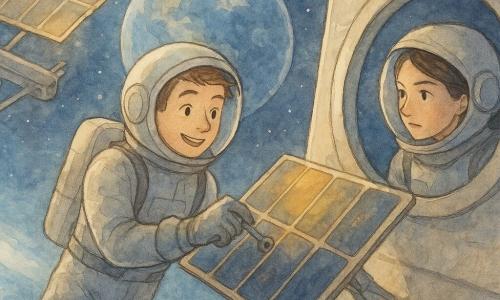
She pictured the station—her destination—glowing in sunlight, its wide solar panels spread out like shiny wings. The solar panels collected energy from the Sun, turning light into electricity. No smoke, no fuel, just sunlight—clean and quiet. Maya loved that part. Space taught you how precious energy was.
In her story, she did a “sleepy tour” of astronaut jobs.
She was a scientist, checking experiments that could help people on Earth—like learning how plants grow in microgravity, or how the human body changes in space so doctors can help patients back home.
She was an engineer, watching how machines behaved, listening for strange sounds, looking for tiny leaks. In space, small problems could become big if you ignored them.
She was also a student, because astronauts always learned new things. They practiced emergency drills, studied maps of the station, and trained in pools to rehearse spacewalks safely.
In her slow bedtime story, she opened the station's cupola—a windowed room like a glass lantern—and looked down.
Earth floated below, bright and fragile.
Maya felt her throat tighten with wonder. Even in her imagination, it was beautiful enough to make her want to whisper, “We will take care of you.”
Her eyelids drooped. The story became softer around the edges.
Then a beep sounded—real, not imagined.
Maya sat up, blinking. It was her wrist timer. She had set it earlier to remind herself of one more sleep technique.
She groaned quietly. “Even my timer is strict.”
But strict could be good.
Strict meant safe.
Chapter 4: The Noise of Silence and the Warm Mug Plan
The next technique came from a psychologist who helped astronauts before missions: make your room feel like a calm capsule.
Maya stood, padded to the small sink, and poured warm water into a mug. No caffeine, no sugar—just warmth. She held it with both hands and let the heat travel into her fingers.
Back in bed, she tried a “sound map.”
She listened and named each sound without judging it.
Air vent: whoosh.
Distant footsteps: tap, tap.
A faraway printer: whirr.
Then she listened for the space between sounds.
Silence wasn't empty. It was gentle.
Maya sipped her warm water and thought about another part of the astronaut job: protecting the spacecraft from tiny space junk. Around Earth, old bits of metal and paint can zip around fast. Space agencies track them carefully. Missions choose safe paths and plan shelter steps if needed.
That tracking—like watching a busy highway—happened in control rooms full of people who stayed on Earth so astronauts could travel. Maya respected them deeply. They were guardians with headsets, keeping their eyes on every number.
She remembered visiting Mission Control as a student. The room had looked like a quiet ocean of screens. A flight director had leaned down to her and said, “The best missions are the ones where everyone helps and no one shows off.”
Maya had carried that sentence like a lucky coin ever since.
Her warm mug plan worked better than she expected. Her shoulders loosened. Her jaw unclenched. The air felt softer.
She set the mug on her bedside table and pulled her blanket up.
“Earth is under this same sky,” she whispered. “And I'm going to come back to it.”
Her thoughts began to drift, but then something else drifted in too: excitement.
She imagined the rocket again, taller than a building, waiting under floodlights. She imagined the countdown, the rumble, the deep shaking sound you could feel in your bones.
Her stomach fluttered.
Maya reached for the final technique—the one her commander called “the trust fall.”
Not the kind where you fall backward into someone's arms.
The kind where you let go of trying to control everything.
Chapter 5: The Last Look Before Launch
Morning arrived like a quiet knock.
Maya had slept—not perfectly, but enough. Her dreams had been filled with floating pencils and laughing solar panels, which she decided was a good sign.
She followed the routine she knew by heart. Wash. Dress. Eat a simple breakfast. Review only the most important steps. She didn't rush. Astronauts didn't do rushed.
In the suit-up room, technicians helped her with the pressure suit. It was heavier and more serious than her flight suit, designed to keep her safe if the air ever changed where it shouldn't. The suit felt snug, like armor made of fabric. They checked seals. They checked connectors. They checked again.
Maya checked them too, because astronauts did their part.
On the way to the spacecraft, the world outside looked freshly washed. The sky was pale, and the air smelled like morning.
She thought of children watching from far away—maybe from a living room couch, maybe from a schoolyard with a phone held up by a teacher. She hoped they would see more than flames and speed. She hoped they would see planning, cooperation, and respect.
Inside the spacecraft, Maya settled into her seat. Straps crossed her shoulders and waist, firm and comforting. She could hear the gentle crackle of voices through her headset—her crewmates, the commander, and the people in Mission Control.
Numbers were read out calmly. Systems were confirmed. Weather was checked. Everyone sounded steady, like people walking carefully over a bridge they had built together.
Maya took one slow breath, the same pattern she had practiced at night.
In… hold… out…
Then, just before the final steps of the countdown, she heard the familiar voice of the flight director. “Crew, Mission Control. You are go.”
Maya glanced at the small camera that sent her image to Earth. She pictured the team in the control room—rows of focused faces, hands near keyboards, eyes on screens. They couldn't come with her, but they were part of every second.
She lifted a gloved hand in a tiny wave.
And in her mind, she saw them wave back.
It felt like a secret handshake across the sky—a last, complicit look that said, We've got you. Do your job. Come home safe.
Maya's smile was quiet but strong. “Copy that,” she said.
Outside, the rocket waited.
Inside, her heart was calm.
And far below, Earth turned patiently, shining as if to remind everyone—astronauts and children and teams of helpers—that wonder was real, and care was a kind of courage.