Chapter 1: Countdown and Careful Steps
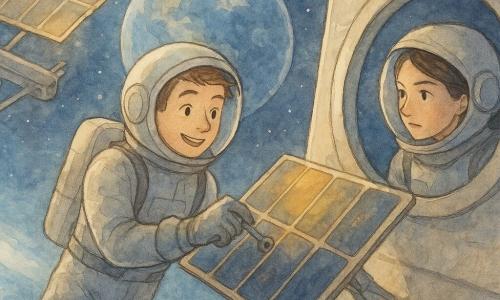
Mira stood by the window of the space station module, her palms warm against the cool glass. Outside, Earth was a blue swirl, and the sun painted a bright stripe across the curve of the planet. She had been an astronaut for a few years, but every mission still felt like a new poem—full of surprise and careful lines.
Today the crew welcomed a shiny new module that would help them grow food and recycle water better. Mira loved machines that helped people and the planet. She liked to say hello to gadgets as if they were small animals, because treating things gently made everyone work better together.
Before the new module arrived, Mira walked through the station with her checklist. She checked the air filters, looked at the little valves that keep water from running away into places it shouldn't, and tapped the panels that measured power use. She liked to save things—energy, water, even time—because wasting made her feel uncomfortable, like a loud noise in a quiet room.
Her teammate, Jonas, zoomed by with a tray of floating tools. “Ready?” he asked, smiling with tool-smeared hands.
“Ready and careful,” Mira answered. She tightened her knot of hair and imagined the module as a new student in class who needed kind questions more than loud orders.
The docking alarm sang softly. Outside, the new module drifted like a silver fish. The crew put on their clip-hooks and gloves, and Mira felt the familiar flutter of excitement and responsibility. This was work that mattered—and work that needed listening.
Chapter 2: The New Module's Questions
When the new module clicked into place, it made a sound like two pages closing. Inside, it smelled faintly of warm metal. Lights blinked, and a screen pulsed with friendly icons: water drops, leaves, a tiny planet.
Mira stepped forward and asked, “Hello, module. How do you breathe?” It was a little joke—machines do not breathe—but she liked asking questions aloud. It helped her think.
The module hummed and a thin voice came through the speaker, like a bell wrapped in cotton. “I use air scrubbers to clean carbon dioxide into oxygen, and a pump to move water through filters,” it said. The voice was simple and precise. Jonas clapped like someone delighted by a small magic trick.
Mira knelt and peered at the pipes and filters. “How much water do you need for the plants?” she asked. “How do you keep from wasting it?”
The module replied with calm diagrams. It explained that most water would be recycled: sweat, dish water, even breath moisture could be cleaned and used again. Plants would take only part of it, and any leftovers would be filtered and returned. Mira pictured every drop as a tiny friend travelling on a long loop around the station. She loved that idea.
When the crew planned the module's routines, Mira listened to engineers on Earth who suggested schedules and to the plants' sensors that told them when the leaves were thirsty. Some decisions were simple, like lowering a light to save power. Some were tricky, like deciding how often to replace filters, because they cost supplies brought from Earth.
Mira asked about the filters. “If we replace them too early, we waste parts. If we wait too long, the air gets tired.” The module's light blinked as if nodding. The engineers answered with numbers, but Mira asked for examples instead— stories she could share with a child on Earth. The engineers loved that. They sent back a picture of a filter with the caption: “Like a sponge that gets heavy when it works.”
Listening to all voices—machines, engineers, plants—made Mira feel like a conductor of a quiet orchestra. Every instrument mattered.
Chapter 3: A Tiny Leak and a Big Team
Two days later, a soft red glow appeared on one panel. A sensor showed a small drop of water where it should not be. Not a flood—only a single, stubborn drop—but in space, even a single drop can float away and find a computer latch to hide inside.
Mira zipped over. She could have fixed it by herself, but she remembered how her science teacher had taught her to ask before acting. “What do you think caused it?” she asked Jonas and Lina, who were nearby.
Jonas suggested tightening a clamp. Lina thought a tiny crack in the hose could be glued. Mira listened to both ideas, and then she spoke gently to the module: “Do you have data? What did you feel?”
The module shared old readings and a small video of the area taken earlier. The leak seemed to start after a light tool bumped the hose during installation—a gentle nudge that loosened a thread. None of them blamed anyone. Instead, they gathered the right tools, prepared a small containment bag to catch stray drops, and patched the hose with tape used for emergency repairs.
Mira's hands moved with soft confidence. “We'll take one step at a time,” she said. Jonas fed her tape like a patient baker handing over dough. Lina fed instructions from mission control. The repair worked. The red light blinked off and the tiny drop dissolved into a filter, where it belonged.
Afterwards, the crew made hot cocoa from powdered mix and warmed water that had been carefully saved. They sat together, clinging to their cup handles so the liquid didn't float away, and laughed about the leak. Mira thanked everyone for listening and for sharing ideas. She felt bright and warm inside, like the sun stripe on Earth.
Chapter 4: Stars, Teachers, and Quiet Thanks
At night—when the station was quiet and the Earth turned like a slow, sleepy toy—Mira floated to the observation window. The module hummed its soft lullaby. She thought about the day's tiny leak, the questions, and the careful patch. She thought about how everyone's listening had fixed the problem without blaming anyone.
She remembered her teacher, Ms. Alvarez, who had taught her to notice small things: a leaf's curl, a puddle's shine, the way a question could open a door. She remembered Mr. Thompson, who taught her to measure and double-check. She remembered a robotics club leader who said, “Ask often, fix gently.” Their voices were whispers in her mind, guiding her hands even now.
Mira closed her eyes and thanked them quietly. She thanked the crew who had shared their tools and ideas, the engineers who answered with pictures instead of numbers, and the module that answered back in its gentle voice. She thanked Earth for the blue swirl she could see, and the station for keeping them safe.
The module blinked in the dark like a tiny firefly. Mira whispered, “We will not waste. We will listen.” The words felt like a promise. She pictured the plants inside the new module drinking only what they needed, the filters breathing clean air, and the water making its long, careful journey again and again.
Before sleep took her, Mira imagined telling children on Earth about the day. She would tell them how astronauts work—measuring, asking questions, fixing things carefully, and always remembering that resources are precious. She would tell them how important it is to listen to one another, even when ideas are different. She would tell them about teachers who plant the first seeds of curiosity.
Outside, the stars kept their soft, steady watch. Inside, the crew slept one by one, tethered gently to their bunks. Mira unhooked her safety line and settled down, the new module's humming a lullaby. Her last thought was warm and small: thank you.
When she woke, the station was bright with the sun's first slice. The plants in the module looked greener by a tiny fraction. The filters hummed cleanly. The team met their checklist with calm smiles. Mira felt proud—not because she had fixed a leak, but because everyone had listened, shared, and cared.
And as the station sailed above the sleeping planet, Mira kept the promise she had whispered aloud. She listened to machines, to people, and to the tiny needs of water and air. She cared for resources like precious friends. She kept learning, step by careful step, and she always remembered to say thank you—especially to the teachers who had taught her how to ask the right questions.