Part One
There was once a young woman who walked like a song. She did not rush past the willows. She did not hurry across the stepping stones. Slowly, slowly she walked, and the world had time to smile back at her.
Her name was Maris. Maris had a small promise in her pocket. It was folded like a paper boat. The promise said: carry the forgotten voice. It had been given to her by an old neighbor who no longer sang, by a child who had forgotten the words, and by a willow that kept hush in its leaves. Maris kept the promise close to her heart. She would not break it. She would not hurry.
One evening, under a moon that hung like a silver lantern, Maris came to a house that was larger than any she had known. It was painted in dusk-blue and had windows like watchful eyes. Inside, a great ballroom waited. The floor shone like a lake of light. Crystal candles blinked. Masks and ribbons and soft shoes made a quiet rustle. The ballroom was a place where music slept in its corners, waiting for a voice to wake it.
"I must find the voice and praise it so it will remember," Maris whispered. Her words were a thread that trembled in the room. She moved slowly across the floor, her footsteps like small drums. "Slowly, slowly," she greeted the polished boards. "Slowly, slowly," she said to the chandelier.
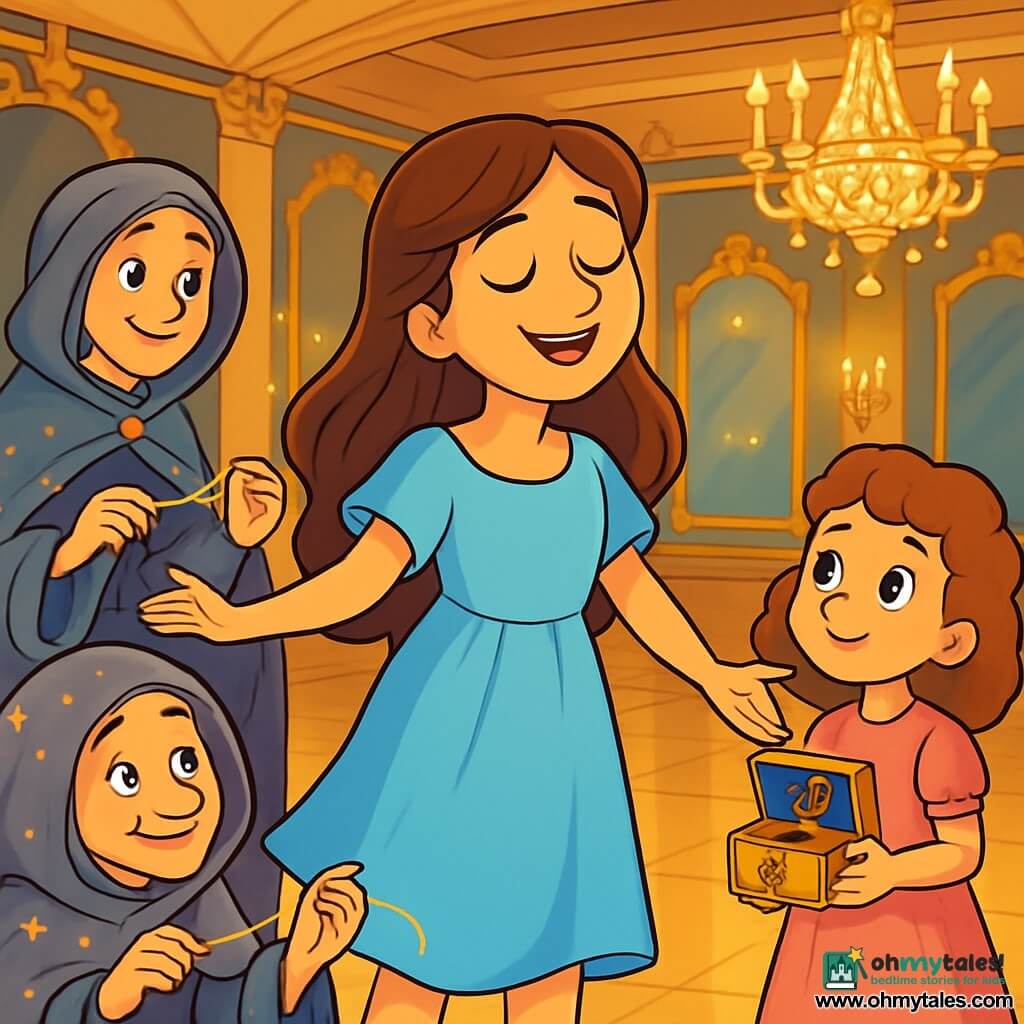
As she walked, Maris met a woman at a loom in a corner veiled in moon-silk. The loom was not for cloth. It was for time and tides. The woman wore a cloak of gray stars. Her fingers moved like birds. She looked up and smiled kindly.
"I am the weaver of fate," the woman said. Her voice was warm as bread. "I weave the small things and the great things into one cloth. What brings you to the ballroom of waiting music?"
Maris bowed. "I carry a promise," she answered. "A promise to carry the forgotten voice. I do not hurry. I will find it and give it back."
The weaver nodded and drew out a fine thread that shone like moon-water. "Take this thread," she said, laying it in Maris's palm. "Tie it to your word. Let it guide your steps. Loyalties are like threads. When they are held steady, they do not fray."
Maris tied the thread round her wrist. It felt warm, and it hummed like a tiny bell. "Thank you," she said. "I will not rush."
Part Two
The ballroom was fuller now with invisible guests. Mirrors watched. Shadows became soft friends. Maris moved where the light was gentlest. She listened with her whole chest. A forgotten voice is a shy bird. It hides in rafters or in the fold of a curtain. It hides in the breath of a room.
She heard a hum behind a velvet curtain. She listened. The sound was thin, like a string half-tuned. Maris reached the curtain and found a small music box resting on a chair. Its lid was carved with tiny dancers. When Maris opened it, a whisper rose and faltered. It was a lullaby that nobody had sung in a long while.
"Oh," Maris breathed. The lullaby was the forgotten voice. It was made of rain and a mother's hands. It trembled and almost slipped away again. Maris drew the music closer and sang softly with it. Her voice held the note like a bird in a palm. "Slowly, slowly," she hummed, and the tune grew steadier.
But the ballroom has corners where old fears sleep. A small fear crept forward like dust on the floor. It said, "Maybe you cannot carry so big a thing. Maybe you should leave the music to the boxes." Maris felt the fear sitting heavy on her shoulders. It wanted her to hurry, to flee, to fold the promise away.
Then came a laugh. It burst from the weaver's place like a bell. It was bright and round and carried a dozen tiny sunbeams. The laugh was not a roar. It was a merry peal, like someone untangling knots. It chased the dust of fear away. The shadows looked surprised and then relaxed. The fear shrank and went under the skirting board.
"Do not let fear pull your thread," the weaver said, leaning closer. "Laughter is a broom that sweeps small monsters out the door."
"Will the voice fit in me?" Maris asked, still gentle.
"It will," the weaver answered. "You must only hold it true. Remember your promise. Remember the moon-thread." She pointed with a finger that left silver sparks. "Loyalty is a lamp. It gives steady light. Keep it near."
Maris took a deep breath. She hummed the lullaby again, and each note settled like a stepping stone. She walked through the ballroom, carrying the song in her chest. People who had been moving like puppets stood still and listened as if waking from a dream. A child's toes tapped, a grandpa's eyes glistened like small seas, and even the chandelier shivered with delight.
At the middle of the dance floor, a figure in a bright coat approached. It was the child who had once said the lullaby but had forgotten its words. The child had grown into someone else, but the heart remembered. "Do you have the lullaby?" the figure whispered.
"Yes," Maris answered, "I will carry it for you." She placed the music softly into the child's hands. But the child looked unsure. "How will I remember?"
"Sing with me," Maris said. "I will sing while you remember. We will not hurry. We will be loyal to the song." So they sang together, slowly, like the turning of a wheel.
Part Three
The song must travel from one heart to another. It does not run. It walks with a steady foot. Maris sang and the child sang, and the weaver hummed a thread-rhythm from her loom. The ballroom brightened as if lanterns had been placed in each chest.
A hush fell, a soft pause like holding a breath. Then a laugh bubbled up again — this time from the child. It was small and proud. It chased away a last sliver of worry. The laugh was full of courage. Fear folded up and left the room with no trouble.
"Thank you," the child said, and the child took the lullaby to the lips and sang it aloud. The words were like blooming petals. The old neighbor in the window wiped a tear that was like a drop of morning. "The song is back," she said. "You kept your promise."
Maris smiled. Her hands were tired in a happy way. The moon-thread on her wrist glowed and then sank like a tiny star finding its place. The weaver came close and touched the thread gently. "You have been loyal," she said. "You did not hurry. You listened. You laughed when laughter was needed. You bound the voice back to its people."
Maris looked around the ballroom. The dancers had slow smiles. The music box had a new shine. The chandelier hummed like a hive. Loyalty had put threads across the room, invisible and strong. It had tied hearts together like little boats tied to a common dock.
It was time to say goodbye. The child took Maris's hand. "Will you stay?" asked the child.
"I will go now," Maris said. "But I will keep your promise for as long as it is needed. I will return if the voice forgets again." She bent and kissed the air above the child's head like a blessing.
Before she left the ballroom, the weaver stood and sang a small last line. The sound was soft and sweet, like bread cooling on a sill. The people joined in, one by one, until the room was full of gentle voices.
They sang a farewell song. It was not sad. It was a ribbon tied at the end of a lovely day. The words were simple: thank you, be well, keep the light. Maris sang too, and her voice floated on the thread she wore.
"Goodbye," she said, and the room replied, "Goodbye and thank you." The lamps winked. The moon tucked itself behind a cloud as if to listen a little more.
Outside, the willows leaned forward to hear the last notes. Maris walked home slowly, slowly, the promise folded like a paper boat in her pocket. The world felt kinder for the carrying of the voice. Loyalty had done its small, brave work. It had been a steady lamp. It had been a thread that would not fray.
That night, when children tucked their dreams under their chins, they heard a faint lullaby from the far ballroom and smiled. The village kept its memory warm. And somewhere by a silent loom, the weaver of fate hummed and waited, weaving little threads into the cloth of morning.
The lesson whispered softly like a breeze: keep your promises. Walk slowly when the road asks for gentleness. Laugh when fear knocks at the door. A loyal heart makes music that can be carried from one hand to another, from one night to the next, as true as a moon-thread tied around the wrist.