Part One: The City of Soft Light
In a city that floated on the backs of slow, silver clouds, the houses were made of warm light and soft music. Bridges of moonbeams tied the rooftops together, and little bellflowers hung from balconies and chimed when the wind told a joke. People walked with gentle steps, because the streets listened and did not like to be hurried.
Among these gentle people lived a man named Tomas. His hair was like the evening mist and his eyes kept a steady glow, as if a small lantern lived inside him. Tomas worked as a keeper of the sky-lights. Each morning he walked the cloud lanes, polishing lamps that hung from the eaves, helping the light to wake in the world.
One night, when the city was wrapped like a blanket and only the softest stars were awake, Tomas heard a sound that was not the bellflowers, not the wind, nor the sleepy feet of neighbors. It was a thin, bright call that seemed to come from a seam in the clouds themselves. The sound felt like a small bird tapping at the ribs of his heart.
"Who calls?" Tomas whispered into the hush. The call answered with a melody that smelled like cinnamon and looked like silver thread. It tugged at him, gentle and certain.
Tomas had always been brave enough for small things: rescuing a kite caught on a starlit branch, guiding a lost child back to a lantern-house. But this call was different. It was bigger. It seemed to ask for someone to follow it beyond comfortable light and familiar bridges.
That night Tomas put on his cloak. It was stitched of dusk and kindness. He pinned a little bellflower to his lapel for courage and stepped onto the cloud-edge. The city sighed, and the moon held its breath as Tomas followed the bright call into the soft unknown.
Part Two: The Path Between Heartbeats
The call led Tomas along a narrow path between two moving clouds, where mist curled like sleepy cats. The path shone faintly under his feet, a ribbon of memory. As he walked, the city behind him hummed a farewell, and quiet homes wrapped their dreams in extra blankets.
Soon Tomas reached a place where the clouds broke into a garden of floating lanterns. Each lantern was a small world, humming with stories and feelings. He paused. A lantern nearest him pulsed with blue light and sighed, "I hold the color of missing someone." Tomas touched its glass and felt a warm ache, like missing his grandmother's bread.
Further along, a lantern glowed gold and laughed, "I keep morning's first brave step." Tomas smiled and thought of the first day he had climbed the light ladder to learn his job. He felt a soft pride, like a coin in his pocket.
As he moved, the call grew clearer, weaving through lantern tales. It moved like a ribbon through a crowd, so brave and shy at once. Tomas reached a clearing where a single lamp hung alone on a tiny cloud. The lamp was not like the others; its glass was not smooth but carved with tiny shapes of hearts and waves.
"Are you the one who called?" Tomas asked.
The lamp blinked its light and spoke in a voice that sounded like rain on a tin roof. "I called because I remember an old song," it said. "The song belongs to a valley under the clouds. Long ago, laughter lived there like a river. But a shadow came and the laughter folded like a paper boat. I cannot mend the song alone."
Tomas thought of the city above, warm and humming. He thought of the lantern that held missing, and the one that kept brave steps. He felt the small bird-tap in his chest again. "Then I will go," he said, and the lamp shivered with gratitude.
The path twisted downward. Clouds thinned into silk ribbons, and Tomas could see, for the first time, the world beneath: a green valley that had been sleeping, its colors muted as if someone had washed them in moonlight. At the valley's center lay a lake that once had shone like a mirror. Now it was dull and quiet.
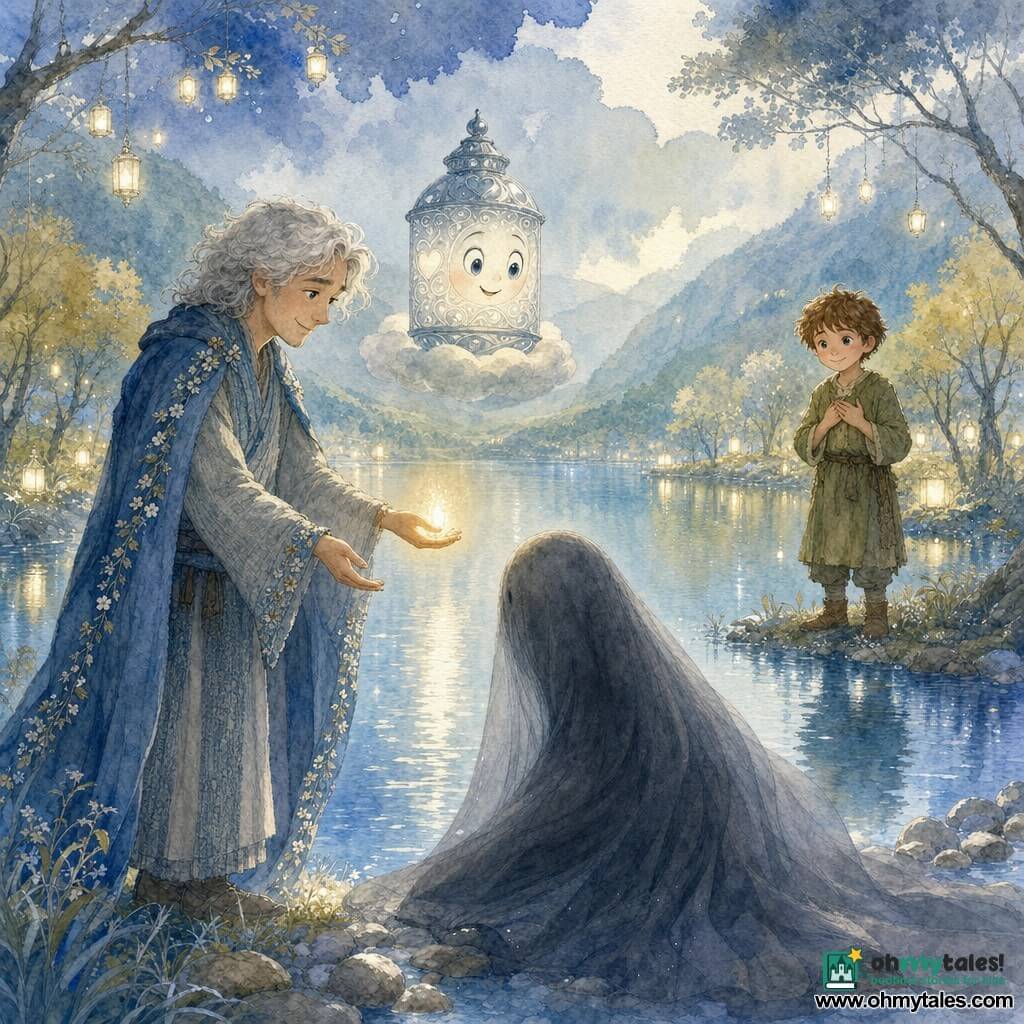
At the water's edge stood a tall, dark shape. It was the shadow the lamp had spoken of. It was not evil in a thunderous way; it was small and stubborn, like a bruise on a leaf. Where the shadow touched, laughter seemed to tuck itself away.
Tomas stepped forward. "Hello," he said. His voice was like a warm loaf of bread. The shadow did not answer but rustled like a afraid curtain. Tomas tried listening. He could not hear laughter here—only the valley's very quiet breathing.
"What makes you hide?" Tomas asked.
From the shadow came a soft, bitter voice. "I am the hush that came when the valley forgot how to be seen," it said. "I am the silence of worries, of little hurts stacked like stones. I keep things safe by holding them away."
Tomas thought of the lanterns and their small houses of feeling. He thought of doors that close when people are afraid. He imagined the valley's laughter, folded and small. "Hiding isn't safe for joy," he said. "Joy needs light like flowers need rain."
The shadow only folded more tightly. Tomas felt a tremor of doubt. The valley seemed very far from his cloud city. He was only one man. What could he do?
A small voice answered. It came from his cloak pocket—the bellflower he had taken for courage. "You are the small answer," it whispered. "You are the hand that can unfold a paper boat."
Tomas reached out. He did not try to push the shadow away with force. He simply held out his palm full of light—memories and small kindnesses collected like soft coins. He told the shadow the story of the lanterns in the sky, how each held a piece of feeling, how the city polished its lamps so others could see. He spoke of the bellflower's bravery, of the way neighbors shared muffins on rainy days.
Slowly, like early fog lifting, the shadow eased. It was surprised to be spoken to kindly. No one had spoken to it like that for a long time. It shivered and some of its gray fell off as thin flakes. Where flakes landed, small things began to stir: a shy giggle, a ripple of green, a pebble that remembered how to sparkle.
"Why do you carry silence?" Tomas asked softly.
The shadow answered, "I wanted to keep things from breaking." Tomas nodded. "We all want to keep what we love safe," he said. "But sometimes keeping it too hidden makes it thin and small."
He dipped his hand into the lake and sent a circle of warm light across the water. The circle spread and touched the folded laughter. The sound that came was a baby of a laugh, a small and surprised chirp. Tomas did not shout. He hummed the city song, the one the lanterns hummed when people cleaned their windows. The melody was simple—just a few notes like stepping stones.
The valley listened. The shadow listened. One by one, the lanterns above came down a little to see. They shone their feelings into the valley: courage like a small drum, comfort like a soft blanket, giggles like bright confetti. The laughter unwrapped itself slowly and tasted like sunlight.
But then, as the valley began to brighten, a gust of cold worry blew in from a distant ridge. Tomas felt it in his bones. The shadow stiffened and the valley's smile trembled. Doubt can be a quick wind.
Tomas closed his eyes. He thought of his city, the faces he knew, the bellflower on his lapel. He remembered his first brave step. Then he began to sing again, and his voice was steady as a bridge. The song did not chase away the cold; it made a soft path for warmth to travel. The lanterns formed a ring, each lending a sparkle. The warmth found the doubt and turned it into a question instead of a wall.
"Will you try?" Tomas asked the shadow.
The shadow hummed like a kettle and then made a small sound like an unlatched lock. "Yes," it said in the voice it used when no one listened—a voice that wanted to help more than hurt.
Part Three: The Light That Stayed
The valley did not bloom all at once. It took a long breath and small, steady steps. Flowers peeked, then rose. A little boy found his lost song and sang into his hands. The lake remembered how to glitter under the moon. The shadow did not vanish; it became a gentle shade under a tree where tired things could rest. Sometimes when night came, it would sit beside a lonely pear and keep it from freezing.
Tomas walked back up the ribbon-path with the lamp that had called him. The lamp now held a new pattern—small loops like laughter lines. It twinkled and told Tomas that the valley had learned how to welcome both light and shade.
"You were brave," the lamp said.
"No," Tomas answered. "I was listening."
When he returned to the cloud city, the bellflowers danced extra bright. Neighbors came to pat his shoulder and ask about his journey. Children clustered at his feet and wanted to hear the story of the valley and the shy shadow. Tomas told it plainly, with soft words, so the children could hold it like a paper bird.
Days passed. The city hummed with new songs. Lamps shone with extra patience, and the bridges hummed a little tune about going slowly. Tomas went on his rounds, polishing, humming, noticing the small things. Sometimes, when the evening wind made the bellflowers whisper secrets, Tomas would look toward the valley and think of the shadow that had learned to be a bench.
On a night of pear-sweet air, Tomas stood alone on the edge of his rooftop. The city below glowed, a constellation of kind houses. He felt a quiet light inside his chest, like a tiny home.
"You followed a call," a child from the window below called up. "Did the world say thank you?"
Tomas smiled and answered, "It sang back." He thought of the valley's first laugh, bright as a new coin. He thought of how the shadow had folded, then opened, and how listening had been the door.
The city slept, but its dreams were a shade warmer. Tomas listened to those dreams like a good friend. He had followed a call and found that courage was not only the stepping into the unknown; it was the steady heart that stayed to mend small things. He had learned that shadows are not always foes; sometimes they are tired, and they only need a hand.
In the mornings after, people would say the sky tasted a little sweeter. Bellflowers seemed to tell longer jokes. Lamps hummed songs of welcome. The valley below kept its laughter by the lake, and the shadow kept a polite little shade for anyone who wanted to think.
One evening, as autumn light folded like paper cranes, Tomas sat by his favorite lamp. He placed his palm on its glass and felt the tiny thrum of the valley's life. The lamp shone, and Tomas heard, in the bright echo, a soft promise.
"Peace is not a finish line," the lamp murmured. "It is the way we hold each other while small storms pass."
Tomas nodded. He tied a little bellflower to the lamp's hook so it would never be lonely. Then he hummed the city song, a tune that now held the valley and the way a shadow could turn into a bench.
When night came, the city of clouds breathed in and out like a gentle bell. Stars sprinkled cold sugar on its roofs. Tomas lay down and watched the moon stitch silver across the rooftops. He felt calm. He had followed a call, crossed a ribbon of clouds, listened to a shadow, and returned carrying a new kind of light—one that kept space for both laughter and hush.
And in this soft world where magic listened to small hearts, the night settled into a long, warm peace. The city and the valley, the lamps and the shadows, learned to live between song and silence, holding each other with the quiet hands of people who had learned to listen.