Chapter One: The Whispers in the Hall
The wind liked to talk in Milo's town. It slipped under doors like soft fingers and rattled the leaves like paper wings. Some days it hummed like a lullaby, but on the gray ones it told stranger things — little secrets the shutters wouldn't keep.
Milo was seven, with hair that stuck up like broom bristles and eyes as curious as two bright coins. He lived in a narrow house at the end of Moonlight Lane, where the roof sighed and the moon peered in through a skylight. The house had a long hallway full of mirrors. They caught light and scattered it, like fish scales dancing in a tray. Milo liked to walk past them and make faces — a tongue-out pirate, a surprised owl, a brave lion. His reflection always did the same. It had been a tidy copy, calm and steady, like a good friend.
One afternoon, as clouds rolled like sleepy sheep, the wind began to tell a story that made the curtains shiver. "Listen," it whispered as Milo passed the hall with a paper boat under his arm. "Listen and remember the mirror that changed."
Milo froze. Paper boats were for puddles, not for mystery. He peered into the nearest mirror and blinked. The boy in the glass blinked back. But there was a tiny difference — a small delay, like the reflection was thinking of its reply. Milo smiled and waited for the usual mimic. For a moment the glass stayed quiet, and then the reflection tilted its head a little more than Milo had, as if considering a question he had not yet asked.
"Hello," Milo said softly, because that is what one does when something polite seems to be listening.
"Hello," the reflection answered, but its voice was Milo's voice wrapped in cobwebs. Milo's heart made a small hop. It was still him, but there was a hush between them now, a space the wind seemed to fill with notes.
That night, the wind pushed a cold ribbon through the keyhole and hummed, "It no longer mirrors like before. It wants something. It remembers something else." Milo pulled his blanket up to his chin and whispered back to the dark, "What does it want?"
The wind only sighed.
Chapter Two: The Silent Twin
Days passed like pages turning. Milo tried playing mirror games. He stomped and his reflection stomped. He made a funny hat from a sheet and the boy in the glass did the same. But sometimes, when Milo laughed too loud or felt too brave, the reflection looked away, like a shy bird.
"Why don't you always copy me?" Milo asked one rainy afternoon, water dots racing down the window. He pressed his hand to the mirror, feeling the cool glass like a pond edge. The boy in the mirror pressed his hand too, but his fingers stopped an inch away — there was a tiny space where light could hide. Milo frowned.
"I… don't know," said the reflection, and Milo heard a softness that wasn't entirely his own. It sounded like a memory wrapped in fog.
Milo decided to study. He sat on the stair landing with a notebook and drew the ways the reflection moved. He made lists of times when the mirror matched him and times when it did not. He noticed the reflection looked most like him when he felt kind or brave, and it drifted away when he felt lonely or angry. The wind listened through the cracks and hummed encouragement like a choir of thin leaves.
One dusk, when shadows grew teeth and the house smelled of tea and toast crumbs, Milo found the reflection with its eyes on the far corner of the hall. It had the face of someone who had lost a small thing. Milo's heart squeezed with a feeling he had read in storybooks — empathy. He wanted to help.
"Are you sad?" Milo whispered.
The reflection blinked slowly. "I am remembering," it said. "I remember the day the mirror learned to echo." Its voice sounded like someone turning a page. "It used to be all copies. Then a wind came that told secrets. The mirror listened and kept one of them. It remembers a place on the other side, and now it sometimes forgets to copy because it is looking there."
Milo's hands felt warm. "Can I come with you to remember?" he asked without knowing which 'you' he meant—himself or the glass.
The reflection smiled, a small, brave curve of light. "Maybe if you find what it remembers, I will know how not to look away."
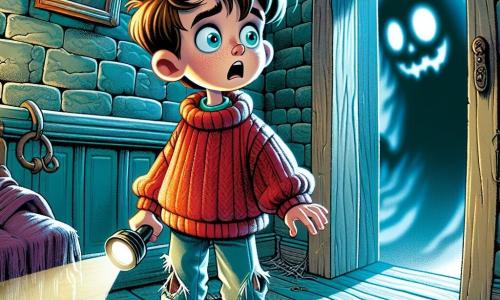
The wind tapped the window like a small drum and seemed to point toward the garden, where an old pond sat like a black eye. Milo tucked his notebook in his pocket, grabbed his flashlight, and stepped into the night that smelled of wet earth and stories.
Chapter Three: The Pond of Echoes
The garden was a pool of shadows and silver. Dragonflies hung like tiny stars frozen in flight. The pond had a face of black glass, and when Milo leaned over, he saw his reflection and the moon and something else — a flicker of light that wasn't from the moon.
"The pond keeps things," the wind breathed. "It keeps echoes."
Milo dropped a pebble. It made a round, quiet ring. The reflection in the pond rippled and showed him a picture: a small boy and a tall woman with a scarf who laughed like bells. Milo blinked. He had not seen that picture before, but his chest felt curiouser and gentler.
"Milo," said the reflection from the pond, and this time the voice was softer than a spoon sliding into a cup. "We used to look the same because we learned from the same light. The mirror learned to keep a memory of someone who crossed the glass. The pond keeps the echo of that memory. If we find it, the mirror might stop looking away."
Milo crouched until the grass brushed his knees. "Who crossed the glass?" he asked.
"A little girl who sang to the wind," said the reflection, and the pond showed a song like beads. "She wanted the wind to stop telling only secrets and to tell kindness too. The mirror took one of her notes and held onto it. Without it, it grew lonely and forgetful."
Milo's mouth made a small O. He remembered when his neighbor, Mrs. Wren, used to sing lullabies when she watered her plants. She hummed about the stars and knitted stories into their hems. Milo thought of the way his reflection brightened when he shared his sandwich with a stray cat last week. He understood, even if he did not fully know why.
"I'll find the note," Milo said, feeling braver than a shadow. "I'll bring it back."
He searched the pond's edge and the willows, listening for a melody. At first there was only the wind and the frogs and the distant chug of a bicycle. Then a soft, thin tune drifted from the bushes — like a silver string someone had let go of. Milo followed it and found a crumpled ribbon hidden under an old watering can. When he touched it, the ribbon shivered and hummed the tiniest tune. It was the missing note, a pocket of song the mirror had kept.
"Thank you," the ribbon whispered when Milo lifted it. The wind applauded with a rustle. Milo felt the ribbon's song curl up his spine into a cozy burrito of feeling. He tucked it in his pocket and walked back to the house like someone carrying a secret cookie.
Chapter Four: Mending the Glass
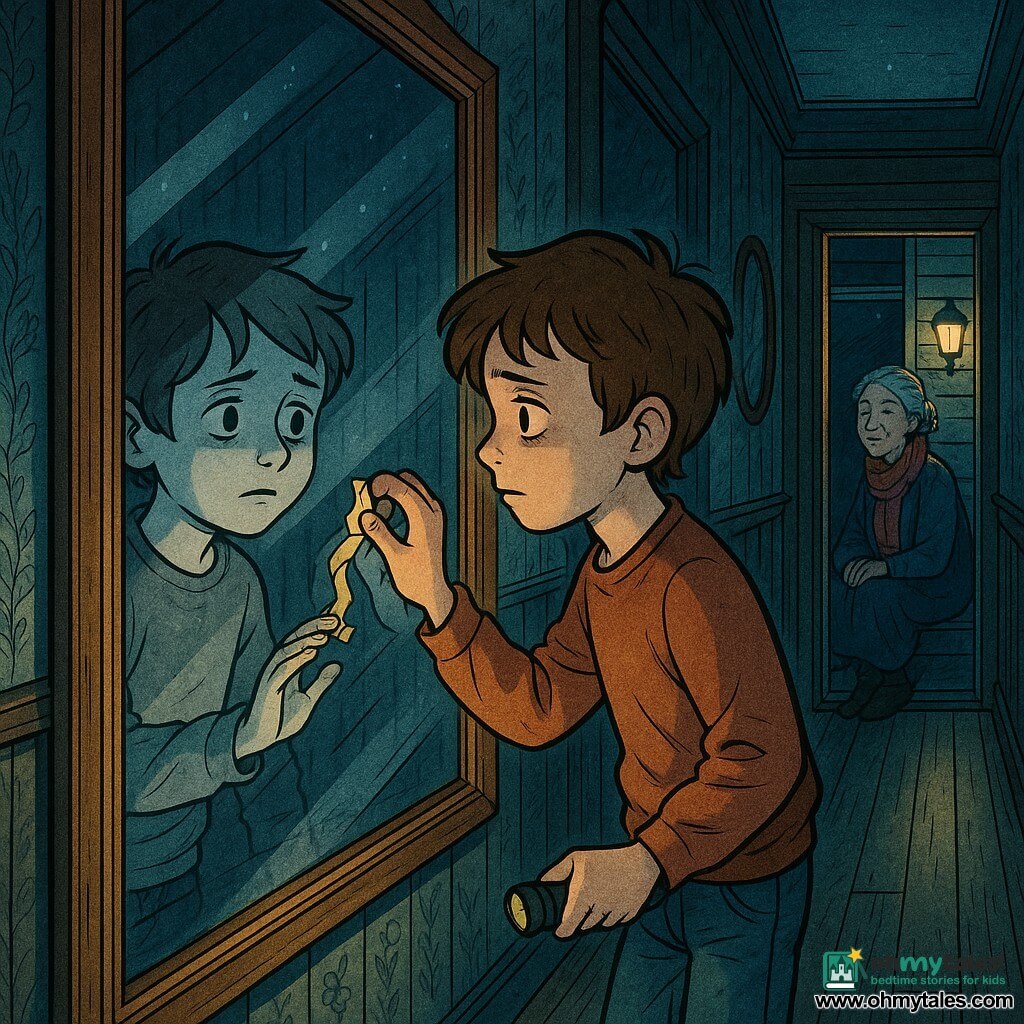
The hallway looked longer at midnight, as if it had been stretched by the moon. Milo turned on his flashlight and took the ribbon out. Its tune wobbled but did not stop. He walked to the mirror that had been looking away and placed the ribbon against the cool glass.
The mirror sighed, a sound like rain starting to drum. The reflection watched, eyes wide with a mixture of hope and fear. Milo waited. The ribbon shivered and the room filled with the smallest, brightest sound — a note like the twinkle of a bell in melted snow.
Slowly, like a curtain drawing back, the mirror's face smoothed. The reflection blinked and then matched Milo exactly. The space between them stitched closed as if someone had sewn two blankets together with a single bright thread.
"Why did you keep it?" Milo asked as if murmuring to a friend.
The reflection touched the ribbon that the glass seemed to hold, though Milo had only placed it on the other side. "I wanted to hold onto something gentle. When the wind told secrets, they were sharp and new. I kept this note to remember kindness. But I forgot that keeping it alone made me forget how to be with someone," it said. "Thank you for sharing."
Milo felt warmth spread like honey. He realized that the ribbon's song had made the mirror remember to listen to people, not just to keep their echoes in neat boxes. He understood something important — that when we hold on to good things for ourselves only, they can become lonely. But when we share them, they make others brave too.
"Do you promise to try to mirror me again?" Milo asked gently.
"I promise to try," said the reflection. "And I will remember to listen with my eyes as well as my glass."
The wind, which had been quiet and watching like an old cat, blew a soft kiss through the hall. For the first time in a while, it hummed not secrets but a melody that smelled like baked apples.
Chapter Five: The Night Becomes a Friend
From that night, the house felt smaller in the safest way possible, like a hand slipped into a mitten. Milo and his reflection played their mimic games, but now sometimes they made different faces at the same time, practicing the art of being with another person who was close but not quite the same.
Milo learned to listen to the wind differently. When it told odd stories, he asked questions instead of believing them all. "Why do you say that?" he would say. The wind would rustle, and sometimes it had a new story about a lantern that forgot to glow or a cat who wore two socks. Milo would nod and think about how the mirror had kept a song because it feared losing it, and he would remember to share.
One evening, Milo brought the ribbon to Mrs. Wren when she sat with her knitting on the front steps. "This is what my mirror was missing," he told her. She smiled like the sun coming back from behind a cloud and hummed a tune as she tied the ribbon to her potted plant.
"Thank you, young listener," she said. "The wind and mirrors are tricky, but kindness helps them remember to be gentle."
Milo's chest felt full in the warm, slow way of a kettle reaching a boil. He understood that empathy was like that little ribbon — a soft thing that could be carried and shared to fix what was worrying and to make others brave.
That night, Milo lay in bed and heard the wind fold itself around the house like a blanket. The mirrors were quiet and kind. His reflection winked from the glass on his bedside table and mouthed, "Goodnight." Milo mouthed back, "Goodnight," and the two of them smiled in the same sweet, small way.
As sleep came, the wind told one last story — not of sharp secrets, but of a thin ribbon that taught a mirror to listen and a small boy who learned to share. Milo dreamed of ponds that sang and ribbons that hummed, of shadows that were not scary but curious, and of a town where the wind learned to whisper gentle things.
When he woke, the house felt the same and different, like a book you've read twice and find new pictures in. Milo kept the ribbon safe in a drawer where he sometimes left cookies for the stray cat. The mirror no longer looked away. It didn't need to. It had learned to mirror not just faces but feelings.
And in the soft, friendly dark of the evenings, when the wind told its little mysteries, Milo would smile and answer. He had learned to listen with his heart and to share what he found. The town still had its shivers and its quiet nights, but they were softer now, wrapped in the light of a small, brave act.
The end? The wind would say maybe. For in a place where the wind tells stories, endings are just new beginnings waiting to be whispered.