Chapter One: The Night That Knocked Like Rain
Mara lived at the edge of the whispering wood, in a small house that hummed like a kettle. She was seven, with hair the color of brown sugar and eyes that caught the light like tiny mirrors. Every evening she listened to the trees breathe and counted the stars until her mother tucked a blanket around her like a warm secret.
One night, as the moon leaned a little closer to the earth and the air smelled of wet leaves, there came a sound at the window. It knocked not with a hard hand but like quiet rain tapping a tin roof. Mara sat up and placed her small palm against the cold glass.
Outside, in the pool of lamplight, a shadow pressed its face to the pane. It was not a person and not an animal, but something between the two, a silhouette stitched of night. It had long ears that curled like question marks and eyes that glowed like two lost coins. Its fur seemed to be made of fog, and when it moved a faint trail of cold spun behind it like a scarf.
The thing looked small, and it looked frightened. Mara's heart did a curious flip-flop. She felt a wave of responsibility, a tiny bell ringing in her chest. She remembered her father's words: “If someone knocks, you listen. You do not turn away.” So she opened the window.
“Hello,” she whispered. Her voice was a candle in a dark room. “Are you lost?”
The creature blinked, and a sound like a sigh of old paper escaped it. It whispered a word that sounded like wind. “Hush,” it said—though perhaps it only thought the word.
Mara climbed down, bare feet cold on the floor, and set a small bowl of milk on the step. The creature's eyes widened until they filled with moonlight. It sniffed and drank like a bird learning to fly. Mara felt its trembling through the wood of the window frame. It was small enough to fit into her hands, if it were not made of shadow.
“You can come inside,” she offered, and the creature stepped over the threshold as if the house had been expecting it all along.
Her mother was sleeping upstairs, and Mara wrapped an old wool scarf around the creature. It smelled of rain and the inside of books. It trembled, not from cold but from a kind of sorrow.
“Why are you here?” Mara asked. The creature pressed its forehead to her palm. Its fur felt like velvet and the hush of an empty hallway.
When the creature looked up, Mara thought she saw a single, tiny tear suspended like a bead of morning on its whisker. She decided then that the creature hurt in a way that needed fixing. She had never put a hurting thing back together, but she knew how to be gentle.
“Stay,” she told it. “I'll help.”
Chapter Two: The Voice That Came from the Walls
Mara called the creature Little Night because it came with the hush of the evening. Little Night moved through the house with the soft curiosity of a moth. It listened to the clock and learned the sound of plates. It liked to sit on Mara's window seat and watch the streetlights sway like sleepy lanterns.
But at times, Little Night would pull away and press its ear to the wooden wall, as if it heard music only it could know. “What is that sound?” Mara asked one night.
Little Night's whiskers twitched. It hopped to the wall and tapped it with a paw that left no print. From inside the wall a voice answered, not loud but layered, like an old song humming through pipes. “Home,” the voice said, a word shaped like a hollow tree.
Mara frowned. She had always thought the walls held secrets, places where the house kept its memories. She had never heard the house speak. Little Night seemed to listen as if the voice were telling it something small and very important.
“Is it your family?” Mara asked. Little Night shook its head slowly. The voice from the wall sighed like wind through dried leaves. “I once belonged to a room that laughed,” it murmured. “But laughter left. I stayed.”
Mara felt a gentle prick at the back of her throat. The house's voice made her feel both sad and awake. She had a book of maps that showed where rivers slept and where mountains kept their crowns. She could trace places on the pages with her finger until the lines became stories. Now she felt like a map herself, and Little Night's sorrow was a path she had to follow.
That night she dreamed of a door at the end of a long hallway. The door was painted the color of thunderclouds and had a brass knob that smelled of stories. In the dream Little Night stood before the door, shaking, and something within it rustled like dry newspaper.
When Mara woke, the house was quiet as if it had been holding its breath. Little Night sat by the window with the same worried look. Mara slid on her shoes, wrapped a lantern in a scarf so its light would not be too bright, and followed Little Night into the wood.
The trees bowed low as they parted, letting Mara walk through a world that seemed to lean toward her in curiosity. Fog lay in the hollows like sleepy animals, and the path was a ribbon of silver moonlight. Little Night led her without haste to an old gate that creaked like a faraway clock. Beyond the gate stood a small stone cottage with ivy for hair and a chimney that panted blue smoke.
Mara felt the same pull she had felt at the window. The cottage seemed a collection of sighs and holds, its paint peeling like dried petals. As they drew closer, the voice from the walls—now louder in Little Night's mind—trembled and became a line of words: “Come home.”
The cottage's door opened on its own, and inside was a room full of toys that had been left to sleep. A rocking horse rested with a paw in the air as if it had paused mid-ride. Dolls sat in a circle with porcelain faces turned to the dim light. In the center of the room lay a small nest of shadows.
Mara knelt and looked in. At first she saw nothing, only the faint shape of a tiny heart fluttering like a moth. Then, slowly, the shadow began to shift and bend into a little frame—a picture of a family, lost and faded, edges worn like shells. The house spoke again, the voice like a reed: “My laughter left because I forgot how to care. I am empty.”
Mara understood in the way that small children understand storms: she could not change the rain, but she could hold an umbrella. She took Little Night's hand and promised, “We will help you remember.”
Chapter Three: The Night of Little Courage
Mara decided that if the cottage had forgotten laughter, they would bring it back. She picked up an old drum with a crack across its skin and tapped it like a heart. She found a book with no cover and read aloud the stories she could make from the pictures. Little Night hummed along in a voice like a shy bell.
They cleaned the cottage with the careful hands of people who wash away dust but leave memories. Mara polished the rocking horse's mane until it gleamed. She warmed a kettle and let the scent of lemon and steam braid with the house's dusty breath. She knitted little mittens from a tangled basket of yarn and put them on the dolls' hands. The dolls blinked, as if remembering how to pretend.
But every time they coaxed a sound from the house, the voice shifted. Sometimes it was a giggle that sounded broken, sometimes a whisper that clung to the curtains. Once the house laughed so quietly that Mara felt it like a ripple under her feet. Little Night shivered with relief.
Yet there were moments when the house pulled back into itself like a snail in its shell. Shadows thickened in the corners and something like doubt crawled along the floorboards. Mara's lantern flickered, and a cold thought whispered that perhaps the house would never learn to laugh again.
“Are you tired?” Mara asked the house once when their hands were sore from working.
A hollow echo answered: “Yes. I am old.”
Mara set her chin in a small, determined way. She took Little Night on her lap and told it about the time she had tripped on the garden stone and her mother had held the scrape like a bright coin until it stopped stinging. She talked about how seeds needed both sun and rain, about how sometimes you must wait for the bud to open.
“You are responsible for helping things,” she said to Little Night and to the house in the same breath. “If we do a little every day, the laughter will come back.”
Little Night leaned forward and placed its head against the wooden floor. The house's voice trembled. “Teach me,” it breathed.
So Mara taught the house small things. They taught it jokes—short, clean jokes like pebbles you could throw. They taught it songs that were soft enough to be safely sung by wind. They taught it how to keep a promise by tucking a tiny note into the mantel every morning: I will try today. They taught it how to remember the way a cup felt warm in small hands.
At night the house tried. It coughed up a chuckle sometimes, like a shy kitten clearing its throat. It learned to make the kettle whistle a gentle tune and to clap once, small and polite, when Mara finished a story. Each sound made Little Night's eyes glow like coals.
There was a moment when the house swallowed a sob so large it made the floorboards creak. Mara and Little Night sat very still and listened. “I am scared to be alone,” the house whispered.
Mara's throat tightened. She had never thought of a building as lonely. “You won't be,” she said simply. “I will come. Little Night will be here. We are responsible now.” She drew the curtains with gentle hands and hummed a lullaby until the room felt like a pocket.
Chapter Four: The Return of the Light
Weeks passed like pages turning. Mara visited the cottage every evening after school. She brought bread warm from the oven and stories stitched with fantastic animals and brave small children. Little Night grew steadier. It no longer trembled when the wind knocked on the panes; it welcomed it as an old friend.
Slowly, the house changed. Where once the wallpaper drooped, now small drawings of suns and stars were taped with care. The smell of lemon lingered even after Mara left. The rocking horse began to sway by itself, tapping a steady beat like a heart at work. The dolls smiled in the corners, and their eyes—once cloudy—gleamed with a light that did not belong to any lamp.
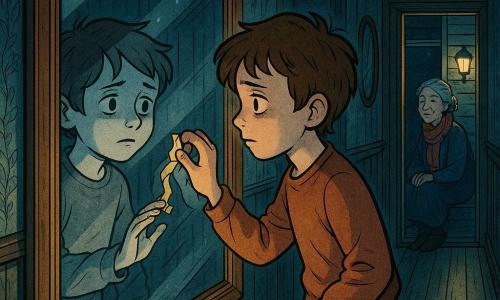
One evening Mara found a mirror behind a shelf, dusty and dull. She wiped the glass until she could see herself. In the reflection, beside her, Little Night stood taller than before, its fog thinning into the softest shade of twilight. Its eyes held a color like the inside of a seashell—warm and pearly.
The house spoke then, a sound that filled the room like sunlight through lace. “Thank you,” it said, and its voice no longer sounded like emptiness. It sounded like a bell that had been found.
Mara felt a blushing pride swell inside her, small but bright. She realized responsibility was not a coat to be worn once and forgotten; it was a rhythm to be kept. You must come back. You must keep trying. You must tend even when the work is small.
That night, all three—Mara, Little Night, and the house—sat by the fire. Little Night curled on Mara's lap like a patch of sky. The house hummed contentedly as steam rose from a pot of sugared apples that Mara had made for them. The dolls clapped politely and the rocking horse kept a tidy beat. Outside, the trees bowed under the moon's approving smile.
“Will you stay?” the house asked finally, its voice wrapped in a shy thread.
Mara looked at Little Night and at the room that had learned to remember. She thought of the window that had been a face at first knock, of the cold that had warmed, of the promise she had given. “Yes,” she said. “We will come. We will be responsible. You are not alone.”
Little Night purred—a sound like a small bell—and the house sighed as if a heavy coat had been taken off. The porch light blinked awake and the shadows softened like wet paint in the sun.
When Mara walked home that night, the path felt friendly, the trees like reassuring arms. She placed her hand to her heart and felt the steady beat of doing what must be done. It was a brave little beat, not loud, but enough.
In her bed she closed her eyes and thought of the cottage, now bright and alive. She pictured Little Night asleep on the windowsill, its body melting into warm shadow. She pictured the house with its laughter saved up like honey. Her last thought before sleep was a small promise: I will come tomorrow.
Outside, the house watched the moon and remembered how to keep a watchful, tender eye. Inside, Little Night dreamed of safe rooms and friendly knocks. The world was full of doors that sometimes knock like rain, and small hands that choose to open them.
And somewhere between the trees and the stars, responsibility walked like a soft creature, carrying tiny lanterns of care and leaving them on doormats for anyone brave enough to answer.