Chapter One: The Little Voice and the Big Suit
When Mateo climbed into the quiet capsule that smelled faintly of metal and lemon cleaner, he pressed the little button that glowed soft blue. His micro audio recorder clicked awake and his voice came out warm and calm. "Audio log, Mateo Silva. Day ninety-two aboard Aurora Station. I remember being seven."
He smiled at the memory like it was a warm pebble in his pocket. In his mind he could still see a small boy with a crooked front tooth, standing under a backyard sky like spilled ink, pointing up with a sticky finger. "I wanted to fly," the boy whispered in Mateo's memory, "like a bird or like the rockets on TV."
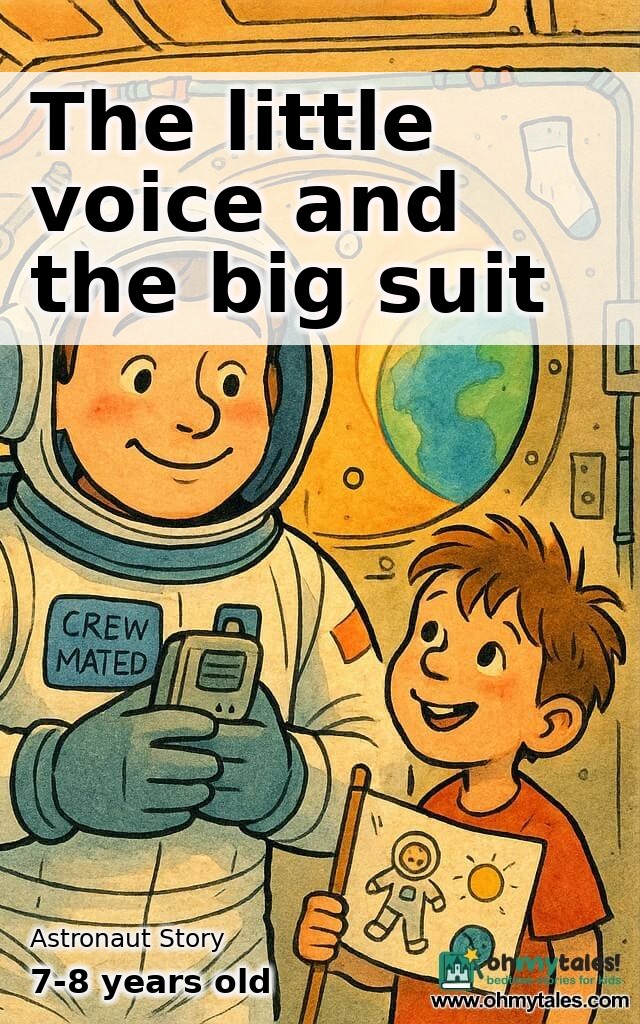
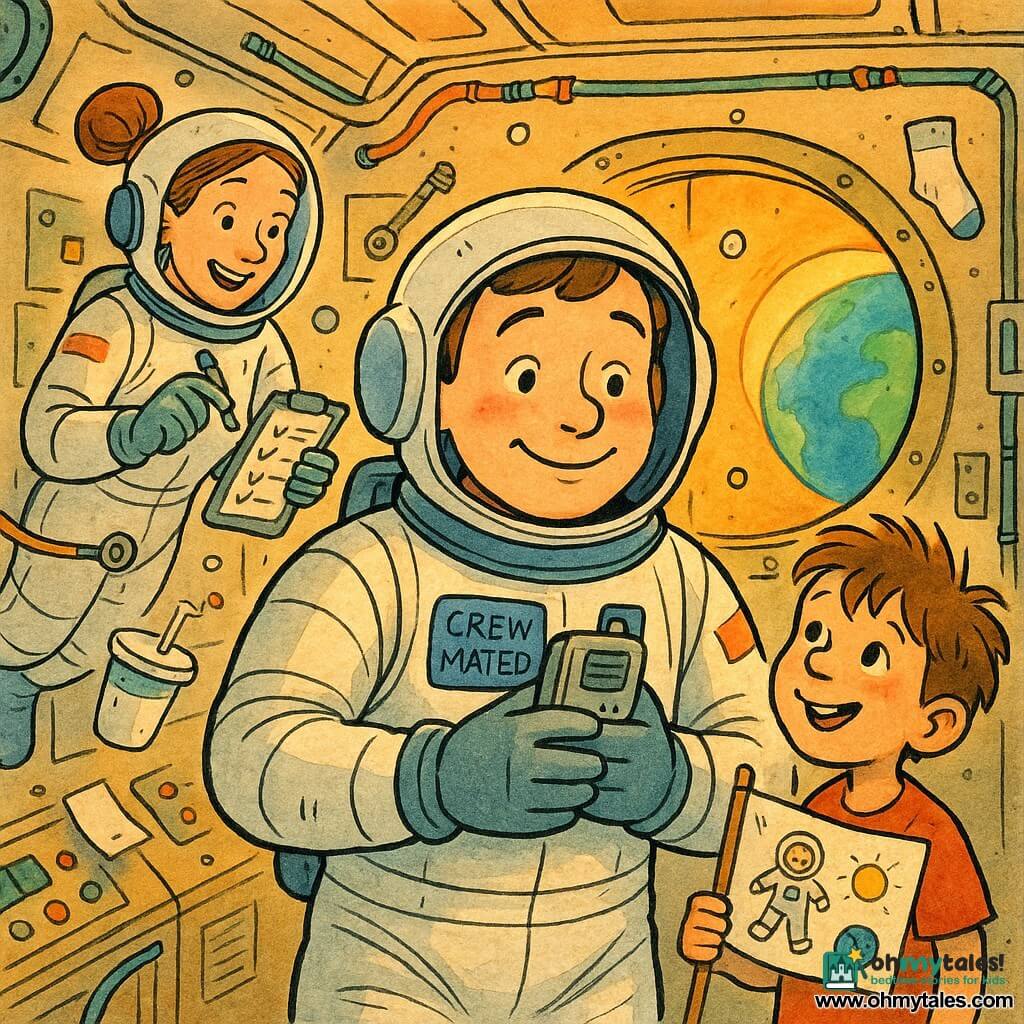
Mateo shifted in his seat. The big suit beside him—white, lined with tiny pockets and silver clasps—took up more room than his childhood dreams ever had. He ran his hands over a patch that said CREW—MATEO. The suit felt soft in places and strong in others. "The suit keeps me safe," he told the recorder. "It hugs me so I can float without worrying."
Outside the small window, Earth spun in blue and green. The astronaut thought of how different things looked from up here—how quiet, how gently beautiful. "When I was small, I thought being an astronaut meant blasting off and waving," he said with a chuckle. "Now I know it's also tying knots, checking buttons, and listening. Lots and lots of listening."
Mateo remembered his first fascination: the people with different jobs who helped him fly. He could almost hear them as if they were in the room with him. "Mission controllers in their calm chairs," he said to the recorder, "do the math and watch signals like detectives. Engineers fix nuts and bolts and make sure the lights glow. Doctors teach us how to sleep in space. And teachers—my teacher Miss Rosa—helped me understand why the stars seem to twinkle."
He felt a soft vibration as the station hummed. "We are a team," he whispered. "Each job matters."
Chapter Two: Floating Socks and Tiny Triumphs
Later, Mateo moved through a small corridor filled with soft footsteps and the occasional beep. He pulled his recorder close and made a little sigh that sounded like a contented bubble. "Audio log, mid-shift. I am going to make tea," he said, and then he laughed because tea in space had different rules.
In the galley, the tea floated in a tiny sealed bag. He pinched a corner and watched a clear blob drift through the air like a slow-motion bubble. "It tastes the same, but the way it floats makes it feel like a cozy cloud," Mateo noted. "When I was little, I would pretend my socks were rocket boosters. The first time I floated, my socks did the same—floating off like tiny moon moons. I learned to clip them down."
He added, "That is what being an astronaut teaches you: small fixes make big differences. A clipped sock keeps the instruments safe. A tightened bolt keeps the whole station steady. You learn patience and you learn to laugh when a spoon decides to fly."
At his workstation, Mateo attached a sensor carefully, the way someone threads a needle. "Engineers taught me to be gentle and precise," he said. "They show me how to test a cable and how to read the tiny letters on a panel. The scientists taught me why we grow plants in little green boxes here—so we can learn how to feed people in far-away places. The pilots taught me how to steer when the stars look blurry. Everyone brings a piece of the puzzle."
A young crew member peeked into the galley, her hair tied back in a bouncy knot. "Mateo, want to hear a joke?" she asked. Mateo grinned. "Sure." She tapped a floating crumb. "What did the alien say to the gardener?" she asked. "Take me to your weeder!" They both laughed, and the sound turned into little bubbles that floated toward the ceiling.
"Humor helps," Mateo told the recorder. "It keeps us calm during tight moments. It reminds us that we are people here—curious and kind."
Chapter Three: A Walk Outside, Safely
Mateo strapped his recorder to his chest when the crew prepared for a spacewalk. The hatch opened and a bright white glare filled his vision. "Audio log, pre-spacewalk," he said. "My heart does a friendly little hop. I always feel that hop. It's not fear—it's excitement wrapped in respect."
The helmet visor reflected his face like a crescent moon. He remembered being small and building a cardboard rocket in the garage, taping it together with determined fingers. "Back then I pretended the cardboard was a real suit," he whispered. "Now I check every clasp and count my tethers for real. That's the difference: dreams become habits of safety."
Outside the station, the world looked like a living marble. Mateo's breath was slow and steady through the radio. "I'm an astronaut, yes, but I'm also a teammate who trusts others," he said. "My colleague Ana watches the gauges. The flight surgeon listens to our heartbeats from Earth. The ground team guides us like a lighthouse."
He reached out and touched a handrail. The feel was smooth, a little warm from sunlight. "You know," he said to the recorder, "when I was a boy, I thought spacewalking would feel like flying. It does, in a way. You float. You glide. But you are also always tethered, always connected. You don't drift away because every person on the team makes sure you come back."
A tiny meteor shower brushed the darkness like silver dust. Mateo pointed it out, and through the earpiece his crewmates whispered soft exclamations. "Look," someone said. "They're lovely." The word felt like a song through the radio. "We respect the universe by studying it gently," Mateo told the recorder. "We can't own the stars, but we can learn from them."
They moved slowly, hand over hand, checking solar panels, tightening a bolt with a careful twist. The teamwork was a dance that took practice and trust. "I used to believe heroes did everything alone," Mateo said. "Here I learned real bravery is asking for help and giving help in return."
Chapter Four: The Night Talk and the Little Audio Memory
Night on the station was a chorus of lights and soft fans. Mateo lay in a sleeping bag tethered to the wall, and the Earth rolled by outside the window like a lullaby. He pressed the recorder against his chest and breathed with the cadence of someone telling a bedtime story.
"Audio log, pre-sleep," he said softly. "When I was seven, Miss Rosa told our class that stars are like tiny holes in a giant blue curtain. I liked that. It made me think the sky was full of secret paths."
He played a small music box on his wrist—an old memento from home. The tune was simple and bright. "It reminds me of my mother humming while she sewed," he said. "Even here, music can make a place feel like home."
Mateo's voice lowered. "Being an astronaut means remembering home. It means sending messages—like this little audio—so others can know how we feel. I speak into this recorder so my children and students on Earth can learn what we learn. I keep a microjournal because tiny things add up."
He told a story about a small plant sprout they had nurtured in the station's window. "We watered it carefully, recorded its growth, and measured leaves with polite rulers," he said with a smile. "You won't believe how proud we were when the first leaf unfurled. A botanist we work with on Earth cried a happy tear into her coffee. That is the joy of space jobs: scientists, engineers, doctors, cooks—each gives something so everyone can learn and live."
Outside, an aurora painted the atmosphere in green waves. The sight was gentle and healing. "I think astronauts are curious people who love Earth," Mateo said. "We study the stars but we never forget the blue marble below. Respect for Earth guides everything we do—how we recycle, how we repair, how we plan to help humanity."
His voice softened. "When you dream big, remember to build small steps. My small steps were study, patience, kindness, and practice. My team helped with their own small steps, too."
Chapter Five: Landing Back with Congrats
The capsule hummed as it prepared for descent. Mateo could hear the distant chorus of mission control cheering quietly like a warm morning. He strapped in, the recorder snug on his heart. "Audio log, final entry for this mission," he said. "We're coming home."
He thought of the boy with the crooked tooth watching rockets on TV. "Do you know what my boy-self would say now?" he asked out loud. "He would clap his hands and say, 'You did it!' But I would say back, 'We did it.'"
The descent was a gentle hug rather than a fierce shake. When the capsule touched down, dust rose like golden promises. Children from the recovery team waved bright flags and held up signs with smiling rockets. Mission control's voice came through the speakers with warm congratulations. "Welcome home, crew Aurora," they said. "Great teamwork, great care."
Mateo stepped out and felt the ground under his boots like a beloved storybook page. The sun was kind and the air smelled like wet grass. He unzipped his suit and reached for his recorder one last time. "Audio log, landing complete," he said with a tired, happy laugh. "I remember my dreams from when I was little. I remember the garage rocket and the socks that flew away. But I also remember every person who helped me put this adventure together."
He turned to the children gathered a little way off. One of them was a small boy with a crooked tooth who looked like a tiny echo of his younger self. Mateo bent down and, smiling, said, "Keep asking questions, little one. Listen to your teachers. Play with blocks and build rockets with safety tape."
The children giggled. A young engineer who had been part of the mission waved and said, "Nice job, Captain!" Nearby, a flight surgeon handed Mateo a small card. On it was written: Congratulations. Mateo's eyes crinkled. He put the card in his pocket like a treasure.
"Everybody did their jobs," he said into the recorder. "Ground team, engineers, scientists, doctors, cooks, teachers—thank you. We respect each other's work because every job keeps the mission safe and brings wonder to the world."
As the sun dipped lower, Mateo sat on a small hill and watched the stars begin to blink awake. "If you want to be an astronaut," he said in his final words to the recorder, "be curious, be kind, and learn to be patient. Love your Earth and love the people who help you reach for the stars. And never forget to smile when your socks float away."
He clicked the recorder off and, with a light heart, turned to the children and the team and said, "Congratulations to all of us. We dreamed together, we built together, and now we celebrate together."
The children cheered, the team clapped, and Mateo tucked the micro audio log into his pocket like a letter to the future. He felt small in the best way—part of a larger story that went on and on, like the night sky itself.