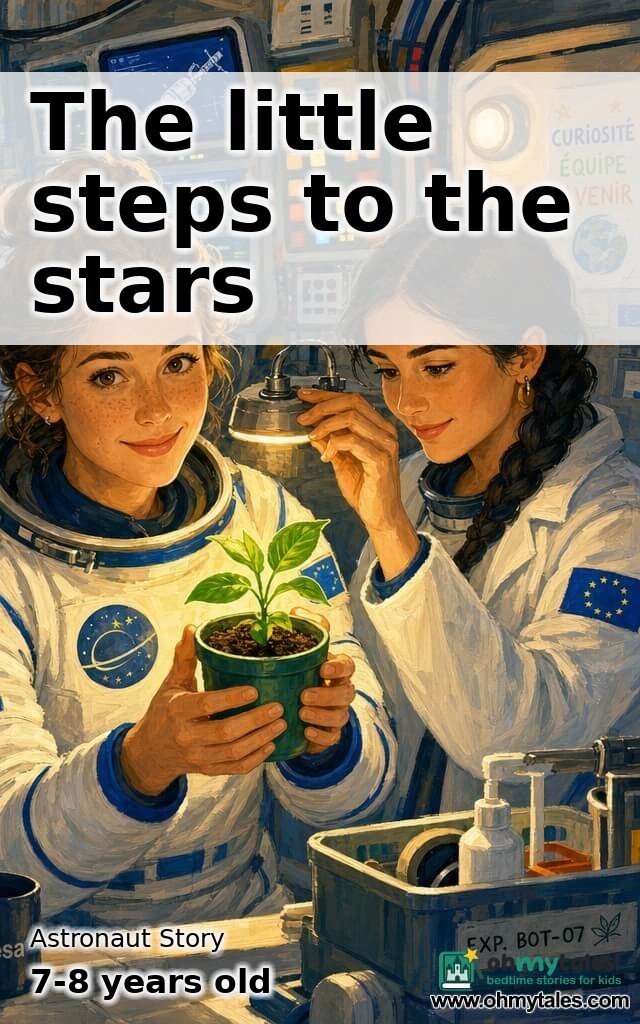
Morning Memories
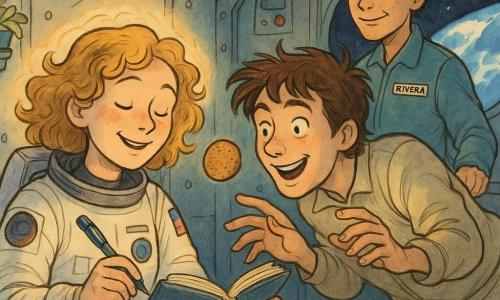
When the sun slipped awake over the round windows of the space station, Captain Mira leaned her forehead against the glass and smiled at the blue planet below. It looked like a bright marble wrapped in clouds and oceans. The room felt cozy and quiet, like an attic full of soft clouds. Mira closed her eyes and let a tiny memory float up, like a balloon.
She had been a little girl once, small enough to curl up in a chair and hold a toy rocket. Her knees were sticky from jam and her hair smelled of summer. She would press her face against a cold window and imagine the stars were fireflies she could count. "When I grow up," she used to whisper to her stuffed bear, "I will visit the fireflies." That whisper had become a promise she kept one little step at a time.
Now she was an astronaut. The uniform on her shoulders felt a bit heavy, but it was also warm with the stories of many people who had helped her. Her boots made soft thumps on the metal floor as she walked to a table covered in papers, diagrams, and a small model of a satellite. Today she had an important task: she had to prepare a presentation for the science congress happening on Earth in a few days. Her heart made a soft drumbeat when she thought about talking to so many curious minds.
Mira picked up a pencil and traced a smooth line across a sheet of paper. Lines could become paths, paths could become plans, plans could become rockets that took people to look at the Moon or study a sleepy comet. She liked to imagine each line as a gentle step. She wrote a list of things to share: how they kept the crew safe, how they cared for experiments, what the planet looked like from above, and how small dreams could grow into big work when people help each other.
She remembered one of her teachers, Mrs. Patel, who had a laugh like a bell and loved to ask questions. "Why does the Moon look different all the time?" she would ask. Little Mira would think, then guess, then try another guess. The teacher would smile and say, "That is curiosity. Keep asking." Captain Mira put a small tack with a photo of Mrs. Patel on the wall near her desk. It made her feel steady.
Outside, the station hummed like a kettle. Machines whispered and lights blinked, but the sound was not frightening. It was the sound of many hands working, even when hands were far apart. Mira touched the model satellite again and imagined the scientists at their labs on Earth, at midnight and in the morning, all sending ideas like paper boats across a river. Cooperation was like that river—always carrying small boats toward a harbour.
Practice and Teamwork
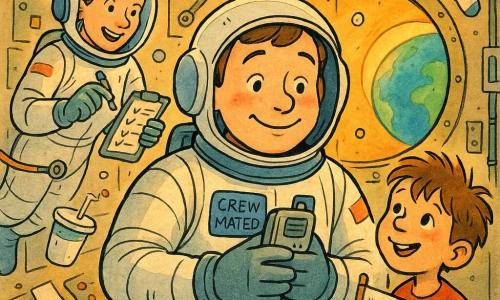
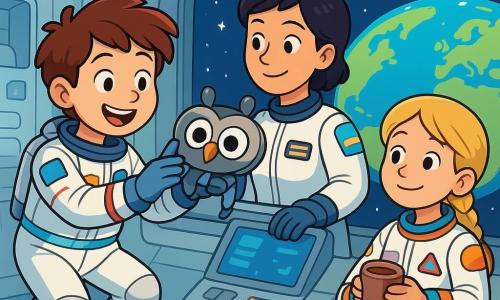
The crew gathered in the lab for practice. There were five of them, each with a different talent. Jamal was the engineer who made circuits sing. Lina was a botanist who knew how to make tiny plants cheer up a tin cup of soil. Ana was a pilot with careful eyes and quick hands. Ben was the doctor who could find a heartbeat in a thunderstorm of beeps. They all wore calm smiles and warm socks.
Mira stood at the front and held her notes like a small map. She practiced telling the story of a science tool that measured how much sunlight reached a plant on the station. "This helps us learn how to grow food," she said. Her voice sounded like a little bell. Jamal nodded and tapped his tablet. Lina clapped softly. Ana asked one question, just one: "Will the slides show the steps?" Mira laughed. "Yes. Step by step."
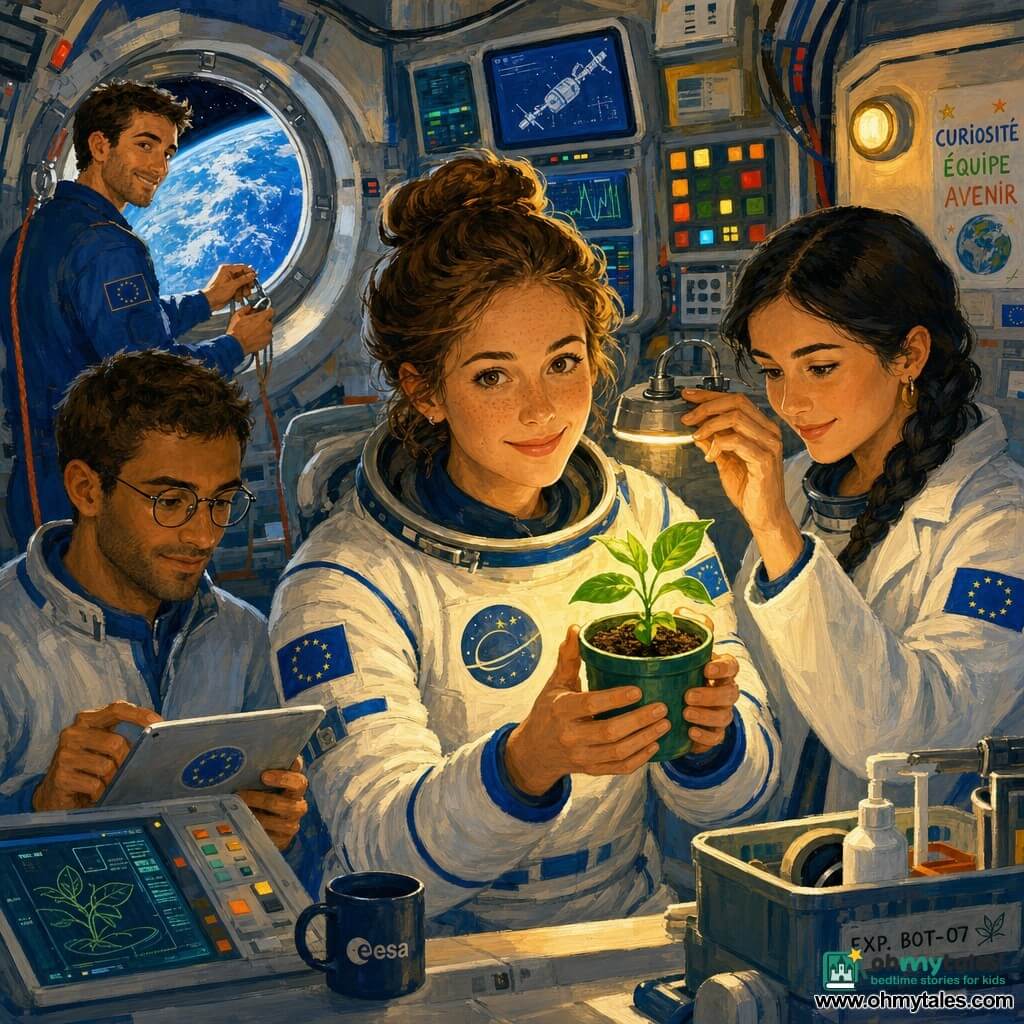
The crew helped her. Ben pointed out a slide that needed simpler words. Jamal suggested showing a picture of a watering can instead of a chart. Lina brought a tiny potted plant to put next to the screen during the talk. "People like to see real things," she said. Mira thought about how children listened best when they could see and touch a small, friendly plant. She set up the model satellite and the potted plant side by side. They looked like two friends ready to tell their story.
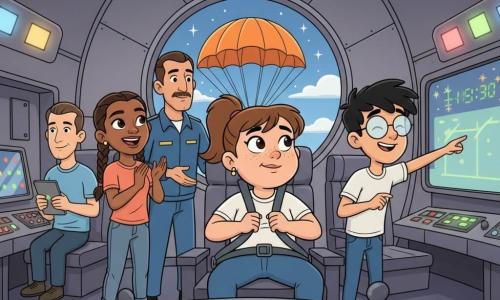
Practice felt like building a blanket fort. Each person added a pillow, a rope, a laugh. They tested the microphone, pressed the clicker, and practiced walking slowly to the pictures on the screen. The crew remembered to say safety steps out loud, too. "We check everything before a spacewalk," Ana reminded them. "We check our suits, our ropes, our radios." Mira liked that. Safety was like a promise to everyone at home.
At one point, a soft alarm went off—a little glitch in an experiment. The lights blinked, and the alarm sounded like a hiccup. The team did not panic. Jamal smiled and said, "One small hiccup," and touched his console. The alarm stopped as quickly as it had started. Mira felt relief rise like warm bread. Even when something went wrong, they could fix it together. That made the work less heavy.
Before bed, Mira took a small walk through the station. She passed by windows where stars looked like sugar on a dark cake. She thought of the congress. She wanted to share not only facts but also how science made her feel—curious, careful, and full of respect for Earth. She imagined the room below filled with children and grown-ups sitting like seeds waiting to sprout ideas. She wanted to water those ideas with stories of cooperation, safety, and gentle wonder.
Presentation Day
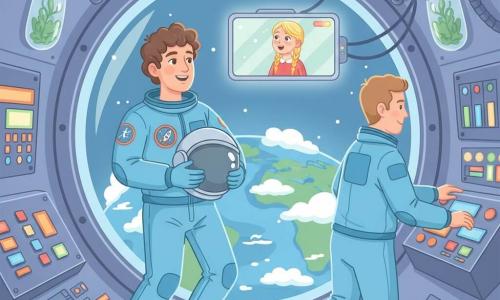
The day of the congress came like a bright comet. Mira's stomach did a little flip, but it was a good flip—like butterflies ready to fly. She woke early and dressed in a tidy suit with a patch showing her mission badge. The crew gathered around a small screen that linked them to the stage on Earth. The screen showed faces: children with star shirts, scientists with pens behind their ears, and teachers holding hands with their pupils.
Mira began with one small secret: she had once been a boy or a girl with a stuffed bear and a jam-sticky knee. "When I was little," she said, "I wished on fireflies, and I wanted to count the stars." Her voice through the speakers sounded bright and gentle. She saw small smiles ripple across the screen like waves.
She told them about the experiments onboard. She showed a picture of Lina's plant growing under a tiny lamp and explained how she and her team measured sunlight, water, and time. "We learn step by step," she said. "First we ask questions. Then we make a plan. Then we check everything, again and again." The children watching leaned forward as if they could hear the pages of her notes turning.
Mira spoke about safety the way someone might tell a bedtime routine. "We wear suits and helmets when we go outside. We make sure our radios are on. We count to three before opening a hatch. We never rush," she said. It felt important to say how respect for the planet and for each other kept them strong. She pointed to a slide of Earth glowing in the dark. "From up here, Earth looks small and beautiful. We must care for it."
One moment made Mira want to hum a soft tune. She described how during a spacewalk, her hands moved slowly like the hands of a careful artist. The kids could see a short video of her floating, a tether holding her to the station like a friendly leash. "The tether reminds me of home," she said. "Home is people who keep you safe when you go far."
Then she told a story about a tiny experiment that almost didn't work. The growth lights blinked and a plant stretched in the wrong direction. The team looked at the data and worked through their measurements. They tried a new angle for the light, then adjusted the water, then checked the soil. The plant straightened. The children on the screen clapped with soft hands. Mira felt her own heart clap with them.
At the end of her talk, Mira asked a question. "What do you wonder about?" The screen filled with small voices and scribbled drawings. One little boy drew a rocket with a smiling sun. A girl asked how plants could sleep in space. A teacher asked how to start a science project at home. Mira answered each question gently. She said, "Start small. Ask why. Try a new thing. Ask for help when you need it." Her words felt like stepping stones across a calm pond.
Thank You Ceremony
After the talk, the crew gathered in a small room lit with soft lamps. They had planned a simple ceremony to say thanks. It was not grand. It was a circle with warm smiles, a ribbon they would pass, and a tiny cake shaped like a moon that Lina had baked with freeze-dried strawberries. They wired the camera to show Earth so friends and family could wave.
Mira stood in the middle and looked at each person. She held the ribbon with both hands and felt the texture of the fabric. Her voice was quiet and warm. "Thank you," she said, naming each teammate. "Thank you for checking the bolts. Thank you for making sure the plant had enough light. Thank you for fixing the alarm." Each thank-you was like placing a small stone in a garden.
Jamal laughed and said, "Thanks for the slides that did not crash." Ben gave Mira a small scarf he had knitted with safe knots and soft yarn. Ana handed her a tiny paper plane painted with stars. Lina gave her a sprout in a cup with a tiny ribbon tied around the stem. The gifts were simple, but they held much meaning. They were proof of nights spent solving puzzles and mornings filled with shared coffee and plans.
Then Mira thanked Earth in her own way. She paused and looked at the blue marble below. "Thank you, Earth, for your air and your rain," she whispered. The crew touched the window as if to say good night. The camera captured the moment and sent it home like a postcard.
At the end of the ceremony, they turned off the bright lights and sat with soft lamps and the moon cake. Mira looked at the small sprout and thought about little things that grow. She thought of children who might tuck this story under their pillow like a secret. She thought of teachers who would tell curious minds to keep asking, of engineers who would wake at midnight to fix a stubborn cable, and of families who sent letters folded into paper stars.
Mira felt tired in a good way. Work done with friends left her heart like a warm cup of tea. She felt proud, but not proud in a loud way. It was the quiet pride that comes from many people leaning together to lift something heavy. The kind that makes you whisper, "We did this together," and mean it.
Before bed, Mira sat by the window one more time. The stars shimmered like scattered sugar, and the Earth turned slowly in the dark, breathing cloud and light. She thought of her little self with jam-sticky knees and a toy rocket. She smiled and said out loud, "We made it a little further. Thank you."
Then she folded her hands and made a small plan for tomorrow: one more practice, one more check of the instruments, one more story to tell. She thought about how science was like a puzzle made of many pieces. Each piece came from a question, a careful test, and a helping hand. She imagined the children who watched her talk might dream of plants, stars, and small, steady steps.
Mira closed the round window and turned off the lamp. Her last thought before sleep was a soft one: dreams can grow, little by little, when people are curious, careful, and kind. The station hummed its gentle song, and the stars watched over them all.