1. The Quiet Tug
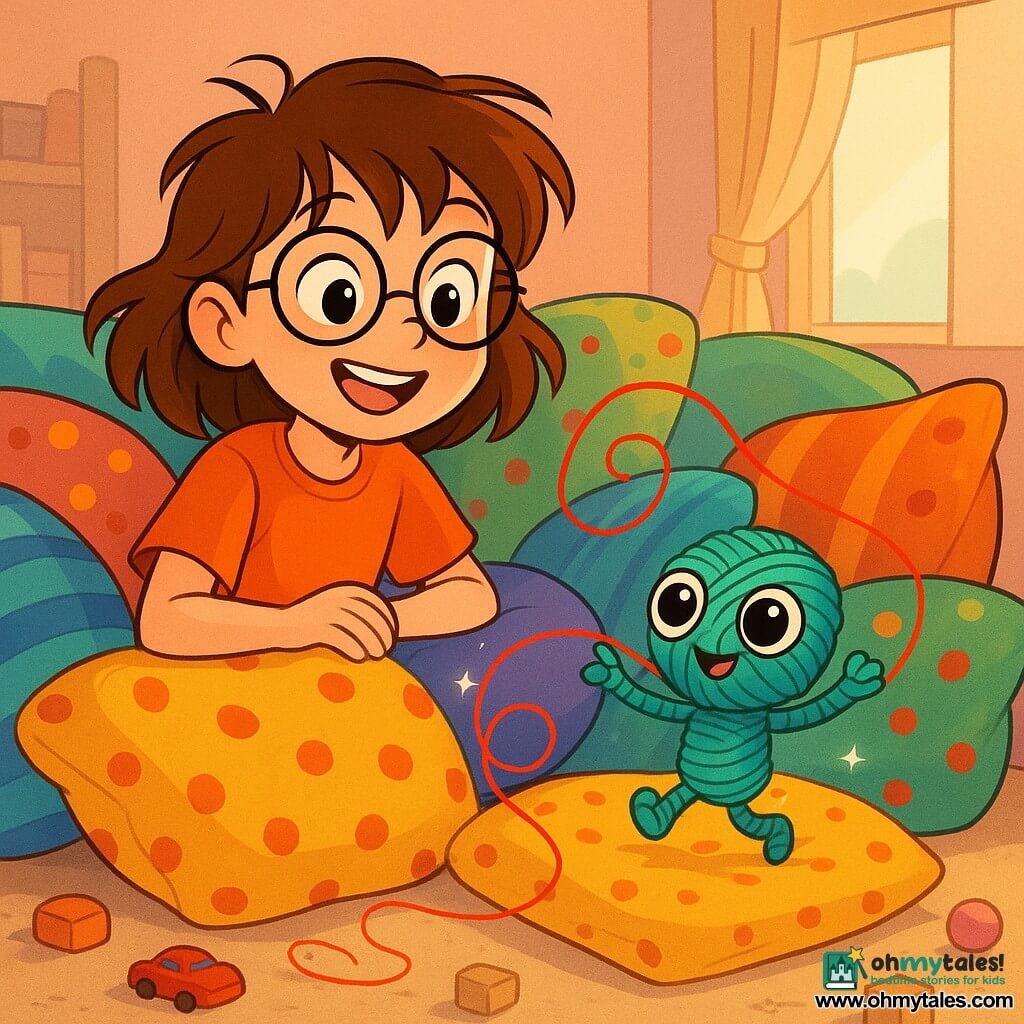
Mabel had a map of ordinary days: school, snacks, the dog who snored like a broken kazoo, homework that waddled away if she left it alone. Today the map had a little wrinkle in the corner because the rain had turned the backyard into a puddle orchestra and her mother had built a fort with cushions in the living room, like a soft mountain range with a door made of a blanket.
Mabel liked forts. They were like tiny secret countries with strict rules: socks were passports, pillows were mountains, and only very brave explorers could eat sandwiches inside without crumbs mutinying. She was nine and very good at fort law.
She was rearranging a blue cushion that smelled faintly of last week's pancakes when a teeny, almost shy tug brushed her fingertips. It felt like the burp of a sleepy cat, or the polite cough of a mole asking for directions. At first Mabel thought it was the cat, who was indeed slumped on the windowsill pretending to be furniture. But the tug had a purpose. When she peered into the seam of the cushion, she saw a thin red thread poking its head out.
“Hello,” she whispered to the thread because the way adults select a name for objects feels less silly to anyone who has ever talked to a spoon. The thread wiggled once, like a fish in a bowl, and then began to unravel with a tiny click, as if a choir of knitting needles were sighing in unison.
It was such a small thing — a single thread — that no sensible person would have expected it to set off an adventure. That is how most big things start: quietly, politely, with a tug that doesn't ask for permission.
Mabel followed the thread. She didn't think she was following anything magical — that would have made everything complicated — she just thought she had found a particularly curious bit of fluff. The thread slipped inside the cushion between two soft cliffs, and the air smelled like warm wool and her grandmother's kitchen. Mabel pushed her hand in. The world went "squee," then "squoosh," and suddenly the cushion folded around her like a giant, velvety handshake.
She had imagined a gap behind the cushion, maybe a forgotten blanket, maybe a hidden biscuit. She did not imagine being swallowed by cushions with polite manners. The fort's blanket door rustled distant thunder; inside, the cushion walls hummed like a tea kettle waiting for a joke.
“Is this a tunnel?” Mabel asked, to be thorough.
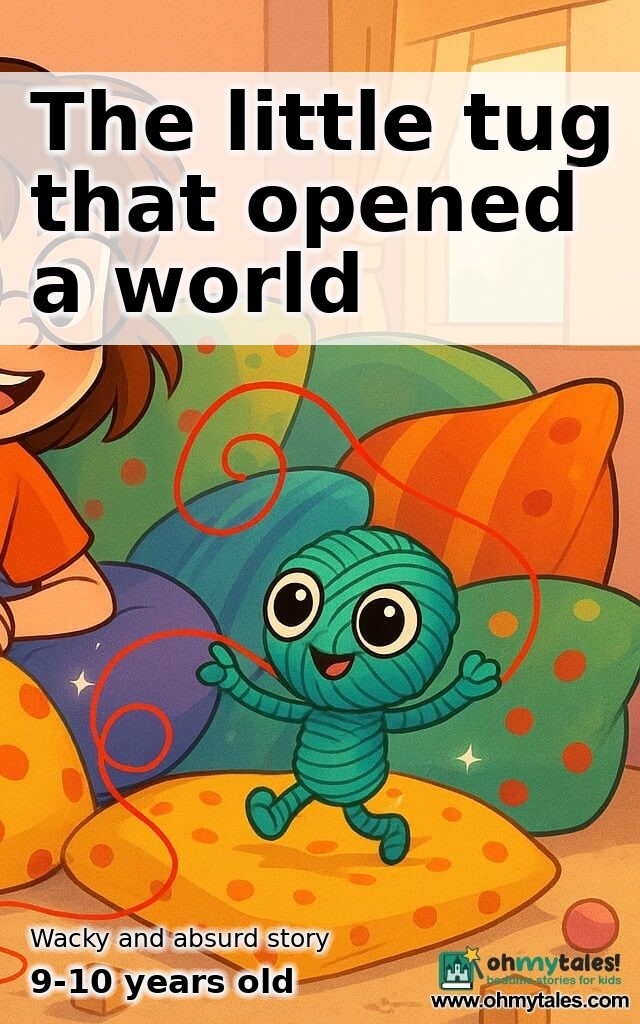
“It's a tunnel,” said a voice that sounded like someone trying to whistle through a stack of socks. The thread gleamed and coiled into the shape of a small, bright ball of yarn. It rolled forward and invited her with a gentle tug. The ball seemed to say, very clearly through the language of yarn, Follow me.
Mabel took a breath that tasted like bravery and crumbs. “Okay,” she said. “Let's follow.” Then she crawled after the yarn until the cushion mouth closed politely behind her, like an eyelid, then opened again with a soft “ehh” that might have been a yawn.
She did not think about the homework at the bottom of her backpack, or the kazoo-snoring dog, or how this would look in a grown-up's calendar. She thought about the thread and how it had started with a discreet tug that asked her to come along.
And so the adventure began, like a song that starts with one note and gathers friends.
2. The Tunnel of Cushions
Inside the tunnel, light was a kind of woolly glow. It didn't shine; it cooed. The walls were stitched in stripes and polka dots, in velvet and corduroy, in prints that reminded Mabel of dinosaur pajamas and of a dress her aunt only wore to weddings. Cushions leaned together like old neighbors gossiping, and some did, in fact, gossip.
“Nice shoes,” one cushion said about Mabel's sneakers. “Where did you get those laces? I could use a spruce.”
“Those are shoelaces,” Mabel said, because if cushions started complementing shoes she could use a compliment for her math homework too.
A cushion with a frilly edge and a monocle blinked at her. “Ticket?” it asked, in the manner of a very formal cushion.
“A ticket?” Mabel echoed.
“For the cushion corridor,” the monocle-cushion said, trailing tiny beads like punctuation. “One compliment per travel, two if you have a joke.”
Mabel laughed, which she did sometimes when the world felt like a particularly well-oiled bicycle. “What if I have only a song?”
The cushion hummed approvingly. “Then sing.”
Mabel glanced at the ball of yarn. It bobbed like a polite bobblehead and rolled forward as if to say, Don't worry, I'll carry the tune. So she took a breath and sang a small, slightly off-key song about socks who wore spectacles and pancakes that wanted to fly. The cushions chuffed and chittered. The monocle cushion stamped her paw with a fluffy leaf. It was an official cushion passport, printed in puff and snooze.
As they progressed, the tunnel widened and squinted sideways into rooms. There were archways made of braided throws and doors decked in buttons that winked. Sometimes the yarn dangled from above like a little glowing vine; sometimes it hopped across the floor like a respectful ball.
“Where does it lead?” Mabel asked.
“To yarn things,” said a cushion with stripes, which was not very helpful.
“To stories,” said a plaid cushion.
“To mislaid things looking for a proper home,” suggested a cushion that smelled faintly of lemon.
Mabel liked that last answer. She liked the idea that lost things could find a home. She wondered if her missing pencil, which had run away earlier that week after a heated argument about erasers, might be in there somewhere, unspoiled and writing smoky love letters to the tip of a pencil sharpener.
The cushions were not stationary furniture; they moved with the grace of sleepy cats. At one point, the tunnel took the shape of a spiral slide with layers of blankets like a cake. When they slid, the air tasted like the inside of a marshmallow. Mabel squealed in a purely joyful way and clutched the thread. The thread hummed. It seemed to have a heartbeat made of stitches.
They stopped in a small alcove where a cushion sat upright like a conductor, its tassels forming a very distinguished beard. Two squeaky pillows on either side acted as ticket inspectors and offered Mabel a peppermint-striped map that smelled faintly of bedtime stories.
“Important stop,” said the conductor-cushion. “Here we decide how much bounce your feet can carry.”
“How much?” Mabel asked.
“Enough to cross the River Sofa,” the conductor said. The River Sofa, Mabel learned, was a place where cushions parted to reveal a thin, moonlit mist that smelled mildly of spilled cocoa. It was a crossing that required both imagination and the occasional hop.
Mabel practiced hopping. She tried slow hops and fast hops, silent hops and sound-effect hops (which involved making the noise “boing” and pretending to be a particularly elastic frog). The cushions clapped. The ball of yarn made a small triumphant noise and looped around her finger like a ring.
“This is ridiculous,” said one cushion, smiling, which made Mabel think of ridiculous as something very kind. Ridiculousness in the cushion tunnel was more of a compliment than a criticism.
At the end of the alcove, the yarn slipped through a zippered seam and tugged harder, as if impatient for the next page of the journey. Mabel stood, packed her courage into her pockets, and hopped. The cushions that were the River Sofa gave her a gentle boing-boing welcome, and she landed on the other side with an accidental little dance.
“Bravo,” said the conductor, handing her a feather-like button. “Take this. Soft things like to be thanked.”
She tucked the pillow-button into her pocket with the kind of seriousness reserved for secrets and very small treasures. The ball of yarn glowed a little brighter, and they carried on, deeper into the muffled world where the impossible leaned politely and asked for a cup of tea.
3. The Yarn's Surprises
The deeper they went, the stranger the rooms became. There was a place full of socks that clapped when she walked by — each sock had a tiny face embroidered at the toe and a habit of applauding people in mismatched shoes. Another room smelled of popcorn and contained a cinema where a bobbing pillow screen showed slides of things people forgot to remember: the taste of a summer lemonade, the sound of a friend's laugh, the smell of a book opened for the first time.
Mabel watched with wide eyes as the yarn led them into a chamber filled with tiny mechanical spools. They spun themselves into new patterns at the mention of "adventure," which was a word the spools took as their instruction manual.
There, she met a small creature the size of a teacup. It was mostly made of thread, with a spool for a body and two button eyes, and it went by the name of Bobbin. “Hello,” said Bobbin in tones like a sewing machine on holiday. “Are you following the thread?”
“Yes,” Mabel said. “I found it in my cushion.”
Bobbin bobbed. “It's a guide yarn. It follows feelings. Not always people, but sometimes people. It's particularly fond of curiosity and well-made jokes.”
“I have both,” Mabel replied, pleased. She demonstrated with a joke about a pencil who lost its point and had to hire a match to keep it company. Bobbin laughed in staccato clicks and declared the joke to be of premium quality.
They traveled together for a while. The yarn sometimes hummed lullabies and other times played hide-and-seek with light. In a room called the Sock Garden, lost things grew on tiny stems and blossomed into useful objects. Mabel spotted a pencil sprouting a cap that looked suspiciously like the one that had run away earlier that week. She almost reached for it, but then the yarn tugged sharply and flicked a spark of ribbon that wrapped around her wrist like a bracelet. The thread had rules of its own.
“The yarn doesn't like being interrupted,” Bobbin explained, as if this were common knowledge. “It wants company, but it doesn't like people to pick up everything it points at. It likes the chase.”
Mabel understood. Even yarn had manners.
But then a small trouble appeared: the yarn started to tangle. It looped and knotted in little swirls like a brain thinking too fast. A snarl of threads made a tiny, timid sound that might have been a hiccup. The yarn's glow dimmed.
“Oh no,” Mabel said, because that phrase fit like a mitten on a surprised hand. Bobbin poked the tangle. “We could pull,” it suggested, sounding like a spool trying to be brave. “Or we could sing.”
“You sing?” Mabel asked.
Bobbin nodded earnestly. “Spools love music of the soft sort. It tells the thread to relax.”
So they sang. They sang a song about buttons who moonwalked and cushions that wore hats. The lyrics were silly and precise, full of rhymes and small theatrical gestures. The yarn steadied. The tangle loosened a little at a time, like a stubborn shoelace being untwisted by a patient friend. Mabel hummed low and steady, then added a little patter that made the yarn laugh — that is, make a happy purling sound — and soon the knot slipped free.
When the thread straightened, it glowed again, tinged with gratitude. “Thank you,” it purred, not in words but in the way light does when it leans forward.
“You're welcome,” Mabel said, feeling very grown-up about it. She had tied and untied more than a few knots in her life: friendship knots, bike-chain knots, headphone knots. This one felt just like untying a promise.
They continued, with Bobbin chattering about stitches and patterns and the secret life of lost gloves. Mabel tucked that pencil's cap into the spool's pocket with a promise: if it ever wanted to be found again, the pencil would know the way home.
By the time the yarn led them out of the spool room, Mabel felt as if she had knitted a small friendship with the place. The cushion tunnel smelled less like a mystery and more like something you wore because it fit.
4. The Soft Market and the Big Bounce
Past the spool-room there was a market that only appeared on certain kinds of slow afternoons. Stalls were made of patchwork quilts and traded in things that had no price: a whisper of a lullaby, a button that could remember a name, a teacup that refilled itself when you told it a secret. The sellers were cushions, each wearing an apron and an expression of professional calm.
“Want something that makes you giggle?” asked a cushion with rainbow piping.
“Need anything that helps you leap?” offered a cushion sprouting springy tassels.
Mabel looked around. It was a place where wishes leaned on stands and hummed softly. She had three coins in her pocket from an earlier errand — not real coins, but small wooden discs the fort's rulebook recognized as tender for "special purchases." The yarn curled by a stall that sold maps of small courageous acts.
“Why maps?” Mabel asked the stall-owner cushion.
“For people who get lost without meaning to,” the cushion said. “A map helps you find the tiny route back to yourself.”
Mabel bought one. It unfolded into a daisy-shaped leaflet that smelled faintly of home-baked cookies. She pinned it under her fort's roof with the gravity of someone who takes small maps seriously.
Beyond the market, they reached a field of bouncing cushions — the Big Bounce. It was a meadow of marshmallow seats and trampoline pillows that would politely vault a person if they asked nicely. A small sign read: DO NOT BOUNCE ON SUNDAYS (unless the sun whistles the right kind of tune).
Mabel approached the Big Bounce with the respectful curiosity of a cat at a shopping mall. The ball of yarn looped around her ankle and formed a small rope. “You can cross by yourself,” it seemed to say, “but ropes are nice.”
She tried stepping from cushion to cushion. Each gave a friendly boing, then a slightly cheeky leap, like a series of mini trampolines with personalities. Sometimes a cushion would make her do a tiny twirl mid-air, just to remind her that travel could be fun. Once, a cushion made a face and refused to bounce unless she promised to tell a joke upon arrival. Mabel promised, because no bargain with cushions goes unappreciated.
Near the far side, the yarn grew taut and pointed toward a bright patch between two figs of wool. It was smaller than the other rooms, like the flap to a secret pocket. The patch glowed warmly.
“Is this the end?” she asked the yarn.
It trembled like a hummingbird. “It might be,” said Bobbin, who had hopped along like an honorary tour guide. “Ends are often beginnings in disguise.”
Mabel laughed. It was the kind of laugh that has a tiny echo and then sits happily on a chair. She stepped onto the glowing patch. For a second she felt like a person who had tumbled sideways into a comic book and found a speech bubble written just for her. Then, with a very polite wheeze, the patch opened like a flap and a little rush of living-room air kissed her face.
She was back at the heart of her fort. The cushion that had once contained the thread seemed exactly as it had been, except for a single stitch that gleamed with newly-won wisdom. Mabel blinked. The blanket door draped like a curtain that had just finished bowing.
She pressed her hand to her pocket and felt the feather-button the conductor had given her, and the daisy map, and a tiny spool-wrapped pencil cap. Her fort seemed to smile in the only way that soft architecture can: by being extra squishy, extra welcoming, as if nothing at all in the house had been the least surprised.
“Hello?” called a voice from the hallway. “Dinner in seven minutes! Wash your hands!”
“Okay!” Mabel called back. Her voice had the same rhythm as the yarn now: steady, cheerful, and a little sleepy around the edges.
She crawled out of the fort, bringing the tunnel's secrets with her like confetti. The ball of yarn, its job completed for the day, rolled into a decorative basket and curled into itself like a cat falling asleep.
5. Home, Slightly Fluffed
After the fort, things were quieter. The rain had softened to a hush, like someone turning the pages of a very big book at the other end of the street. Mabel sat on the couch where her adventure had started, the living room lamp casting a cozy circle. She set her treasures carefully on the coffee table: the feather-button that looked like a tiny moon, Bobbin's polite spool (now safely snug), and the daisy map that smelled faintly of cookies.
The cat on the windowsill yawned the way only cats can yawn: as though it had swallowed the dictionary and was now trying to cough up synonyms. Mabel stroked its head because animals always remembered adventures precisely the way their humans did: with slight exaggeration and complete love.
Her mother came in with a bowl that steam painted like a small cloud. “How was your afternoon?”
Mabel thought about how to explain a tunnel of cushions, a polite ball of yarn, a conductor cushion with a monocle, and a market where teacups kept secrets. She thought of Bobbin, the song that untangled the yarn, the River Sofa's boing, and the way the tunnel smelled like her grandmother's kitchen.
“It was excellent,” she said, which was true and true in several different ways. “I followed a thread.”
“A thread?” her mother echoed, pouring a spoonful of something that looked suspiciously like mashed potatoes.
“Yeah.” Mabel tapped the feather-button to show. The button made a tiny sound like a secret being pleased. “And I crossed a River Sofa, and I helped a yarn get untangled, and I got a map.”
Her mother smiled, careful and wide. “Sounds like you had quite the journey.”
Mabel nodded. She felt different in a way that neither shoes nor haircuts could give: that quiet feeling you get when you know you can find your way back. The daisy map folded itself near the lamp as if it wanted to be read again soon. The yarn called from the basket, very faintly, like someone humming when they are happy.
That night, when Mabel climbed into bed and the fort had folded itself into the sofa like a satisfied shape, she placed the feather-button under her pillow with the seriousness of someone saving a wish for later. The house kept its usual rhythms: the kettle sighed, someone outside kicked a ball, a distant television breathed out a polite laugh. Mabel listened. The world had not stopped being ordinary; it had simply added a new small note to itself, like a bird that learned a new tune.
Before sleep sighed her name, she whispered to the feather-button, “Thank you.”
A tiny rustle answered, as if the button had been waiting for manners. Then the house settled. The rain slowed to a silver whisper, then to a hush, then to nothing at all. Her thoughts, which had hopped and boinged like trampoline cushions earlier in the day, now slowed like a song's last line. They unwound themselves into soft loops and gently tucked in.
Mabel dreamed of the cushion tunnel not as a place she might visit again but as a friend's garden gate left slightly ajar. If tomorrow the thread tickled her fingers again, she would follow. If not, she would still keep the map. Either way, the world felt ready for her small interventions and big jokes.
In the morning, the cushion seam showed no obvious signs of adventure. The ball of yarn lay curled like a sleeping question mark, waiting politely. Mabel smiled, folded her daisy map and tucked it into the inside of her fort's blanket roof where it could be reached for rainy afternoons. She put the feather-button on her shelf as a small moon that winks when anyone passes by.
As she left for school, she said goodbye to the living room like one says goodbye to a trusted hat. The tunnel was still there, content with its day's work. It kept a place open for anyone who loved the sound of soft things and the feel of a very small, very certain tug.
And somewhere between the raindrops and the school steps, Mabel hummed the song she had used to untangle the yarn. It was a little tune, not important to anyone but her and the thread. It leaned into the morning like a friendly neighbor and, for a moment, the entire town seemed to sigh in knit and purl.
The day went on. Homework did its proper waddle back into her backpack. The dog continued to snore like a kazoo under polite protest. Mabel's map lay safe, her button shimmered slightly on its shelf, and the memory of the cushion tunnel made her chest feel like a pocket where quiet, improbable things could be kept. She walked into school with the steady step of someone who had learned the art of following a small tug and finding, inside it, a big and gentle world.