Chapter One: The Little Station
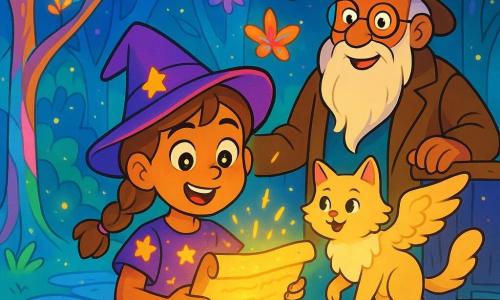
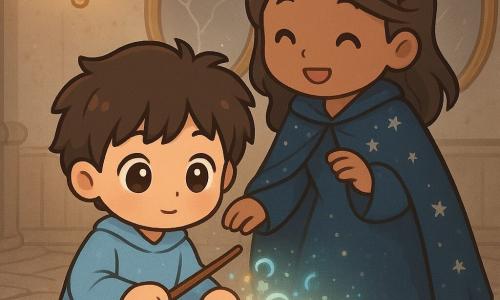
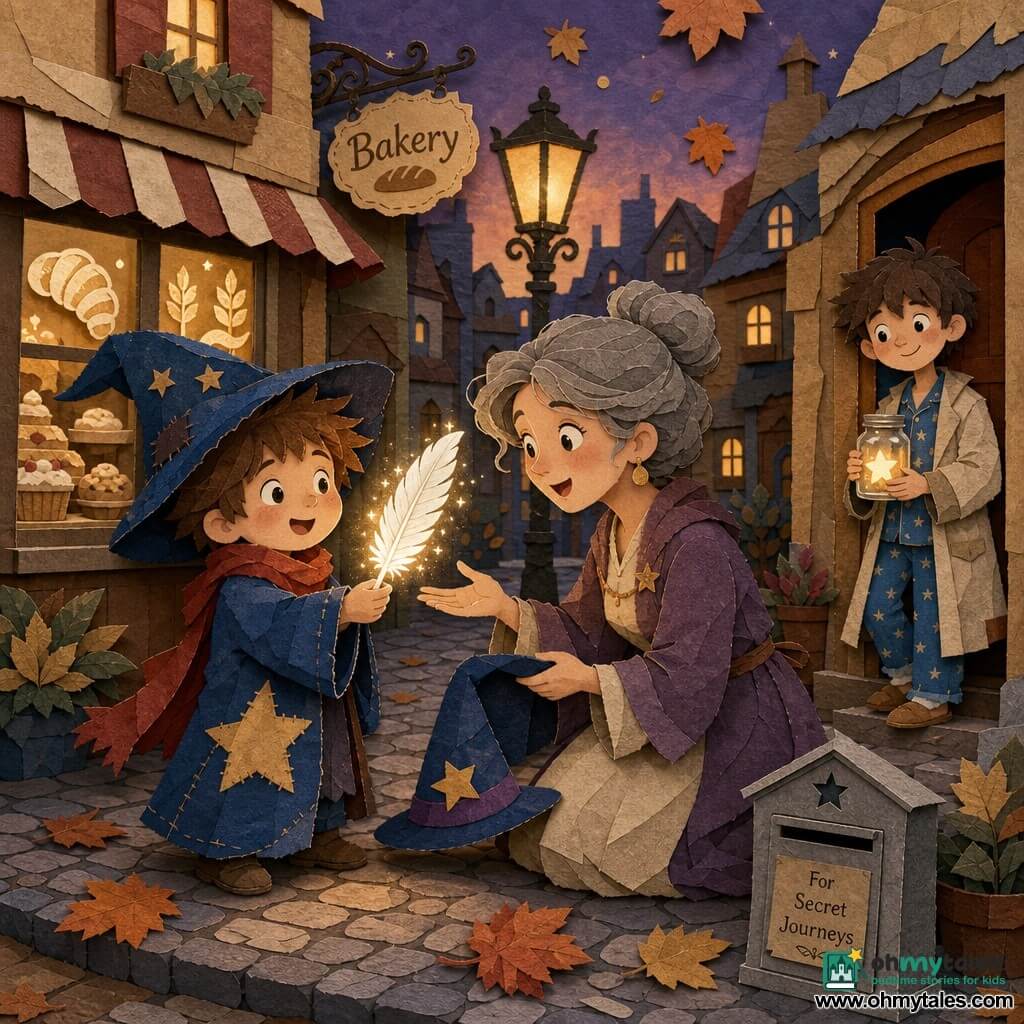
Pip woke to the sound of a small bell. It was not the loud bell of a town clock. It was a soft bell, like a spoon tapping a teacup. Pip rubbed his sleepy eyes. He was six, and an apprentice wizard. His hat was a little too big, and his robe had a patch with a star sewn on by his grandmother.
"This bell again," he whispered. He shuffled to the kitchen. A paper note lay on the table. It read, in looping ink: Pack a scarf. Find the feather.
Pip's heart thudded. He loved feathers. He loved feathers the way the moon loves the night—quietly and with wonder. He put on his coat, his scarf, and his small wand. Outside, the air smelled of toast and rain.
At the end of the lane was a station no one spoke of in town. It was small and gray, with a clock that showed two different times. A brass sign above the door read: For Secret Journeys. Most people walked past. Pip did not. He loved secret things.
Inside, the platform was narrow. A single bench faced the tracks. A train sat there that looked like an old storybook. Its carriages shimmered with colors that changed like soap bubbles. A lantern hung on a post. Its light was warm, the color of honey.
"Mind the gap," said a voice. Pip blinked. A boy sat on the bench. He wore pajamas under a coat and held a jar with stars in it. He had dust on his eyelashes as if he had slept in the sky.
"Hello," Pip said softly.
"I'm Dreamer," the boy said. "I travel where dreams go when the sun takes them. You must be Pip. You smell of toast."
Pip giggled. "I'm looking for a feather. An enchanted feather," he said. "It flew from my teacher's hat during a storm. She needs it to finish a spell."
Dreamer tapped his jar. "Feathers like that like secret stations," he said. "They like doors that look like nothing special. They like rivers that walk and mirrors that listen."
Pip's eyes grew wide. "Do you know where to go?"
Dreamer smiled. "There are three stops. The first is for small wishes. The second is for lost glints. The third is for things that remember. We will go to the third."
Pip nodded. He climbed into the carriage. The train smelled of lemon cake and old books. It hummed like a friendly cat. They took a seat by the window.
Outside, the town shrank. Houses folded like paper. Trees bowed and waved. The clock on the wall inside the carriage ticked with two hands that smiled.
"Are you brave?" Dreamer asked.
Pip thought about the comb he had used to fix a broom and the soup he had stirred when his grandmother was tired. "Yes," he said. "I try to be."
"That's enough," Dreamer said. "Being brave is mostly trying."
A conductor in a coat full of pockets walked by. He had a badge shaped like a key. "Tickets, please," he said.
Pip handed a small coin his grandmother had given him. The conductor winked and stamped it with a leaf. "Next stop: The Mirror Marsh," he said, and the train sighed like someone telling a secret.
Chapter Two: The Marsh of Mirrors
They stepped out onto a platform of reeds. Mist drifted low and sweet. A wooden sign read: Welcome to Mirror Marsh. The ground was soft and smelled of mint. Little fish swam in the air, leaving ripples like waves.
"Be careful," Dreamer said. "Mirrors here do not always show faces. They show truths."
Pip hugged his wand. He loved wands. This one had a small knot at the end from an apple tree. They walked between tall glass panes that grew like trees. Each pane blinked and shimmered.
Pip peered into one mirror. He saw himself in a raincoat. He also saw a far-off hill he had never climbed. He saw his teacher laughing. He saw a feather drifting on a breeze. It was not his feather, but it made his fingers tingle.
"Do you see it?" he whispered.
"I see many things," Dreamer said. "Some are like clues. Some are like riddles wearing a hat."
They passed a mirror that showed a kitchen. A spoon stirred itself. The spoon winked. Pip chuckled. It felt like the marsh liked jokes.
At the center was a pond. The water was a perfect mirror. The feather floated on the surface, white as cloud and rimed with silver. It bobbed like a small boat.
"There!" Pip said. He reached out. The feather drifted away.
A voice rippled across the pond. It was soft and old. "To hold the feather, you must answer me," it said. The voice came from the pond and the sky and a chorus of frogs.
Pip swallowed. "What must I answer?"
"What you keep when you let go," croaked the pond.
Pip thought of his grandmother tucking him in. He thought of his teacher's laugh. He thought of the little star patch on his robe. "Gratitude," he said before he could think too much. "I keep being thankful."
The pond shimmered. The feather floated closer. Dreamer clapped softly. "You have a wise heart," he said.
Pip lifted the feather with both hands. It was warm. It hummed like a tiny wind. The pond's surface reflected Pip not only as he was, but as he could be: smaller at first and then taller with a light like a lantern in his chest.
"Take it," the pond said. "But remember: feathers move hearts as well as hats. Be gentle."
Pip nodded and tucked the feather into his scarf. It fit like a piece of a puzzle. He felt grateful—his chest felt like a sun stretching.
They walked back to the platform. The fish in the air applauded with tiny splashes. Dreamer hummed a tune that smelled like peppermint.
On the train, a window fogged with a small message: Thank you for the courage. Hold on to each other.
Pip grinned at Dreamer. "Where to next?"
"Back home, mostly," Dreamer said, "but the train must stop at one last place. Reflections like to say hello."
The carriage rocked and the world rearranged like a shelf of books being tidied.
Chapter Three: The Glass That Lies and Loves
They arrived at a station that was almost invisible. It was a little alcove with posters for places like The Hill of Forgotten Stories and The Market of Where-Ifs. A tiny mirror shop stood at the end, with bells that chimed like laughter.
Inside the shop, mirrors of all sizes hung like curious owls. Each mirror had a face. One had freckles. One had freckles and a hat. One whispered, "Pip, come see."
Pip walked up to a full-length mirror. He expected himself. He saw himself, the feather, and Dreamer beside him. But the reflection did something odd. It put its hand over its heart and opened it. Inside was a small glowing seed. The reflection smiled and pointed to Pip's scarf.
Pip gasped. He took off his scarf. Inside the fold, the feather trembled. The reflection nodded.
"Reflections sometimes show what we forget to see," said a mirror with a brass frame. "They show what we carry inside."
Pip looked at Dreamer. "What did the pond mean about moving hearts?"
Dreamer tilted his head. "I think it meant that everything we find and keep can change us. Feathers can remind us of people. Mirrors can remind us of who we are grateful for."
Pip thought of his teacher's hat and how she had always tied his shoelaces when they came undone. He thought of his grandmother's soft hands and the stories she whispered. He felt his chest warm like a mug.
"Do you feel happy?" Dreamer asked.
Pip nodded. "Yes. And... grateful."
"Good," said the little mirror shopkeeper, who was a woman with silver hair and pockets of stars. "Gratitude makes small things shine like lanterns."
At the counter, the shopkeeper wrapped a tiny ribbon around the feather. "This ribbon will remind you to say thank you," she said. "Say it out loud once a day and the feather will remember where to rest."
Pip thanked the shopkeeper. He felt a bubble of cheer. He wanted to tell his teacher and his grandmother and even the town bell.
They returned to the train. The ride back was quiet. Outside, the clouds wore hats.
When the train stopped at the small station, Pip hopped off first. The town looked the same, but Pip felt different. He walked down the lane with his scarf tied and the feather safe inside. He stopped at the bakery and smelled bread. He thought of the conductor, the pond, and the mirror.
At the corner of the lane, his teacher waited, hat in hand. Her eyes were kind and surprised. "Pip!" she said. "You found it!"
Pip put the feather in her hand. It hummed and made tiny stars pop like bubbles. His teacher laughed in a way that made Pip's ears tingle with joy.
"How did you…?" she began.
Pip told her about the train and the marsh and the mirror. He told her about Dreamer and the pond's question. He told her about the grateful feeling in his chest.
She listened, and each time Pip said "thank you," she folded her hands as if keeping a secret. When he finished, she knelt and hugged him. "You are a good apprentice," she said. "You noticed what mattered."
Pip blushed. He felt like a small sun.
Later that evening, Pip sat by the window with his wand and a cup of warm milk. He thought of the train and the jar of stars Dreamer kept. He wished he could thank Dreamer properly.
There was a soft knock. Dreamer stood at the doorstep in his pajamas, a scarf of moonlight around his neck. "Thought I'd collect my thanks in person," he said, grinning.
Pip jumped up. "Thank you for coming with me," he said, and then, quieter, "Thank you for helping me remember."
Dreamer sat and opened his jar. One star drifted out and landed on Pip's shoulder like a tiny warm pebble. "And thank you," he said, "for sharing your brave heart."
Pip smiled. He felt grateful for the train, the pond, the mirrors, and for the friends who help us find lost things. He pressed the feather to his teacher's hat before bed. It shimmered and settled, as if it had found home.
As he climbed into bed that night, the bell in the lane chimed once, softly. Pip smiled. He knew that the world had small doors and that sometimes the smallest thanks could open them wide.
He closed his eyes. The last thing he felt was a warm, bright thank-you, like a blanket tucked in around the moon.