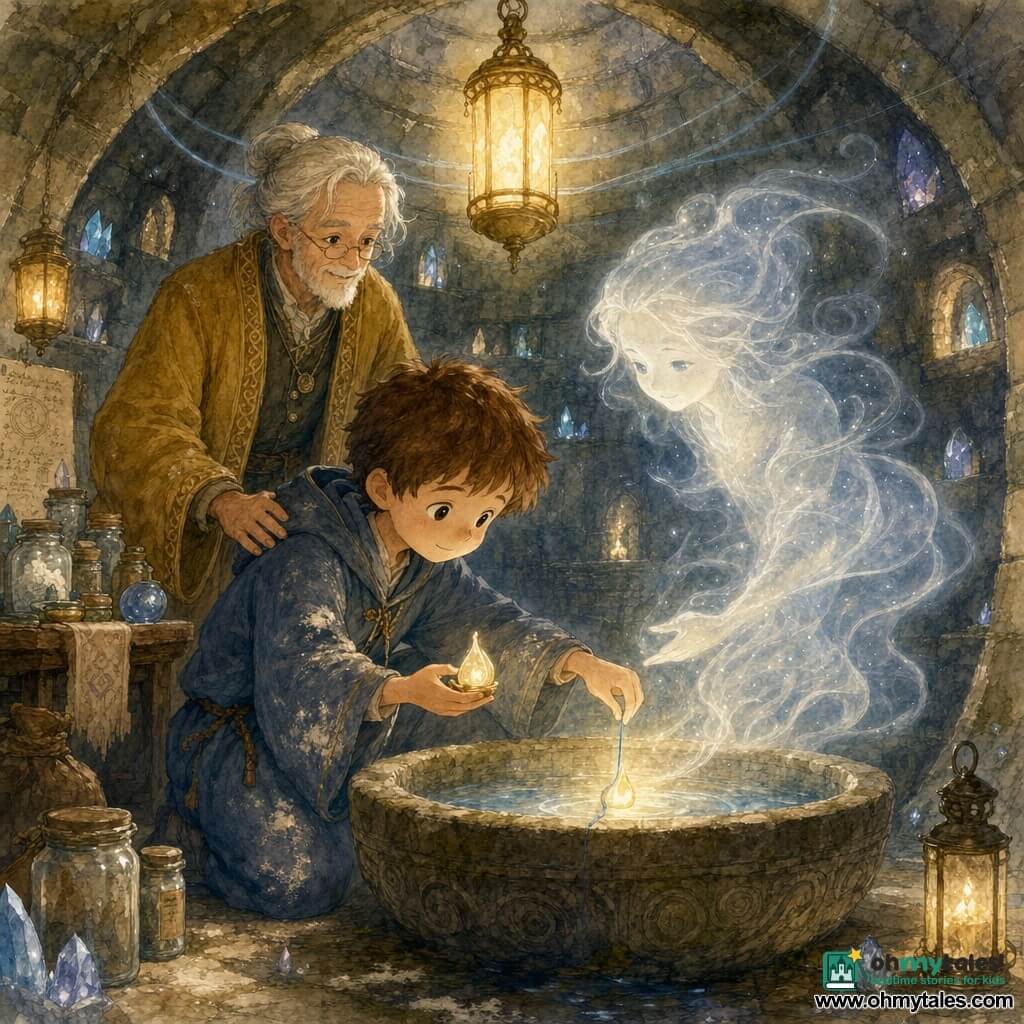
Part 1: The Quiet Wizard and the Warm Breath Below
Milo was a wizard, but not the kind who rushed around with his hat falling off and his pockets full of frogs. Milo liked to pause. He liked to listen. He liked to think before he did anything at all.
On a bright morning in the ordinary town of Bramblewick, Milo stood by his kitchen window and watched a cloud that looked like a sleepy sheep. His kettle hummed. His spellbook sat closed, as if it was resting too.
Then something strange happened.
The spoon on the table trembled. Not from a bump or a breeze. It trembled like it was trying to point somewhere. Milo leaned closer. The spoon slid, very slowly, toward the cellar door.
Milo's eyebrows lifted. He opened the cellar door and smelled cool earth—until a warm breath rose up, soft and ancient, like a giant animal sleeping under the house.
He stepped down the wooden stairs. His wand tip glowed the color of honey. The cellar wall, which had always been plain stone, now had a thin crack of light in it. The crack widened with a slow, polite creak, and a narrow doorway appeared.
Milo did not shout. He did not run away. He simply took a deep breath and walked through.
The air on the other side was warm and damp. The stone corridor curved like a ribbon. Small crystals in the walls winked like tiny stars. Somewhere far away, water dripped in a steady, patient rhythm.
Milo had heard of places like this in old stories—catacombs under the town, woven into the ground like secret roots. He had never seen them open before.
As he walked, he noticed something else. Thin threads of light, like pale blue spider silk, stretched across the hallway. They were not sticky, and they did not touch his skin. They seemed to hover between stones, linking one dark corner to another.
Milo felt them in his chest more than in his hands. Invisible ties. Quiet connections. The ordinary world above and the extraordinary world below, holding on to each other without anyone noticing.
Ahead, a sigh rolled through the corridor. It was not the wind. It sounded tired.
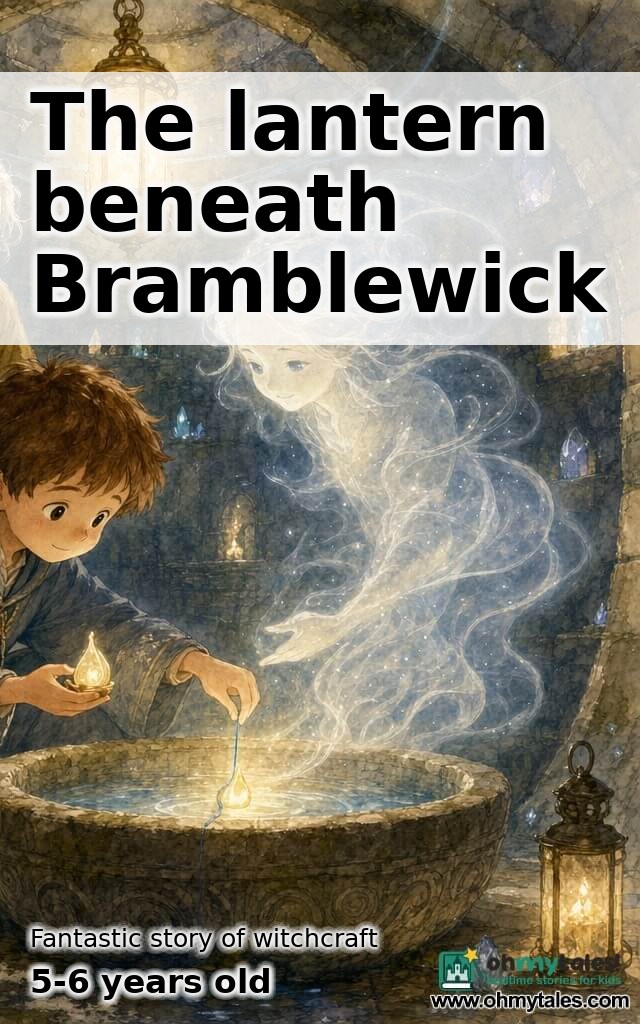
Milo followed the sigh until he reached a round chamber. In the middle stood an old stone basin, dry and dusty. Above it hung a lantern that was not lit, yet it glimmered faintly, as if remembering light.
And in the shadow near the basin, a shape shimmered.
It was an ancient spirit, thin as mist and pale as moonmilk. Its face looked like a sad painting that had been washed too many times. Its eyes were open, but they did not seem to see.
The spirit's sorrow filled the room like fog.
Milo's heart squeezed a little. He did not want to chase it or trap it. He wanted to soothe it, the way one calms a frightened cat: slowly, gently, with steady hands.
He took a step forward. The spirit shivered, and the lantern above gave a tiny, worried flicker.
Milo stopped. He bowed, not too low and not too high—just respectful. Then he placed his wand on the stone floor and stepped back from it, showing he meant no harm.
The spirit's misty shoulders eased, only a little.
Milo looked around the chamber. On the wall was a faded symbol: a circle with a small star inside. Below it, carved words in old, crooked letters read:
“REMEMBER ME KINDLY.”
Milo whispered the words to himself, and the air seemed to listen.
Part 2: The Patient Alchemist and the Puzzle of Calm
Milo left the chamber quietly. He did not want to crowd the spirit with his kindness. Sometimes kindness needs space.
He followed the warm tunnels deeper, past arches shaped like upside-down smiles. The catacombs breathed softly, as if they were alive. The warmth was not scary; it was like a thick blanket on a chilly day.
Soon the corridor opened into another room. This one smelled of oranges and clean smoke. A table stood there, covered with jars and bowls. Some jars held glittering sand. Some held dried petals. One held a single marble that rolled by itself in slow circles.
Behind the table sat a man with silver hair tied back neatly. He wore a long coat dusted with chalk and cinnamon. He stirred a pot with a spoon that looked far too big for the pot, as if he enjoyed the silliness of it.
He looked up, calm as a pond. “You've come down the old way,” he said.
Milo nodded. “I think something is troubled.”
The man's eyes softened. “Then the catacombs have chosen well. I am Orin, an alchemist. I make mixtures that help magic behave.”
Milo had met busy people and loud people, but Orin was patient in a way that made the room feel safer. Even the rolling marble slowed, as if it was paying attention.
Milo told Orin about the spirit: the misty shape, the tired sigh, the words on the wall.
Orin listened without interrupting. When Milo finished, Orin tapped a jar thoughtfully. “An ancient spirit is not always angry,” he said. “Sometimes it is simply…unfinished.”
“Unfinished?” Milo asked.
Orin nodded. “Spirits are tied to memories. If a memory is knotted, the spirit can ache. We must find what it needs to loosen the knot.”
Milo glanced at the jars. “Is there a potion for that?”
Orin chuckled, a gentle sound like a page turning. “Not a potion. A recipe, perhaps. But the main ingredient is not in my jars.”
He reached under the table and pulled out a flat stone tile. On it was drawn the same symbol Milo had seen: a circle with a star.
“This mark is a link,” Orin said. “A bridge between the ordinary and the extraordinary. The spirit once guarded that bridge. Long ago, it helped people who were lost.”
Milo imagined travelers with lanterns, whispering prayers to the dark. He imagined the spirit standing proud, bright, and brave.
“What happened?” Milo asked.
Orin sighed. “The town forgot. People stopped telling the story. Forgotten helpers grow heavy with silence.”
Milo's chest warmed with a new idea. “Then it needs to be remembered kindly.”
Orin's smile spread slowly, like sunrise. “Yes. And it needs a small act of trust. Magic does not like being pushed. It likes being invited.”
Orin lifted three items and laid them on the table: a pinch of starlike salt, a ribbon of pale blue thread, and a tiny candle shaped like a teardrop.
“The salt is for clarity,” Orin said. “The thread is for the invisible ties. The candle is for a soft promise.”
Milo looked at the thread. It was the same color as the hovering lines in the corridors. “How do I use them?”
Orin placed the candle in Milo's palm. It was warm, as if it had been held in sunlight. “You will place these by the basin,” he said. “Then you will speak a true memory—your own. Something kind. Something real. You will offer it without demanding anything back.”
Milo's stomach fluttered. He was used to spells with steps and rules. This sounded simple, but it felt big.
“What if it doesn't work?” Milo asked.
Orin's eyes twinkled. “Then we try again with more patience. That is also magic.”
Milo took a breath and gathered the items carefully. Orin slid a small pouch across the table as well. It clinked softly.
“What is that?” Milo asked.
Orin coughed once, hiding a smile. “A few sugar buttons. For courage. Courage can be sticky in the mouth.”
Milo laughed quietly, and the tension in his shoulders loosened.
Then Orin did something that surprised him. The alchemist stood, walked around the table, and placed his own hand over Milo's, gently closing Milo's fingers around the candle.
“A gesture of trust,” Orin said. “You are not alone in this.”
Milo felt the warmth of that simple touch travel up his arm like a friendly spark.
He nodded. “I will go carefully.”
Part 3: The Spirit's Lantern and the Kind Remembering
The way back to the round chamber seemed shorter, as if the catacombs themselves were guiding Milo. The pale blue threads in the air shimmered a little brighter when he passed. One thread drifted close to his sleeve and then floated away, like a shy greeting.
Milo reached the chamber and stopped at the doorway. The spirit was still there, gathered near the basin like mist hugging a cold stone.
Milo did not rush in. He walked slowly, making his footsteps soft. He placed the starlike salt on the edge of the basin. It sparkled faintly, like tiny frost stars.
Then he laid the pale blue thread in a gentle curve, like a smile, beside the salt. As soon as it touched the stone, the floating threads in the room answered with a quiet hum. The air felt connected, as if the chamber was holding hands with itself.
Last, Milo set the teardrop candle in the center of the basin.
He did not light it with a flashy spell. He simply held his wand above it and breathed out slowly, letting his calm sink into the air.
A soft flame appeared—small, steady, and golden.
The spirit's head turned. Its eyes, once far away, focused a little more.
Milo swallowed. Orin had said: a true memory. Something kind.
Milo thought of many things. He could talk about his first wand, or the time he made his socks dance by accident. But that felt like showing off.
Instead he remembered a rainy day when he was small, before he even knew he was a wizard. He had been lost in the market, surrounded by tall coats and hurried feet. He had felt very tiny. Then a gentle old woman had taken his hand and led him to his father, patiently, without scolding him for being scared.
Milo's voice was quiet, but clear. He told the spirit about that hand, that steady walk, that feeling of being found. He spoke as if he was placing the memory down like a blanket.
As he spoke, the candle flame grew a little taller, still soft, never sharp. The salt glittered. The blue thread lifted at one end, waving slightly, like it was pleased.
The spirit trembled. A sound escaped it—half sigh, half song.
Then, like mist touched by sunlight, the spirit's shape became clearer. A figure appeared: not frightening, not angry. It looked like a guardian in old clothes, with a gentle face and eyes that had been waiting a very long time.
The lantern above the basin sparked. Once. Twice. Then it lit fully, filling the chamber with warm light the color of butter.
Milo felt something change. The heavy sadness thinned. The air tasted sweeter, like clean water.
The spirit drifted closer to the basin. It looked at the candle, then at Milo. Its expression was not a grin, exactly, but it held the same feeling as a smile.
Milo lifted his hand, palm open, not grabbing. “You were helpful,” he whispered. “You mattered. I remember kindness. I will tell your story.”
The spirit placed a pale hand over the blue thread. The thread glowed brighter, and the hovering lines in the air shone in answer. The invisible ties were no longer hidden. They were still gentle, still quiet, but they felt strong.
For a moment, Milo saw something like a picture in the light: travelers in the dark, a guiding lantern, a calm presence leading them safely through. The spirit had been a friend to strangers.
The spirit bowed, slow and deep. Then it lifted like smoke rising and flowed into the lantern's flame.
The lantern did not burn hotter. It simply burned happier.
Milo blinked, and realized he was holding his breath. He let it out. His shoulders fell. The chamber felt peaceful, like the end of a long, tense song.
A tiny sound came from his pocket. He pulled out Orin's pouch of sugar buttons. One had melted a little, sticking to the cloth. Milo smiled. Courage really was sticky.
He placed one sugar button on the basin's edge, like a small gift. “For you,” he said, feeling a bit silly and also very proud.
The lantern flickered, as if amused.
Milo gathered the empty salt jar and carefully wound the blue thread around his finger. The candle kept burning, but its flame was now as calm as a sleeping cat.
When Milo walked out, the catacombs felt different. Still warm, still ancient, but now they seemed to breathe easier.
The threads of light followed him partway, then settled back into place, tying stone to stone, story to story.
Up the corridor, Milo found Orin waiting, hands folded, as if he had been listening for the change in the air.
Milo nodded once. “It's calm now.”
Orin's eyes crinkled with relief. “You did well.”
Milo held up the blue thread. “It feels like the tunnels are…friendlier.”
Orin gave a small laugh. “They are. You reminded them that they are part of something bigger.”
They walked back together. When Milo stepped through the doorway into his cellar, the crack of light sealed gently behind him, like a book closing after a good chapter.
Aboveground, the world was the same—sun on rooftops, birds in the hedge, the kettle still humming. Yet Milo could feel the invisible ties now, quiet as whispers, strong as roots.
That evening, Milo wrote the spirit's story in his spellbook, not as a spell, but as a tale. He drew the circle and star in bright ink. He added the words:
“REMEMBER ME KINDLY.”
Then, because creativity likes to dance, he painted a small lantern beside the words and sprinkled a little ordinary flour on the ink, making it shimmer like starlight. It was a silly trick, but it made him smile.
And somewhere beneath Bramblewick, in warm catacombs with an ancient breath, a lantern glowed steadily—soft, brave, and no longer forgotten.