Chapter 1: The Little Diplomat
Mira always carried a scarf with tiny comet stitches. At nine, she called herself a diplomat because she had a gentle way of listening. She lived in a town with glass greenhouses and wind-chimes that sang when the sea breeze came. Folks smiled when Mira approached; she folded her hands like a book and waited until people found their words.
One bright morning, a soft thudding came from the marsh behind the town. The marsh was a patchwork of bright green moss, shallow pools, and old stepping-stones that children used as boats. Mira sniffed the air, tasted salt and something like soap bubbles. She slipped into her boots and set off along the mossy trail, the comet scarf tucked under her jacket.
Along the trail, the moss hummed under her feet. It felt like walking on a sleeping cat. The path twisted through low birches and around a hollow where wild strawberries still clung. Mira loved the way the world smelled here—wet leaves, damp earth, tiny sun-warmed stones. She hummed a tune she'd heard from her grandmother and felt brave.
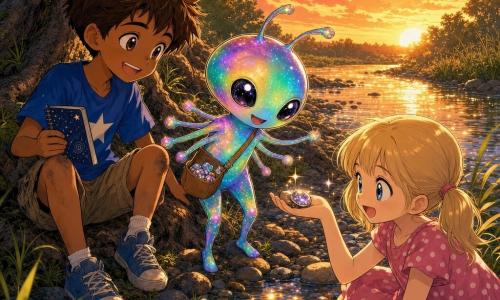
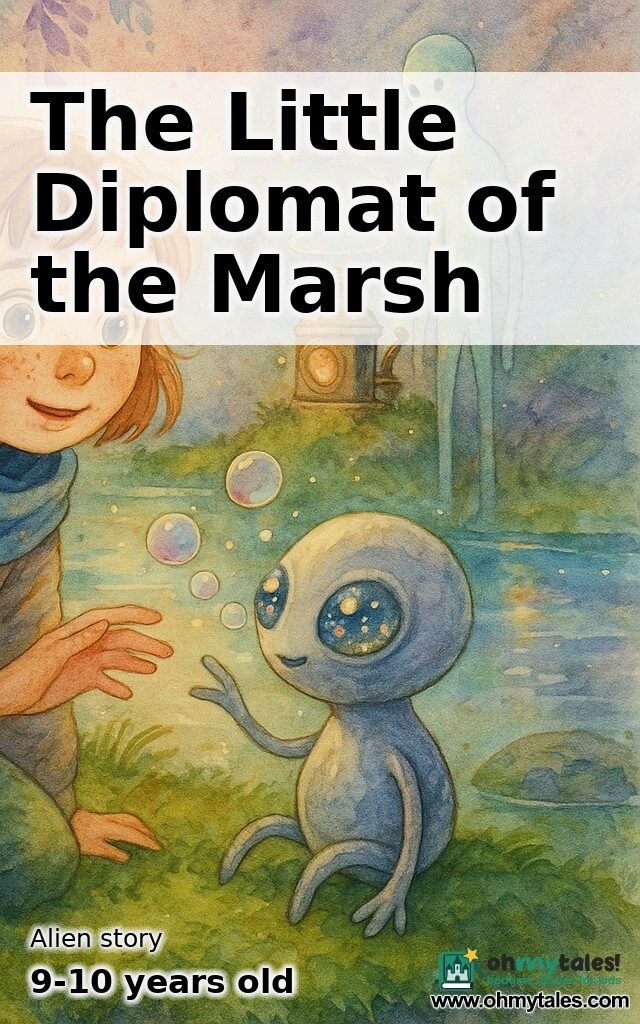
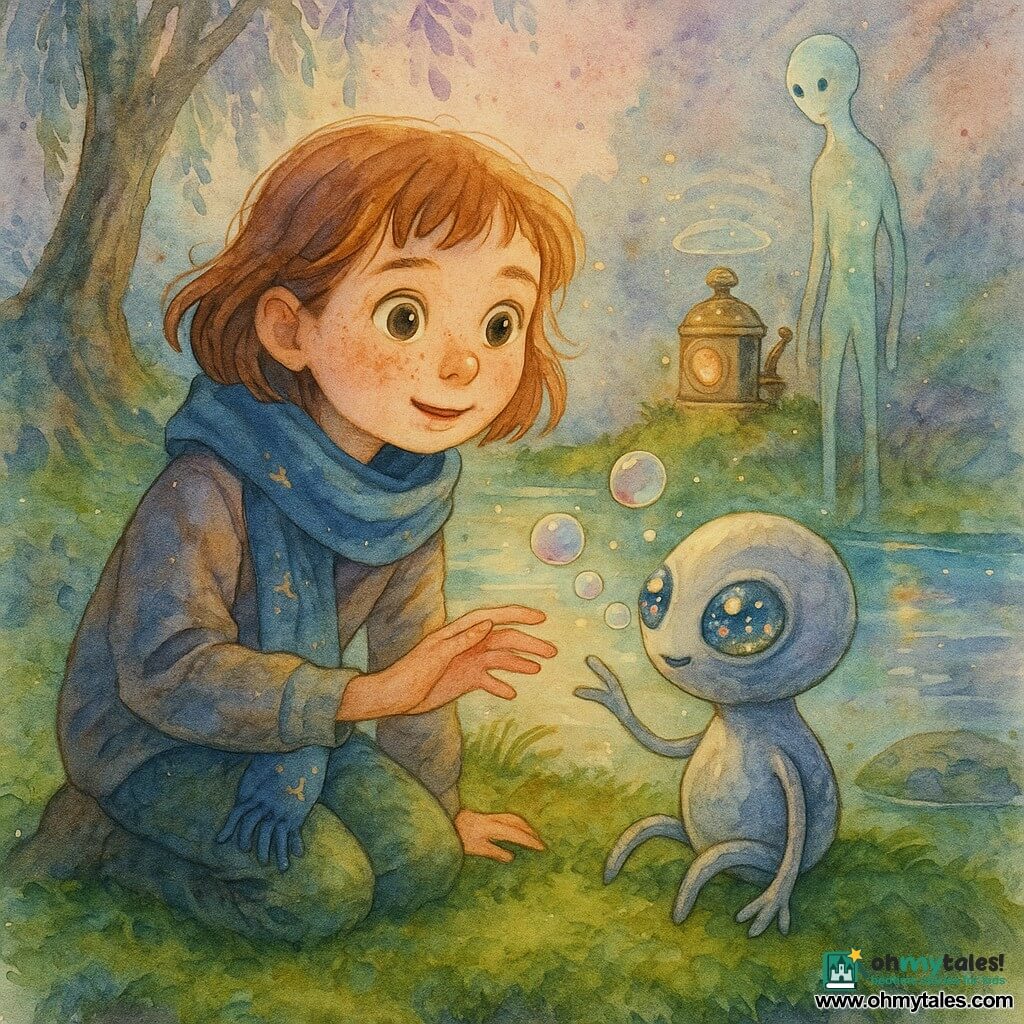
At the pond, something shone like a little silver moon. It bobbed and blinked. When Mira knelt, a shape rose—no bigger than a garden lantern, with round, glassy eyes and skin like polished river stones. It had three thin arms and a mouth that made bubbles instead of words.
Mira froze. The creature blinked slowly and lifted one arm in what looked like a wave. She remembered her diplomat lessons—first, breathe. Second, listen with your whole body. Third, be patient. So she breathed, smiled small, and lifted a hand in return.
The creature answered with a gentle ripple through the moss. Little lights ran along its sides. It hopped on to the mossy trail like a pebble skipping, then paused and tapped the ground. Mira realized it was pointing—toward the deeper marsh, where a light pulsed under the roots of an ancient willow. The creature wanted Mira to follow.
Mira knelt, picked a pebble, and set it on the trail as a marker. She named the creature Pebble, and Pebble chirped. They walked together into the trails of moss.
Chapter 2: The Language of Waiting
The farther they went, the softer the moss became. It swallowed their steps in silence. Pebble communicated in small gestures—flaring lights, a gentle push, a curl of one arm. Mira tried to copy. She tapped the moss with her fingers and smiled. Pebble pointed at her hands, then held them over its eyes, blinking a slow rhythm. Mira realized it was teaching her a game: patience.
They reached a clearing where the moss grew like a velvet carpet around a ring of stones. In the center stood a machine older than the town, half-buried and shining with sea-worn brass. Its top had a glass dome that breathed tiny fog rings. Around it were seedlings that shivered with a silver breath.
Pebble hopped onto the machine and pushed a lever that hummed like a trapped wasp. A panel opened to reveal a map of stars and a tiny compartment with a glowing seed. Pebble made a soft sound and tapped the glass dome; the ring of fog drifted out and circled them, sparkling.
Mira understood that Pebble missed someone—there was a hole in the machine like a missing gear, and the glow in Pebble's chest flickered when the fog passed. She sat on the stones and thought of her diplomatic handbook: to help, you must understand why someone waits. So she waited with Pebble. She didn't try to fix the machine right away; she listened to its sighs, watched how it blinked, and let the fog curl around her fingers.
Hours passed like pages turned slowly. A breeze played with her comet scarf. Pebble alternated between bright pulses and soft dimness. Each time the light faded a little, Mira hummed—a steady tune—and Pebble would pulse brighter. The patience stretched them into a quiet agreement. They were not in a hurry; they were making room for whatever might come next.
At sunset, a shadow rose from the marsh—a boat-shaped craft made of woven light. A figure stepped down, slender and taller than Pebble, with skin that shimmered like wet glass. Its eyes were gentle; it moved with the slowness of someone who had lived a long way, and who had time for everything. The figure knelt and placed a palm on the machine, then smiled at Mira.
Mira learned that this being was called Lilt. Lilt's voice was a series of bell-like notes that Mira could feel more than hear. Lilt thanked Pebble by touching the creature's head and then looked toward Mira. Mira bowed her head slightly. Lilt placed a hand on Mira's shoulder and closed their eyes for a long moment, as if saying thanks with their whole body. Mira felt warm all over.
Chapter 3: The Mossy Puzzle
Lilt explained—without words, but with patient gestures—that their craft had wandered off course. A gear inside the machine had slipped and needed a small crystal to guide it. Without it, their path home would fade like a map left in the rain. Pebble's glow answered to that crystal; without it, the creatures felt lost and remembered wrong star patterns.
Mira offered to help. Lilt handed her a small lens that magnified the moss like a map of tiny cities. Beneath the moss, the machine hummed with old songs. Mira crawled along the trail, lens pressed to stones, searching. She used patience the way one uses a fishing line—hold still, watch the float. Sometimes that meant sitting very quiet while shrimp-like bugs skated across the water. Sometimes it meant following a silver snail that left a glittering trail.
At the edge of a hollow, the moss grew tall like long hair. Mira knelt and peered into the green. There, tucked in a hollow root, was a nub of crystal the size of a thumb. Its colors shifted like oil on water. Mira reached in, but the root curled back like a shy animal. The crystal rolled deeper.
Mira breathed. She remembered how her grandmother would wait for a shy robin to come close. So Mira didn't grab. She stayed, palms open, humming the same tune she'd used for Pebble. Slowly, as the sky sent down lavender light, the moss relaxed. A tiny snail nudged the crystal forward. Pebble circled and nudged it with a single arm, then stepped back. Mira scooped it up.
When she returned, Lilt's whole body brightened. It fit the crystal into the machine with gentle fingers. The machine sighed and then sang a clear note. Light spilled into the marsh in a new pattern, drawing a path above the reeds like a ribbon of stars.
Mira felt proud but also tired. Lilt saw that and offered a small cupping of water shaped like a shell. Mira drank and felt the world steady again.
Chapter 4: Saying Goodbye Without Words
The craft hummed to life. Lilt thanked Mira by pointing to the sky and then to their heart. Pebble pulsed in a rhythm that made Mira's knees tremble with the need to be brave and sad at once. She had grown fond of them; she had learned their patience and been taught to wait by the softest of teachers—moss and marsh and a little creature that made bubbles.
Lilt bent close and touched Mira's forehead with a fingertip that felt like warm glass. In that touch, Mira felt pictures—images of moons, of small gardens on star-planes, of families sitting in rings beneath thin suns. Lilt folded those pictures into their hands and held them out toward Mira. The gesture meant, I will remember you. Mira felt words in the gesture, but no sound was needed.
Mira wanted to say goodbye. The diplomat in her had always used words, a handshake, a bow. Lilt crouched and drew in the moss a pattern with a finger: three spirals and a line. Pebble added a small pebble on top and tapped the line twice. Lilt then placed both palms on the ground and exhaled a long, soft breath. Mira mirrored them—palms on moss, a long slow breath out.
They stood like that for a while, not speaking. The exchange was simple and whole. Mira realized that goodbyes could be done with the heart and the body—by making space, by leaving a mark that says, "I was here, and I will carry you with me." She traced the spiral with her finger and pressed a pebble into it, closing the circle.
Before boarding, Lilt presented Mira with a tiny, flat disk that fit on her scarf like a new comet stitch. It pulsed softly when she touched it. Lilt tapped their chest, then tapped Mira's, then touched the disk and pointed toward the sky and then the marsh. Mira understood: this disk would remind them, across distance, of the place and the patience shared. Mira predetermined a quiet smile and put the disk on her scarf.
Pebble rolled up and tucked one arm into Mira's sleeve—a tiny friend who might visit in dreams. Mira laughed, which sounded like bells to the marsh, and Pebble answered with a bubbly chuckle. Lilt raised their hand once, slowly, and then—without a word—lowered their arm. The simple motion felt like closing a book with care.
Mira copied the motion, raising her hand to the sky and then lowering it slowly, palm out, as if tucking the sky into a pocket. This was how they said goodbye without words—one patient lift and a slow return to the earth. It felt like folding a letter into a drawer.
Chapter 5: Home Light
The craft lifted like a dandelion seed riding a gust. Light wrapped around it and the marsh watched in soft hush. Pebble chirped once, a sound like a soap bubble popping gently, then nestled against Mira and closed its glassy eyes.
Mira walked back along the mossy trail alone. The stones remembered their footfalls. The comet scarf felt heavier with the disk and lighter with the memory of new friends. She thought of patience the way one thinks of a warm blanket—something you put on when the night feels long.
At the pond where they had met, the machine glowed faintly. Lilt's light still traced the path above the reeds like a ribbon no one could untie. Mira knelt and smoothed the moss where they had drawn spirals. She left a pebble on the spot for the next traveler to find.
The town's wind-chimes were singing as she returned. Mira's mother made tea, and the kettle whistled a voice of welcome. Mira sat at the kitchen table and placed her fingers over the disk on her scarf. It pulsed once—a soft, steady heartbeat—and then dimmed.
Before she went to bed, Mira walked out to the little attic room where she kept jars of seawater and pressed flowers. On the wall hung a tiny switch that her grandfather had installed when she was small. He used to say it was the "thinking switch" because you flipped it to remember something important. Mira smiled and fingered the disk.
She lifted her hand and did the slow motion she and Lilt had shared—hand to sky, hand back to earth, palm gentle. She pressed the switch down with the same care. The room grew softer. The attic lamps dimmed to a low, comforting glow. The comet stitch on her scarf pulsed once, as if blinking a last little hello.
Mira lay back and felt patience like a pillow beneath her. She had learned a new way to say goodbye without words, and to wait with a steady heart. Outside, the mossy trail hummed under the moon. In the sky, a ribbon of light twined among the stars and then, somewhere far away, a little craft folded its light and went home.