Chapter 1: The Path That Hummed
Mira walked the forest path the same way she always did—soft steps, hands in her pockets, eyes searching for the mischievous rabbits that lived under the bracken. The trees here leaned together like old friends, their leaves whispering secrets. On that evening the path itself seemed to hum, a secret tune that made the hair at the back of her neck stand up in a pleasant way.
She was nine, small in stature but steady in thought, the kind of child who liked to count things carefully: the rings on tree trunks, the number of pebbles in her pocket, the steps from the old gate to the mossy log. Counting made the world feel friendly and knowable.
Tonight the air smelled of damp earth and wild mint. Mira paused by a silver birch and looked up. A sliver of sky peeked through the leaves, and beyond it glowed a slow, polite light—like a lantern bobbing across a huge dark sea.
Something landed, not with a crash but a neat little whoosh. Leaves whooped and settled. A small shape shimmered where the path opened to a clearing. It was not like anything Mira had seen in her books—a thing made of pearly panels and soft blue filaments, like a seashell wearing starlight.
"Hello," said a voice that sounded like a bell being rung gently. Mira stamped on the spot to stop herself from running. "Hello. I'm Mira."
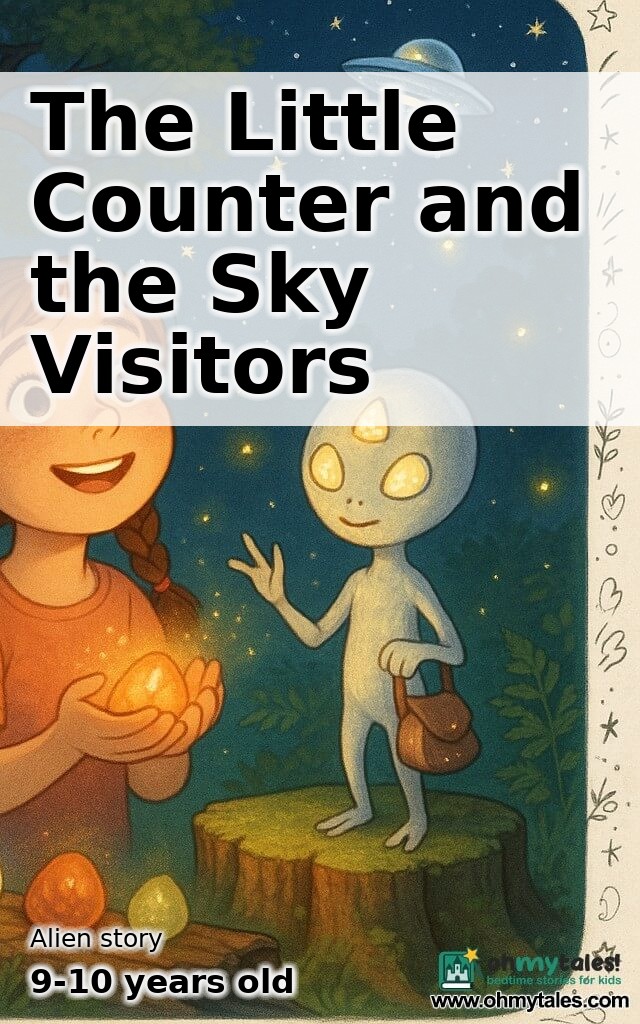
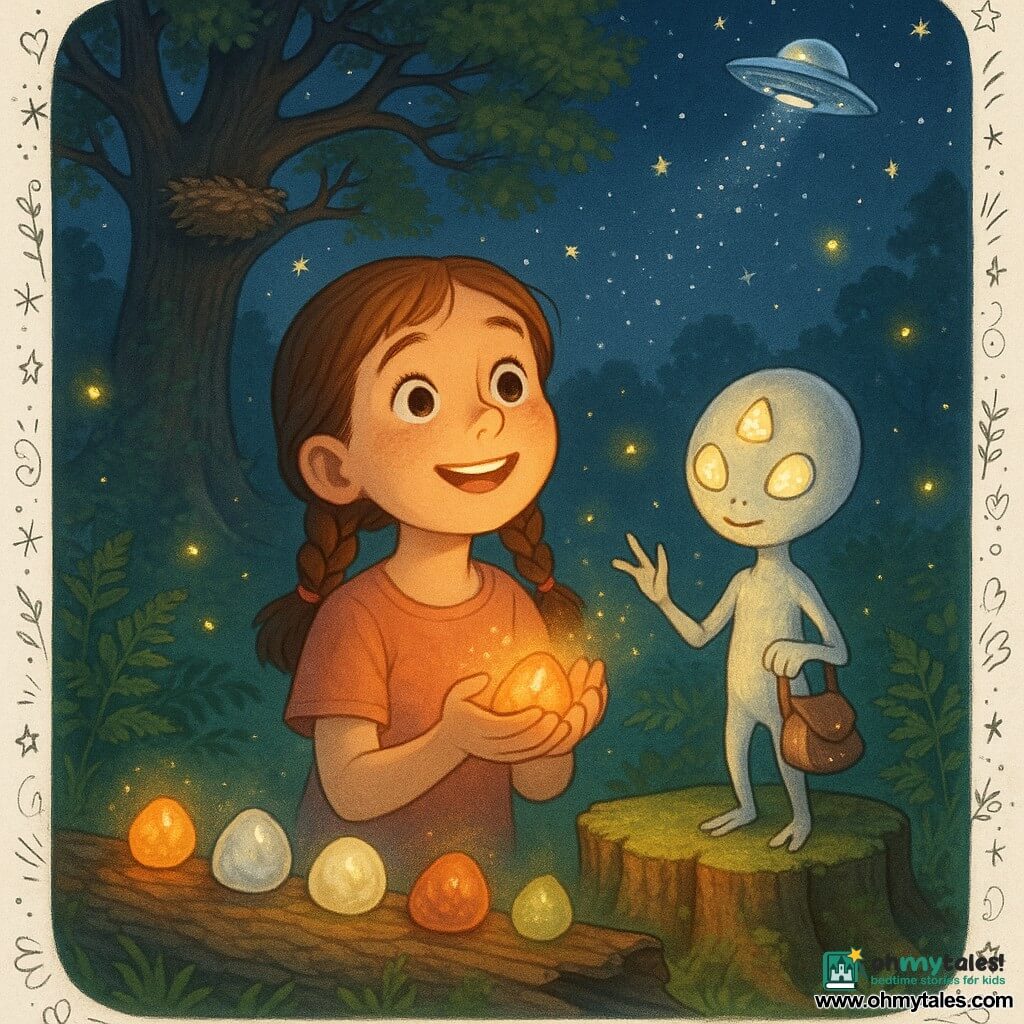
A door in the pearly shell sighed open, and out slid a creature no taller than Mira's knee. It had three bright eyes arranged like a triangle, each blinking with polite curiosity. Its skin shimmered the color of new coins. It carried a little satchel.
"We are visitors," it said, each word a tiny bell. "I am Talli. We counted the wrong star and landed here."
Mira smiled. "I'm very good at counting," she said. She had not expected to be a guide for an alien, but the forest seemed fine with it. "Do you want to count things with me?"
Talli's three eyes shifted into a pleased triangle. "Please."
They sat on the log together. The forest hummed like a sleepy orchestra. Trees nodded above them. Talli opened its satchel. Inside were thin devices that looked like pencils and a small bell that jingled with cosmic dust. It was all slightly ridiculous and entirely wonderful.
"How many stars did you mean to find?" Mira asked.
Talli tapped its forehead with a filament. "We sought seven meteors to show at the Festival of Passing Lights. We counted wrong and followed a wandering dust-path. Now we must find the meteors."
Mira thought. Her list of counting chores lived in her head like a neat row of jars. "We can count things to practice," she said. "Then we'll find your meteors together."
Talli clapped three tiny hands. The bell in the satchel rang, and somewhere birds decided it was time to stop watching and to watch more closely.
Chapter 2: The Map of Fingers
They walked along the winding trail. Mira pointed out landmarks the way a cartographer with freckles might: a stone with a smile-shaped crack, the fern that always leaned toward the sun, a willow root that made a perfect seat. Talli's eyes recorded everything and ticked invisible counters in the air.
"One willow root," Mira counted. "Two stones. Three rabbits—wait, two rabbits; I miscounted. That's good practice."
Talli laughed; the sound was like beads rolling on a wooden tray. "Practice is excellent."
They reached a clearing where the ferns opened like a green sea. There, stuck in the moss, was something bright and small—an orange shard that hummed faintly. Mira picked it up. It warmed against her palm.
"A meteor?" Talli whispered, three eyes suddenly very round.
"It could be," Mira breathed. She tapped it with a finger. It glowed and cast a tiny map on her wrist, a shimmering line like a finger-drawn trail across the sky. Little numbers blinked along the line.
"It's a map!" Talli said. "It chooses a friend."
Mira grinned. She loved maps—she loved the idea that something could be lost and then found, and that maps were the friendly argument between places. "It shows three more markers," she read. "One at the brook, one by the old fence stump, and one where the fox's den used to be."
They began counting again, aloud this time. One mossy stone, two crooked branches, three sighing oaks. With every count, the shard pulsed softly. When they reached the brook, a glint of metal lay tangled in the reeds. Another meteor, round and quiet. Talli clapped; the bell in its satchel chimed like a small salute.
As dusk deepened the forest filled with a soft blue glow. Fireflies stitched their own little tally into the air. Mira felt her chest loosen, the concentration she kept like a secret tool for the world making room for delight.
"Why do you collect meteors?" she asked as they walked.
Talli's eyes tilted. "They hold stories. The people of our sky-garden place meteors in a circle and listen. Each meteor remembers a journey. We wanted to show our children how many ways the world can change hands without losing its songs."
Mira liked that. She thought of the moss, the rabbits, the willow that leaned toward the sun. She imagined listening to stones sing.
At the old fence stump they found the third meteor, tucked under a blanket of dead leaves. It was soft to the touch and smelled faintly of rain. Mira counted each leaf as she brushed them away. The meteor hummed like a lid being lifted.
"Three now," Mira said. "Three found. Four to go."
Talli nodded and set down its satchel. "We will make the counting part of the story," it said. "Every number will be remembered."
They sat and marked the moments. They labeled each meteor with a leaf-woven ribbon. Counting had become a way to carry gratitude: thank you, said the ribbons, for being found.
Chapter 3: The Night the Meteors Sang
A hush fell as night grew thick and the clearing filled with the pool of sky. Stars concentrated their glow, about to perform. Talli and Mira moved toward the fox den, where the map said the fourth piece waited. The path narrowed and turned over a little wooden bridge. Mira hummed a tuneless count as they crossed—one, two, three, four steps—and the wood complained happily.
In the hollow near the old den crouched a meteor shaped like a pebble. When Mira picked it up, the world around them seemed to listen. The meteor did not sing as a human would; it made a series of bell-like notes that fit together like a laugh and a thought. Talli hummed along, matching the pitch with its three eyes.
"We have four." Mira said, surprised to find the numbers felt like friends now, not rules. "Four and counting."
They had only one meteor left to find. According to the shard's map it would be beneath the highest branch in the clearing. That sounded impossible until Mira remembered the tall oak that wore a nest like a crown. She climbed the oak with the careful rhythm she'd learned when counting steps—left foot, right foot, count, count—until she reached a fork and a quiet nest of twigs. In it lay a small, warm stone that seemed to hold a lamp.
Mira lifted it down like a secret. The moonlight pooled into its surface and threw the clearing into a gentle silver. Talli's eyes glowed with delighted shock.
"The fifth piece!" it said. But the map had shown five markers—Mira's heart did a small, surprised flip. "Wait," Talli said. "There should be seven."
Mira looked at the five meteors lined on the log. They were not bright like suns. They were more like honest things that remembered rain and travel. She felt an inkling of sadness for Talli and the children of the sky-garden who had expected seven.
"Maybe the map counts more than we see," Mira suggested, though she did not fully know what she meant. "Maybe some meteors are invisible unless looked at the right way."
They placed the five together. The bell in Talli's satchel began to vibrate and a soft sound spilled out—the voice of the meteors like a choir assembled. It told of long journeys, of falling through curtains of cold and being warmed by campfires, of children on other worlds who pressed palms to skies and whispered wishes.
Mira sat very still. She felt a vast, gentle gratitude swell up inside her like a warm tide. For the forest, for the strange, lovely Talli, for the chance to help. She touched the meteor nearest her and said, "Thank you."
Talli blinked, and the three eyes were suddenly damp with tiny, sparkling tears. "We are grateful," it said, voice shaking like a bell that had been swung too hard and then steadied.
Gratitude, Mira found, made the air taste sweet.
Chapter 4: The Counting of Home
The bell's vibration loosened a thread of light that rose into the sky like smoke rising to a lantern. The light wrapped the meteors and lifted them, not by force but by invitation. They drifted together and formed a little constellation above the clearing—their shapes close and comfortable. Talli's ship hummed, ready to fold itself around the light.
But before leaving, Talli turned to Mira and produced from its satchel a tiny instrument that looked like a comb and a spoon. "We have a tradition," it said. "Before we go, we count the gifts given by friends and name them."
Mira thought for a moment. She had already counted five meteors, many steps, and several new kinds of laughter. She set her palms on the ground and felt the moss, felt the cool pulse of the earth. She counted aloud slowly and with attention.
"One—friend on a path. Two—meteors found. Three—songs shared. Four—lessons learned. Five—gratitude for the trees. Six—new stories to tell."
Talli added with its own soft clicks, "Seven—home is many places."
The final number made Mira smile; it felt right. The bell in the satchel rang once, then twice—a tiny applause from a tiny audience. The pearly shell of Talli's ship unfolded like a thank-you card. The small constellation winked as it moved higher.
"Will you come back?" Mira asked. Her voice was steady because she trusted counting and trusts the way grown-up things sometimes surprise you kindly.
"We will tell our children the story of the kind counter on the forest path," Talli promised. "We will return when the sky asks for more stories."
They hugged in the awkward, careful way that beings of different shapes hug—Mira pressed a palm to Talli's satchel and Talli looped a filament around her wrist like a bracelet. It left a faint, warm glow.
As the ship rose, it scattered silver motes that drifted down through the branches like confetti. The forest seemed to bow. Fireflies lit their tiny lanterns in farewell. Mira counted the falling motes until they blurred into a gentle glitter.
When the last light moved away, the forest returned to its usual hush. The path felt wider and somehow more solemn. Mira brushed her palms on her jeans and looked at her hands, which smelled of moss and stars.
A warm breeze, soft as an old blanket, slid through the clearing. It touched her cheeks and smelled of wild mint and distant water. Mira closed her eyes and felt grateful for the simple, enormous fact of things—friends found, stories kept, numbers that stitched moments together.
On the path home she counted the steps again, not because she had to but because she liked the rhythm. One, two, three—she walked into the night carrying a small glow on her wrist and a pocket full of quiet numbers. The wind beside her settled like a hand on her shoulder, and the whole world felt very much like home.