Part 1: The Sky-Steppe and the Sacred Heart
Morning spread across the wide steppe like warm milk over bread. The grass shimmered silver-green, and the wind ran in long, laughing lines. Far away, round felt tents rested on the earth, and horses moved like dark waves.
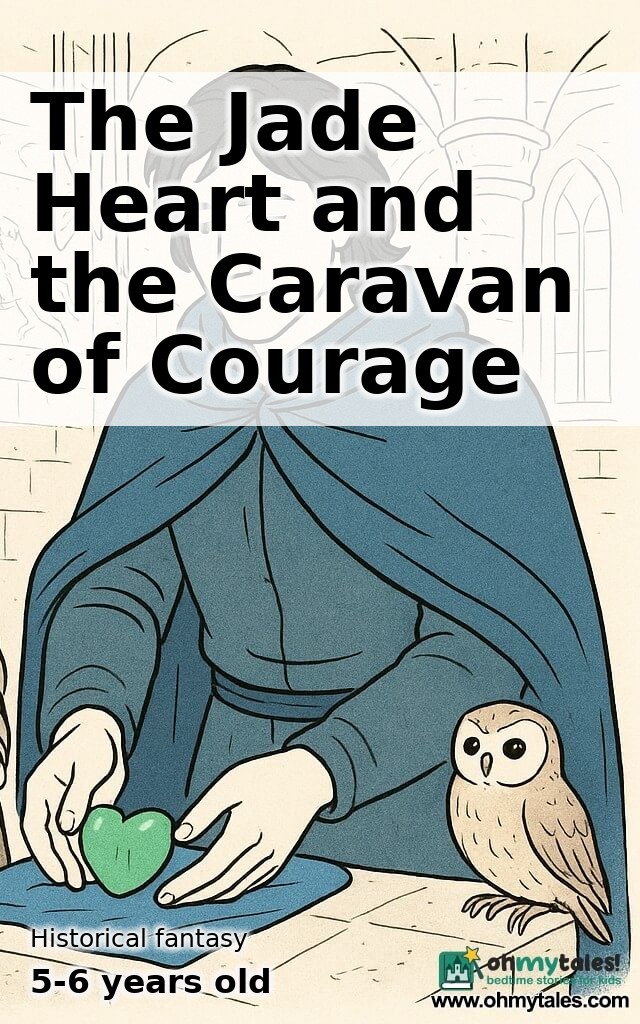
Arslan rode alone, wrapped in a blue cloak that smelled of smoke and sage. He was a man with quiet eyes, the kind that noticed small things before big ones. He noticed a hawk turning in the sky. He noticed how the clouds made a soft road above him. He noticed, too, when the air felt different, as if an old song had started under the world.
At his belt hung a little pouch of leather. Inside it lay a sacred artifact: a small jade heart, smooth and cool, carved with tiny swirls like wind. People called it the Heart of the Eternal Sky. It was not loud magic. It did not flash or roar. It was a calm magic, like a steady drum.
The Heart was meant to be kept safe for the clans. Long ago, wise shamans said it helped the steppe stay kind. It kept springs from drying. It helped lost travelers find paths. It reminded people to share, even when winter bit hard.
Arslan's deep goal was simple in his chest and heavy in his hands: protect it.
That day, he traveled toward Karakorum, the great city of the Mongol dynasties, where roads met like strings tied in a knot. He had been asked to bring the Heart to the temple of old stones, where monks would hide it in a secret place.
The wind rose. It brought dust and the smell of far thunder. Arslan's horse, a strong chestnut mare, flicked her ears and snorted. Arslan patted her neck and listened.
In the distance, he saw riders. Their shapes were thin and sharp, like broken twigs. They moved fast.
Arslan turned his mare toward a low hill where stones stood in a circle. It was an ancient place, older than any khan. The stones were stained with time and painted with fading signs. At the center, the grass grew in a perfect ring, as if the earth still remembered a dance.
Arslan slid down from his horse and knelt. He did not speak much, but in his mind he asked for help from the old spirits of the steppe. The jade Heart in his pouch grew slightly warmer, like a small animal waking.
Then, from behind one stone, a child appeared—small, dusty, and wide-eyed. The child wore a worn coat and carried a bundle of reeds.
Arslan's first feeling was surprise, then worry, then care. A child alone on the steppe was like a candle in a big wind.
He offered the child water and a piece of dried cheese. The child ate quickly. The child's eyes kept darting toward the distant riders.
Arslan did not ask many questions. He only watched the sky and the grass and the way fear moved like a shadow.
The jade Heart warmed again, and Arslan understood with his quiet intuition: those riders were not coming by chance. They were hunting the magic.
He needed more than speed. He needed solidarity.
Part 2: The Whispering Stones
The riders came closer, their horses throwing up dirt. Their flags were dark, and their faces were hidden under scarves. They looked like a storm that had learned to sit in a saddle.
Arslan guided the child behind the stones. He moved gently, like a herder with a nervous lamb. The child clutched the reed bundle and shook.
Inside the stone circle, the air felt cool and still. It smelled of old rain and rock. The carved signs on the stones seemed to watch.
Arslan opened his pouch just a little. The jade Heart glowed softly, pale green like moonlight on a pond. The glow did not shout. It breathed.
He pressed the Heart to the ground. The grass trembled. A low hum rose, not in ears but in bones, as if the steppe itself was speaking.
The stones answered. Their shadows stretched and turned, sliding like slow water. A narrow gap opened between two stones, where there had been only solid rock. It was a hidden passage, a secret mouth of the past.
Arslan's eyebrows lifted. Even he, a man who believed in quiet magic, had not expected the stones to move.
He led the child into the gap. They stepped into darkness that did not feel scary. It felt like a blanket. The passage sloped down and then opened into a chamber lit by a thin crack of daylight.
On the wall, old paintings showed riders, drums, and stars. A great blue sky was painted above them, with a jade heart shining in the center. Arslan felt as if he had stepped into a story told by grandfathers.
A mini twist came quickly. The child's reed bundle began to rustle on its own. Out popped a tiny owl, no bigger than Arslan's hand, with golden eyes and a serious face. The owl hopped onto a stone and tilted its head.
Arslan stared. He had thought the bundle held only reeds.
The owl fluttered its wings. A single feather drifted down and landed on the jade Heart, which Arslan still held. The feather melted into light, and the Heart's glow turned steadier, as if it had found a friend.
The child's fear loosened. The owl felt like a brave little guard.
Above them, hoofbeats thundered around the stone circle. The hidden chamber stayed quiet.
Arslan knew the riders could wait. He could not stay underground forever. He needed a plan that did not hurt anyone, a plan that used cleverness and community, not anger.
He listened again. The owl blinked slowly. The child held Arslan's sleeve, trusting him.
Then another sound came, faint but real: jingling harness bells and many hoofbeats, coming from the north. Not the hunters' sound. A different rhythm, like a caravan.
Arslan's eyes brightened. The steppe was not empty. People moved across it every day, carrying cloth, tea, stories, and help.
Solidarity was already walking toward them.
Part 3: The Caravan of Kind Hands
When the hoofbeats around the stone circle finally faded, Arslan climbed up the hidden passage. He peeked out carefully. The riders had spread out, searching. Their horses were restless.
Arslan led the child out on the far side of the hill, keeping low. The owl flew above them, silent as a snowflake.
Soon they reached a shallow valley where a caravan traveled—carts creaking, camels swaying, and people wrapped in bright coats. A banner fluttered with a sun stitched in yellow thread. Traders, storytellers, and families moved together like one long, friendly creature.
Arslan approached with calm steps. A gray-haired woman noticed him first. Her eyes were sharp but kind. She saw the dusty child and the tired horse and understood without being told.
The caravan did not ask for payment. They offered water, bread, and a place by the carts. Someone wrapped the child in a warm shawl. Another person checked Arslan's mare's hooves. Small hands brought soft hay.
Arslan showed the woman a corner of the jade Heart's glow. He did not explain everything, but he did not need to. In the old days and the dynasties of now, people knew that some things were carried for everyone.
The caravan leader, a broad man with a calm face, nodded. He signaled his people. They began to change their order, moving carts to form a slow, protective ring.
The hunters returned near sunset. They watched from a ridge, seeing many travelers together, many eyes, many hands. The caravan was not weak. It was not alone. The hunters did not like crowds. They liked single riders on open land.
Still, the hunters tried a trick. They sent one rider down in a friendly way, waving as if he carried news. He came closer, closer, then suddenly urged his horse forward, aiming for Arslan.
Arslan's heart beat fast, but his mind stayed clear. He stepped back into the circle of carts. The caravan people did not panic. They moved as one. A tall youth lifted a long pole with a flag. Two women pushed a cart forward to block the path. Children were guided behind blankets.
The rider found no easy opening. He turned, angry, and rode away. The other hunters followed, like wolves that had found the herd too tight.
Night arrived, deep and blue. Stars filled the sky like spilled beads. The caravan lit a small fire, and the flames painted faces orange and gold.
Arslan held the jade Heart in both hands. It glowed softly, and the glow touched each person's fingers when they reached near, as if the artifact thanked them for their courage and care.
The child sat close, now calm. The owl perched on a cart wheel, eyes half closed, guarding even in rest.
Arslan felt something gentle in his chest. He had protected the Heart so far, but he had not done it alone. The steppe had helped. The stones had helped. The caravan had helped. Even a tiny owl had helped.
The old magic, he realized, loved togetherness.
Part 4: Karakorum and the Smile of Destiny
In the morning, the caravan rolled toward Karakorum. The road grew wider. More travelers joined—herders with sheep, riders with messages, monks walking in pairs. The air smelled of wood smoke and distant kitchens.
Karakorum rose ahead with its walls and busy gates. It was a city of many tongues and many trades, where the past and present met under the same sky. Temple roofs curved like sleeping dragons, and markets shone with silk and copper.
Arslan felt small in the grandness, but not afraid. The jade Heart was steady at his side. The child walked close, holding a simple wooden charm given by the gray-haired woman.
They reached the temple of old stones near midday. Monks in plain robes welcomed them. Their faces were peaceful, as if they had been waiting for this moment for a long time.
Inside, the temple was cool and bright. Sunlight fell in soft squares on the floor. A bell chimed far away, slow and clear.
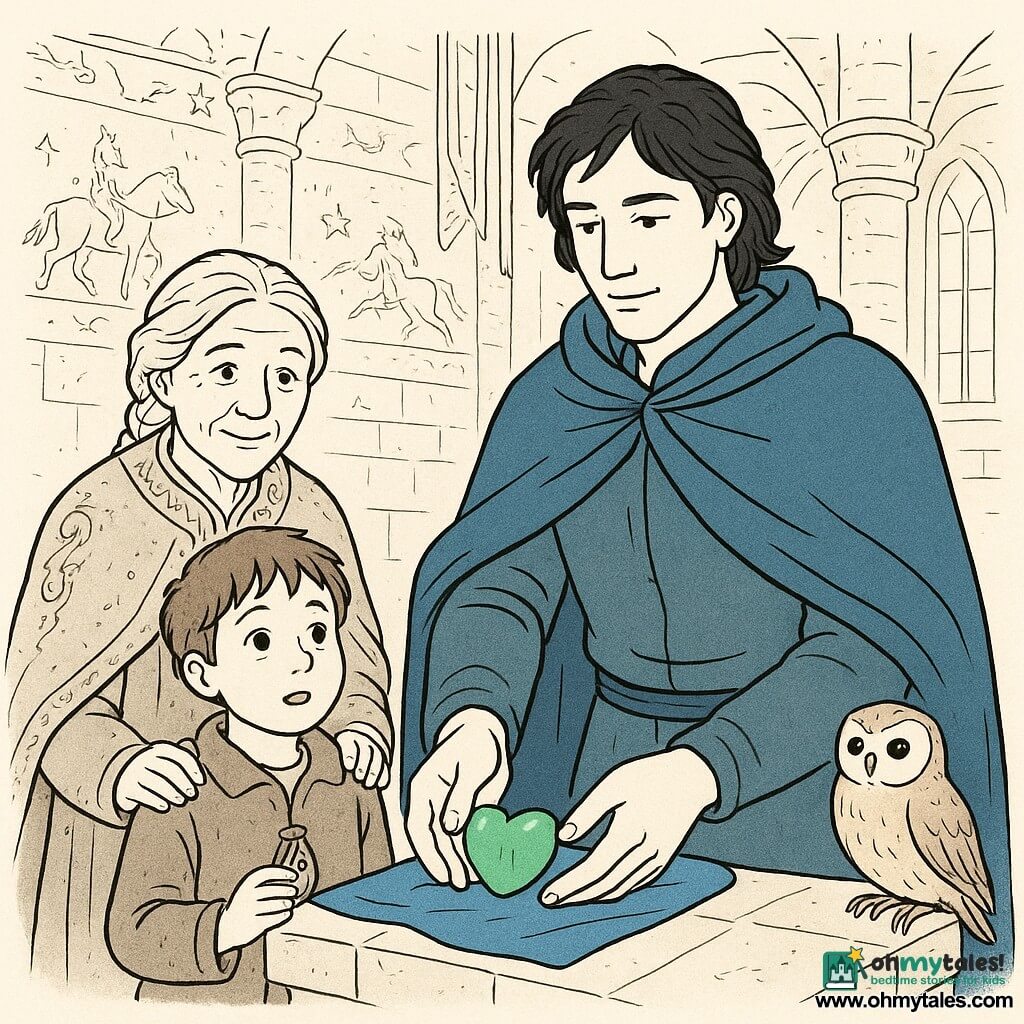
Arslan placed the jade Heart on a cloth of blue silk. The monks bowed. The Heart's glow spread across the silk, making it look like a piece of sky.
Another gentle twist appeared, not scary, but wondrous. The jade Heart pulsed once, like a heartbeat, and the carved swirls on it began to shine brighter. On the wall behind the altar, a painting that had been faded showed new color, as if someone had just brushed it with fresh paint. The painted riders, the painted stars, and the painted steppe all looked alive again.
The monks nodded, pleased. The Heart was happy to be home, safe in a place built for calm magic.
Arslan expected to leave right away, to return to the wide grass and the moving clouds. But the gray-haired woman from the caravan stepped forward with the child. She spoke softly to the monks, and they listened.
The child was not nameless after all. He was a lost helper from a small village, separated during a storm. The caravan had carried him, and now the temple would help find his family.
Arslan watched the child's face brighten like morning. The child bowed clumsily, then smiled so wide it seemed to lift the whole room.
Outside the temple, the wind stirred prayer ribbons. The sky was deep and clean. Arslan stood on the steps and breathed.
He had protected the sacred artifact, but he had also found something else: a reminder that strength can be gentle, and that help grows when people stand together.
As Arslan turned to go, a shadow crossed the ground. He looked up. The tiny owl circled once, then flew toward the open steppe, carrying a small green feather that glittered in the sun.
Arslan felt the future open like a road made of light. In that moment, he sensed destiny itself—quiet, watchful, and kind—leaning close.
And it felt, to Arslan, as if destiny was smiling.