Chapter I — The Forgotten Valley
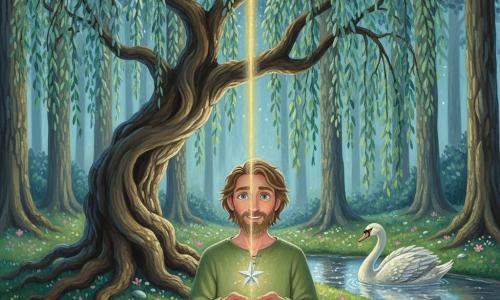
Long ago, where the map of men wore a dusty corner, there lay a valley wrapped in morning mist and silver ferns. Trees there kept secrets like old friends, and the river hummed soft lullabies as it moved over stones polished by time. In that valley lived a young man named Elias. He had eyes like warm bread and hands that remembered how to mend things. People in the valley called him Gentle Elias, because he spoke slowly and listened to the wind.
The valley was not empty. Little lights lived in the hollows of oak trees. Wisps, the spirits of the land, threaded through grasses like thin ribbons of sunrise. Deer with moonstone antlers nibbled at starlight, and hedgehogs wore tiny crowns of clover. Everything had its place, and everything was patient.
One evening, as the sky put on its deepest blue cloak, an elder willow bent her long branches toward Elias. “There is a crack in the Heart-Stone,” she whispered, her voice like leaves rubbing together. “It is an old crack. It makes a cold shadow drift over our dreams.”
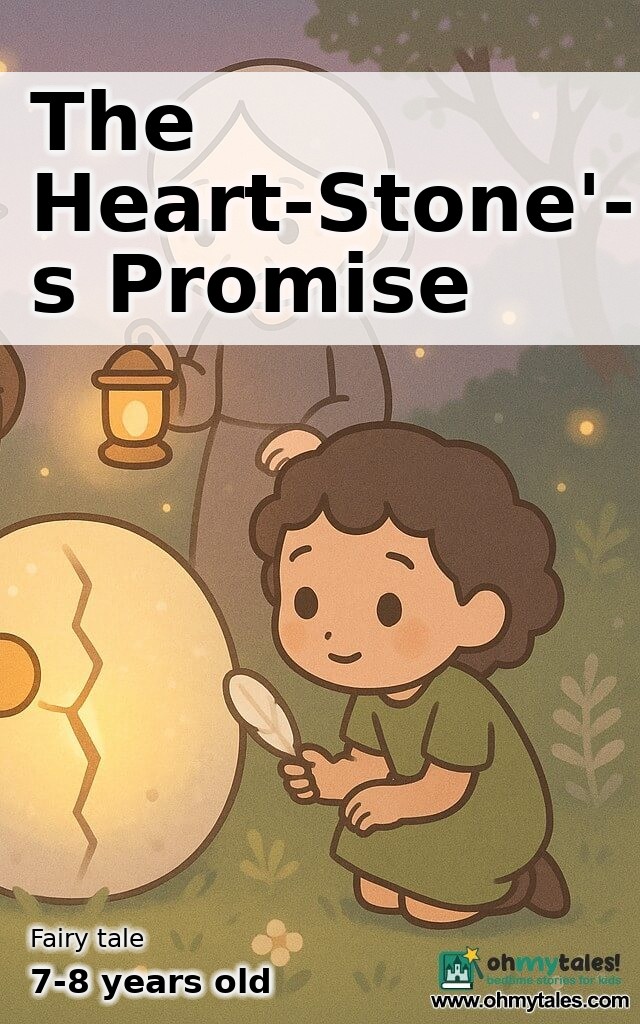
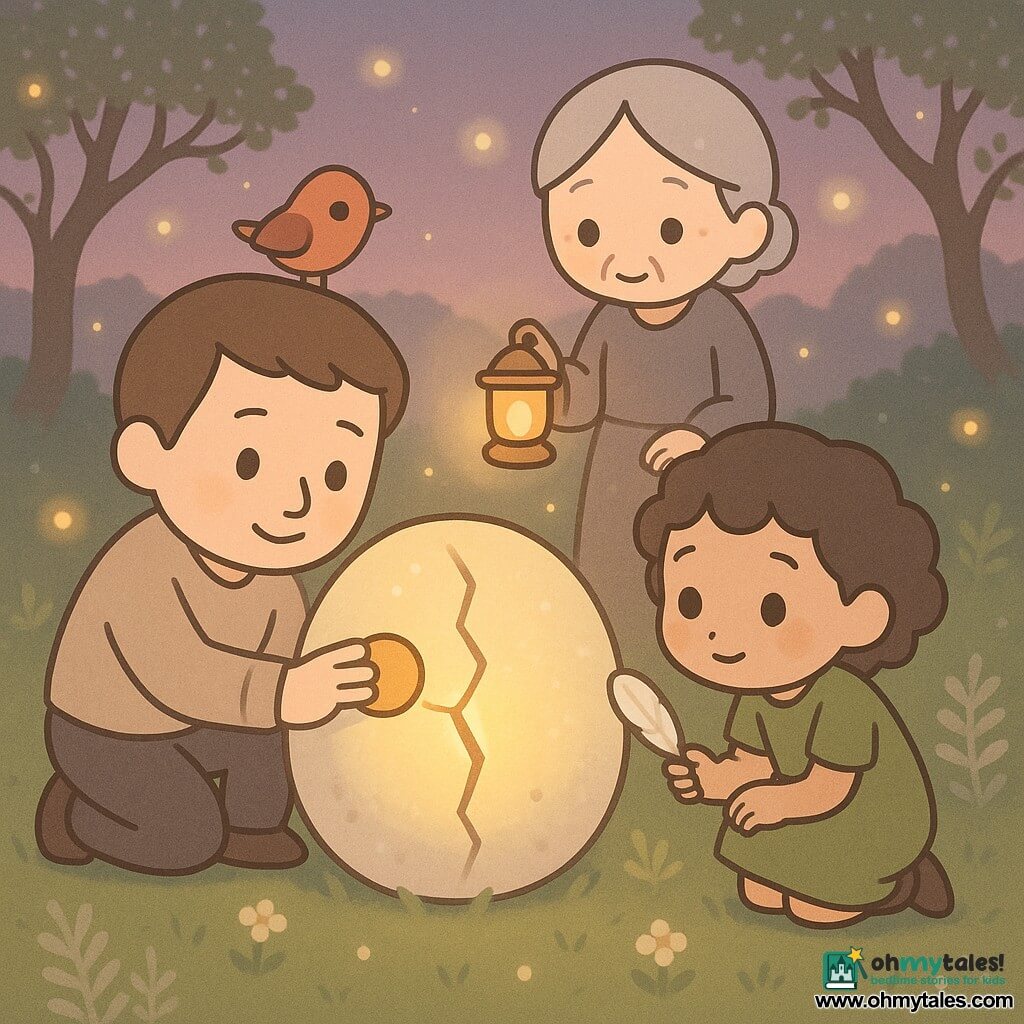
Elias had seen the Heart-Stone as a boy. It sat in the middle of the valley, a smooth, round rock the size of a cartwheel. It glowed with a small inner sun that warmed the grasses and sang to the nightbirds. But lately, its song had grown thin. A hairline fissure had opened across its face like a worried smile. When moonlight fell on it, the glow shivered.
“That crack was made long ago,” said an elder wren, fluttering to Elias's shoulder. “Some anger, some sorrow—some mistake—came to rest here. The light dims, and with it, our laughter.”
Elias placed his hand on the Heart-Stone. The crack tingled under his palm. He felt, like a child touching a sleeping cat, the faint tremor of something wounded. Inside him there rose a quiet answer: I will mend it.
“Will you teach me?” he asked the willow and the wren. “I do not know the old ways.”
“We will teach you,” the willow said, “if you will promise to be patient. Some threads are tangled and old. They need a gentle hand.”
Elias promised. The valley watched. Even the crooked mushrooms leaned forward as if they were listening.
Chapter II — The Lessons of Light
At dawn the next day, Elias woke to the sound of a bell made from frost. The valley had arranged itself into a school of small wonders. A fox with a patchwork tail taught him to listen to silence; the fox pressed his nose to Elias's ear and said, “Silence knows where the hurt began.” A spider with wings of glass showed him how to stitch thin lines of dew; “Stitches must be soft,” she hummed, “so the stone may breathe.”
The wisps circled Elias and lent him a strand of their glow. “Carry us,” they whispered. “Carry the light where it is needed.” Elias tied the glowing thread around his neck like a necklace and felt the warmth of a dozen dawns.
Days passed, each one a gentle lesson. When he asked how to fix something so old, the wind answered, “Undo the anger, sew the truth.” The river's music taught him patience by telling him the tale of a pebble that took a thousand years to become smooth. “Great things mend by small, steady ripples,” hummed the river.
Elias learned to listen with his whole body. He sat beside the Heart-Stone for hours and talked to it like he might talk to a shy child. He told the stone about the birds' new songs and the fox's clever tricks. He sang small songs; sometimes he hummed silly tunes so the stone would not feel alone. The valley answered. The trees leaned in. The glow in the stone breathed faintly.
One twilight, when the stars were tiny stitches in the sky, a ripple of shadow slithered across the meadow. It carried a coolness that smelled like old rain. “You cannot mend what you do not understand,” the shadow said in a voice that sounded like a closed door.
Elias did not flinch. He knelt and touched the shadow with a finger wrapped in wisp-glow. “Will you tell me why you are sad?” he asked.
The shadow sighed. “Long ago, someone closed their heart to our laughter. They took more than they gave. That wound sank into the stone. It grows cold when we forget our promises.”
Elias thought of the way people sometimes left the valley, forgetting to thank the trees for shade or the river for its songs. He thought of one small day when a cart had scraped against the stone and left the first crack. He remembered the cart-wheel's driver, frightened and in a hurry. The young man had wanted to do right, but the same hurry had closed his hand instead of opening it.
“I will mend it,” Elias said. The shadow made a small sound like the world catching its breath.
“You will need more than thread,” said the willow. “You will need to find the Three Gentle Things.”
Elias peered at the night. “What are they?”
“Patience like river-stone,” said the river. “A promise like spring, fresh and honest,” said the wren. “And a kindness that can be placed in the heart and kept there,” said the spider with wings of glass.
The wisps lit a path that led beyond the stone, past silver mushrooms and singing brambles, into the mossy woods where time liked to take naps. Elias put the wisp around his neck tighter and stepped forward.
Chapter III — The Three Gentle Things
The path first took Elias to a deep pool where a white heron stood like a statue with water for a mirror. The heron's eye held centuries. “You seek patience,” the bird said. “But patience is not waiting like a statue. It is moving like the river and resting like the leaf.”
Elias watched his reflection. He watched the heron fold and unfold its wings. He sat with the pool for a whole day and a whole night, letting the hours pass like soft, slow pages turning. He learned to watch clouds drift and to count the breaths of the trees. When he left, the heron touched his shoulder with its beak and left a small feather that would not blow away. “Patience is now a feather in your chest,” the heron whispered.
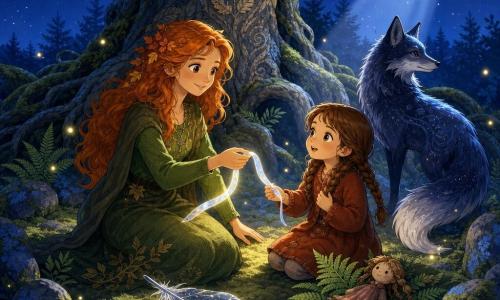
Next, the path wound to a garden braided with moonflowers. There, under a silver arch, an old woman with hair like spun moonlight tended a small lamp that never burned low. She welcomed Elias as though she had been expecting him since the world began. “A promise,” she said, “must glow even when feathers fall and when rain visits. It must be kept warm.”
Elias knelt and spoke aloud, “I promise to mend the Heart-Stone. I promise to remember the valley's songs.” The woman cupped his hands and placed the small lamp in them. The lamp felt like a summer's smile. “Carry it inside you,” she told him, “and let it not be blown out by hurry.” A light flickered in Elias's ribs, and for a moment he felt as if the promises he had made tied him softly to the world.
For the third gentle thing, the path grew steep and led Elias to a cavern where little crystals chimed when he breathed. There lived a child of the earth, a small one who could not speak in long words but who always gave a bloom of kindness. This child—the valley called her Liri—offered a pebble of heart-stone that was warm enough to hold. “Kindness,” she said with her hands, “is small and keeps warm the things it touches.”
Elias took the pebble. It fit into his palm like a sun that had just learned to be brave. He tucked the pebble into his pocket beside the feather and the lamp. The wisp-glow around his neck chimed like a bell. With the Three Gentle Things, Elias felt not bigger, but filled—like a jar that had been given honey.
On his way back, he spoke softly to the shadow that had warned him. “I have patience, a promise, and kindness,” he said.
The shadow looked at the trio in his pocket and, for the first time, a small smile loosened on its edges. “Then perhaps,” it whispered, “you can stitch what was torn.”
Chapter IV — Mending the Ancient Mistake
Elias returned to the Heart-Stone as the valley gathered like a cloak around the evening. The fox sat on a moss throne, the deer bowed their antlers low, and the wisps hummed with expectation. The crack on the Heart-Stone looked at him like a puzzled moon.
He placed the feather on the stone's surface. It lay down and breathed slowly. The lamp he held near the fissure and lit it with the soft promise he had made. Warmth seeped into the small lines of weakness. Then Elias opened his palm and placed the round pebble of kindness in the hairline gap. It fit as if it had been waiting there all along.
“Now speak,” said the willow.
Elias gathered the valley inside his chest and spoke simple, true words that did not rush. “I am sorry for hurry that breaks things. I promise to listen to the land and to the small voices. I promise to keep light in my pocket for others.”
The Heart-Stone shivered. Tiny lights—new stories—hopped from the pebble into the stone. The crack, which had been a pale line of worry, began to stitch itself with thin threads of moon-silk. The wisps leaned in to help. The feather's patience smoothed the edges, the lamp's promise breathed steadiness, and the pebble's kindness filled the hollow where cold had been. The shadow that had guarded the wound let out something like a sigh of rain and uncurled.
As the stitching finished, the Heart-Stone flared in a gentle burst of color: blues like deep sea-gloves, golds like warm bread, and greens like new leaves in spring. The valley exhaled. The sky let down a curtain of silver rain that tickled everything awake.
“Look,” gasped the river. “The songs are brighter.”
Birdsong rose like a treasure chest being opened. The fox barked a happy, ridiculous laugh. The deer pranced like bells. Even the mushrooms lifted their caps to applaud. The Heart-Stone hummed again, not with the thinness of a tired lamp, but with the strength of many small candles making a ballroom glow.
Elias sat beside the mended stone and felt the wisp-glow warm his belly like porridge. The shadow came to stand in the light's edge. It was not fierce now, only a cool friend that loved the night. “You have put back what was lost,” it said. “But remember, old cracks can return if hands hurry and hearts forget.”
Elias nodded. “I will watch,” he promised.
The willow tucked one of her leaves into Elias's hair as a crown. “You have the patience of rivers and the promise of lamps,” she said. “You carry kindness in your pocket.”
Chapter V — A Promise of Light
Days then rolled like soft apples. The valley sang and mended little things: a bird's wing that forgot a note, a brook that lost its skip, a hedgehog who could not find its crown. Elias walked among them, his hands ready, his heart like a warm lantern. Children from neighboring groves—rare visitors from the edges of maps—came to sit by the Heart-Stone and listen to its story. They traced the new stitches with careful fingers and promised, like Elias had, to remember.
One night, as fireflies did their slow, polite ballet, the elders of the valley gathered around the stone and asked Elias to place his hand upon it once more. He did, and the Heart-Stone's song hummed through him like a low, lovely bell. He heard the river's memory, the willow's counsel, the fox's jokes, the heron's patience, the woman's lamp, the earth child's kindness—the valley wrapped around him like a warm cloak.
“You have repaired more than the stone,” said the wren. “You have healed a promise between the land and its keepers.”
Elias thought of the driver of the cart who had once frightened the valley. He thought of hurried hands and small forgotten thank-yous. He thought of all the gentle things he had kept in his pocket. He bent and spoke, as if to a small, sleeping thing: “I promise to keep the light, and to teach others to keep it, too.”
The Heart-Stone shone as if pleased. The moon leaned down to listen. Stars put lanterns in their hands and sprinkled the valley with soft gold. The shadow stepped back into the hem of night and, with a voice like closed doors opening slowly, left a sentence like a gift: “Where there is light, shadows keep their shape and do not fear. Where there is kindness, worries find a home to soften.”
Elias smiled. “Then we will leave a light on the path,” he said. “For anyone who might lose their way, human or fae, so they can find the valley again.”
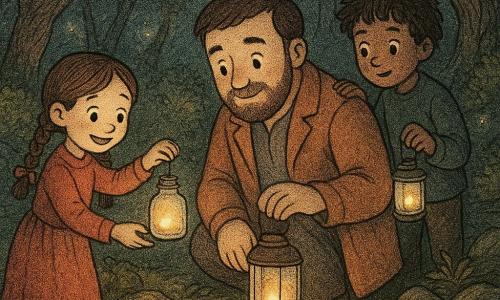
So they did. The valley made a little lantern house near the path's beginning. It glowed with the same gentle light that Elias wore around his neck. Travelers who slipped by maps and tide found their way to the soft place and sat upon its stones. They learned to say thank you to the willow and to listen for the river's old jokes. And the Heart-Stone kept singing.
Years passed like kind pages. Elias grew, not old as trees are old, but full like the river when it runs widest. Children grew with him, and some of them became gentle menders too. Whenever a small crack appeared—because life, like stone, sometimes remembers its old grooves—someone would take a feather, a lamp, and a pebble and do as Elias had done: sit, listen, promise, and place kindness where it was needed.
One morning, as the sun lifted a new shawl of gold, Elias sat with his hands folded on his knees. He felt the wisp-glow dim to a soft ember and then, as if it were pleased, it went on living inside those who came after. He looked to the Heart-Stone and said, softly, “We will keep the light.”
The Heart-Stone answered in a way that only a stone full of songs and stitches can answer: it shivered with a glow that felt like a smile. The valley promised back, and the promise shone like a small, steady star.
And so, in a place forgotten by maps but remembered by hearts, the mistake that had once opened a crack was gently mended. The lesson lived in children and elders and in the small lights that darted in the trees: that patience, honest promises, and kindness could stitch what hurry had torn. The valley kept its wonders and offered a path for those who needed warmth. Its last gift was simple and true: a promise of light, kept safe in gentle hands and given freely to anyone who would carry it with care.