Chapter I — The Quiet Sand
Beneath a sky like warmed honey, the desert of gold and rubies shimmered as if it breathed. Sands of glittering ochre rolled in gentle waves, and here and there red stones winked like tiny hearts buried in the dunes. Caravans moved across that shining sea like slow, patient whales, their lanterns bobbing like distant stars.
In a small caravan, under a tent stitched with moonlight, lived a young man named Amir. He was quiet as a folded letter and careful as a gardener pruning a living poem. People saw his plain robe and thought him simple; children liked to sit by his feet and whisper riddles to him. He carried no sword, only a satchel of plain bread and a small, silver compass that did not always point north. When asked about that compass, Amir would smile and say, "It points where the heart must go."
One evening, as a caravan bell chimed a slow note, an elder named Laila pressed her wrinkled hand to Amir's. "There is a hush in the dunes," she said. "Something tilts the balance of the caravan trails. Merchants quarrel. Little jars of pearl-sugar vanish. Justice, like a soft cloak, is slipping away."
Amir's eyes, which held the calm of deep water, grew bright. "Then I will walk," he said. "I will mend what is fraying."
"Ah," Laila chuckled, "you are too gentle for quarrels."
"But gentleness can be strong," Amir answered. "It is the oak that opens its arms to shelter the sparrow."
Before the caravan left at dawn, Amir kissed the elder's palm and slipped out with his compass. The desert welcomed him with a hush like a lullaby. The sand around his feet sang faintly, as if remembering old tales of justice.
Chapter II — The Caravan of Mirrors
On the second night he reached a trading crossroads, where paths of crushed ruby met lanes of gold dust. There he found a caravan wrapped in mirrors that made the moon feel shy. The Mirror-Caravan traded laughter and secrets; its leader, Merchant Razan, was known for fine silks and a tongue like polished stone.
"Why do you look so grave, young traveler?" Razan asked, peering into Amir's face. A thousand reflections of Razan winked at Amir from his caravan's mirrored walls.
"Because justice here is forgetting its name," Amir replied. "Small wrongs gather like sand, and soon storms will bury the truth."
Razan laughed, but his laugh had a rim of worry. "Truth pays in thin coins. Do not get lost in dreaming."
Amir stayed the night with the mirror folk. In the morning, as they packed, a child cried. Her little box of painted buttons had vanished, and the caravan accused a passing baker, who swore he was innocent. Voices rose like hot wind. Razan was about to decree a punishment when Amir stepped forward.
"Let us not punish by shadow," Amir said quietly. "Let the mirrors tell the tale."
He set the silver compass upon the ground and laid his hand on it. The mirrors around them shivered and, for a breath, became not glass but clear water. In those reflected pools the truth unrolled like a ribbon: the child's box lay behind a cloth near the camel's feet. The baker's pockets were empty.
"See?" Amir said. "Look where the heart points."
Razan motioned for the child to fetch her box. When she found it, her face bloomed like desert-flower after rain. But Razan's smile softened further into a shade of shame.
"Who moved it?" he asked.
A small merchant, cheeks flushed with heat and greed, confessed. He had thought the child's buttons would fetch a bright tale elsewhere. He came forward trembling. "I am sorry," he said. "I forgot the worth of others."
Amir placed a steady hand on the man's shoulder. "Then make it right," he said. "Return with an open heart."
The shameful merchant replaced the buttons and added a ribbon and two sweets as apology. The mirrors reflected this and, for a moment, glowed with a warm red like embers. Razan, with newfound softness, declared no stones would be thrown, only wisdom shared.
"Justice need not be a gavel," he said. "It can be a lesson, wrapped in kindness."
As Amir left the caravan, the mirrored walls hummed a little tune of thanks. The compass in his satchel pointed south-west, toward a trail where the rubies shone like blood-orange lamps.
Chapter III — The Silent Oasis
Under the sun's gentle thumb, Amir walked toward an oasis that travelers spoke of in hush. It was a place where palms whispered poems and the water held the sky like a promise. There he met a small band of mystic caravan folk who sang to their camels and braided light into their tents.
But beneath the oasis' cool shade, a shadow had crept like spilled ink. The well's water tasted less sweet; a group of villagers claimed a young shepherd's flock had been led astray by a cunning trader with velvet boots. The shepherd, named Yasin, stood with eyes like wet stones, accused of trickery he did not know.
"People point fingers," Yasin said, hands empty. "But I only pointed my finger at the sky and watched my sheep. They wandered—perhaps by a gap in the fence."
"They say you stole," murmured an old woman, and the old woman's voice trembled like a tiny bell.
Amir sat on a sun-baked rock and listened. The caravan people argued, voices stacking like bricks. Finally Amir rose and walked to the well. He placed his palm upon the water and said softly, "Water remembers."
The water shivered and, to the wonder of all, images rose in its surface like minnows. They showed a fox with a ribbon of moonlight in its fur meandering through the sheep, nudging them toward a broken gate. Then the image shifted: a trader with velvet boots had scooped a handful of the shepherd's barley and laid it out near the path, knowing foxes follow grain.
"See," Amir whispered. "The thief is the temptation, not the shepherd."
The trader, who had been bargaining loudly at the oasis edge, flushed. "I meant no great harm," he said. "The barley was for show, to lure customers. I did not think of foxes or fences."
Amir's gaze was kind and steady. "When you think of numbers and trade, remember the small lives that live beneath the tents and trees. A small wrong is a net that ties many feet."
The trader knelt, picking up the grains like seeds of regret, and helped mend the fence. He learned to carry his trade with care, scattering his fame with responsibility. The shepherd's name cleared like sky after a storm. Yasin wept not from sorrow but from relief and gratitude. "Who are you?" he asked Amir.
"Just a traveler with a compass that listens," Amir replied. "And a friend now."
That night the oasis glowed with a soft laughter. The caravan sang, and the palms swayed like a chorus. Children crowded around Amir to hear his stories of mirrors and wandering foxes, and he told them in a voice that was ribbon and bell. The compass in his satchel felt warm, as if the desert favored his quiet hands.
Chapter IV — The Hearth of Justice
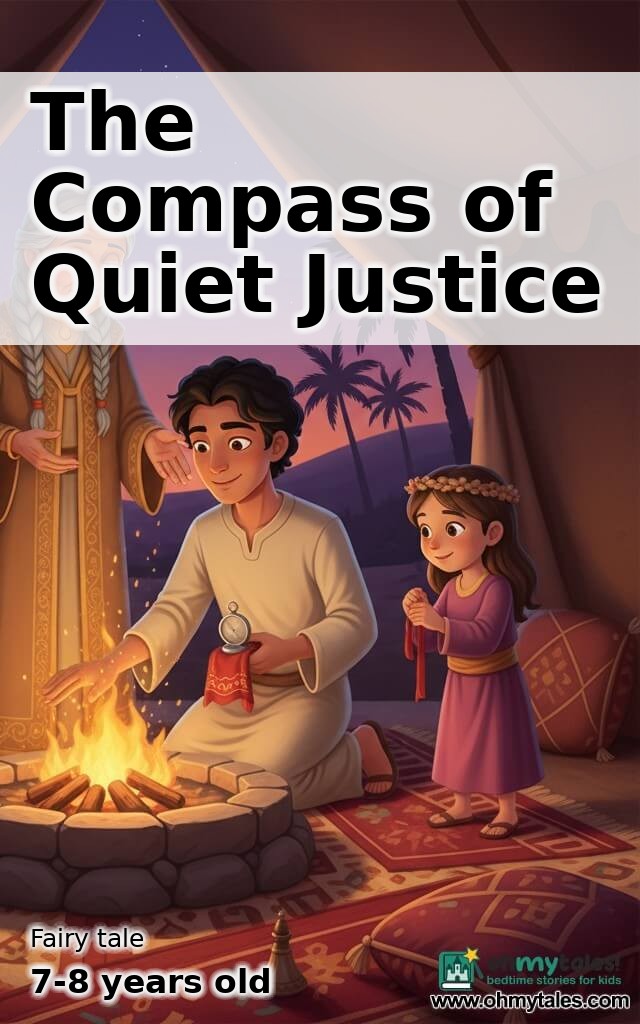
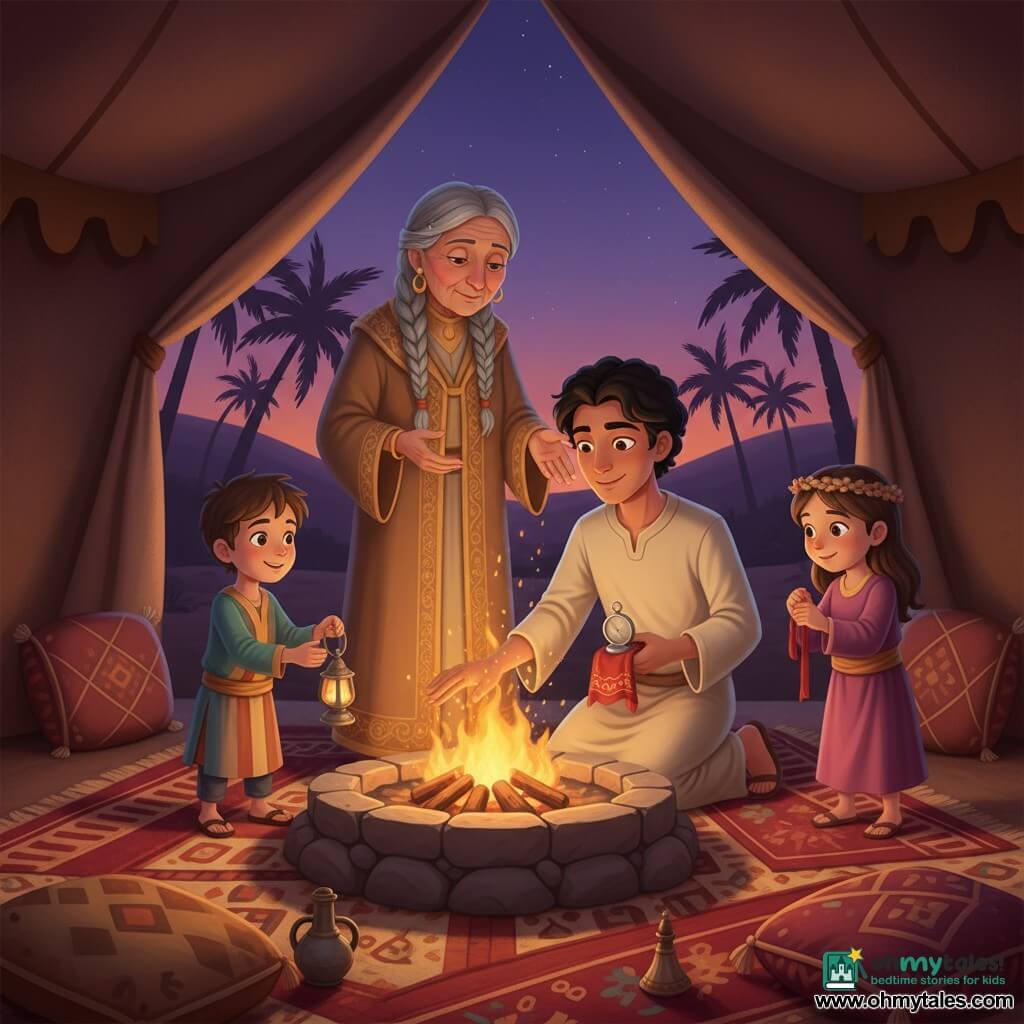
News of Amir's gentle mending wandered on the wind like a sparrow's song, until it reached the farthest caravan — the oldest of all, with rugs sewn from stories and a leader named Nasim, who kept the ledger of fairness. Nasim was a woman whose eyes carried a century of winters. She invited Amir to her camp, and there, beneath a tent stitched with starlight, she presented a problem that made even Amir pause.
"Our caravans have begun to drift from truth," Nasim said. "Long ago we had a Hearth—a ring of flame set in the center of our gatherings. Each traveler touched that hearth and promised to keep promises. But the Hearth has gone cold, and promises have thinned."
Amir touched the ledge of the cold hearth. It was dull, like a moon that had lost memory of its rounds. "How did it go cold?" he asked.
"A long silence," Nasim replied. "We argued over trinkets of wealth instead of listening. We traded favors that folded into crumbs. The Hearth remembers only fire made from honest hands."
Amir sat and thought. He remembered the mirror caravan, the shepherd, and all the small rightings. He stood and said, "Then we will light it again. But first, we must mend what frays."
"Who will teach us to be true?" someone asked.
"You will," Amir said softly. "Each of you carries a small light. Bring them to the Hearth."
From their pockets, traders drew tiny lamps, beads, and whispered vows. A child gave his toy candle. A merchant offered a ribbon he no longer wanted. The trader who had lured the fox brought a handful of barley as a promise to feed, not trick.
Amir placed the compass at the hearth's edge and, with a gentle touch, poured from his satchel a pinch of golden sand mixed with the rubied dust he'd gathered on his way. "This sand remembers the steps of honest feet," he murmured. "It will hold the warmth."
One by one, each person touched the hearth and spoke a small truth aloud: "I will return what I borrow," "I will speak kindly," "I will keep my promises." The words were not grand, but they were honest as a child's hand. As each vow was made, the hearth breathed and glowed. The light grew steady, like a heartbeat.
When it was Amir's turn, he put his hand in the fire not to hurt, but as a gentle bridge. "I promise to carry truth not as burden but as song," he said. The compass shuddered and pointed, then spun soft as a lullaby. The hearth shivered into life and spread warmth that felt like a mother's shawl. It cast a light that made every heart look more kindly at its neighbor.
Nasim smiled until her crow's-feet crinkled into stars. "You have taught us what we forgot," she said. "Justice is not only rules, but the warmth that keeps promises living."
Amir shook his head. "No. We did it together. The Hearth is a mirror of our choices."
As the caravans prepared to leave, people visited Amir to say thanks. He received no reward but the quiet satisfaction that fit like a new glove. Children pressed small gifts into his hands: a painted pebble, a feather, the tiny bell from a camel. He tucked them into his satchel, not as payment but as memories of the goodness he'd seen.
Before dawn, Nasim pulled Amir aside and gave him a small cloth embroidered with a ruby-thread sun. "When the road grows lonely," she said, "wrap this around your compass. Remember the Hearth."
Amir bowed, feeling his heart full of a light that was gentle and strong.
The compass now pointed homeward, but it did not guide toward a place. It guided toward a task: to keep tending the small wrongs, to stitch kindness into the caravan trails, and to remind the world that promises, like seeds, need careful tending.
Months passed, and tales of Amir's quiet justice traveled like starlight. He never sought praise; songs found him as bees find flowers. In each caravan, children pulled him aside to ask, "What is the bravest thing?"
"To do small right things when no one watches," he would answer.
The world changed, not with thunder but with the soft work of giving back lost buttons, mending fences, and speaking apologies aloud. The desert itself seemed lighter. Nights smelled sweeter, and the rubies in the earth shone like laughter.
One evening, as the caravans gathered around the Hearth, Nasim leaned close and whispered, "Love is the greatest justice, Amir. It heals where rules cannot."
Amir looked around: old men rocking, merchants trading honest smiles, children weaving crowns of desert grass. He felt a warmth in his chest that was both bright and quiet.
"I have learned," he said simply, "that pure intentions are like lanterns. They do not glare, but they show the path so others can follow."
As the final ember of the night rose, the caravans set their lamps to float on the desert breeze. Each lamp carried a wish: honesty, kindness, the mending of small wrongs. They drifted like a flock of glowing birds toward the horizon. Among them rose one lamp that burned a steadier, softer light—the lamp Amir let go, its flame shaped not as a boast but as a promise.
The desert swallowed those lights gently, and in return it offered dew at dawn and rubies that seemed to sing. Amir walked on, his compass warm against his palm and the little cloth wrapped around it. He met faces that needed justice sewn back like loose hem, and he mended them with words, with actions, with love.
Once, long after, when children asked about the quiet man who had walked the dunes, their elders would smile and say, "He learned to be brave not with a sword but with a heart that kept its promises." And in every caravan the little lamps burned a bit steadier, for the Hearth had been rekindled, and love had become its flame.