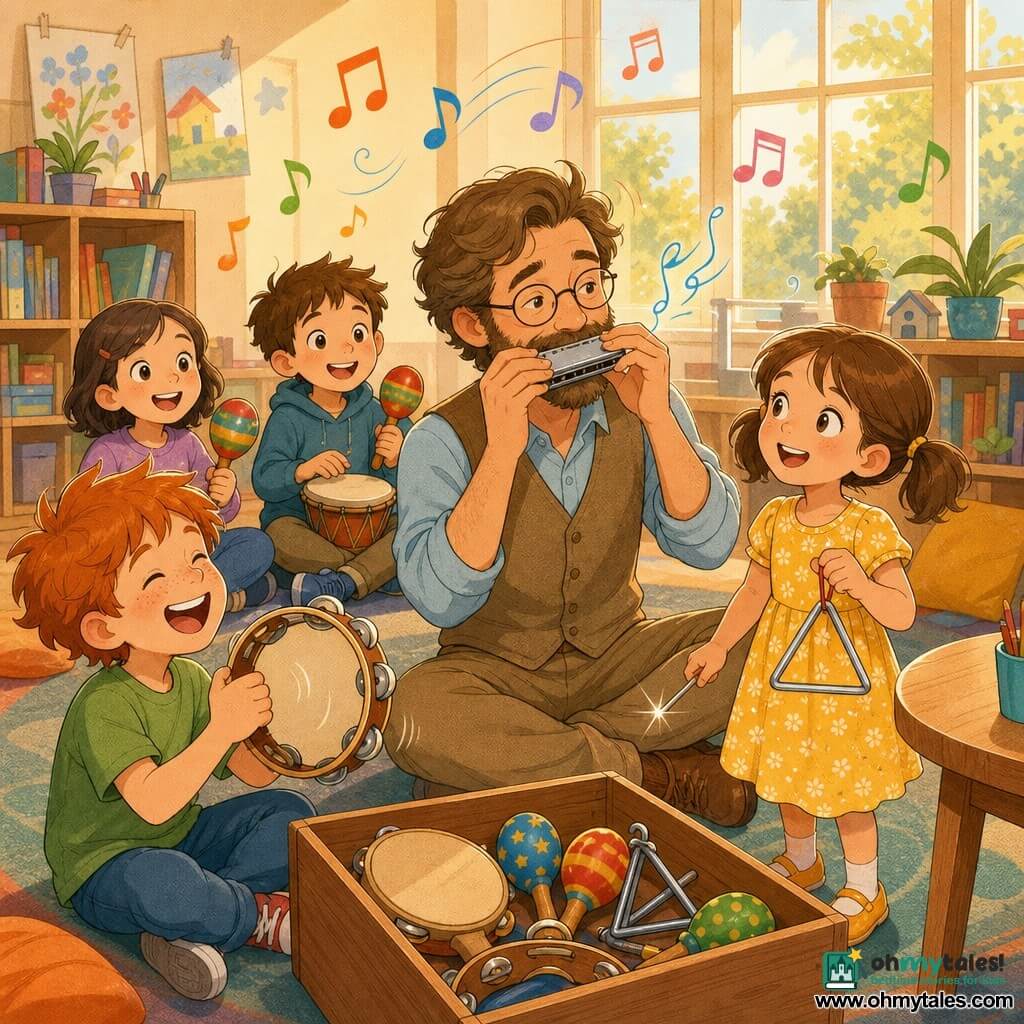
Chapter 1: The Harmonica in the Backpack
In a small, sunlit town, there was a musician named Mr. Eliot. Mr. Eliot was tall, with gentle brown eyes and a beard that always seemed to smile along with him. Every morning, before he left his cozy house, he slipped his shiny silver harmonica into the pocket of his backpack. The harmonica was his favorite instrument—small enough to carry everywhere, but big enough to fill a whole room with music.
Monday was Mr. Eliot's favorite day of the week. That was the day he visited the after-school club at Maple Grove Primary, a place buzzing with laughter and ideas. The children there knew him as “Mr. E,” and they loved how his songs made their imaginations dance.
As he walked down the street, Mr. Eliot hummed a cheerful tune. He thought about all the music waiting to be made. The wind played with the leaves, and he imagined them swirling like notes on a page. By the time he reached the school, he was whistling, his feet tapping a secret rhythm on the sidewalk.
Inside the after-school club, children were building with blocks, drawing colorful pictures, and reading books. At a round table near the window, he saw his friend Mia, who always asked the best questions.
“Hi, Mr. E!” Mia called, waving.
“Hello, Mia! I hope you're ready for some music today,” Mr. Eliot replied, setting down his backpack.
The other children gathered around as Mr. Eliot gently took out his harmonica. It gleamed in the afternoon sun, and everyone leaned in closer.
“What's it like to be a musician?” asked Tom, his eyes wide.
Mr. Eliot smiled. “Being a musician is like being a painter, but instead of colors, you use sounds. Sometimes you play alone, and sometimes you make music with others. Every day is a chance to share a new song.”
He lifted the harmonica to his lips and played a sweet, twinkling melody. The notes floated around the room, light and ticklish, making even the shyest children giggle. The music felt like bubbles rising in lemonade—bright, fizzy, and full of smiles.
Chapter 2: The Afternoon Melody
After his little concert, Mr. Eliot asked, “Would you like to learn about my harmonica?”
“Yes!” everyone cheered.
He passed the harmonica around carefully, so each child could hold it and feel the smooth metal, cool and shiny. “This instrument is small, but when you breathe in and out through these holes, it can sound like a train, a bird, or even the wind,” he explained.
Mia tried blowing gently into the harmonica. A soft note came out, a bit wobbly, but she grinned. “It tingles my lips!” she laughed.
“That's the magic of music,” Mr. Eliot said. “It tickles you from the inside out.”
The children took turns, each one making a different sound. Some notes were high and squeaky, others low and rumbly. Together, they made a patchwork of funny noises that made everyone laugh.
Then Mr. Eliot asked, “Who wants to help me write a song?”
“I do!” called Tom, and soon all the hands shot up.
Mr. Eliot took out a notebook. “Let's think of something we love about our school.”
“The garden!” said Mia.
“Snack time!” giggled Alex.
“The rainbow mural in the hallway,” added Lucy.
Mr. Eliot wrote down their ideas. “Now, let's turn these into a song. Musicians often turn their feelings and memories into music. Would you like to try?”
He played a gentle tune on the harmonica while the children sang about the garden's flowers, crunchy apples at snack, and bright colors in the hallway. Their voices blended together, soft and happy.
Chapter 3: The Band of Friends
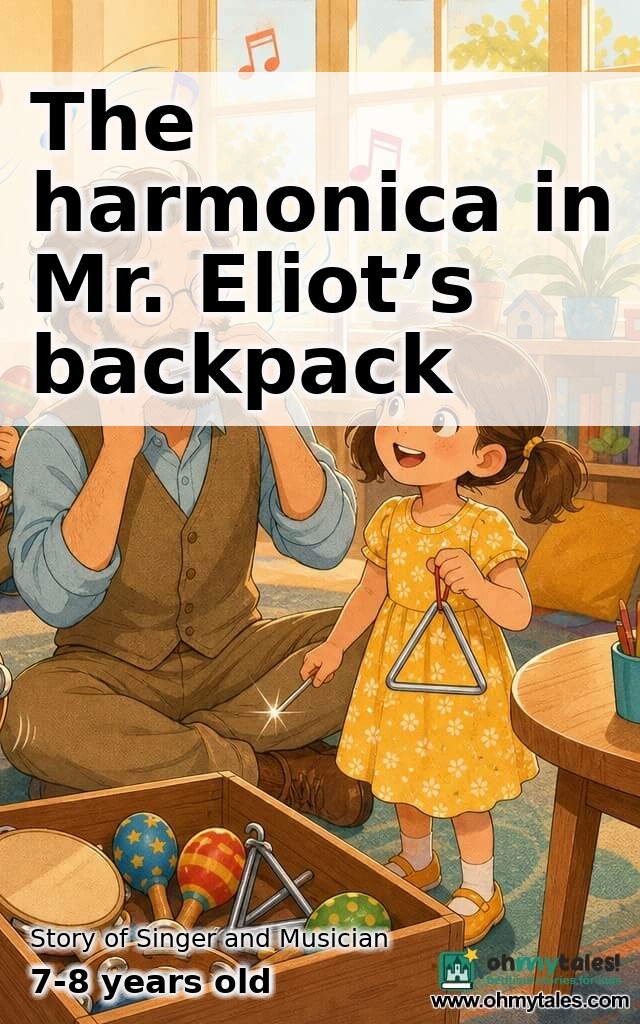
After the song, Mr. Eliot opened a big wooden box and revealed a collection of simple instruments: triangles, tambourines, maracas, and little drums. “Let's make a band!” he suggested.
The children's eyes sparkled. They chose their instruments—Mia picked a triangle, Tom grabbed a tambourine, and Alex shook a maraca. Mr. Eliot tapped his harmonica gently, making a silvery chime.
“Every musician is important,” he explained. “No matter how big or small your instrument is, you make the song special.”
They practiced together, each one playing their part. Sometimes they were a little out of time, and sometimes the music was loud and silly, but they always ended up laughing. Mr. Eliot guided them, showing how to listen to each other and play together, like a team.
“Let's try our school song again, but this time, with our band,” he suggested.
The children nodded eagerly. Mr. Eliot counted, “One, two, three, four!” and they all played. The harmonica led the way, bright and cheerful, while the triangles tinkled like tiny bells. The tambourine jingled, the maracas rattled, and the drums thumped softly.
Their music filled the room, echoing down the hallways. Even the teachers smiled as they passed by, tapping their feet to the beat.
Chapter 4: The Little Performance
Later that afternoon, Ms. Green, the club leader, peeked into the music room. “That sounds wonderful! Would you like to perform for everyone before home time?”
The children looked at each other, a bit nervous but excited too.
Mr. Eliot knelt down to their level. “Being a musician is not just about playing perfectly. It's about sharing joy, even if you make mistakes. Are you proud of what you've made?”
“Yes!” said Mia, her eyes shining.
“Then let's share it,” Mr. Eliot encouraged.
They set up a small ‘stage' at the front of the room. Parents and teachers gathered, smiling and chatting softly. Mr. Eliot introduced the band, making sure to mention everyone by name.
He looked at his young band and whispered, “Remember, music is a gift you give to others. Just play from the heart.”
He started with a gentle harmonica melody, and the children joined in. The triangles chimed, tambourines jingled, and maracas rustled. Their school song floated through the air, warm and bright as sunlight. Even the shyest children played their instruments, proud and happy to be part of the music.
When the last note faded, the room filled with applause. The children grinned, cheeks glowing with pride.
Chapter 5: The Final Tinkle
After the performance, the children surrounded Mr. Eliot. “Will you come back next week?” asked Tom.
“Of course,” Mr. Eliot said. “There are so many more songs to write, and music to make.”
Mia gave him a triangle. “Can you play the last note?”
Mr. Eliot smiled, holding the triangle gently. He raised the little metal beater and tapped the triangle. It sang a clear, sparkling note, like a tiny star at bedtime.
He looked at all the children and said softly, “Remember, you can make music anywhere—with your voice, your hands, or even just by listening.”
The children nodded, their hearts full of music and simple pride. As parents arrived to take them home, the room was still tingling with laughter and song. Mr. Eliot packed away his harmonica, his spirit as light as a melody drifting into the night.
And as the sun set, the last sound in the school was the gentle tinkle of triangles—sweet, bright, and full of dreams.