Backstage Breath
Mira sat on a wooden stool behind the blue curtain. Her soft dress rustled like a calm river. In her lap lay a small notebook of songs and a bright guitar with a sleeping strap. She smiled and placed her hand on her chest.
She breathed in slowly, feeling the air travel down past her shoulders, past her ribs, all the way to a quiet place inside. She whispered to herself, "In, like filling a balloon. Out, like a bird letting go." Then, just before stepping onto the stage, she breathed in again—deep and steady. It was her tiny, secret ritual.
Around her, lights hummed. People moved quietly. The stage felt like a garden waiting for seeds—seeds of song. Mira looked at the pencil marks on her music sheet, each one a small friend reminding her of a soft note, a warm pause, a kind silence.
"Are you ready, Mira?" asked Tomas, her friend who would play the piano tonight.
Mira nodded. "Yes. I breathe. I listen. I play."
"Good," he said. "Your breath is like a metronome you carry inside."
Mira laughed. "My metronome wears a smile."
She stepped out, the curtain parting like two open hands. The lights washed over her face, gentle and golden. The audience was a sea of calm faces. Some people were whispering. Others twinkled with quiet excitement. Mira placed her fingers on the strings and breathed in once more before she sang. The first note landed softly, like a pebble in a pond. Ripples of sound moved outward.
The Little Concert
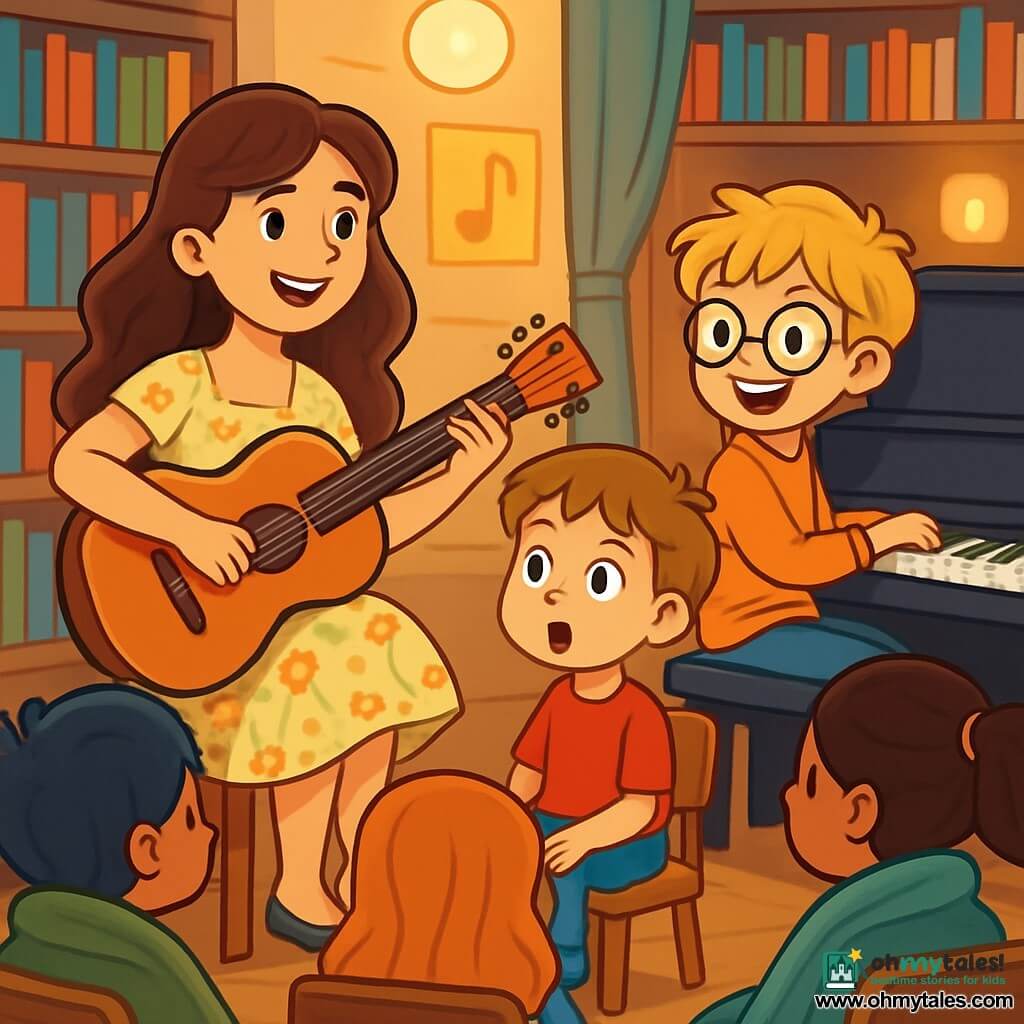
This was not the largest stage in the world. It was a little hall in the town library, where the seats folded like paper boats and the night smelled of books and lemon tea. Children wrapped in blankets sat in the front row. An old man with a white beard clapped his hands like slow thunder. A little girl named Noor hugged a stuffed rabbit.
Mira began with a gentle lullaby. She used her voice like a paintbrush, coloring the room with warm orange notes and cool blue hums. Between songs she told short stories about wind chimes and moonlight. After each entrance, she breathed. The breath helped her find the first step on the musical staircase.
"How do you always sound so calm?" whispered Noor when Mira knelt to tune her guitar between songs.
Mira smiled and showed Noor where she put her hand when she breathed. "I fill my belly first. Then I listen—inside and outside. Your breath is a little boat. Let it float."
Noor tried it. She breathed like Mira and made a tiny sound like a bell. The bell joined Mira's music like a friendly bird.
The songs were simple. Mira taught the room about listening by making the music change when it heard. Once, Tomas played a soft riff on the piano. Mira closed her eyes and let her voice follow him, little bird to tree. When the piano grew louder, she leaned her melody to it. When it quieted, she let her voice hum like a moth near a lamp. The whole hall felt as if it were breathing with them.
Between songs, Mira told about practicing. "Practice is like planting seeds," she said. "Each time, you water the seed with your breath. Over time, a seed grows into a sound you can hold in your hands."
A boy in the audience raised his hand. "Do you always hit the right notes?" he asked, with the frankness children are good at.
Mira thought. "Sometimes I miss a step," she admitted. "But missing teaches me more than being perfect. It shows me where to listen more carefully. If I tune my ears, I find the note again."
She sang a song about a rainy day where a drummer made puddles and a violin played the rainbow. The children hummed. The old man tapped his foot like a small drum. The room filled with listening.
The Listening Game
After the third song, Mira invited everyone to play a listening game. She loved little games because they turned learning into light.
"Close your eyes," she whispered. "Now listen. What do you hear?"
The hall grew a little softer. Paper pages breathed. A heater clicked like a small tree stretching. In the distance, a car hummed as if it were a sleeping whale. A child sighed like a tiny trumpet. Each sound was a gift.
"Now," Mira said, "I will play a note, and you tell me what color it is. Ready?"
She plucked a string. High and clear, the note shone silver. Hands shot up. "Blue!" called one voice. "Like the moon," said another. Mira smiled. "Yes. Sound can be colors when you listen."
Next, the piano played a warm, round chord. "Orange!" said a little boy. "Like toast," said a girl. They laughed. Tomas winked at Mira. It was like listening to a garden where each plant wore sound instead of leaves.
Then Mira taught them about echoes and silence. She sang a line and asked the children to sing it back softly. Each child returned the line not as a copy but like a tiny echo wearing their own voice. Some echoes were high; some were thick like honey. The music changed with each echo. Mira explained, "We listen to each other to make the music grow. When you listen, you give the next person a place to stand."
A mother in the back stood and said, "I didn't know listening could be so loud."
Mira laughed quietly. "Listening is loud when you pay attention with your whole body. Ears, heart, toes—everything listens."
She also taught about caring for a voice and an instrument in a simple, gentle way. "Warm your voice like you warm your hands," she said. "Hums, little sirens, or slow slides. Water helps voices feel tidy. And instruments like a song to be cleaned and loved."
Noor raised a hand. "Does the guitar feel the love?" she asked.
"It does," Mira said with a smile. "Strings remember who treats them kindly."
The children listened to the guitar again. This time the strings sounded like they were smiling.
A Night of Gentle Sounds
The last part of the evening was a quiet one. Mira chose songs that sounded like soft blankets. The lights dimmed like sleepy fireflies. The audience wrapped themselves in the music.
Before singing each song, Mira inhaled, small and deep. She pictured the breath as a tiny lantern that lit only the very next note. The lantern kept her steady. Around her, the band—Tomas on piano, a small drummer named Leila with brushes, and a flutist named Omar—also breathed. They were a team of quiet gardeners growing a park of sound.
During one lullaby, a boy in the back started to hiccup. In the past, that might have made Mira hurry or lose the thread. But tonight she simply smiled and turned the hiccup into a rhythm. She sang with the hiccup, and soon it felt like a small drum that made the song even friendlier.
After the last song, the hall was very still. No loud cheer burst out. Instead, soft clapping, like rain on a windowpane. Faces shone. Some children were asleep with their heads leaning on parents. Noor held her rabbit and did not want to breathe too loudly.
Mira walked off the stage and sat on the same wooden stool. She breathed deep once, then again. Tomas sat next to her and handed her a warm cup of tea.
"Did you hear the boy's hiccup?" Tomas asked.
"I heard him," Mira said. "And I listened. He became part of the music."
From the doorway, the librarian came forward. "You taught them to listen," she said. "How do you do that?"
Mira looked at the sleeping children and at the warm faces. "Music is a mirror," she said softly. "When we sing, we show people how to listen to tiny things—the creak of a chair, the breath after a note, a child's hiccup. When we listen, we learn to care about those small things. That's a music lesson and a life lesson."
Tomas nodded. "And your breath," he added. "You always breathe before you start."
Mira touched the scar on her thumb where an old string had left a mark. "My breath tells me where to place my feet," she said. "It tells me how to hold the note so it keeps its color. It's how I hear the room. It's how I hear myself."
As they packed up, a little boy approached with an envelope. "This is for your songs," he said, placing a crayon drawing inside. It showed Mira on stage with a big moon smiling above her. She looked surprised and very pleased.
"Thank you," she said. "I will keep this near my music."
When Mira walked home under a sky scattered with stars, she hummed a tiny tune. Night air brushed her face like cool silk. She breathed in and felt grateful. She thought about how music can make ears kinder and nights gentler. She thought about how each breath before an entrance was like a promise—to listen, to be present, to share.
At home she put her guitar on a hook and gave it one more small strum. The note lingered like a memory. She wrote in her notebook, folding the little drawing inside: "Practice, breathe, listen. Share a sound. Help others listen."
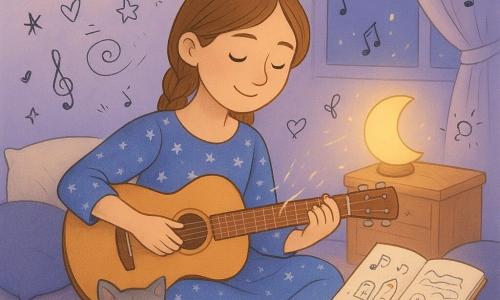
Mira climbed into bed and thought of the children's faces. She pictured Noor trying the belly breath and the boy's hiccup turned drum. She smiled and breathed in slowly, imagining her breath as a soft lantern. Then she breathed out and let the night keep her company.
The last sound in the house was the quiet of someone who had listened well. Outside, the trees hummed low and the moon hummed back. Mira drifted into sleep like a note that had finally found its rest, carrying a tiny song for tomorrow.
The next day, she knew she would wake and warm her voice again, breathe deep, and go out to make more music. She would teach more children the listening game. She would remind people that music is not only about singing loudly but about hearing softly. And each time she stepped onto a stage, she would take her breath like a little lantern, lighting the very first sound she would share.