Chapter 1
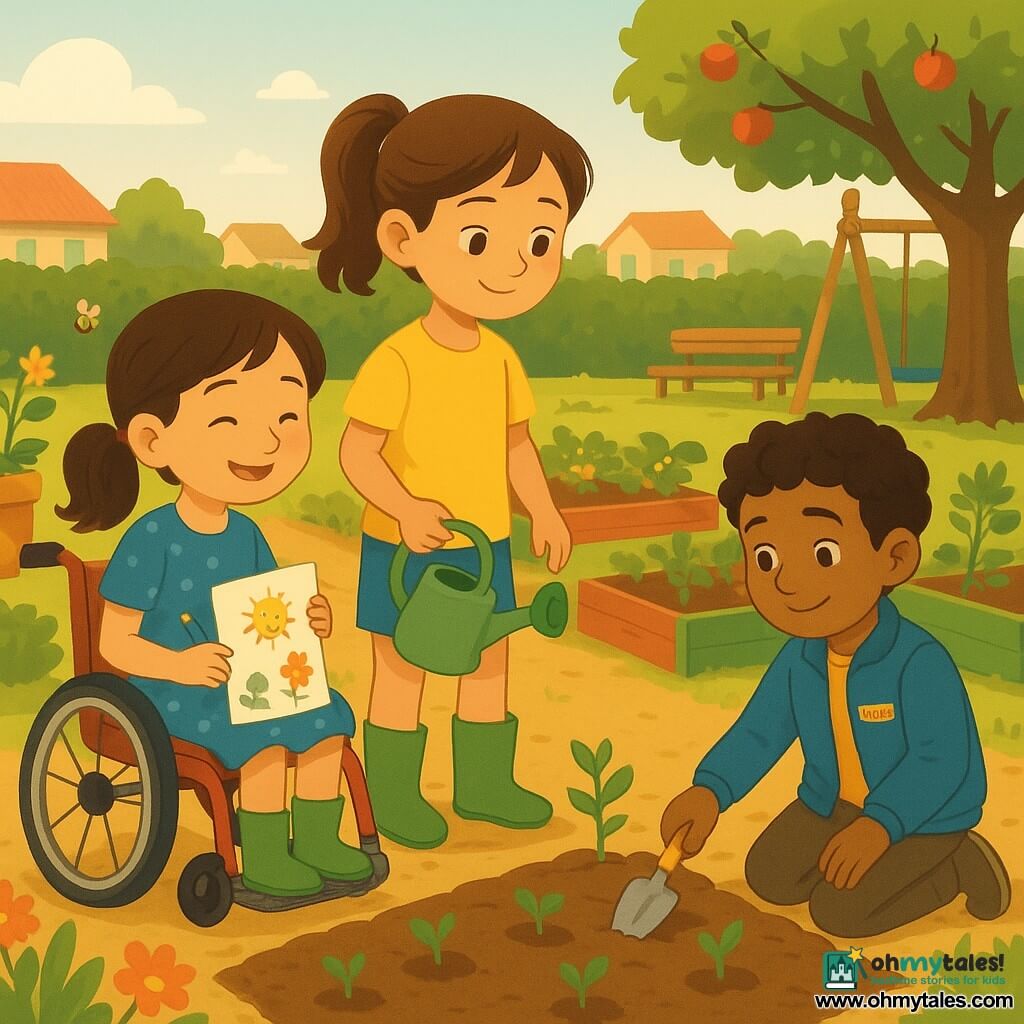
Maya and Lila met every Saturday morning at the shared garden. The garden was in the middle of their small town. Neighbours cared for the beds and bright pots. Bees hummed, tomatoes grew, and old Mrs. Alvarez kept a little bench under the apple tree.
Lila loved to draw the plants with coloured pencils. Maya liked to check the soil and wiggly worms. Lila used a small wheelchair, but she rolled around the paths as if she were flying. They were both seven and laughed easily.
One morning, while they watered the marigolds, a new boy came by the gate. He had shiny shoes and a blue jacket with a name patch that read "Arun." His skin was brown and his hair was curly. He looked at the rows of carrots and smiled.
"Hi, I'm Arun," he said softly.
"Hello! I'm Maya and this is Lila," Maya answered.
They gave him a tomato to taste. Arun's smile got bigger. "We don't have a garden at my building," he said. "My grandma plants herbs on the balcony."
"Would you like to help today?" Lila asked. Arun nodded. He picked up a trowel and began to dig.
Chapter 2
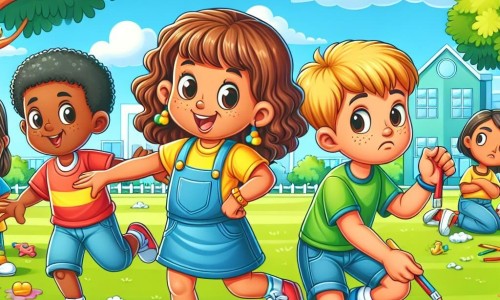
A little later, three children from school came to the garden. They were loud and a bit rough. One of them said, "Why does he have that name? It sounds funny." Another laughed and copied how Arun spoke.
Maya felt a hot, tight feeling in her chest. She looked at Arun and then at the three children. Arun's smile dimmed. Lila's fingers tightened around her pencil.
"That's rude," Maya said, but the children only snickered. They made jokes about Arun's lunch, too, pointing at the packet of spices he had in his pocket.
"It's not funny to make fun of that," Maya said, her voice small but firm. The words surprised her because she had never said them out loud before. The three children stopped for a second. One of them shrugged and said, "We were just joking."
Arun looked down at the soil. "It's okay," he murmured, but Maya saw that he was hurt.
Mrs. Alvarez came out from her house. Her braid bounced on her shoulder as she carried two mugs of tea. She set them down on the bench and sat slowly. "What's going on?" she asked gently.
Maya told her. Mrs. Alvarez listened with kind eyes. "Names, food, dress, skin — all of these tell a story about someone," she said. "But they do not tell us whether that person is kind or brave or funny. We must listen to the person, not the first thing we notice."
Arun looked up. "In my country," he said, "we sing different songs. I miss my grandmother's rice, but I like your tomatoes."
Lila smiled. "Then you can teach us a song, and we can teach you how to plant beans."
Chapter 3
Maya felt a little braver. She addressed the three children. "We are a garden. We grow things together. We will not laugh at someone because they are different."
"But we were only joking," one boy protested.
"Yes, but it hurt Arun," Lila said. Her voice was steady. "Jokes are okay when everyone laughs, not when someone feels small."
The oldest neighbour, Mr. Chen, arrived with a wheelbarrow. He had taught Lila how to make compost. He had seen many kinds of people in his life. "When someone is hurt, a kind thing is to apologize," he said. "Then we learn."
The three children looked at each other. It was hard to say sorry. The boy who had made the first joke pushed his cap forward. "I'm... I'm sorry, Arun," he mumbled. Arun breathed out and nodded. "Thank you," he said, and his smile came back a little.
After that, the day changed. The children helped plant peas. Arun hummed a song while they planted, and Maya tried to copy the tune. Lila drew a picture of the garden and gave it to Arun. "For you," she said.
Mrs. Alvarez brought out a plate of biscuits. "Share, and tell your favourite thing about your family," she said. One by one, the children spoke. Arun talked about his grandmother's stories. The boy who had joked said that his grandfather had lived far away in a different country when he was small.
Maya noticed how easy it was to find things they had in common: a love for biscuits, a pet, a song. The garden made the differences look gentle, like many colours in a painting.
Chapter 4
That evening, Maya could not stop thinking about the ache she had seen in Arun's smile. She wanted to do something more. She and Lila sat at the kitchen table with coloured pens.
"We should write a letter," Lila said. "Not a long one, just to tell someone how we feel."
They wrote to a small local group that spoke up against unfair words and helped children learn about diversity. Maya wrote, "We watched someone be made fun of. It hurt. We want to learn how to stop this when it happens."
Lila drew a picture of the garden and the people holding hands. Maya added, "We planted seeds, and we planted kindness." They signed their names and drew little hearts. The letter was simple and brave.
The next day, they walked with Arun and Mrs. Alvarez to the postbox. "What if people laugh at our letter?" Arun asked.
"They will listen," Lila said. "Because it's true."
They dropped the letter in the red box. It felt small and important. The shared garden hummed behind them, like a promise.
A week later, the group sent a reply. They invited the children to a meeting where people of different backgrounds would read stories and play games. The note said, "Thank you for speaking up. Children like you help us build kinder places."
Maya read the letter aloud. Her voice wobbled with pride. "We did something," she whispered.
Chapter 5
As summer moved on, more children came to the garden. Sometimes someone would make a joke, and sometimes someone would say, "Remember to be kind." The three children from before started to ask questions instead of laughing. They asked Arun about his songs and his favourite foods. Arun showed them how to use spices gently in soup. Maya showed how to check if a plant needed water. Lila set up a little library with picture books about different towns and families.
One evening, as the sun set and the gold light washed the apple tree, Maya felt calm. She and Lila sat on the bench with Arun and Mrs. Alvarez. "I used to think everyone thought like me," Maya said. "But now I see that people think differently, and that can be good."
Lila nodded. "Talking helps," she said. "Asking helps."
Arun tossed a small seed into his palm. "We planted seeds out here," he said, "and in people, too."
They all laughed softly. The garden smelled of soil and biscuits. The town felt a little kinder, like a plant that had been watered. Maya thought of the letter in the postbox and the people who replied. She felt certain that when someone said something unkind again, she would speak up. She knew the words to use and the way her chest tightened when someone was hurt.
"Even if it's hard," Maya said, looking at her friends, "we can learn and change together."
Lila squeezed Maya's hand. The evening was quiet and safe. They would keep planting, keep talking, and keep sending letters when they needed to. The small world of the garden had taught them a lesson: kindness grows, if you look after it.