Part One: The Walk to the Whispering Hill
Mira pulled her cloak tight. The wind smelled of sea and moss. It sounded like a story. In her village the old stones sang at dusk, but nothing sang like the first stone. Mira had heard the tale since she was small. The first stone was the beginning of everything. It could make rivers kind and make night gentle.
Mira was practical. She liked maps and ropes and clear plans. She also believed in small wonders. She kept a bag with a loaf, a wool thread, and a little bell that tinkled like a bright star. Friends laughed when she tied the bell to her belt. Friends loved when she shared her bread.
She walked to the Whispering Hill with a steady step. The hill was green and dotted with white flowers that opened like tiny moons. The hill whispered names. The hill told of old times. Mira listened. She hummed back a tune, and the hill hummed a reply.
At the top she found Aderyn, a boy from the cliffs, and Branna, a quiet woman who braided trees. “We will help,” said Aderyn with a grin. “We will help,” said Branna with a calm voice. Mira liked that. She liked friends who said what they would do.
“Where is the first stone?” Mira asked. “It waits,” said Branna, “where water sleeps and light remembers.” Aderyn pointed to a line of stones that led down into the valley like a fish's backbone. The stones glowed faintly, as if they breathed.
Mira tied her bell, checked her rope, and stepped carefully. She liked maps, but this path was a map of feeling. Step by step they walked, step by step the world breathed softer, step by step the sky leaned down to listen.
Part Two: The River of Lost Names
They reached a river that moved like a ribbon of glass. It did not rush; it held small bright boats of cloud. The river asked questions with ripples. It asked old names and new names. It asked the name of the first stone.
Aderyn knelt and dipped his hand. The water showed him images—fish that wore crowns, reeds that sang like bells, a great root holding the whole place like a giant's hand. Branna hummed a tune that made the reeds bow. Mira tied her rope to a bent oak and called the river with a clear voice.
“I am Mira. I am looking for the first stone,” she said. The river listened. The river spoke with a soft voice that smelled of wet moss. “To find the first stone,” the river said, “you must give what you have, and keep what you are.”
Mira thought of her loaf, her bell, her rope. She set the bell on a smooth rock and let it ring once. The sound was small and true. The river shivered. A fish leaped and left a silver coin that had a tiny carved sun. Aderyn caught it and laughed. Branna smiled and braided a reed into a knot.
They made a small raft from fallen branches. They paddled where the river slowed, where the water held mirrors. In the mirror, Mira saw a woman with bright honest eyes and hands that fixed things. She did not see a queen or a hero. She saw herself. The river had shown her that the first stone needed someone who could do things, who could not be moved by fear.
At the last bend the river opened into a pool. In the pool floated a stone like a pale moon, wrapped in ripples. Around it swam tiny lights that looked like minnows made of lantern. The first stone was not loud. It was patient.
Part Three: The Test of Night and Light
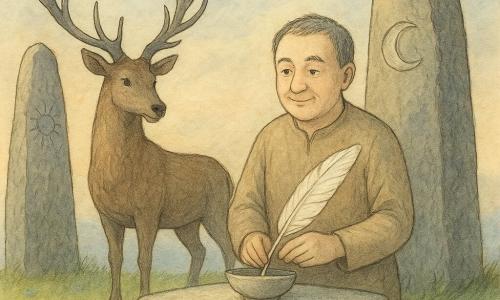
They reached the pool as the sky turned plum. A long shadow moved across the water. The shadow was a guardian, a deer with antlers like branches of living oak. It did not speak with words. It bowed. It breathed out small leaves that smelled like cinnamon.
“The first stone will choose,” said Branna softly. “It will ask you to remember and to share.” Aderyn stepped forward with a brave grin and offered the silver coin. The deer sniffed and shook its antlers. The coin turned into a spark that floated like a tiny moon and joined the minnows of light.
Mira stepped then. She touched the water. It felt like cool silk. The first stone hummed under her palm. A thread of music unrolled from the stone and wound around her fingers. It showed her a bridge made of light and small stones that fit, one by one, like words in a song.
“You must build the bridge,” said the stone without speaking, “and you must trust hands.” Mira's chest hummed. She looked at Aderyn and Branna. She looked at the bell at her belt. She was practical. Building a bridge needed plans, ropes, and friends.
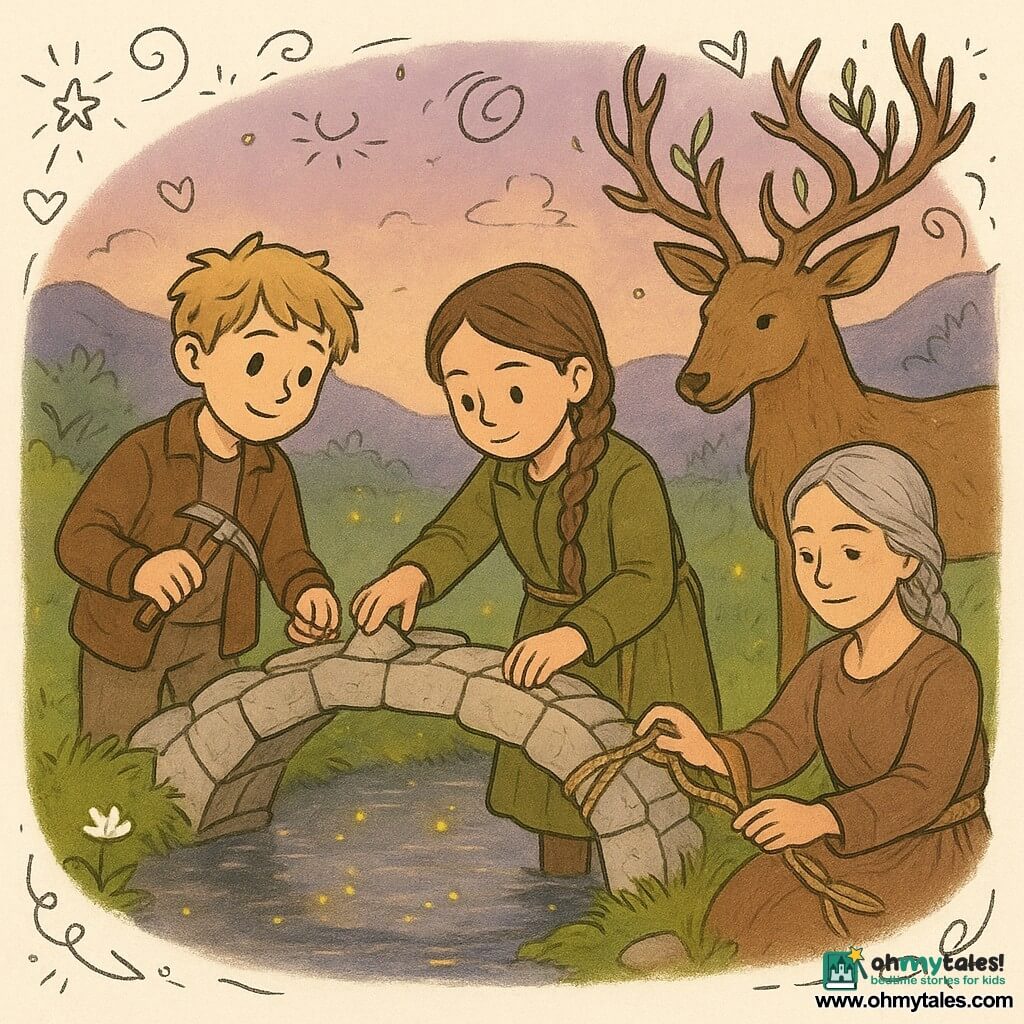
They worked together by the water. They placed stones one by one. Aderyn found stones that chimed. Branna braided a rope of reeds that would hold the line. Mira fitted stones like a seamstress fits cloth. Night tried to pull the stones apart with cold. Morning crept like a shy fox and warmed each place with light. Sometimes a stone wobbled. Sometimes a small doubt flickered. Then one of them would say, “We can,” and the other would say, “We will,” and they would set the stone again.
An old eagle watched from a crag and cried a note like a bell. The river clapped with little waves. The first stone glowed until it matched the shape of a small arch. When the arch was done, the stones sang together—soft, clear, like pebbles laughing in rain.
Part Four: The Bridge That Holds
They stepped onto the bridge. It felt alive under their feet, like a good promise. Mira held Aderyn's hand and Branna's braid. The river flowed under, gentle as a lullaby. The light from the pool painted their faces golden.
“You found the first stone,” said the deer, its antlers catching starlight. “You have given what you had—song, coin, work—and you kept who you are—brave, kind, true.”
The bridge arched over the quiet water. It was small and strong and bright. It joined the hill to the other side where new stories waited. Villagers would come to cross and to feel the stone's singing under their feet. Children would skip and say the two words everyone had said while building: “We can.”
Mira looked at her hands. They were callused from rope and warm from bread and steady from work. She smiled. She had planned, she had listened, and she had trusted her friends. The first stone hummed under the bridge like a sleeping heart.
They walked across together, and the bridge held.