Chapter One: The Last Song of the Hollow
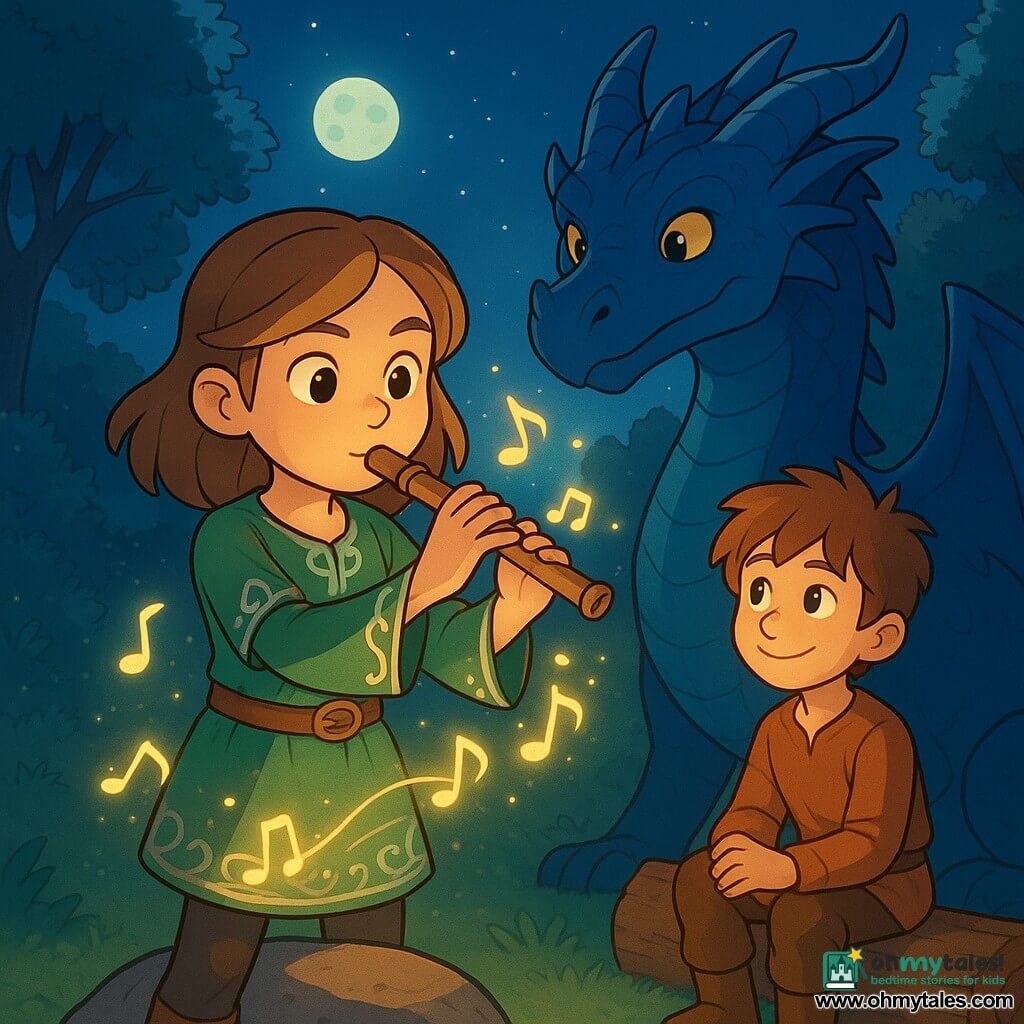
Maelin lived in a village wedged between grey cliffs and a wide, whispering marsh. When she was small, music hung in the air like golden dust—trills and bell-tones that helped seeds sprout and lamps burn. Now the songs were thin; magic had thinned like daylight at dusk. Maelin kept the last true flute, carved from a white reed and stitched with a silver thread. She had learned to play for her friend Rowan, who taught foxes to sit and listen and could mend a broken boot with a few kind words.
One night, when the moon hid itself behind a cloud thicker than wool, men on dark horses came. They carried banners of ink and silence. The villagers woke to a soundless world: the hens clucked but did not lay, the kettle did not sing, and a chill crept into smiles. The leader of the riders was called the Moonless King, a tall figure with a crown that drank light. He searched houses for singers and musicians. He claimed songs were dangerous; he said magic needed to be caged and counted.
They took Rowan. Maelin watched him lifted into the King's shadowed carriage, his hands held like a child's. Rowan looked back, and in his eyes Maelin saw not fear but a question: remember the river by the black-barked tree? Maelin tightened her fingers around the flute. She would not let the Moonless King make the world mute.
Chapter Two: The Map of Lost Stars
Maelin packed the flute, a rope, a slice of oatbread, and a small jar of nightlight—glow-worms wrapped in glass—that hummed warm. She crept to the marsh, where the last lantern-ferryman, Old Bral, lived in a boat patched with rune-stitched leather. Bral had once ferried poets across the moon-swollen river. Now he spoke in whispers.
“You're going after the Moonless Court?” he asked, his voice like a reed cracking.
“For Rowan,” Maelin said. “And for songs.”
Bral pushed a boat into the dark water. “There's a map,” he said. “Not drawn on paper, but etched in a drake's memory. Drakes keep long things. If you find Elthra—the drake of the blue caverns—she will lead you. She hates the King. She remembers where the Moonless Court hid its keys.”
Maelin stepped into the boat. The marsh sighed and the stars looked thin and hungry. Bral's oar cut the water, and they passed the bulrushes whose heads rattled like bones. In the moonless sky, the path to the caverns was a thread of cold fire.
Chapter Three: The Drake of Blue Caverns
The blue caverns yawned beneath cliffs that smelled of salt and smoke. Stones glowed with slow, gentle light, but the air was a drumbeat of power. Maelin climbed into a wide chamber where Elthra lay coiled, scales like polished sapphires and eyes like lantern-glass. She was older than the cliffs.
“Elthra,” Maelin called, bowing because that felt right in a cavern. The drake lifted her head. Her voice was like distant thunder. “You remember this land. Can you find the Moonless Court?”
Elthra snorted a breath that warmed Maelin's shoulders. “I remember many things,” she said, which was a kind of yes. “But I ask for a song.”
Maelin drew her flute and played a single note—a thin, brave ripple that filled the cavern and made stalactites tremble like an audience leaning forward. The drake's great eye shone. She remembered the songs that fed her when she was small, the lullabies that kept nightmares from gnawing at her scales.
“You have courage, small one,” Elthra said. “I will carry you across the country beneath wind and stone, but the Moonless Court has watchers. The King gathers silence like a net. You will need more than courage.”
They traveled on the drake's back. The world from above was a quilt of forests, black rivers, and fields of ash. Below, they passed villages where people peered out with blank faces—no whistles, no little songs to change a teapot's mood. Elthra told Maelin of places where the Moonless King planted gray trees that swallowed sound. She led them to the edge of the King's domain where the air tasted of iron and vinegar.
Chapter Four: The March of Silent Soldiers
At the border, soldiers in shadow-armor marched in a slow, practiced silence. Their steps did not echo. They held banners sewn with empty eyes that seemed to watch the sky. Maelin hid in a hollow as Elthra curled behind a ridge. Rowan's carriage was set in the center of a courtyard like a hush carved into stone.
If she stormed with blade and shout, she could not stop the silencers who drained magic. So Maelin did something strange: she began to play.
The first notes were quiet—she had to warm her throat. Notes climbed like tiny flames, careful and bright. They flowed over Elthra's scales, slipped beneath a soldier's helm, and surprised a sentry with a memory of a childhood rhyme. A single whistle of warmth flickered through one of the gray trees. A bird inside it stirred; its wingbeat was a drum of soft rebellion.
Soldiers turned, eyes wide with forgotten things. The Moonless King's men had never been cruel; they had been taught, and the teachings were thin. A harmonica by a guard's belt twitched like a sleeping thing waking. Another pulled his glove and hummed, one small thread of song. One by one, sounds returned as if someone had opened shutters.
But then the Moonless King stepped from the palace. He was tall and his face was smooth as a lake of ink. His voice was a pit that swallowed light. “Leave,” he said, a command that seemed to make the stones go quiet.
Maelin played on. She thought of Rowan's laugh, of foxes sitting, of Bral's crooked oar. Her notes braided into the air and formed a ladder of melody. The King tried to sweep it away, sending black wind. Elthra breathed and broke that wind into a shower of sparks. The soldiers hesitated, then knelt as if someone had tugged at their hearts. The King's crown cracked where a spark touched it. He hissed and called for silence. His guards answered, but their voices had grown rough with resisting song.
Rowan's carriage creaked. The lock that held him was not iron but a vow made of forgotten music. Maelin played the tune Rowan had taught her by the hidden river—the one that made foxes hush and stars listen. The lock unthreaded like a seam.
Rowan climbed out, messy-haired and smiling with relief. For a moment, everyone forgot fear. They remembered picnics, fireflies, a cake gone wrong but laughed over. The King's eyes darkened; he could not stand to watch this reweaving.
He raised his hand and the moon in the sky went down like a shutter. For an instant, the world teetered toward silence again. Maelin felt the flute go heavy in her fingers. She closed her eyes and played the whole song, not to break the King's spell, but to share the song with everyone there—soldier, drake, ferryman, friend. The music became a thing passed hand to hand, a loaf shared. It warmed like a hearth.
The Moonless King tried to take the music into himself, to hoard it as a collection of jewels. But music is not a jewel; it is a story. It slips between fingers and finds mouths to hum. The King's crown splintered into notes and fell like a scattered constellation. Where the crown hit the ground, little shoots of sound unfurled. The King shrank from the noise, not because it harmed him, but because he had forgotten how to listen.
Chapter Five: The Sharing of Light
After the contest of song, the Moonless King was not burned or banished but undone like a spell that had lost its thread. He stood in the courtyard and listened—for the first time in his reign—to a child tapping a tin, to a woman calling names into a bakery. His voice trembled. “I wanted to save the world,” he said, voice small and raw. “I thought if I removed magic it wouldn't hurt anyone.”
Maelin lowered the flute. “Magic is not only danger,” she said. “It is what we give each other. It heals when shared. It is a kind hand and a brave song.”
Rowan put a gentle hand on the King's shoulder. “You were afraid,” he said. “Fear is heavy. But you can learn to carry it without crushing others.”
People came forward—not to punish but to teach. They brought a seed of song. Old Bral hummed the ferry rhyme; a baker whistled the way to bake bread that never burned; Elthra rumbled a lullaby she had kept for her hatchlings. The King listened, and something like understanding rose in him. He did not become merry at once. He had shadow still. But his crown—now a pile of scattered notes—was gathered by Rowan and threaded into a ribbon for a child who liked hearing frogs. Magic returned not in one bright flood but in a comforting rain.
Maelin gave the flute to Rowan for safe-keeping, but she kept humming tunes in her pocket like little warm stones. Elthra consented to watch over the great libraries where songs live. The gray trees began to hum faintly, as if remembering wind.
The village by the marsh filled with sound again. Lamps sang when lit. The nights felt fuller; children chased notes as if they were fireflies. The Moonless King stayed near the court, learning to listen, sometimes stepping down to plant a seed or repair a roof. He could not undo the harm he had caused, but he became a slow student of kindness.
Maelin sat once more by the black-barked tree by the river with Rowan. They watched the moonless nights now less frightening—because even when the moon hid, people carried lanterns of song. Rowan leaned his head against Maelin's shoulder. “You were brave,” he said.
“You taught me,” Maelin replied, thinking of foxes and ferrymen and an enormous drake who loved lullabies. “And we shared the song.”
Above them, in the blue caverns, Elthra curled and dreamed of music that would travel on her breath. The world had been fractured and mended, not by a single hero's thunder, but by many small hands and many shared notes. Magic, like a river, flows when people open the gates. In the evenings, when the villagers played by the river's edge, the music rose, and the Moonless King—now simply a man learning to hear—sat on a low wall and listened.