Departure at Dawn
The low sun spilled gold over the plain, where grassy barrows rose like the backs of sleeping beasts and ancient menhirs stood in ragged lines like old guards. Birds called and the wind moved through the grasses, carrying the scent of wild thyme and distant rain. Lyra stepped out from the hollowed mound that had been her home, her cloak stitched with thread the color of riverwater and a small bronze bell tied at her throat. The bell did not ring to frighten; it sang soft and steady so she would be remembered.
She was the emissary of truce, chosen not because she was the strongest, but because she was clever, quick with words, and steady in the face of storms. People had come to her with folded hands and broken swords, and she had walked between anger and grief like a bridge. Now the plain itself trembled with a new danger: two great kingdoms, one to the north of the stone-lines and one to the south, had amassed banners and sharpened spears. Their kings whispered of honor and old wounds. Their generals counted losses and promised fire.
Lyra tightened the strap of her satchel. Inside lay a scroll sealed with blue wax, a map of the boundary where both armies would meet, and the Promise-Grain — three tiny seeds given to her by the oldest woman in the village. “Plant them only when the bell is silent,” the woman had said. “They will know hunger, and hunger calls for bread.” Lyra did not know exactly how seeds could stop swords, but she trusted the woman's hands and the plain's slow wisdom.
She walked past the menhirs, their shadows pointing like long fingers toward the low road. As she went, villagers stepped from doorways and tossed her apples, bread, and a carved wooden horse for luck. A boy pressed into her palm a smooth stone that felt warm from the sun. “For carrying between hearts,” he said. Lyra smiled and tucked the stone into her pocket. It was a small thing, but she liked small things; they fit easily in the mouth and the soul.
At the edge of the plain, the drum of war was already beginning — not with a clash but with a tremor. Scouts flew between camps like restless crows. Lyra saw a rider with the northern colors fasten a wreath of iron around his horse's mane and a southern standard being stretched on a pole. She breathed in the wind and set her feet toward the meeting ground, where tents puffed like heavy clouds and sentries stared through the dawn haze. Her heart beat like the bell at her throat, steady and true.
Crossing the Stone Fields
The road to the parley wound through the Stone Fields, where menhirs clustered in crooked rings. Folk said the stones remembered the voices of old kings and would sometimes whisper when the moon was full. Lyra kept to the path worn by cart wheels and foxes, but even that worn path had stories lying across it, and sometimes stories tripped a traveler.
Halfway through the field, a column of riders barred the way. They were scouts from the southern army. The leader, a woman with a scar that ran like a river down one cheek, dismounted and approached with suspicion sharp in her eyes. Lyra bowed. “I carry a plea,” she said, voice small but clear. “The king told me to seek truce.”
The scarred woman laughed bitterly. “Truce,” she said, “is a word for the weak.” Her men tightened their grips on lances. “Why should we listen to a solitary girl between men who will cut us?”
Lyra did not answer with her sword. She reached into her satchel and drew out the carved wooden horse. She placed it on the ground, sun warming its wooden flank. “I carry a story,” Lyra said. “A story of a child who lost a horse in a thunderstorm and found, under the same storm, a friend on the other side of the road. He taught her how to mend a broken wheel. She taught him how to light a safe fire. They made bread from one sack of grain and shared it until both their children were fed. The two families forgot their kings' quarrels because their bellies were full.”
The scarred leader blinked. The men around her relaxed, just a little. One reached out and touched the wooden horse's chipped mane as if it might speak. Lyra kept a calm face. The plain did not shout with swords yet; it hummed with memories. Stories were like seeds too; they took root if someone listened.
“You think stories will stop spears?” the leader asked.
“I think stories can change the listening,” Lyra answered. “If you listen, you may remember something you chose to forget.”
At that moment, a southern child, no more than seven, peered from behind a tent and squealed with delight at the toy. The child ran forward, the trappings of camp forgotten, and grasped the wooden horse. The sound melted something in the men's shoulders. The leader knelt, her scar softening, and gave Lyra a drink of water. Word trickled to the northern scouts too, and they watched from a ridge. In that small exchange, Lyra felt a tiny widening of the world. It was not peace, but it was a shade of it — a pause long enough to plant a thought.
She continued forward. At a crossing where two ancient stones leaned like old friends, she found a northern priest arguing with a captain over the list of slights and losses. They spoke in raised voices, their breath like steam in the cool. Lyra stepped between them and sang, softly, a tune their mothers once hummed. It was a lullaby for men with weapons, a tune about mending nets and sharing fish. They quieted before her as if a warm hand had pressed the song onto their ears. A priest offered her a coin. Lyra refused; she only asked them to remember the song if they felt anger rising.
By noon she arrived at the line of tents where both armies faced each other across a field that glowed like a sheet of tarnished silver. The captains marked their distances and read their grievances from leather rolls. The sky seemed thin with expectation. Lyra tied the bell at her throat and walked into the great circle of banners, feeling small and very brave.
The Night of Parley
The parley began with horns and the chink of armor. Kings sat under canopies stitched with their houses' symbols, faces mapped with years of rule. The air was full of smoke, roasted meat, and the brittle tension of warriors who waited only for the finger to fall. Lyra took her place on a low stone between them like a bird perched to watch storms collide.
Her voice trembled once, then settled into a practice she had learned on cold nights when the plain's wind had tried to pry courage from her bones. She told the kings the simple truth: children were hungry, fields lay trampled, and old grudges could make rivers of sorrow. She offered no laws and no ultimatums. She offered bread to whoever would accept it — a loaf given in trust.
The northern king scowled and spoke of oath and honor, his voice rolling like thunder. The southern queen answered with the memory of a raid from long ago; her eyes were flint. Words grew sharp. A captain spat on the ground. The parliament of generals leaned forward like predators.
Lyra listened. She tipped her head and let their wrath clean itself out. Then, when the kings' voices had run hoarse, she told them about the Promise-Grain. She drew the three seeds from her satchel and held them up so the camp firelight blinked off their skins.
“These are not ordinary seeds,” she said. “They are emptiness-challengers. Plant them, and they will ask for the simplest of things: water, warmth, and hands to care. They will not grow into weapons. They will grow into food. If you plant them together, they will ask for the same hands, and those hands must cross the border to feed them.”
There was silence. The kings stared at the seeds as if they burned. A scribe whispered in his scroll. A general muttered that the story sounded like a trick. Lyra set the small stone from the village into the center of the circle. “This stone remembers the plain,” she said. “It remembers how the menhirs have stood through winters and summers. They do not choose sides. They listen to what the ground needs.”
A young captain stood quickly. He was known for daring charges and a laugh that frightened mothers. He scoffed at seeds. “We will not be made fools,” he said. “We will not be tied together by grain.”
Lyra met his gaze. “If you do nothing, you will be made fools by hunger and sorrow,” she answered. “If you plant these, you will be bound by work and sharing, not by oath alone. You will make meals together. You will talk as farmers do, low and close, not as commanders do, loud and far.”
The bell at her throat chimed once. The sound was soft, like a leaf landing in water. A child from the northern camp, whose mother had been tending to the king's horses, stepped forward and plucked at the hem of Lyra's cloak. “Will it be a bread big enough for us?” he asked, earnest and small.
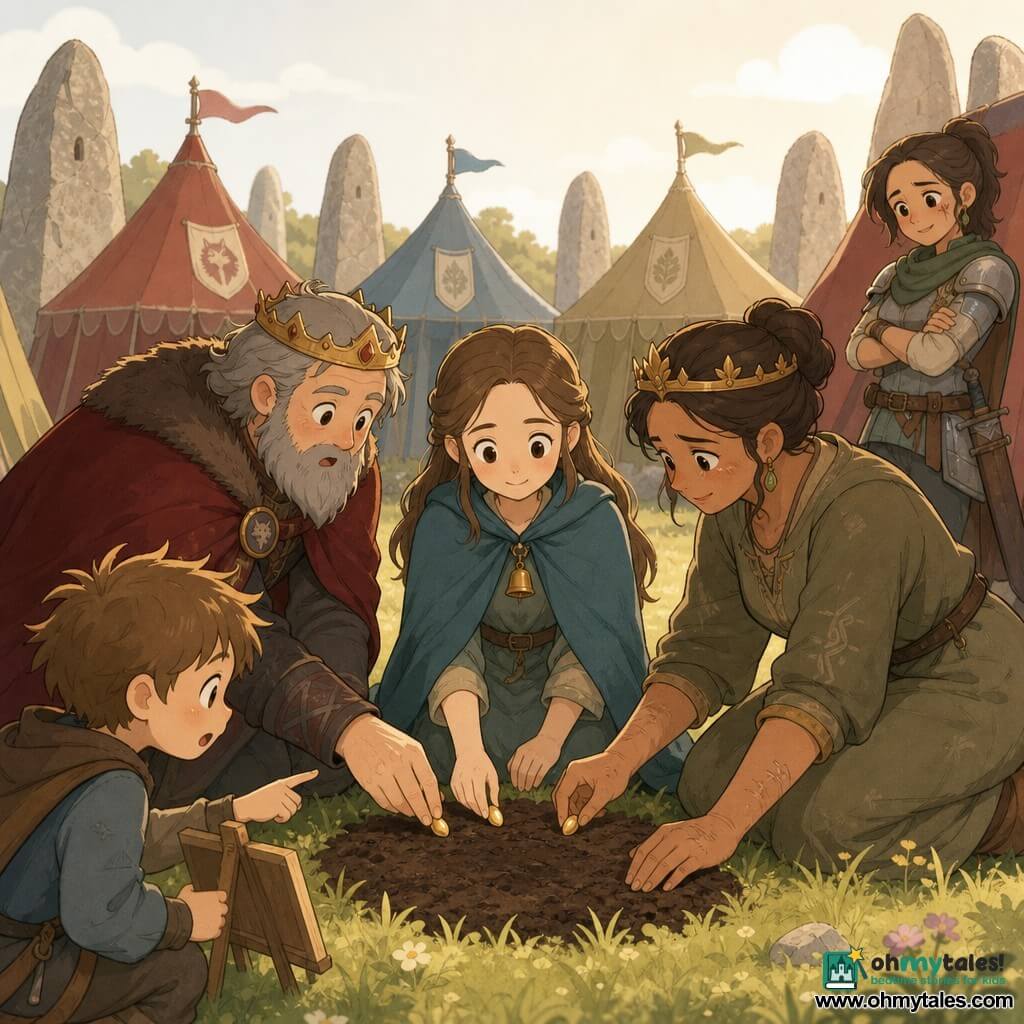
That question washed through the circle. The kings looked at each other, really looked, for the first time that day. They thought of sons, of daughters, of winter. The southern queen's hands, which had lines like braided rope, trembled as she reached for one of the seeds. The northern king's jaw loosened. He put out his hand as well, slow as the tide, and the two took the seeds together and touched.
It was a tiny thing: hands meeting over a seed. But the plain held its breath and then released it in a long sigh that stirred the grass. The captains grumbled, but their swords did not move.
The Choosing of Peace
Dawn after the parley was a thin green light. A group of men and women from both camps gathered where the kings had set the seeds in a shallow bowl of earth. Lyra knelt and pressed the three seeds into the soil. Around them, soldiers who had sharpened spears the week before held spades and buckets. For some, this was a humiliating task. For others, it was strange. None knew the rhythm of sowing quite as well as a woman who had mended nets and plowed small plots. Lyra's hands were steady.
They worked through the day and into the evening. They made a fence of woven branches to protect the little patch. They built a small shelter for the wind. Many minutes passed where nothing happened, and several people snorted at the emptiness. The kings sat and smoked and waited for a miracle, but the land abides by its own clock. It does not hurry grief or growth.
On the third night, when stars scattered like spilled salt and a thin moon rode low, a pale tender shoot pushed through the soil. A murmur ran through the camp like the passing of water. The shoot opened into a leaf the color of new coins. It smelled faintly of warm bread. More shoots rose, and small green heads pushed upward like children peering over a wall.
The camps watched as the plants spread, not tall like weeds, but thick and sweet, and like a promise, little ears of grain began to swell. The men who had never planted started to learn. The women who had always loved the earth showed others how to fetch water with tuns and how to sing low songs that helped roots settle. They took turns, from dawn to dusk, sitting beside the patch and telling small stories. They repaired wounds and mended feelings with quiet kindness.
When the grain was ready, both kings stood together and reaped the stalks with hands that had always held swords. They sat around a common fire, and the first bread was baked on a flat stone. A child broke the loaf and passed the pieces. There was enough, and the taste was warm with sun and sweat and surprise. Around that fire, someone told a joke so clumsy it made everyone laugh until they cried. Laughter is a strange kind of peace that nobody can command.
Lyra watched the two rulers feed their hands to the same bread, and she felt the bell at her throat vibrate with a little song. She had not solved centuries of hatred or even mended every broken roof, but she had opened a door. The people who had leaned on spears now leaned on work and the shared weight of keeping a field healthy.
Months folded like leaves. The patch grew into a long swathe of green that could not be ignored. Trade reawakened across the border; fishermen met fishermen; smiths exchanged tools and tales of storms. Children learned to call each other by name rather than by the crest on a shield. The menhirs watched, patient and slow, as the plain's rhythm changed a bit. When disputes flared, men and women would sit in the field where the Promise-Grain had been planted and argue with the smell of bread in the air until tempers cooled.
One spring morning, when the plain had winked free of frost and the sky looked like a fine blue bowl, the kings came to the barrows and lifted the old bell from around Lyra's neck. They placed it on a stone and carved a ring in the grass around it: a place of meeting in times of trouble. “You have given us a bridge,” the northern king said, voice thick yet bright. “We will keep it.”
Lyra shook her head and smiled. “The bridge was here,” she said. “I only invited you to cross.”
People brought gifts: a cloak dyed the color of dusk, a loaf shaped like a wheel, the southern leader's silver comb. Lyra accepted with hands that had learned the craft of taking small things and making them mean a lot. She kept the small warm stone in her pocket; she kept the bell for the sound of it. But she no longer walked alone between anger and grief. Others walked with her, sometimes with jokes, sometimes with heavy boots, always with the steady business of keeping peace.
The menhirs stood taller in the long months that followed, catching the wind and weighing it down with old truths: that wars are costly, that bread is simple, that hands joined in work will remember each other more kindly than hands raised in oath. Lyra would ride across the plain to visit villages, always leaving a seed or a story behind. Where once there had been the rustle of armor, there was now the softer rhythm of plow and laughter.
On summer evenings, children would press their small faces to the low stone where the bell lay, and Lyra would tell them how a truce began with three tiny seeds and a wooden horse. They would listen wide-eyed and promise, solemn as monarchs, to keep their hands busy and their ears open. The plain had been spared a devastating war, not by a single hero's blade but by patient deeds, music of voice and bell, and the courage to plant something that asked only for care.
And Lyra, who had set out with only a bell and a brave pocketed stone, grew into a figure of legend that smelled of thyme and warm bread, her laughter a small, steady drum across the barrows. The world, less sharp now, showed its softer lines — very much like the curve of a loaf fresh from the oven — and that was enough to make a plain full of menhirs and barrows sing.