Chapter 1: The Polite Note
Milo was the kind of kid who said “thank you” to vending machines, just in case they had feelings. Bea, his best friend, said “please” to doors before pushing them open—mostly as a joke, but also because Bea liked to test the universe.
On Saturday afternoon, they were in the regular, non-magical part of town, doing the most thrilling activity known to preteens everywhere: waiting for Bea's older brother to finish soccer practice.
They sat on a bench outside the train station, sharing a bag of gummy bears that had exactly three green ones left. Milo was about to offer Bea one (he always offered, even when it hurt his soul) when a folded piece of paper slid out from under the bench like it had been waiting for its moment.
Bea picked it up. “Ooo. Secret bench mail.”
Milo leaned in. “Could be a coupon. Could be a warning. Could be… directions to treasure.”
Bea unfolded it carefully, like it might explode into confetti. The note was written in neat, swirly handwriting:
PLEASE KNOCK BEFORE ENTERING.
THANK YOU FOR YOUR GOOD MANNERS.
Bea blinked. “That's… aggressively polite.”
Milo looked at the station doors. They were normal glass doors. Boring. Honest. Not even a mysterious smudge.
“Knock on the glass?” Milo suggested. “People will think we're trying to sell them something.”
Bea tapped the note with her finger. “It says please. We have to.”
Milo sighed the sigh of someone who knows kindness is a trap and steps into it anyway. “Fine. But if anyone asks, we're doing… a science experiment.”
They walked to the glass doors. Bea raised her knuckles and knocked—tap, tap, tap—like she was greeting a giant invisible fish.
For a second, nothing happened.
Then the air in front of the doors wobbled, like heat above a sidewalk. The glass shimmered. The automatic doors didn't slide open. Instead, they… softened.
“Um,” Bea said, voice suddenly small. “Milo?”
Milo reached out. The surface looked like glass, but it behaved like a thick soap bubble. It squished under his fingertip.
“I think the station is… made of pudding now,” he said.
Bea grinned. “Finally. A station with personality.”
Milo swallowed. He was careful by nature, like a human seatbelt. But he also had a very curious brain that hated unfinished sentences. The note had been polite. The station had responded. That seemed… weirdly fair.
“Okay,” Milo said. “We go in. We stay together. We don't touch anything suspicious.”
Bea immediately touched the door again, just to see it wobble. “Too late.”
They stepped forward.
The world made a soft whump sound, like a pillow being punched politely, and the station swallowed them whole.
Chapter 2: The Cotton Station
They didn't fall. They didn't spin. They didn't even bump into anything.
They simply arrived—standing on a platform that felt like a mattress covered in fresh snow.
Bea looked down and sank half an inch into the ground. “This floor is… fluffy.”
Milo knelt and pressed his palm to it. It was cotton. Not the scratchy, cheap kind either. The kind you'd find in a fancy stuffed animal that cost too much.
He stood slowly. “Okay. New rule: we definitely touched something suspicious.”
All around them, the station stretched out in soft, bright layers. The walls were rolled cotton, stacked like giant marshmallows. The pillars were wrapped in quilted batting with tiny stitched swirls. Even the signs were made from puffed fabric, the letters sewn on in dark thread.
A loudspeaker crackled overhead. Instead of a normal announcement, it gave a gentle clearing of the throat.
“Ahem. Welcome. Please enjoy your stay. Please do not lick the timetable.”
Bea's eyes shone. “Did that speaker just ask us not to lick the timetable?”
Milo pointed at the schedule board. It was a big rectangle of white fluff with neat rows of stitched times. A tiny sign beneath it read:
PLEASE RESIST THE URGE.
WE MEAN IT THIS TIME.
Bea put her hands behind her back like a cartoon criminal. “I wasn't going to.”
Milo gave her a look that said: I have known you for eleven years.
A train rolled in without a sound. It didn't rumble. It sort of… floated, like a long pillow being pushed gently across a bed.
Its windows were clear but framed with soft yarn. The doors were stitched shut with big, obvious loops, like someone had sewn them closed in a hurry.
Bea tiptoed closer. “How do you get in?”
Milo scanned the platform. There were benches that looked like giant sofa cushions. There were trash cans that looked like plush hampers. There were people too—except they didn't look exactly like people.
A man made of beige felt stood reading a newspaper that was, unfortunately, also felt. He turned a page with slow determination.
A little kid—at least Milo thought it was a kid—was shaped like a cotton ball with sneakers. It bounced in place, humming.
Bea whispered, “Are we… still in our town?”
Milo tried to answer, but his voice came out quieter than usual, like the cotton was stealing sound.
“I think we're in the station,” he said. “But the station is having a… fabric phase.”
Bea walked toward an archway that looked like an entrance to a hallway. A sign above it read:
TO THE TICKET OFFICE
PLEASE WALK, DO NOT ROLL
Bea paused. “Why would anyone roll?”
Milo didn't have time to answer, because a gust of air swept through the station and—no joke—carried a tumbleweed of cotton right past them. It rolled, softly and proudly, like it had a schedule to keep.
Bea burst out laughing. “There! That's why!”
Milo couldn't help it. He laughed too. It was hard to be terrified in a place that warned you not to lick the timetable.
They followed the sign toward the ticket office, their shoes making tiny poof sounds.
As they walked, Milo noticed something: the cotton walls weren't random. There were seams. Stitches. Everything was built with careful, patient work—like someone had crafted the station with love and a slightly silly sense of humor.
Then they saw it.
A door at the end of the hall. A perfectly ordinary-looking door, except the handle was enormous—shiny, curved, and very much not made of cotton.
It was brass.
And it gleamed like it wanted to be touched.
Chapter 3: The Handle That Wanted a High-Five
The hallway grew quiet, as if the station itself was holding its breath. Even the loudspeaker didn't dare clear its throat.
Bea slowed down. “That handle looks… important.”
Milo nodded. “Also suspicious.”
A small sign was stitched into the cotton beside the door. The letters were neatly embroidered:
PLEASE DO NOT GRAB THE HANDLE.
YOU MAY GENTLY BRUSH IT.
WE ARE A STATION, NOT A DRAMA.
Bea read it out loud. “We may gently brush it.”
Milo frowned. “That's a very specific instruction.”
Bea lifted her eyebrows. “It's also kind of tempting.”
The handle sat there like a golden eyebrow, arched in challenge. Milo felt a weird tug in his brain, like when you're told not to press a button that clearly says DO NOT PRESS.
His wise side said: Don't.
His curious side said: But it says you may.
His polite side said: The station asked nicely.
Bea stepped closer, hands held out like she was approaching a shy cat. “Just a brush,” she said. “A respectful brush.”
Milo moved beside her. “Together,” he said, because if something weird happened, he wanted it to happen to both of them. It felt fair.
They leaned in.
Bea extended one finger. Milo extended one finger. Two fingers, two cautious preteen hearts.
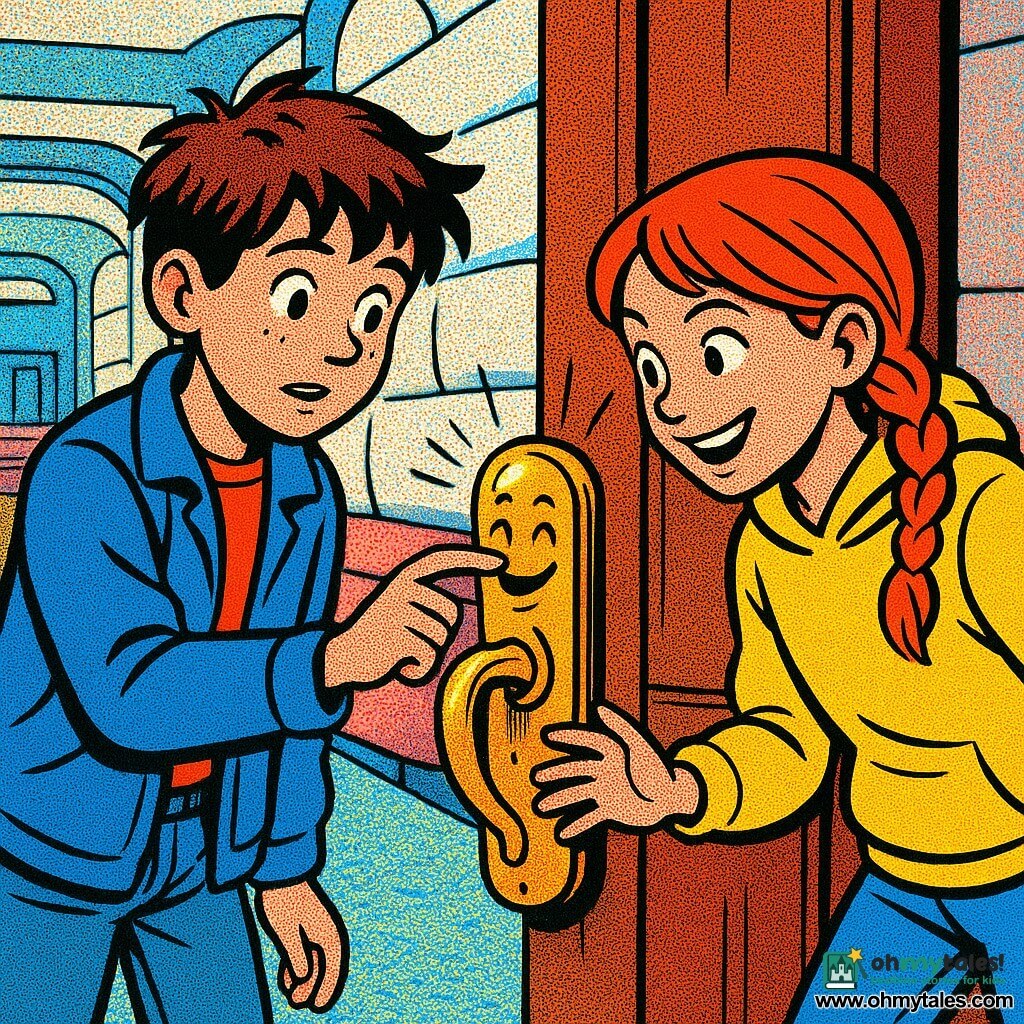
They brushed the handle at the same time.
It felt warm. Not hot—more like the handle had been sitting in sunlight, enjoying life.
The brass handle hummed.
Not like electricity. Like a happy bee in a tiny metal sweater.
Then it giggled.
Milo froze. “Did… did the handle giggle?”
Bea whispered, delighted, “It giggled.”
The handle wiggled under their fingers, as if it was trying to shake hands with both of them. The door behind it shivered. The cotton walls tightened their stitches.
The loudspeaker cleared its throat with great seriousness. “Ahem. Manners detected. Handle interaction approved. Proceeding to the next part of the station.”
Milo's mouth opened, but no sound came out. Bea's grin was so wide it could've been used as a bridge.
The handle lifted slightly—as if bowing—then swung down with a click.
The door swung open.
Inside was not a room.
Inside was… a wind.
A gentle, sweet-smelling breeze rushed out, carrying the scent of laundry soap and popcorn. It tugged at their sleeves like a friendly dog.
Bea stepped forward. “Milo. I think it wants us to go.”
Milo's wise side tried one last time. Are we sure?
But the note had been polite. They had been polite. The station was being weird, but not mean. And honestly, a door that giggled was hard to argue with.
“Okay,” Milo said. “But if we end up inside a giant sock drawer, I'm blaming you.”
Bea saluted. “I accept responsibility for all sock-based disasters.”
They walked through the doorway.
The breeze wrapped around them.
The cotton station blurred.
And they found themselves standing in a place that looked like their train station again—except for one tiny difference.
Everything was… slightly too cheerful.
The floor shone. The trash cans sparkled. A potted plant looked like it had recently been complimented.
And a desk stood in the middle of the main hall with a sign that said:
LOST AND FOUND
AND ALSO SLIGHTLY CONFUSED ITEMS
Behind it sat a woman with hair piled in a bun so tidy it could have been measured with a ruler. Her name tag read: MRS. LINTON.
She smiled at them as if she'd been waiting all day. “Ah. The brushers.”
Milo blinked. “The… what?”
Mrs. Linton pushed two little paper tickets toward them. They were warm, like fresh toast. “You brushed the handle politely,” she said. “So now you're eligible for the station's very special service.”
Bea leaned on the desk. “What service is that?”
Mrs. Linton's smile sharpened—friendly, but in a way that suggested she could also organize a tornado.
“Returning lost things,” she said. “Including things that don't know they're lost.”
Chapter 4: The Case of the Missing Quiet
Mrs. Linton slid a clipboard across the desk. Milo expected a normal form. Instead, the paper was soft and a little fluffy at the edges, like it had been printed on a napkin that dreamed of becoming a cloud.
At the top, it read:
TODAY'S LOST ITEM: QUIET
LAST SEEN: SOMEWHERE BETWEEN PLATFORM 2 AND A SNEEZE
Bea read it twice. “Wait. Quiet is missing?”
Milo rubbed his forehead. “That's not an item. That's… a vibe.”
Mrs. Linton nodded firmly. “Exactly. And without it, the Cotton Station gets… noisy.”
As if on cue, a distant sound echoed through the building: BOING. Then PFFT. Then, strangely, a polite little ta-da.
Milo flinched. “Is the station… making sound effects?”
“Not on purpose,” Mrs. Linton said. “When Quiet goes missing, everything fills in the gap with unnecessary noise. Doors whoosh dramatically. Coins clatter like they're auditioning for a movie. Someone's stomach growls in C major.”
Bea's stomach chose that moment to give a small, embarrassed grrrr.
Milo looked at her.
Bea looked at the ceiling. “It's… naturally musical.”
Mrs. Linton tapped the clipboard. “You two are the right age,” she said. “Old enough to take instructions. Young enough to believe a station can lose Quiet.”
Milo opened his mouth to argue, but Bea spoke first. “We'll do it.”
Milo turned. “We will?”
Bea nudged him. “Come on. This is the first interesting thing that's happened all week. Besides, she gave us tickets.”
Milo lifted his warm little ticket. On it, stitched in tiny letters, was:
ONE (1) TRIP TO FIND QUIET
PLEASE DO NOT FOLD CHILDREN
Milo sighed. “Fine. But we do it carefully. Quiet sounds… delicate.”
Mrs. Linton reached under the desk and produced two items.
One was a small cotton pouch. “This is a Quiet Bag,” she said. “When you find Quiet, it will try to drift away. Put it in the bag. Do not shake the bag. Do not sing at the bag. Definitely do not tell the bag a joke.”
Bea raised a finger. “What about a pun?”
Mrs. Linton's eyes narrowed. “Especially not a pun.”
The second item was a map. It was stitched on fabric, with little embroidered arrows. In the corner, it said:
MAP MAY BE SLIGHTLY SARCASTIC
Milo unfolded it. A tiny stitched speech bubble pointed to Platform 2 and read: TRY NOT TO GET DISTRACTED, HEROES.
Bea snorted. “The map is judging us.”
Mrs. Linton stood and smoothed her skirt. “Quiet likes to hide where people don't notice it,” she said. “It might be under something ordinary. Or inside something silly. Or behind something that thinks it's ordinary but is actually silly. You understand.”
Milo didn't, but he nodded anyway. “We understand.”
“Wonderful,” Mrs. Linton said, and clapped once. The sound came out as a soft poof, like applause from a pillow. “Now go. And remember: in the Cotton Station, politeness opens doors. Literally.”
They headed toward Platform 2, following the sarcastic map.
As they walked, the station's unnecessary noises got worse.
A man sneezed and it sounded like a trumpet. “Ah-CHOO!” BRAAAAP.
Bea burst out laughing, then clamped a hand over her mouth. “Sorry! I'm trying to respect Quiet, wherever it is.”
Milo pointed to a water fountain. It dripped with the drama of a waterfall: plunk… PLUNK… PLUUUUNK.
“Quiet is definitely missing,” he muttered.
Platform 2 appeared ahead, padded and bright, with cotton benches lined up like marshmallow slices. A sign swayed gently:
PLATFORM 2
PLEASE WAIT PATIENTLY
PATIENTLY
PATIENTLY
Bea read the repeated word and whispered, “Even the sign sounds stressed.”
They stepped onto the platform. Milo held the Quiet Bag like it was an egg carrying a secret.
“Okay,” he said. “We look for places Quiet might hide. Under benches. Behind signs. Inside—”
A suitcase rolled past them on its own, wheeling neatly in a straight line.
Bea pointed. “Inside a suitcase!”
Milo blinked. “Did you see that?”
The suitcase stopped, turned slightly, and rolled away again, as if it had decided they were not worth its time.
The map's stitched speech bubble seemed to smirk.
TRY. NOT. TO. GET. DISTRACTED.
Bea exhaled. “Right. Quiet first. Haunted luggage later.”
They began searching carefully. Milo lifted the corner of a bench cushion. Bea peered behind the timetable (without licking it).
Under the third bench, Milo found something that made his fingers pause.
A small, pale fluff—almost invisible against the cotton floor—trembled like a shy breath.
It wasn't loud. It wasn't even solid.
It was a pocket of calm.
Milo whispered, “Bea. I think… this is it.”
Bea crouched. Her voice softened, naturally, like the station was teaching her. “Hi, Quiet,” she whispered. “We're not here to bother you. We're here to… put you in a bag, which sounds rude, but it's for your own good.”
The little fluff quivered.
Then it scooted deeper under the bench.
Milo stared. “Quiet is… running away from us.”
Bea looked at the fluffy floor, then at Milo. “Maybe we're being too loud with our faces.”
Milo whispered, “How do you be quiet with your face?”
Bea gestured dramatically, then stopped herself mid-gesture. Very slowly, she arranged her expression into something calm. “Like this,” she mouthed, making the gentlest face she could. It looked like she was trying not to laugh at a funeral for a banana.
Milo almost giggled, but he caught it. He copied her. They both crouched, breathing softly.
Bea pointed at the Quiet Bag and mouthed: Ready?
Milo nodded.
Together, in slow motion, they reached for the little trembling fluff.
It drifted away from their fingertips like a feather avoiding sneezes.
Bea's eyes widened. Milo's hand froze.
And then, from behind them, came a very loud, very unnecessary sound.
BOIOIOING!
They spun.
A cotton ball kid bounced past, shouting, “BOUNCE TAXI! WHO ORDERED A BOUNCE TAXI?”
Quiet shot out from under the bench like it had been startled—except it didn't move fast. It moved… elegantly, like a sigh sliding across a window.
Milo reacted on instinct.
He lifted the Quiet Bag, opened it gently, and—without grabbing, without rushing—let Quiet drift into it like mist into a jar.
The bag warmed slightly.
The station's loud sound effects paused, like someone had hit mute.
Bea whispered, “We got it.”
Milo nodded, heart thumping in respectful silence. “We got it.”
Chapter 5: The Return of the Hush
Carrying the Quiet Bag changed the way they walked. Their footsteps were softer. Their shoulders relaxed without permission. Even Bea's usual restless energy turned into a careful sparkle.
They followed the map back toward the Lost and Found desk. As they went, the station's noises calmed down, one by one, like instruments packing up after a concert.
The dramatic water fountain became a normal drip. The trumpet sneeze turned into an ordinary “achoo.” The signs stopped repeating words like they'd had too much coffee.
Bea glanced at the Quiet Bag. “It's kind of amazing,” she whispered. “Like we're holding… the pause between thoughts.”
Milo whispered back, “Or the moment right before someone says something smart.”
Bea tilted her head. “Do we have those moments?”
Milo gave her a look. “Rarely. But yes.”
They reached the main hall. Mrs. Linton stood at her desk, polishing a bell that looked like it had never been rung because it didn't need attention.
She looked up as they approached. Her smile softened. “Ah. The station sounds like itself again.”
Milo carefully set the Quiet Bag on the counter. “We found it under a bench,” he whispered. “It tried to hide.”
Mrs. Linton nodded knowingly. “Quiet is shy. People forget that.” She leaned over the bag as if greeting a small animal. “Thank you,” she whispered, and the words felt like a blanket settling.
Bea whispered, “So… do you just… put it back?”
Mrs. Linton pulled out a tiny key. It was made of something that looked like pressed cotton and moonlight. She unlocked the pouch and didn't dump Quiet out—she simply opened the bag and let it escape on its own.
Quiet drifted upward like a pale breath, then spread through the station.
Immediately, the air felt smoother. The cotton walls looked less jumpy. The lights softened from “excited” to “pleasant.”
Somewhere far away, a suitcase stopped rolling and sighed, as if it had finally remembered where it was going.
Mrs. Linton closed the bag and tucked it away. “Well done,” she said, normal volume now, but still gentle. “You returned what was missing.”
Milo cleared his throat. “So… do we get sent home?”
Bea elbowed him lightly. “Milo. You don't say that out loud. What if it takes longer?”
Mrs. Linton chuckled. “You'll go home,” she said. “The Cotton Station doesn't keep well-mannered children. It only borrows them briefly, like a library book.”
Bea brightened. “Do we get a receipt?”
Mrs. Linton slid something across the desk.
It was a small fabric patch, stitched with two tiny figures holding a little pouch between them. Underneath, it read:
CERTIFIED QUIET FINDERS
PLEASE DO NOT BRAG TOO LOUDLY
Bea pressed the patch to her chest like she'd been knighted. “This is going on my backpack.”
Milo studied Mrs. Linton. “Can I ask… why the station is cotton?”
Mrs. Linton's eyes twinkled. “Because the world is full of hard edges,” she said. “Sometimes a place decides it wants to be soft. And sometimes it needs help remembering how.”
Bea nodded slowly, like that made perfect sense. “So the polite note…”
“A test,” Mrs. Linton said. “Not to trick you. To invite you. Politeness is like knocking. It gives the world time to open the right door.”
Milo glanced back toward the hallway where the brass handle waited behind its cotton wall. “And the handle?”
Mrs. Linton smiled. “It likes being treated gently. Like most things, really.”
Bea raised her hand. “One more question.”
“Yes?”
“Does anyone ever lick the timetable?”
Mrs. Linton's expression became very, very serious. “Once,” she said. “And the station still talks about it at parties.”
Bea's lips pressed together as she tried not to laugh. Milo felt his own smile grow, careful not to disturb the newly returned hush.
Mrs. Linton reached toward the desk and slid their warm tickets back to them—now with a new stitch on each:
RETURN TRIP
THANK YOU FOR YOUR SERVICE
She pointed to the main entrance doors. “Go on,” she said. “And remember: if something impossible happens, it helps to say ‘please.'”
Milo tucked the ticket into his pocket. “We will.”
Bea waved. “Bye, Mrs. Linton! Bye, Station! Please continue being… cottony!”
Somewhere, the loudspeaker gave a quiet, satisfied little cough.
Chapter 6: Back to Ordinary (With Extra Softness)
They walked toward the exit, and the station gradually felt more like the normal one—still bright, still calm, but less stitched at the edges. The cottony smell faded into the usual mix of pretzels and metal and someone's too-strong perfume.
At the doors, Milo hesitated. “Do we need to knock to leave?”
Bea considered. “Maybe we should say thank you.”
Milo nodded. Together, they faced the doors.
“Thank you,” Milo said.
“Thank you,” Bea echoed, and added, “Please don't lose anything else important.”
The glass doors slid open like normal doors, as if they'd never been pudding, never been cotton, never hosted trumpet sneezes.
They stepped outside.
The air was crisp. The sidewalk was hard. The world had its usual sharp corners again.
Bea bounced on her toes. “Did that really happen?”
Milo reached into his pocket and pulled out the stitched patch. It was real. Soft. Ridiculous.
“It happened,” he said.
They sat back on the bench where it all started. The sun was lower now, golden and calm. Somewhere in the distance, Bea's brother yelled something about a missed goal.
Bea leaned back, sighing. “I kind of miss the cotton floor.”
Milo nodded. “It was easier on the knees.”
They sat quietly for a moment. Not an awkward quiet. A good one. The kind that felt like the station's gift.
Bea whispered, as if practicing, “Maybe Quiet isn't supposed to be missing all the time.”
Milo glanced at her. “Maybe we're supposed to notice it more.”
Bea grinned, but gently, like she didn't want to scare the hush away. “So… if life gets loud, we knock politely on it?”
Milo thought about the giggling handle, the shy fluff under the bench, the way the station had relaxed when Quiet came home.
“Yeah,” he said. “We knock. We brush the handle. We don't lick the timetable.”
Bea nodded solemnly. “A wise rule for all ages.”
They sat, listening to the ordinary sounds of town—cars passing, distant voices, a bird arguing with a lamppost.
And in between those sounds, there was a small, soft space.
Quiet—no longer lost—resting right where it belonged.