Chapter 1: The Sign That Never Sat Still
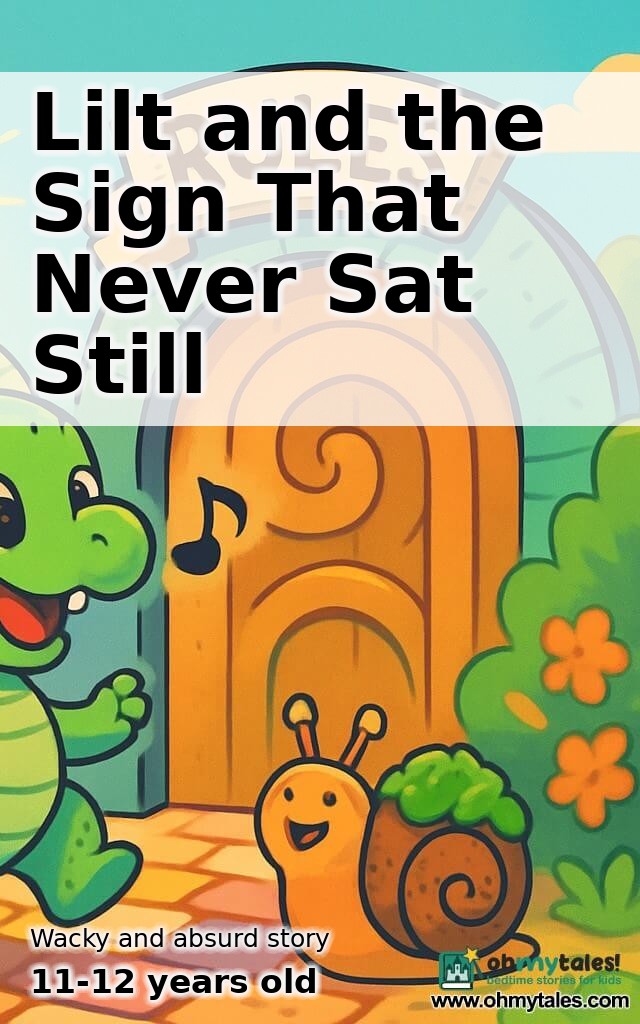
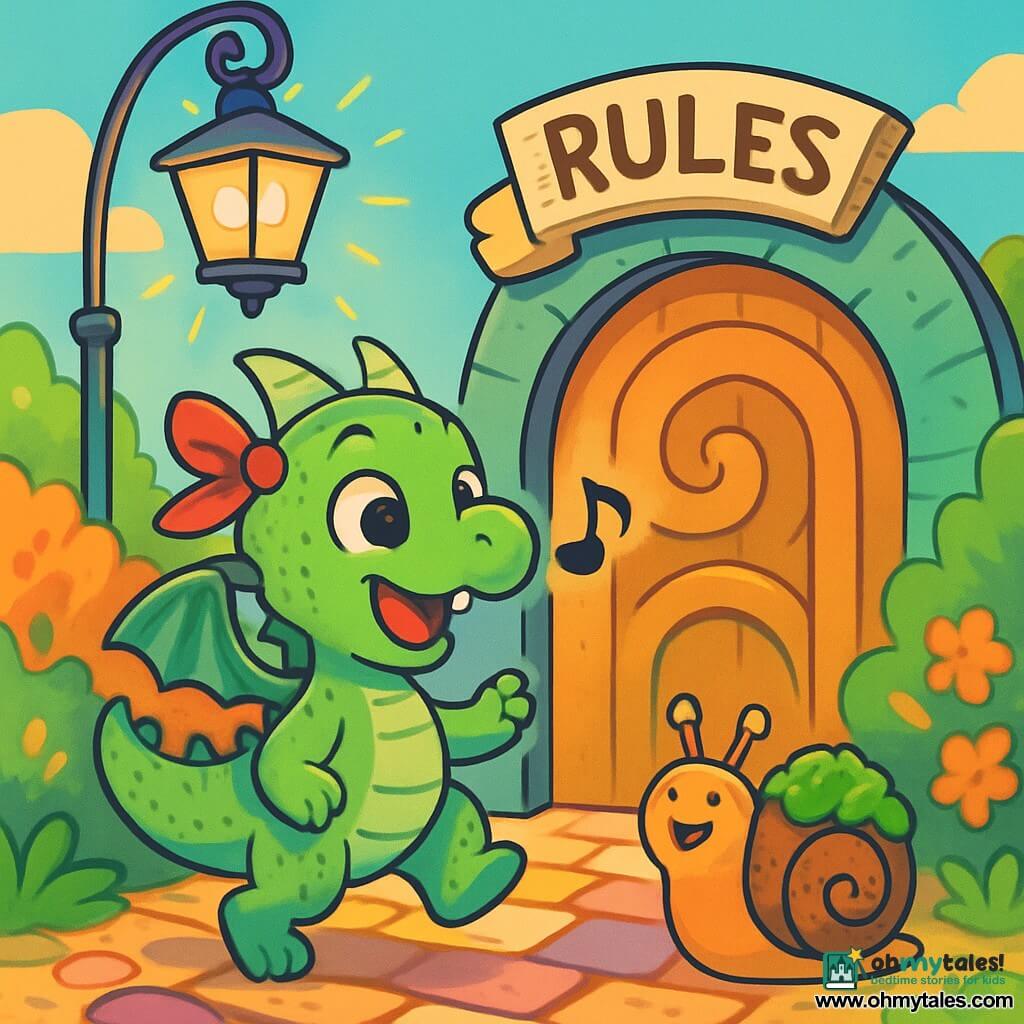
Lilt was a small, bright dragon with freckled scales and a habit of singing to sandwiches. He lived in a town called Whimble Green, where hedges liked to gossip and park benches told bedtime stories to pigeons. Every spring, the Parade of Bounce rolled down the main path, all drums and juggled muffins, and anyone who wanted to join had to pass through the Gate of Rules.
The Gate of Rules was tall and twirly, like a question mark that had eaten too much spaghetti. Over it hung a sign that everyone called the Sign That Never Sat Still, because the rule written on it changed every time someone blinked.
Lilt had watched last year from a tree stump that smelled like cinnamon. He'd wanted to join. He'd wanted to dance behind the tuba lizards and toss jellybeans to the crowd. But he hadn't dared to try the Gate, not with a sign that shifted like pudding on a seesaw.
This year, he decided he would try. He wanted to understand the rule, no matter how wobbly it seemed. He wanted to bounce.
“Today I learn the rule,” he told the nearest daisy. The daisy nodded as if daisies often attended meetings about mysterious rules.
On the morning he chose, the sky was a friendly blue and the clouds were polite and round. Lilt tucked a ribbon behind one horn for luck. He trotted toward the Gate along the path of well-behaved stones, past a lamppost named Lampkin, who was polishing his own glow.
“Morning, Lilt,” said Lampkin, flicking a light in greeting. “You going to wrangle that sign today?”
“I'm going to be nice to it and ask it to explain itself,” Lilt said.
“Good plan,” Lampkin said. “Signs like manners.”
The Gate shimmered and hummed. The Sign That Never Sat Still flashed a rule in curly letters: Clap exactly three times before you step.
“Great,” Lilt said. He clapped one-two-three.
The letters smeared like jam and rewrote themselves: Do not clap exactly three times before you step!
“Oh,” Lilt said.
He looked at his hands. He looked at the Gate. The Gate hummed in a suspiciously cheerful way. Lilt took a small breath, the kind you take before tasting a potato that might also be a cupcake.
“Okay,” he told himself. “One step at a time. Or maybe one half-step. Or possibly a wiggle.”
But the sign had already changed again: No wiggling, unless it is yesterday.
Lilt didn't have a yesterday handy. He backed away, thoughtful, and not even a little bit wiggly.
Chapter 2: Everyone Has Advice, Even a Rock
He flopped on the grass and watched the rules tumble like laundry. Do not blink unless you blink a lot! Be invisible but wave! Count to five, but not using numbers! The Gate was being silly on purpose. Or it had a purpose and the purpose was to be silly. Lilt wasn't sure which was worse.
Zip, the local snail who wore a racing stripe of moss, slid up to him. “You look puzzled,” Zip said. “I collect puzzled looks. They keep the rain away.”
“I want to join the Parade of Bounce,” Lilt said. “But that sign changes the rule every time I try to follow it. It's like playing tag with fog.”
“Did you try asking it a question?” Zip asked.
“I tried being polite.”
“Questions are polite that do a little more,” Zip said wisely, and then he bumped into a pebble and apologized to it. “Excuse me, sir.”
The pebble cleared its throat. “If I may,” it said, because of course even rocks had advice in Whimble Green, “some rules are shy. If you look them in the eye, they hide. If you look at their shoes, they get brave.”
“That's very shoe-based,” Lilt said.
“Very,” the pebble agreed, proud of its theory.
Lilt thanked Zip and the pebble and went back to the Gate. He kept his eyes on the Sign's curly edges, not meeting the curly word-eyes. “Hello,” he said. “May I please know today's rule?”
The letters arranged themselves carefully: Say the word banana while hopping on your left foot.
Lilt said, “Banana,” and hopped on his left foot. The sign changed mid-hop: Do not hop. Also, do not say banana. Especially not banana.
“Banana,” Lilt said by accident, because sometimes the last word you're told not to say is the only word stuck on your tongue. The Gate giggled. Lilt heard it. It was a real giggle. The Gate was having fun.
Lampkin's light fizzed in sympathy. “Cheeky thing,” he said. “Always making things hard. Yesterday, it asked me to be taller than myself. Rude.”
“Maybe there's a pattern,” Lilt said. “Maybe it changes to be the opposite of whatever I do.”
“Maybe,” Zip said. “Or maybe it wants you to stop chasing it and start… something else.”
“Start what?” Lilt asked.
“Start being you,” Zip said simply. “You know, the you that sings to sandwiches.”
Lilt blinked. “That Lilt?”
Zip nodded. “That one.”
Lilt wasn't sure how sandwich songs would help. But he sat with Zip and Lampkin and watched others try. A plum-colored cat tried to sneak through by walking backward. The sign changed to No backward walking unless you are a carrot. The cat sulked and pretended not to know what a carrot was. A kite-fishing otter declared, “I will juggle trout,” and the sign wrote, Please do not juggle trout indoors. The Gate always answered the person, but it always answered in a way that made the person doubt.
“The Gate listens,” Lilt said. “Then it flips it.”
“It listens,” Lampkin agreed.
“But why?” Lilt said. “And how do I get it to stop flipping, so I can bounce with the others?”
The wind, which sometimes gave good hints, tugged his ribbon. He felt the tug. He felt something else too. A wish. A wish for more time in each moment, so he could think his way through the flip before it flipped. He didn't want to rush. Rushing made the Gate giggle.
“Where do you go when you need a thing you don't quite know?” Zip asked. “I go to the Lost-And-Found Oak.”
“The tree that returns stuff you will lose later?” Lampkin's light brightened. “Handy, if confusing.”
“Let's go,” Lilt said.
Chapter 3: The Slowglass That Knew How to Wait
The Lost-And-Found Oak was a wise old tree with pockets in its bark. It smelled like warm toast and rainy music. Things stuck out from its trunk here and there: a cloud's misplaced button, a spoon with a map on it, a hat that had once been a pie.
Lilt bowed. He always bowed to trees. “Hello,” he said. “I need a thing for thinking. I need a way to make a moment stretch.”
The Oak rustled. A small panel slid open with a yawn. Inside was an hourglass, but not a normal hourglass. This one had a dial around its belly marked with numbers and tiny pictures. It hummed like a cat and sparkled like patience. A little tag hung off it that said: Slowglass. Adjustable. Please return when you finally remember where you left it.
Lilt balanced the Slowglass in his paws. There was a slider that went from Swift to Turtle to Snail to Tea Time. He turned it to Snail, because he knew a snail, and because Snail seemed friendly.
“Thank you,” he told the Oak. The Oak patted his ribbon gently with a twig.
Lampkin bounced his light in applause. “Oh, that's clever. Slowing things makes thinking bigger.”
Zip polished his stripe. “Snail speed is perfect. Very fashionable.”
Back at the Gate, Lilt took a steady breath. He set the Slowglass on the grass, turned the dial to Snail, and flipped it. The sand inside didn't really look like sand; it looked like tiny pauses, falling slowly.
The world softened. Not frozen, not stuck. Just soft, like stepping into warm socks.
The Gate's hum stretched into a hum-m-m-mmm. The Sign wrote: Sing exactly two notes and step on the third.
Lilt didn't move. He watched. He watched the letters twitch, as if the sign was watching him back. He watched the edges of the rule wiggle, waiting for his first twitch, ready to flip when he flipped.
“It reacts to the first move,” he said. “The very first move.”
“Mm-hmm,” Lampkin hummed.
“If I sing, it will make singing wrong. If I step, it will make stepping wrong. If I do nothing, it might play by itself,” Lilt said. “But if I declare the first move in a way that the Gate can't flip…” He blinked. His freckled scales buzzed like bees getting a good idea.
“The first move is… you,” Zip said gently.
“What if the rule is always this,” Lilt whispered. “The rule is: Don't let the sign be the boss of your confidence.”
He stepped closer, Slowglass humming in the grass. He smiled at the Sign That Never Sat Still in a way that wasn't a challenge but also wasn't a question.
He said, clearly and kindly, “Here is my rule. I will hum two notes that I choose, I will step on the third beat that I choose, and I will wave at the Gate because I am polite.”
The letters paused, as if startled. They flickered. They began to write: Do not— Then they stuttered. The Slowglass fell another tiny pause. The letters tried again: Only if— They fizzled.
“I am choosing,” Lilt said, with a voice like a bell that had learned good manners. “I will follow my rule kindly. You can agree.”
He hummed two notes. He stepped on the third beat. He waved at the Gate. The Gate glowed, and for once, it didn't giggle. It sighed, like a curtain deciding to be a door.
The path beyond flickered open, just for a moment, a slice of parade light peeking through. Then the shimmer sealed again, a little grumpy.
“That almost worked,” Lampkin said, delighted.
“It did work,” Zip said, even more delighted. “It only needs practice. Like balancing on pudding.”
Lilt grinned. He felt taller, although his horns had not grown at all. He picked up the Slowglass, turned the dial to Turtle, and flipped it again.
Chapter 4: Declaring the Rule Out Loud
They practiced. The Gate loved games, so Lilt made it a game too. He stood before the Sign and declared his own simple rules, carefully, each time. He made them kind. He made them something he could do. He made them clear enough that even the Gate could nod.
“My rule,” he said, “is that I will skip on squares that rhyme with blue.”
“That's not a thing,” Lampkin whispered.
“Blue, glue, shoe,” Lilt whispered back, and he skipped on squares shaped like shoes that someone had drawn in chalk, because Whimble Green sidewalks sometimes wore chalk shoes. It worked. The Gate hiccuped but didn't flip, and a sliver of path shined open again.
“My rule,” he said next, “is that I will not clap three times because three is busy. I will clap four times because four has free time.” He clapped four. The Gate tried to say No— but Lilt's calm voice kept going, steady as pouring honey. The shimmer widened.
“My rule,” he tried, “is that I will balance a muffin on my nose and say thank you.” He balanced a muffin, said thank you, and tasted a crumb by accident. The Gate wrote DO NOT E— and then crossed itself out, because who would say no to a please and a thank you that came with a muffin on a nose?
Zip whooped in a small snail way. Lampkin shone so brightly a moth swooned.
Others gathered to watch. The plum-colored cat returned and tried declaring a rule: “My rule is that I will announce I am a carrot.” The Sign considered, then shrugged in curly letters and allowed a carrot-shaped shadow to pass. The cat stopped and purred. “I feel crunchy,” it said.
A breeze-fox, made of wind and whiskers, whispered, “My rule is that I will float three inches above the ground and compliment the Gate's hinges.” The Gate blushed. Hinges squeaked. The path welcomed the breeze-fox in a puff.
Lilt tilted the Slowglass to Tea Time, the slowest of all. The sand moved so lazily that he could feel each second yawn. In that gentle slow, he noticed something else. The rules he made worked best when he believed them. Not just said them, but believed them like you believe in your own tail. When he doubted, the Sign got teeth again. When he trusted himself, the Sign became toothless and soft, a gummy grin of curly letters that said okay.
“It likes confidence,” Lilt said.
“It likes kindness too,” Zip said, tapping the glass of the Slowglass to make it go plink.
“And it likes when you go first,” Lampkin added. “You set the step. It follows.”
Lilt nodded. The feeling in his chest was like the moment before a bounce, but steadier. He was going to pass the Gate. He was going to bounce in the parade. He would not trick the Sign. He would lead it, politely.
Chapter 5: The Parade of Bounce Begins
The morning of the Parade looked like a musical cake. Streamers hung from tree to tree, and confetti birds practiced landing in neat squares. Drums thumped like big hearts. The Gate of Rules was extra shiny, thrilled to be important.
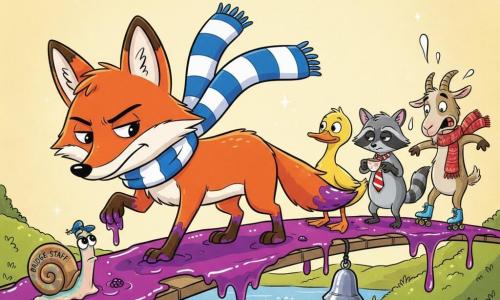
A line of hopefuls stretched along the path. There were ribbon eels, a porcupine who hummed jazz, a sapphire goat on roller skates. Lilt nibbled a courage crust (a small toasted piece of boldness) and checked the Slowglass. He set the dial back to Snail. Just enough slow to hear his own thoughts. Not so much that the parade would slip onto next week.
Lampkin cleared his throat with a bright ding. “You've got this.”
Zip straightened his moss stripe. “You are very you today. That will help.”
Lilt stepped forward when it was his turn. The Sign That Never Sat Still fluttered with content. It wrote: Balance on your left claw while counting backwards from a sandwich.
Lilt bowed to the Gate. “Thank you for the suggestion,” he said. “Here is my rule, and I will follow it kindly. I will tap my tail once, hum two notes, and step on the third beat while I smile exactly as much as I feel.”
He tapped. He hummed. He smiled, not too big, not too small, exactly himself. The letters sputtered. The Gate stalled. Lilt felt a small tremble of doubt try to sneak up his spine like a naughty squirrel. He breathed. He let the Slowglass do the rest, stretching the moment like taffy so he could choose again.
“I will keep my rule,” he said. “I will keep it gently.”
He stepped. The path opened.
A jellybridge appeared, wobbling but strong. A row of tiles lit up blue-blue-green, like a code that already knew the answer. From far down the street came the thump-thump of parade drums getting closer.
Halfway across, the Sign tried one last hiccup. It wrote: No smiling on Thursdays. It was Thursday.
Lilt grinned wider. “I will smile,” he said. “Because my smile is mine. My rule is mine.”
The jellybridge steadied itself, as if pleased to carry a dragon who trusted his own feet. Lilt crossed to the other side. The crowd—no, not a crowd of people, but a collection of tree stumps, benches, kites, and critters—cheered wildly. Someone released a basket of round applause. It sounded like hands clapping and also like rain on a roof, somehow both at once.
The plum cat crossed next, declaring, “My rule is that I will meow three syllables of encouragement: you-can-do-it.” It worked. The porcupine hummed a rule. The roller goat glided through on a promise to whistle like a kettle. Everyone made rules that fit them. Everyone moved with their own beat.
Lilt stood by the gate and helped. When a wobble-eyed frog froze at the first flip, Lilt leaned down and said, “Choose a rule you can love. Say it out loud. Then walk your own footsteps.”
The frog whispered, “My rule is that I will hop like raindrops and not like thunder,” and got through with damp joy.
Lampkin floated his light in twirling loops. Zip gave pep talks in a voice that was steady as a spoon. The Gate giggled less and listened more.
And then the Parade of Bounce reached the Gate. Drummers bounced, trombones bounced, even custard pies bounced. Lilt fell into step beside the tuba lizards, and the world tilted into a rhythm so cheerful it almost fell over.
“I did it,” he told his ribbon, which waved in the wind like a small proud flag.
“You did,” said the ribbon, which sometimes spoke on special days, and today was very special indeed.
Chapter 6: Lukewarm and Lovely
After all the bouncing and all the music, when the Parade had looped around the lake and the confetti birds were finally tired, Whimble Green did its favorite thing. It settled. The sun softened like butter on warm bread. The hedges whispered a lullaby about how nice it is to be a hedge and also about worms.
Lilt, Lampkin, and Zip found a bench that smelled like sleepy cinnamon and sat together. The Lost-And-Found Oak sent over a tray by rolling it along a root. On the tray were three cups that were exactly, perfectly, lukewarm.
“Moon-leaf tea,” Lampkin read, his light dim and cozy. “Not hot. Not cold. Right in the middle, where calm lives.”
Lilt cradled his cup. It sat in his paws like a quiet bubble. He sipped. The taste was soft, like the color of moss, and gentle, like a promise. It wasn't exciting. It didn't need to be. It was the perfect kind of not-exciting, the kind that lets your shoulders drop and your tail relax and your heart say, Oh, hello, you.
Zip slurped, which was the proper way to drink if you were a snail with a stripe. “You know,” he said, “the Gate will be tricky again next time.”
“I know,” Lilt said. “Gates like to be gates.”
“You'll be you again next time,” Lampkin said, eyes glowing like two tiny moons. “That's the part that matters.”
Lilt turned the Slowglass in his lap. The sand—those falling little pauses—had almost all settled at the bottom. He turned the dial to Gentle. The Slowglass hummed a sleepy note. When he looked up, the Sign That Never Sat Still was still there, of course it was, twitchy and twirly and ready to flip anyone's first step. But it didn't look like a monster. It looked like a friend who didn't know how to say hello and needed someone to go first each time.
“I used to think I had to chase the right rule,” Lilt said, voice lengthening into something like a song that had found a comfy chair. “But the right rule can be what I choose, if I choose it kindly and stick to it. The sign can listen. I can lead. Even when it flips, I can keep my beat.”
“Exactly,” Zip said, polishing the last sip from his cup.
The breeze-fox drifted by and tucked a ribbon of wind into Lilt's ribbon, which made it look fancy in a quiet way. The plum-colored cat napped upside down under the bench and purred like someone humming into a bottle. The Gate of Rules hummed to itself too, but softly now, as if it had learned a lullaby.
Lilt leaned against the bench. He let his breath be slow. He let the tea do its gentle work. He let the day fold itself into evening.
When he had finished, he set his lukewarm cup on the tray. He returned the Slowglass to the Lost-And-Found Oak's pocket, patting the bark in thanks. “I'll borrow you again,” he whispered. “Probably when I forget where I put my own calm.”
The Oak patted his horn with a leaf and made the tiny sound trees make when they are pleased: a sound like a page turning.
Lilt stood, stretched, and felt the soft click of each scale as if each one had its own happy sigh. He looked at the Gate one more time—a tall twirl that would always be silly, always be itself—and he looked at his friends, who were also themselves in the best way.
“Ready for next year?” Lampkin asked, voice barely louder than the glow he wore.
“Ready for tomorrow,” Lilt answered, because tomorrow always comes first. “And ready for every silly sign that wants me to forget who I am. I won't forget.”
Zip yawned. “Good. There will be many. Signs love attention.”
They walked home along the path of well-behaved stones, which were now yawning and making gravelly goodnights. The hedges whispered them secrets about worms again. The confetti birds tucked themselves into nests that looked like party hats. The moon leaned out of a cloud and winked.
Lilt's ribbon gave a final, floaty wave, and his steps became the soft kind of steps you make when the day is pleased with you. He hummed to himself, a small melody that he chose, a melody that matched his beat, a melody that said: I can lead with kindness. I can set my own rule. I can trust my feet, even on jelly.
And in the very last fizz of the evening, when even the Gate had stopped humming and the town had sighed, the taste of the lukewarm cup lingered, warm enough to remember, cool enough to keep, like the steady glow of a lamppost, like the patient trail of a snail, like a dragon's own quiet, confident smile.