The Big Idea That Went Ding
Leo Lark was a young man with calm eyes, a tool belt that never squeaked, and a notebook full of odd ideas. He lived on Willow Street above the bakery, so his notebooks always smelled faintly of warm bread. For the annual Street Picnic, he wanted to build a machine that could help with little problems before they grew big.
“Not for showing off,” Leo told his cat, Biscuit. “For helping.”
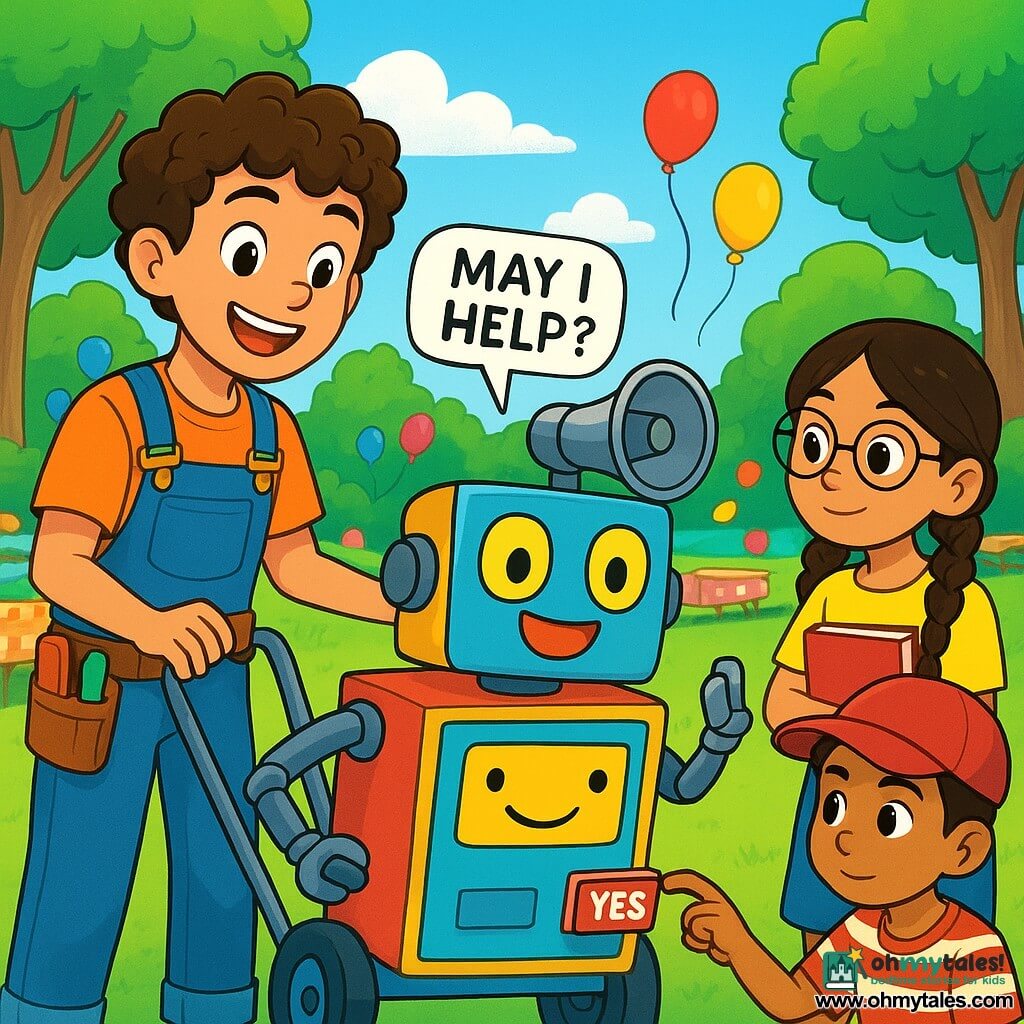
He drew a quick picture. Then another. Soon his page looked like a lemon squeezer married a bicycle and a music box. He called it the Helpful Hodgepodge, or HH-1 for short. It was a small pushcart with soft wheels, tidy drawers, and a friendly face painted on the front so no one would be scared. A bright red button on top read PAUSE, just in case.
On its sides, there were switches labeled Very Gentle, Ask First, and Make It Fun. Little arms could tie a bow. A tiny vacuum could sip up a spill. A spritzer could puff helpful smells, like vanilla when someone felt grumpy. Best of all, a speaker could say, in a polite voice, “Hello! May I assist?”
Leo tested every part with pillows and plush toys. He dabbed hot glue with care. He wrote in his notebook: “Note: The tickle brush must not tickle without permission.” Biscuit batted a ribbon, then settled on the cart like a captain on a ship.
“There,” Leo said. “The picnic will be smoother than butter.”
He went to sleep dreaming of neat napkins, steady tables, and lemonade that never sloshed.
The First Try Is a Bubble
Saturday morning, Leo pushed the HH-1 to Maple Park for a practice run. The sun was bright and the grass was as tidy as a combed mustache. Mr. Gomez the baker was testing a tower of rolls. Ms. Patel the librarian had a stack of storybooks. Coach Reed set up cones. Kids raced in zigzags, and Biscuit trotted along like he owned the path.
“Hello!” Leo called. “This is the Helpful Hodgepodge. If you want, we'll try tiny tasks.”
“Fix my wobbly table?” asked Mr. Gomez.
“May I assist?” chirped the HH-1. It rolled over and snugged four rubber bands around each leg. The table stopped wobbling. It bounced. Boing! Boing! The tower of rolls jiggled like jelly, then settled. Everyone laughed, even Mr. Gomez.
“Okay,” Leo said, cheeks pink. “Note: fewer rubber bands.”
Mira and Jamal ran up with a pitcher. “We always spill a little,” Jamal admitted. “Can it help?”
“Ask First mode,” Leo said. “Ready?”
The HH-1's tiny vacuum sipped the edges of the pitcher. The spritzer puffed a soft mist. It smelled like apples. The pitcher looked steady. Then the tiny vacuum hiccuped.
Bloop.
A shimmering bubble grew and wrapped the top of the lemonade like a glass hat. It floated upward—tugging the pitcher, the cups, and Mira's hat with it. Everyone stared, surprised but not scared, as the bubble rose. At exactly one meter high, it sighed and popped. The lemonade settled with only one brave drop on Jamal's shoe.
“That was… cool,” Mira said, clutching her hat. “But maybe don't take my hat skydiving.”
“Note: No bubble hats,” Leo wrote.
The HH-1 zipped toward a picnic blanket where ants had discovered a sandwich. It played a tiny march on its speaker—tap-a-tap tap!—and wagged a peppermint flag. The ants turned, very politely, and marched around the blanket instead of across it. Biscuit followed, pretending to be an ant, his tail like a flag.
A gust of wind lifted a napkin. The HH-1 popped out a clothespin arm and clamped it down. Then another gust came. The machine's fun mode, perhaps too eager, released a sprinkle of confetti like a tiny parade. Confetti settled, sparkling, on everyone's shoes.
“Is it cleaning,” Coach Reed asked, “or partying?”
Leo rubbed his nose. “Both, it seems.”
“Note,” he added. “Confetti is for the end.”
The Listening Bench
By the slide, Leo set up a little cardboard sign: Ideas Welcome. He sat on the park bench with a pencil. Biscuit leaped up, settled like a loaf, and blinked slowly at everyone who stopped by.
Ms. Patel adjusted her glasses. “It is a lovely start, Leo. Perhaps a clear ‘Ask Before Assist' rule. Sometimes people like to solve their own small problems.”
“Good point,” Leo said, writing. “Maybe a chime. And a big Yes or No button.”
Mr. Gomez patted the cart like a friendly dog. “Less bounce, more brace,” he said. “Also, a cinnamon smell makes people calm. Rollers like calm.”
Coach Reed twirled a cone. “Could it have a team mode? Like four people can signal at once. Hand signals are fast, like in soccer.”
Mira and Jamal had a list. “Quieter tickle brush,” Mira read. “And a duck horn, not a siren,” Jamal added. “Siren sounds like trouble. Ducks sound funny.”
A lady with a stroller leaned in. “A pause button you can press with a toe,” she said, balancing a baby and a bag. “Sometimes hands are full.”
Leo nodded so much his curls bounced. “Toe button. Duck horn. Team mode. Ask Before Assist.” He turned to the cart. “We're learning.”
The HH-1 hummed as he tinkered. He added a big friendly YES and NO button on the front. He screwed in a duck-shaped horn that gave a polite “whap.” He slid cinnamon sticks into the scent drawer. He attached a green light that blinked while it waited for a human to answer. He moved the confetti to a secret, end-of-day drawer and wrote “Do Not Open Until Party” in big letters.
Biscuit tested the toe button. He balanced, booped it, and the cart said, “Pausing. Thank you, Captain Biscuit.” The kids giggled so hard they nearly fell off the bench.
“Try again?” Coach Reed asked.
“Let's,” Leo said.
This time, when Jamal held a water cup, the HH-1 chimed and asked, “May I assist?” Jamal hit YES. The vacuum sipped carefully. The duck horn said “whap” at a helpful moment. The cup stayed still. The ants marched politely. No hats floated. No confetti flew.
Then Ms. Patel sneezed. The cinnamon puff was too eager and spritzed a cloud. It smelled like a bakery sneezing cookies. Everyone smiled. Then Leo scribbled, “Note: Cinnamon—one puff only.”
The Wind That Wanted To Help
On picnic day, Willow Street glittered with flags and fruit salads. Tables stood like a line of friendly giants. Leo wore clean goggles and a grin. The HH-1 rolled beside him, upgraded with tiny anchors that popped like umbrellas into the ground. A chalkboard on the side read: Team Mode On.
“Positions?” Coach Reed said, half-joking.
“Positions,” Leo agreed. “Mira and Jamal on cups. Mr. Gomez on rolls. Ms. Patel on the Yes/No station. I'll guide and watch.”
The wind arrived with big ideas. It swooped down the block and lifted tablecloths like capes. People grabbed edges. Cats became surprised pillows. Biscuit sprang onto the cart and planted his paws like a sea captain.
“May I assist?” the HH-1 asked.
“Yes!” Ms. Patel pressed the button.
The anchors deployed with soft thunks. The cart braced two cloths. It passed clip after clip to waiting hands, like a friend handing out pencils. Coach Reed pressed the duck horn at the right times. “Whap!” People laughed, even as they worked. Laughter made everyone faster, in a light way, not frantic.
A pie tried to fly. Mr. Gomez lunged and caught it with the grace of a pie dancer. A tower of paper cups started to lean. “On it,” Leo said. The HH-1 chimed and asked Mira, “Teamwork?” “Yes!” she said, and the cart extended a gentle fan that blew against the wind, not stronger, but enough to give the cups a chance. Jamal placed a hand on the top cup and smiled.
A small boy stared at the tickle brush. “May I tickle your shoe?” the cart asked. “No, thank you,” he said. It blinked green, then tucked itself away, proud.
The wind took another deep breath, then a deeper one, as if it wanted to help too. It scooped a tablecloth and sent it sailing like a kite—with a stack of napkins riding it like brave surfers.
“Confetti?” whispered the HH-1, hopeful.
Leo shook his head, smiling. “Not yet. Anchor mode.”
“Anchor mode,” the cart said. It popped a parachute the size of a pillow and sent it toward the flying cloth. The parachute caught the corner. It was silly and it was perfect. The runaway cloth slowed, slowed, and drifted down, right onto Coach Reed's head. The duck horn gave a small “whap,” like a wink. Everyone cheered.
“Pause,” Leo said softly. The cart listened at once. He looked around. People were smiling. No one was worried. He could feel it: his calm spreading through the crowd like a quiet song.
“Thank you, team,” he said. He didn't mean just the helpers. He meant all of them—the kids, the bakers, the book lovers, the wind, and even Biscuit.
The Step We Took Together
By late afternoon, Willow Street felt like a cozy story. The wind had settled on a porch for a nap. The picnic turned merry and gentle. Songs played. Jokes floated like soap bubbles that needed no popping. A tiny ant parade skirted the dessert table, carrying a breadcrumb like a treasure. Biscuit had claimed a sunspot.
Leo rolled the HH-1 to the middle. He pressed the secret drawer. “Do Not Open Until Party” popped out with a soft click. Confetti flew, just a little, and only where the wind couldn't get it. It sparkled on shoulders and hair like a friendly crown.
“Speech,” Ms. Patel said, hands clasped.
Leo held up his notebook, which now had smudges and a paw print. “I wanted to build a helper,” he said, “and I did. But it got really helpful when I listened. When we all added a little bit—ideas, laughter, a duck horn—that's when it worked.”
Mira nodded. Jamal saluted. Coach Reed balanced a cup on his elbow. Mr. Gomez lifted a roll like a tiny trophy.
“We didn't fix every little thing,” Leo added. “We don't have to. We learned to ask. We learned to try. We learned to giggle when lemonade wears a bubble hat.” People laughed again, just remembering.
He flipped to a fresh page and wrote in big letters: “Milestone 1: Team Mode True.” Then he turned the chalkboard on the HH-1 around. On the back, painted that morning, were the words Saturday Helper Club.
“Every Saturday,” Leo said, “I'll bring the Helpful Hodgepodge to the park. We'll fix small things together. Bikes. Wobbly tables. Worries. If we can't fix a thing, we'll at least make it friendlier.”
“Count me in,” Ms. Patel said. “I'll bring labels and gentle tape.”
“I'll bring rolls,” Mr. Gomez added. “Cinnamon smell, one puff.”
“Ducks,” Jamal said, and squeezed the horn. “Whap.”
Biscuit answered with a dignified meow, which meant, probably, “Captain in.”
As the sun slid down, Leo tucked his pencil behind his ear. The HH-1 shut its eyes—the painted ones—and hummed like a contented teapot. The street felt warm, as if it wore a sweater made of high-fives.
Leo looked at his team. He felt taller, not in inches, but in spirit. Nothing in his cart was magic. It was wire, wheels, and listening. But together, it felt like more. Not perfect. Better. Moving forward.
He closed his notebook with a soft thump. “Next week,” he said to the evening air, “we build a rain-saver for the garden. With less bouncing.”
Biscuit flicked his tail. The duck horn gave one last “whap,” like a goodnight kiss.
And the whole block agreed, in the quiet way streets do, that they had taken a step. Not one person's step, and not one machine's—but a step made of many feet, heading toward the next helpful thing, together.