The Day of the Knot
Barnaby Bear had a plan. It was written on a scrap of paper and pinned to his hat with a thimble. It read: Tie boat to cloud. Nothing else. No one had ever tied a boat to a cloud, and Barnaby liked that. He was a patient tinkerer. Patience, said Barnaby, was a kind of slow, polite magic. He believed it was only polite to ask a cloud before you borrowed it.
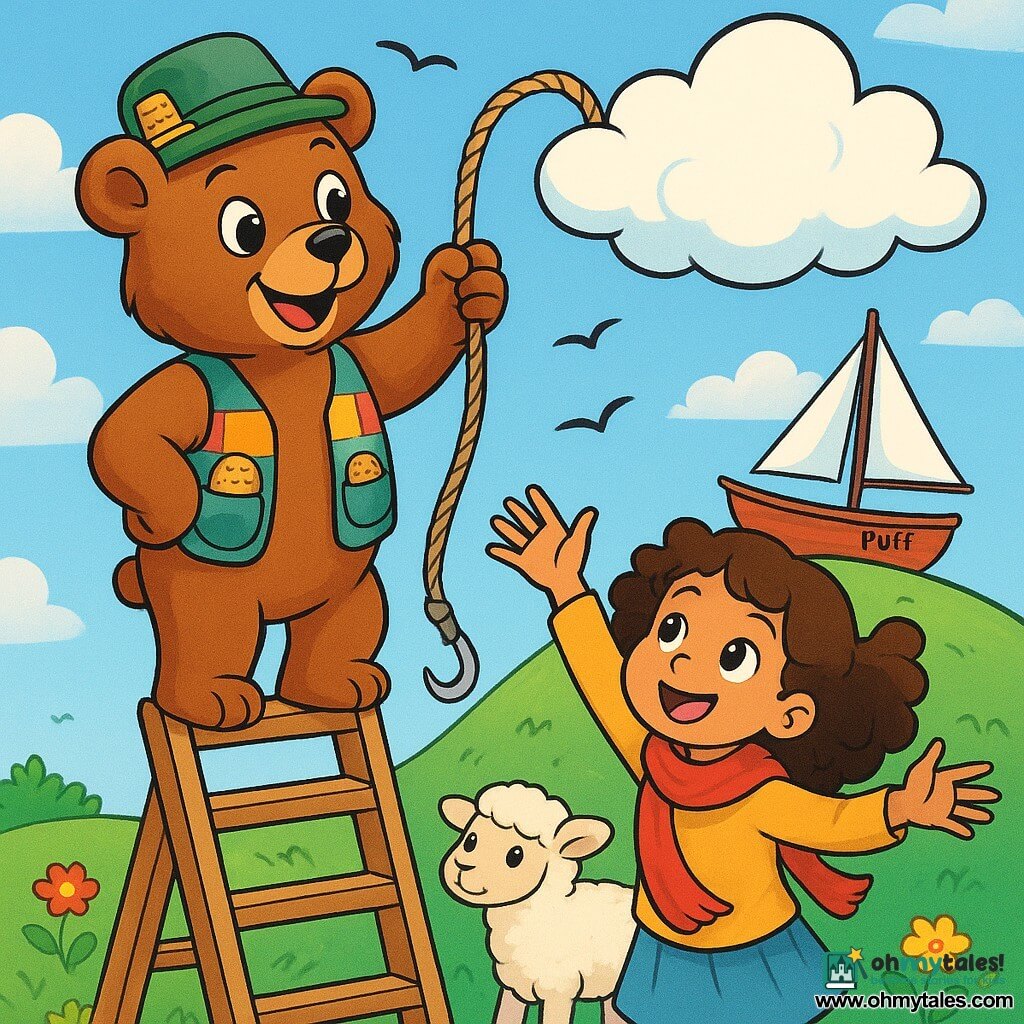
He polished his boat. The boat was small and stout and called Puff. Puff had a cheerful dent on the bow, as if it had smiled too hard at a wave. Barnaby packed rope, hooks, a spool of sticky tape (for emergencies that were not at all magical), biscuits, and a pair of glasses with a chain that jingled like tiny coins. He also packed a ladder. A sensible ladder. A ladder that believed in being tall.
The village folk watched. They nodded as if this sort of thing happened sometimes. The children giggled as if it had happened once last Tuesday. Old Mrs Maple, who sold jam and wisdom, offered Barnaby a pot of her best marmalade. "For courage," she said. Barnaby smiled and promised a ride on Puff if the cloud would allow it. This promise, made with such sincere generosity, would be important later.
He set Puff on the hill where the wind told stories. The sky had a good cloud overhead—white and puffy like a stack of pillows. Barnaby sat on his stool, tightened his belt, and thought very carefully. He believed in knots that lasted. He believed in being kind. He believed in biscuits.
The First Try
Barnaby climbed the ladder until he could nearly tickle the cloud. He threw a rope with a hook. The rope sailed through the air like a lazy fish. It met the cloud. The hook tickled the cloud's belly. The cloud sneezed. The rope came down like rain with a mind of its own and tangled in the hair of Mrs Finch's laundry, which was fluttering on a line below.
"Oops," said Barnaby.
"Steady," said Mrs Finch, who was always steady and always mending other people's mistakes with a needle and a smile. She unhooked the rope and handed it back. A triangle of socks came with it.
They tried again. This time the rope became riddled with feathers. A passing flock of geese thought it a most peculiar ribbon and used it for a parade. The rope came back with a honk and a goose feather stuck in Barnaby's hat.
"Perhaps a gentler approach," Barnaby said. He had patience. He had biscuits. He had a spool of sticky tape, which performed admirably in sticky situations involving jam and should not be used on clouds. He did not use the tape on clouds. That would be rude.
Word spread. Children arrived with jars of wind in them—just for fun. The wind in jars was very good at being mischievous. They offered Barnaby songs. The songs were short and hopeful. Barnaby liked songs. The cloud liked songs too. It drifted nearer and listened, making soft, thoughtful bobbles as if it were a thinker of clouds.
But the cloud was not a thing to be tied by ropes alone. It had feelings. It liked being free. It liked playing at being a sheep and at being a boat and at being nothing at all. It would not be a mooring post. It would not be a lamppost. It would be a cloud.
The Long Rope and the Longer Lunch
Barnaby paused. He sat on his stool and ate a biscuit. He watched the children, watched Mrs Maple, watched the geese, and watched Puff resting on the hill, looking hopeful. He decided that perhaps tying a boat to a cloud was not only about ropes. It was also about giving.
A little girl in a red scarf pointed to the distant mountain where a lamb had wandered and could not find its way back. The lamb bleated politely but with great conviction. No one was very tall enough to see the path from the mountain and no one was very brave enough to go by themselves. Barnaby's tools were for fixing more than things. He tied a knot around his own heart—a friendly knot—and set off.
He borrowed a longer ladder, lent his glasses to a boy who couldn't see the map, and gave half his biscuits to a dog who wanted to help by barking directions. The group walked, sang directions, and carried a large jar of wind for emergencies. They found the lamb nibbling on a cloudberry bush, convinced it was a small mountain. The lamb had a name—Cloudle—and it had wandered because it wanted to learn how to count the clouds.
"Thank you," said the lamb, which was a surprisingly polite lamb. It walked with Barnaby back to the village. Barnaby, who loved to tinker, felt his heart warm like a kettle on a kind stove. He had helped the lamb. He had shared his biscuits. He had given away his glasses and felt the world in a new way.
The cloud watched. Clouds are very old and remember kindness. The cloud had watched Barnaby tie his life with small generous acts. It moved down until it hovered shyly above Puff.
Now the people gathered to see. Children held the rope. The geese offered feathers to tickle the cloud. Mrs Maple brewed jam tea and gave everyone a spoonful. Barnaby climbed the ladder once more. He spoke plainly to the cloud.
"Would you like a boat?" he asked. "Not to be a chain, but to be a place to float together? I will tie nothing that will make you sad."
The cloud replied by puffing a small, shy rain that smelled like lemons. It liked the offer. Clouds like to be asked. They do not like to be cornered. They like to be part of a joke where everyone is smiling.
Barnaby fastened the rope around a friendly loop on Puff. The rope felt warm because a rope can feel warm when it is full of good intent. The children held the rope. The geese held the ends with their beaks. The lamb chewed a little of the end and promise, just to be sure.
With a little hop and a polite cough, the cloud wrapped its soft self around the rope. It was like tying a ribbon around the sky. The rope became part cloud. It hummed. It smelled faintly of marmalade.
The Boat on the Cloud
Puff lifted. It rose like a happy balloon. The village clapped and laughed. Barnaby steadied himself with his hands in his pockets and his hat on straight. Puff bobbed on the cloud like a pea on a leaf. The children climbed aboard one by one. Mrs Maple took a seat and munched jam with the dignity of someone who has always expected small miracles. The geese formed a procession and acted as marshals. The lamb lay down and counted clouds in a new, contented way.
They sailed the village sky slowly, because Barnaby believed in safe sailing and polite navigation. Below them, the houses looked like buttons on a coat. The lake winked at them. The fields smelled of mowed hay and good news. The cloud laughed. Clouds have a laugh that sounds like a distant drum and a bell.
Barnaby shared the ropes. He taught the children how to knot a reef knot and how to tie a bowline that did not feel like a trap. He taught them to share biscuits and to listen to a cloud's wishes. The cloud carried them gently. It took them to places a boat on water could not reach—over the baker's crow's nest, above the place where the river wrote its name in little waves, past the mountain where the lamb had once thought clouds were mountains.
They gave rides to anyone who wanted one. They collected lost things. A little girl's lost red glove was found in the cloud; it had been camping there because the cloud thought it made a fine hat. They returned it with a bow made of fog. They rescued a scrawny kite stuck in a high holly. They dropped off a note of apology to the sun for borrowing a sliver of light at dawn. Giving, Barnaby discovered, was a very busy thing. It filled the rope with laughter, which is the best kind of filling.
At the end of the day, when the sun had turned its face to a cozy orange and the stars were practicing how to wink, Barnaby tied Puff back down on the hill. He did it gently. He asked the cloud if it wanted to stay a little longer. The cloud said no. It liked its rambles and its naps high above. But it promised to visit. It promised to keep an eye on the village. It promised, in a manner of cloud promises, to always remember the jam and the biscuits.
Barnaby invited everyone to stand in a circle. He thanked them for their help. He offered the remaining biscuits to the children, and to the geese, and to the lamb, and even to the cloud, which accepted them as a small, misty drizzle that tasted faintly of lemon and jam.
They all laughed. The laugh began as a small chuckle. It grew like a knot, snug and happy. It rolled down the hill and up to the stars. It bounced from roof to roof. It smelled of biscuits and marmalade and the warm hush of a good day.
The laugh did not stop. It lasted quite a long time. It went on until the moon had finished tying its own shoelaces and had to sit down and rest. It continued until even the cloud, drifting away with a satisfied puff, felt its edges tremble with joy. That laugh folded itself around the village and kept everyone safe, as a good laugh will, and it lasted.